Physical Address
304 North Cardinal St.
Dorchester Center, MA 02124
Physical Address
304 North Cardinal St.
Dorchester Center, MA 02124

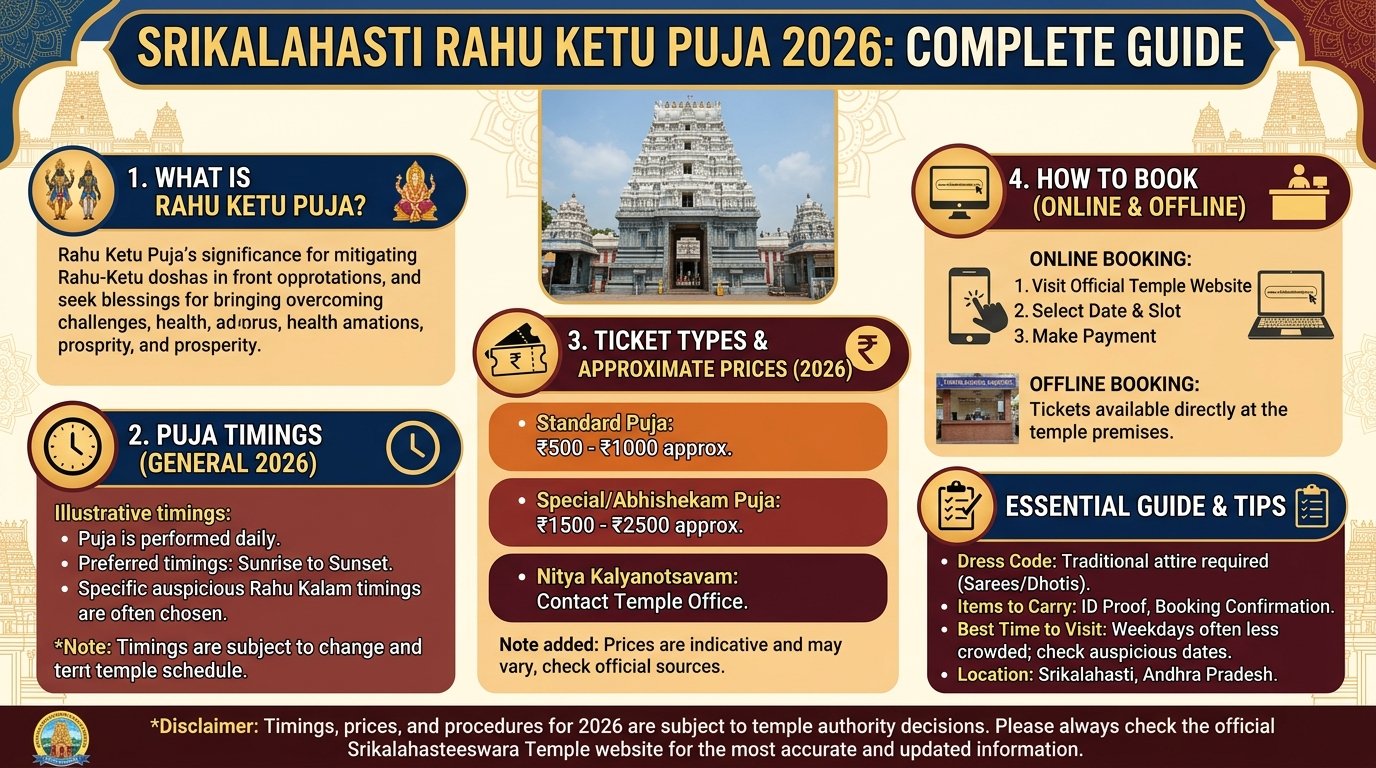
If you’re planning a trip for Srikalahasti Rahu Ketu Puja 2026, honestly, you’re not alone this temple gets absolutely packed every single day with people trying to fix Rahu Dosha, Ketu Dosha, and the dreaded Kalasarpa Dosha.
Srikalahasti Temple, tucked away in Andhra Pradesh, is widely regarded as one of the most powerful places in India to perform this particular puja, and there’s a reason astrologers keep sending people here instead of somewhere closer to home.
In this guide we’ll walk you through everything — puja timings, ticket price, dress code, online booking steps, and a bunch of small details competitors usually skip (like what actually happens astrologically during the puja and what to do once you’re back home).
Let’s get into it.
Srikalahasti Temple is one of the few temples in India where Rahu Ketu Puja is performed even during Solar and Lunar Eclipses — most temples actually shut their doors during eclipse hours, so this is kind of a big deal. Devotees believe that the eclipse energy amplifies the puja’s effect, which is why so many people specifically time their visit around eclipse dates.
The temple’s spiritual weight comes from more than just the dosha remedies though. The Srikalahasti Lingam is considered Swayambhu (self-manifested), and the temple’s history is deeply tied to Bhakta Kanappa, a devotee whose story of extreme devotion is still told to pilgrims today.
Srikalahasti is also part of the Pancha Bootha Sthalam, representing the Vayu Lingam (element of air) — one of five temples across South India each dedicated to a natural element.
Here’s a quick snapshot before we dive deeper:
| Aspect | Details |
|---|---|
| Location | Srikalahasti Temple, Andhra Pradesh |
| Significance | Pancha Bootha Sthalam (Vayu Lingam); famous for Rahu Ketu Dosha remedies |
| Main Purpose | Reduce Rahu Dosha, Ketu Dosha, Kalasarpa Dosha |
| Temple Timings | 5 AM – 9 PM (daily) |
| Puja Timings | 6 AM – 8:30 PM (batch-wise) |
| Ticket Price Range | ₹150 to ₹5,000 depending on category |
| Recommended Dress | Traditional Indian attire |
| Booking | Online via AP Temples Portal / Offline at counter |
Basically, whether you’re dealing with a rocky marriage, career instability, health scares, or you’ve just been told by an astrologer that Kalasarpa Dosha is messing with your life — this puja is meant to address all of that at once.
Srikalahasti Rahu Ketu Puja timings for 2026 run from around 6:00 AM to 8:30 PM daily, split into continuous batches so you don’t need to book an exact hour slot in advance. Each session lasts roughly 30 minutes to an hour, and the temple keeps cycling devotees through in groups.
If you’re wondering about Srikalahasti Rahu Ketu Puja timings tomorrow — good news, the schedule doesn’t really change day to day (barring festival days or eclipses, when hours can extend). So whatever slot works below is basically your answer for any regular day in 2026:
| Time Slot | Schedule |
|---|---|
| Morning | 6:30 AM – 12:30 PM |
| Afternoon | 12:30 PM – 3:30 PM |
| Evening | 3:30 PM – 8:30 PM |
One thing worth mentioning — arrive at least an hour before your preferred slot ends, because on weekends the queue for even the basic hall can stretch out longer than people expect.
Rahu Kalam → increases the effectiveness of → Rahu Ketu Puja, according to traditional Vedic belief. Rahu Kalam is a roughly 90-minute window that occurs daily, and its exact timing shifts depending on the day of the week and sunrise/sunset. Since Rahu’s planetary energy is considered strongest in this window, performing the puja during it is thought to deliver faster results.
| Day | Rahu Kalam Time |
|---|---|
| Sunday | 4:30 PM – 6:00 PM |
| Monday | 7:30 AM – 9:00 AM |
| Tuesday | 3:00 PM – 4:30 PM |
| Wednesday | 12:00 PM – 1:30 PM |
| Thursday | 1:30 PM – 3:00 PM |
| Friday | 10:30 AM – 12:00 PM |
| Saturday | 9:00 AM – 10:30 AM |
Quick disclaimer here — these are approximate and can shift by a few minutes depending on local Panchangam calculations, so don’t build your whole travel plan around a fixed minute. Check with a local priest or panchang app closer to your travel date.
Srikalahasti Rahu Ketu Pooja tickets price starts at ₹150 and goes up to ₹5,000, and the category you pick basically decides where you sit and how close you get to the main puja area. All categories offer the same core ritual, so nobody’s getting a “lesser” puja — it’s really about comfort and crowd.
| Category | Price (INR) | Suitable For | Venue Location |
|---|---|---|---|
| Basic | 150 | 1 devotee | Hall outside main temple |
| Standard | 300 | 1 devotee | North-side puja hall |
| Special | 700 | 1 devotee | Temple outer hall |
| A/C Hall | 1,500 | 1 devotee | Air-conditioned hall |
| Couple Ticket | 2,500 | 2 devotees | Near Dwajasthambam |
| Premium Couple | 5,000 | 2 devotees | Inside Mandapam, close to Utsava Murthy |
Ticket Category → determines → Seating Proximity and Comfort Level, so if you’re bringing elderly parents or travelling with kids, spending a bit more on the A/C hall genuinely makes a difference during peak summer months. Couples going for the ₹2,500 or ₹5,000 slab usually say the quieter atmosphere near the sanctum is worth the extra cost.
Srikalahasti Temple Rahu Ketu Pooja online booking is done through the official AP Temples portal, and slots typically open up to 30 days in advance. This is honestly the easiest way to skip the long physical queue, especially on weekends and Amavasya/Purnima days when crowds triple.
Pro tip — save a screenshot of the confirmation too, because sometimes network issues at the temple gate make it hard to pull up your email in real time.
The same AP Temples portal that handles Rahu Ketu Puja booking also lets you reserve other Srikalahasti Temple sevas, so if you’re planning to combine multiple rituals in one trip, it’s worth checking the full seva list before you finalize your travel dates. Common sevas include Go Puja (cow worship), Kalasarpa Dosha Nivarana Puja, and special Abhishekams during festival periods. Booking these together in advance saves a lot of running around on the actual day.
The recommended dress code for Srikalahasti Rahu Ketu Puja is traditional Indian attire — dhoti or kurta-pyjama for men, and sarees or salwar kameez for women. While the temple doesn’t turn people away for wearing regular formal clothes, sticking to traditional wear is considered more respectful and, honestly, most priests seem more comfortable guiding devotees who are dressed appropriately.
A few practical dress-code notes:
Before your priest can start the ritual, they’ll usually ask for three details specific to your horoscope:
If you’re not sure about these, it’s worth calling a family elder or your family priest a day or two before travelling. Getting these right actually matters because the mantras chanted are tailored to your birth chart specifics, not generic for everyone in the hall.
Most articles tell you that Rahu Kalam and eclipses matter, but very few explain why. Here’s the deeper picture.
In Vedic astrology, Rahu and Ketu aren’t physical planets — they’re shadow points formed by the intersection of the Moon’s orbit with the Sun’s path (called the lunar nodes). When Rahu and Ketu align badly with other planets in a birth chart, especially forming a chain around all seven other planets, it creates what’s called Kalasarpa Dosha.
This is believed to cause delays, obstacles, and instability across career, marriage, and health — basically a pattern of “things almost working out but not quite.”
Rahu Kalam → represents → the daily window when Rahu’s shadow influence peaks, which is why performing remedial rituals during this time is thought to work with the planetary energy rather than against it.
Eclipses take this further during a Solar or Lunar Eclipse, Rahu or Ketu is believed to be directly influencing the Sun or Moon, making the shadow planets’ energy at its most concentrated for the whole year.
That’s the actual reasoning behind why Srikalahasti keeps its doors open (and busy) specifically during eclipse hours when most temples close.
This part genuinely gets skipped by almost every guide out there, but it matters just as much as the temple visit itself. Once you’re back home, astrologers commonly recommend:
None of this replaces the temple ritual, but treating the puja as a “one-time fix” and ignoring these follow-ups is honestly one of the biggest reasons devotees feel the effects fade quicker than expected.
Unfortunately, wherever crowds gather, a few bad actors show up too. Keep an eye out for:
If anyone pressures you or seems pushy near the entrance, just walk to temple staff directly and clarify.
Once your batch is called, here’s roughly what happens:
Higher categories (₹1,500 and above) get quieter halls and a shorter walk to the sanctum, which really does make the whole experience feel less rushed.
Srikalahasti Railway Station is about 2 km from the temple, and free temple buses run from around 4:00 AM. Autos are also available for roughly ₹20 if you miss the bus.
By road, the temple sits about 43 km from Renigunta, roughly an hour’s drive, and many pilgrims combine this trip with a Tirupati visit right after.
Free meals (Annadanam) are served daily near Gate No. 4 starting around 11:30 AM. The temple also offers budget accommodation, bookable at the counter or online through the AP Temples portal — worth locking in early if you’re travelling on a weekend or during eclipse season.
The puja runs from around 6:30 AM to 8:30 PM in continuous batches daily, so devotees can walk in anytime within these hours without a fixed appointment.
Ticket prices range from ₹150 to ₹5,000, depending on the hall category, seating comfort, and proximity to the main sanctum area.
Visit aptemples.ap.gov.in, select Srikalahasti Temple, choose Pratyaksha Seva Tickets, and complete registration, slot selection, and payment online.
Timings remain largely consistent daily — 6:30 AM to 8:30 PM — unless there’s a festival or eclipse, which may extend hours slightly.
Sundays, Amavasya, Purnima, Maha Shivaratri, Navratri, and especially Solar/Lunar Eclipse days are considered the most spiritually powerful.
Yes, traditional belief holds that Rahu’s energy peaks during Rahu Kalam, making rituals performed then more effective for faster relief.
Traditional Indian attire is recommended — dhoti/kurta for men, saree/salwar for women — though the temple doesn’t strictly enforce it.
Yes, couples typically opt for the ₹2,500 or ₹5,000 Couple Ticket, which offers joint seating closer to the sanctum area.
You’ll need your Janma Nakshatra, Janma Rashi, and Gotra, so check with family or a local priest before your visit.
Most sessions wrap up within 30 to 60 minutes, including mantra chanting and the idol-offering ritual.
It’s mainly performed to reduce Rahu Dosha, Ketu Dosha, and Kalasarpa Dosha, which affect marriage, career, health, and finances.
Yes, the same portal allows booking for Go Puja, Kalasarpa Dosha Nivarana Puja, and various seasonal Abhishekams alongside Rahu Ketu Puja.
No fasting is required, though many devotees avoid non-vegetarian food and alcohol on the day of the puja as a mark of respect.
Book only through official counters or the AP Temples portal, avoid touts, and get dropped at Gate No. 4 to bypass commission-driven auto drivers.
Continue remedies at home like chanting Rahu/Ketu Beej Mantras for 40 days and making small donations, since one-time rituals work best with follow-up practice.