Physical Address
304 North Cardinal St.
Dorchester Center, MA 02124
Physical Address
304 North Cardinal St.
Dorchester Center, MA 02124

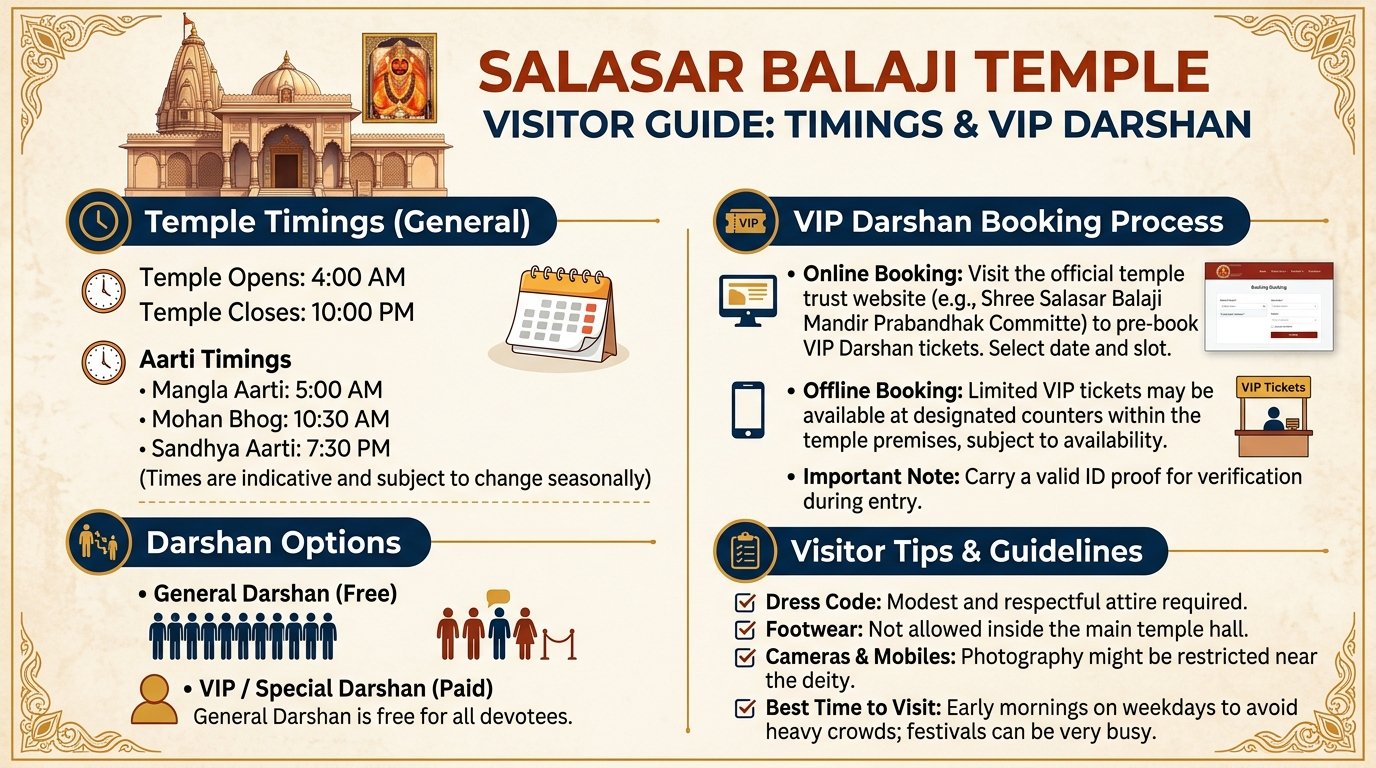
If you’re planning a trip to one of Rajasthan’s most powerful shrines, you’ve probably typed “Salasar Balaji Temple VIP Darshan” into Google at least once and got a dozen half-finished guides.
This one’s different we’re going to walk you through everything, timings, booking, prices, travel, even the temple’s fascinating backstory, so you don’t land up confused at the gate like a lot of first-timers do.
Salasar Balaji Temple, home to a rare bearded and moustached idol of Lord Hanuman (Bajrang Bali), sits in Salasar town near Sujangarh in Rajasthan’s Churu district. Lakhs of devotees visit every year, many opting for VIP darshan to skip the long general queues.
Whether you’re going for the first time or you’re a regular, this guide covers darshan timings, VIP darshan price, online booking, sawamani price list, the temple’s legendary story, and how to reach it basically everything you’d want sorted before you pack your bags.
Salasar Balaji Temple is considered among the most sacred Hanuman pilgrimage sites in India, and honestly, once you stand in that crowd chanting “Jai Bajrang Bali,” you understand why. Devotees believe prayers offered here with true devotion rarely go unanswered — that’s the core belief driving lakhs of people to make this journey every single year.
The temple is managed by Shri Hanuman Seva Samiti through Shri Balaji Mandir, and to be fair, they do a decent job handling the sheer volume of visitors, especially during peak season. From crowd control to cleanliness drives to keeping the darshan lines moving, the management team basically runs a small city’s worth of operations round the clock.
Two grand fairs happen here every year and honestly they’re worth experiencing at least once:
During these fairs, the entire town of Salasar turns into one giant devotional gathering — extended darshan hours, special poojas, food stalls everywhere, it’s an experience in itself.
A lot of visitors ask about the Salasar Balaji story, and it’s genuinely one of the more interesting temple legends in Rajasthan. As per popular belief, the idol of Lord Hanuman was discovered from the ground near a village called Asota in the 18th century (local accounts place it around 1754 CE). A farmer, while ploughing his field, apparently struck something hard — and to everyone’s surprise it turned out to be the idol.
The story goes that the farmer had a dream instructing him to send the idol to Salasar, where a devotee named Mohandas ji, who had been performing severe penance, was destined to receive it. When the idol reached Salasar riding a bullock cart (some versions say the cart just stopped on its own outside Mohandas ji’s home and wouldn’t move further), it was installed there — and that spot became the temple we know today.
What makes this Hanuman idol truly one-of-a-kind is its beard and moustache, a form almost never seen elsewhere. Local tradition holds this represents Hanuman ji’s fierce yet fatherly protector form. This unique iconography → is what distinguishes Salasar Balaji from nearly every other Hanuman temple in the country, and it’s a big reason pilgrims travel from far just to witness it once in their lifetime.
The Salasar Balaji temple opening and closing time is 4:00 AM to 10:00 PM on a normal, non-festival day. That’s roughly 18 hours of darshan availability, which honestly is generous compared to most major temples in India.
A lot of people specifically search for the Salasar Balaji temple closing time in afternoon thinking there’s a mid-day break like some temples do — but there isn’t. The temple stays open continuously through the afternoon; there’s no shutdown for lunch hours or anything like that. You can walk in anytime between 4 AM and 10 PM without worrying about a closed gate in the middle of the day.
If you’re checking Salasar Balaji darshan time today or Salasar Balaji temple timings tomorrow, the standard schedule (4 AM–10 PM) applies unless it’s a festival date. During Chaitra Purnima, Ashwin Purnima, or Hanuman Jayanti, the temple usually stays open 24 hours to manage the crowd surge, so timings effectively don’t apply on those days — it’s open round the clock.
We’d still recommend calling the temple office or checking the official notice board a day before your visit, since timings can shift slightly during unexpected high-footfall days.
| Darshan Type | Timings | Average Waiting Time |
|---|---|---|
| General Darshan | 4:00 AM – 10:00 PM | 15–45 minutes |
| Special Darshan | 4:00 AM – 10:00 PM | 10–20 minutes |
| VIP Darshan | 4:00 AM – 10:00 PM | 5–10 minutes |
| Festival Days | Open 24 Hours | Depends on crowd |
Best time for a peaceful darshan is early morning, between 4 AM and 7 AM, or late evening after 8 PM on regular (non-festival) days — the crowd thins out considerably during these windows.
General darshan → is free of cost → for every devotee, no exceptions. It’s the traditional route most pilgrims take, though on Tuesdays, Saturdays, full moon days, or festival dates, the queue can stretch for hours. If you’ve got time on your hands and want the full traditional pilgrim experience, this is the way to go.
Special darshan sits between general and VIP — faster than the regular line, but a bit more affordable than full VIP access. It works well for weekends or moderately crowded days when you want to save some time without spending on the premium option.
VIP darshan → reduces → waiting time significantly, offering near-direct access to the sanctum. This is genuinely the best pick for:
One thing to keep in mind — VIP darshan tickets are limited, so during peak season they can sell out fast. Book ahead if you can, don’t leave it for the last moment.
Here’s the honest, updated breakdown of Salasar Balaji VIP darshan price and other charges devotees usually ask about:
| Darshan/Seva Type | Price (INR) |
|---|---|
| General Darshan | Free |
| Special Darshan | ₹200 – ₹500 per person |
| VIP Darshan (Individual) | ₹200 – ₹500 per person |
| VIP Darshan (Family) | ₹5,100 per family |
The price variation within the ₹200–₹500 range mostly depends on the day of the week and season — weekday visits generally sit at the lower end, while Tuesdays, Saturdays, and festival dates push prices toward the higher end due to demand. The ₹5,100 family VIP darshan package is genuinely popular because it lets the whole family go through together in one priority queue, instead of buying individual tickets and getting split up.
Devotees often book a Sawamani seva (a traditional offering ritual, roughly equal to 40 kg of prasad/offerings) as a way to fulfil a manat (vow) made to Bajrang Bali. The exact sawamani price list varies depending on what’s being offered — laddoo prasad, boondi, or a full seva package — and rates are revised from time to time by the temple trust.
As a rough guide, sawamani packages generally range from around ₹1,100 to ₹11,000+ depending on the scale and type of offering chosen. Since these rates do change, it’s best to confirm the current sawamani price list directly with the temple counter or official website before booking, so you’re not caught off guard.
Other rituals offered include:
This is where most guides fall short — they’ll tell you booking “exists” but never actually walk you through it. Here’s the real process:
A quick tip — cancellation and refund policies for darshan bookings tend to be strict or non-existent, so double-check your travel dates before confirming the payment.
The ideal window is October to March, when Rajasthan’s weather is pleasant enough to stand in queues without the punishing summer heat working against you. Summers here get brutally hot, and combined with long waiting lines, it can genuinely wear you down.
For a calmer experience, weekdays beat weekends by a mile. Tuesdays and Saturdays are considered especially auspicious for Hanuman ji, so expect noticeably heavier crowds those two days specifically. If you want maximum peace, plan around mid-week, avoid Chaitra and Ashwin Purnima unless you specifically want the fair experience, and go for VIP darshan if festival timing is unavoidable.
A common search is simply “Salasar Balaji temple distance” from various cities — here’s a quick reference:
Since a lot of devotees combine both pilgrimages in one trip, the Salasar Balaji to Khatu Shyam distance is roughly 55–60 km, and the drive typically takes around 1.5 to 2 hours depending on traffic and road conditions. It’s a very popular combo route — many pilgrims visit Khatu Shyam ji temple either right before or after their Salasar darshan since both fall in the same general region of Sikar/Churu.
Salasar has solid road connectivity to Jaipur, Delhi, Bikaner, Churu, and Sikar. Rajasthan Roadways buses run regularly, and private taxis are easy to arrange too. Honestly, if you’ve got the option, driving down by private vehicle is the most comfortable — highways in this stretch are reasonably well maintained.
Sujangarh Railway Station is the nearest station, about 25 km from the temple. It’s well connected to major Rajasthan cities and a few neighbouring states. From the station, local taxis and shared autos will get you to the temple in roughly 30–40 minutes.
The nearest airport is Jaipur International Airport, around 170 km away. From there, you can hire a taxi or catch a bus toward Salasar — the road journey takes about 3.5 to 4 hours depending on traffic.
This is the part most guides completely gloss over. Once you land at Sujangarh station or get dropped near Salasar’s main road, here’s what actually helps:
Knowing these last-mile details in advance genuinely saves a lot of confusion once you actually reach Salasar.
Salasar town is fairly well set up for pilgrims. You’ll find:
During Chaitra Purnima, Ashwin Purnima, or Hanuman Jayanti, rooms get booked out fast, so honestly, book at least a few weeks ahead if you’re planning a fair-time visit.
A few simple things to keep in mind before you head in:
Many first-time visitors search for a Salasar Balaji mandir photo before travelling, just to know what the temple complex and the idol actually look like. While we’d recommend checking the temple’s official website or verified social pages for authentic, up-to-date images, what stands out in most photos is the temple’s distinct architecture and, of course, the bearded Hanuman idol itself, which really is unlike anything you’ll see at other Hanuman shrines.
Planning a trip to Salasar Balaji Dham doesn’t need to be stressful once you know the darshan timings, VIP booking process, and travel logistics in advance. Whether you go for the free general darshan or opt for the ₹5,100 VIP family package, the spiritual experience at this temple, with its legendary story and unique idol, makes the journey genuinely worthwhile. Plan smart, book early if possible, and you’ll have a smooth, peaceful darshan.
Yes, devotees can book VIP or special darshan through the official Salasar Balaji temple website, subject to slot availability. Avoid third-party agents claiming guaranteed bookings, as they’re often unreliable.
VIP darshan charges range from ₹200 to ₹500 per person, while the VIP family darshan package costs ₹5,100, allowing the entire family priority access together.
The temple opens at 4:00 AM and closes at 10:00 PM daily. During major festivals like Chaitra Purnima, it typically stays open 24 hours for devotees.
No, the temple doesn’t close during afternoon hours. It remains open continuously from 4 AM to 10 PM without any mid-day break or shutdown.
On a normal day, darshan runs from 4:00 AM to 10:00 PM. On festival dates, the temple usually stays open round the clock, so timings don’t restrict entry.
Yes, general darshan is completely free for every devotee. Only special and VIP darshan options involve a nominal ticket charge for faster access.
The idol here uniquely has a beard and moustache, a rare form among Hanuman temples, believed to represent his fierce protector avatar per local legend.
Legend says the idol was found underground by a farmer in the 18th century and, guided by a dream, was carried to Salasar and installed there.
Salasar Balaji Temple is approximately 170 km from Jaipur, roughly a 3.5 to 4-hour drive depending on traffic and the route taken.
The distance between Salasar Balaji and Khatu Shyam temple is around 55–60 km, taking roughly 1.5 to 2 hours by road, making it a popular combined trip.
Sujangarh Railway Station is the nearest, located about 25 km from the temple, with taxis and autos readily available from there.
Sawamani seva packages generally range from around ₹1,100 to ₹11,000+ depending on the offering scale. Rates change periodically, so confirm current pricing at the temple counter.
Tuesdays, Saturdays, Hanuman Jayanti, and the Chaitra and Ashwin Purnima fairs attract the heaviest crowds, so plan visits around these dates carefully.
Yes, VIP darshan is highly recommended for senior citizens since it offers quicker, easier access without long standing queues or crowd pressure.
Yes, dharamshalas, budget hotels, and guest houses are easily available within walking distance of the temple, though early booking is advised during festivals.