Physical Address
304 North Cardinal St.
Dorchester Center, MA 02124
Physical Address
304 North Cardinal St.
Dorchester Center, MA 02124


Most people go to Puri for the Jagannath darshan and head home. They miss a small, quiet shrine on the highway where Krishna is said to have walked as a witness.
The Sakshi Gopal Temple Puri is that shrine. This guide covers timings, history, entry fee, images, aarti, location and phone details in one place, along with the legend, the distances and some honest travel tips.
If you only have half a day to spare on your Puri trip, you’ll want to read this before deciding.
The Sakshi Gopal Temple is a Krishna temple in Odisha, in Sakhigopal village (also called Satyabadi), about 20 km from Puri on the Puri-Bhubaneswar highway.
The deity here is Lord Krishna as Sakshi Gopal, meaning “the Gopal who was a witness,” and Goddess Radha stands beside him. Devotees also call the place Satyabadi Gopinatha Temple.
People spell it in a few ways: Sakhigopal temple, Sakshigopal temple or Sakshi Gopal Mandir Puri. They all point to the same place, so don’t get confused when Google Maps shows a slightly different spelling.
The temple matters for two reasons. Its legend is one of the best-known in Odisha, and many pilgrims believe a Puri pilgrimage isn’t truly complete without stopping here. In Odia tradition, the Gopal is the one who “vouches” that your Puri journey was real, so visiting is believed to seal the yatra.
| Detail | Information |
|---|---|
| Temple name | Sakshi Gopal Temple (Satyabadi Gopinatha Temple) |
| Presiding deity | Lord Krishna (Sakshi Gopal) with Goddess Radha |
| Location | Sakhigopal, Puri district, Odisha 752014 |
| Distance from Puri | Around 20 km |
| Distance from Bhubaneswar | Roughly 38-40 km |
| Entry fee | Free, no ticket |
| Timings | Around 6:00 AM to 9:00 PM (verify locally) |
| Architecture | Kalinga style |
| Famous festival | Amla Navami |
| Photography | Not allowed inside the sanctum |
The Sakshi Gopal Temple Puri timings are generally 6:00 AM to 9:00 PM, all seven days of the week. Most travel sources list the same hours for every day, Monday through Sunday, and the temple is open through the year, including festivals.
There’s a catch, though. Like most Odisha temples, the sanctum usually closes for a few hours in the afternoon for the deity’s rest and bhog offering, even when websites show a continuous “6 to 9” slot. So don’t plan to arrive at 1:30 PM and expect an open sanctum. The safest windows are:
Timings can shift during festivals such as Amla Navami, Janmashtami, Radha Ashtami and Holi, so ask a local shopkeeper or your driver the day before.
There is no entry fee at Sakshi Gopal Temple. Darshan is free for everyone. You’ll find small donation boxes, and some priests offer paid special poojas, but none of that is compulsory.
About the phone number: the temple doesn’t have a verified, publicly listed official contact number. Several travel portals show “N/A,” and that’s honest.
If you need information, the Puri tourist office or your hotel’s travel desk is the better bet than random numbers floating on the internet. Be careful with unofficial numbers that claim to book special darshan for a fee.
This is the heart of the temple, and honestly the reason most people visit.
The Sakshi Gopal Temple Puri story is about a young Brahmin whose promise of marriage was broken, and Lord Krishna who walked to a village to testify on his behalf. The most popular version goes like this.
Two Brahmins from a village called Vidyanagar, one elderly and one young, set off on a pilgrimage to Vrindavan. The elder man fell sick on the way, and the young man nursed him with total devotion. Moved by this service, the elder promised to marry his daughter to the younger man.
Back home, the elder’s family refused. The promise had been made in front of no human witness, the family said, so who could prove it? The heartbroken young man returned to Vrindavan and prayed before the Gopal deity.
Krishna agreed to go with him as a witness on one condition: the young man must walk ahead and never look back. The Lord would follow, and the sound of his anklets would tell the boy he was still there.
Near the village, the anklet sound stopped in the soft sand. The young man, worried, turned around, and the Lord became a stone image right there. Still, the villagers were convinced. The marriage happened, and the image became known as Sakshi Gopal.
According to Odia tradition, the image was later brought to Odisha by King Purushottama Deva of the Gajapati dynasty, after his military campaign in the south in the 15th century. It was kept first at Cuttack and then installed at Satyabadi. Historians debate some of the dates, and local accounts differ in details, so treat these as tradition rather than settled record.
A second tradition says the shrine goes back to King Vajra, the grandson of Krishna, who is credited with setting up many Krishna shrines across India. Both stories live side by side in local belief, and nobody in the village seems bothered by that.
Bengali pilgrims have loved this tale for centuries, partly because Bengal and Odisha share so much of the Vaishnava tradition, and Chaitanya Mahaprabhu is said to have visited the place on his way to Puri.
In Bengali, the idiom “সাক্ষীগোপাল” (sakshigopal) has even entered everyday speech. It refers to someone who is present at an event but does nothing, just a silent witness. So when a Bengali friend jokes about being a “sakshi gopal” in a meeting, now you know where it comes from.
The temple is commonly dated to the 11th century, though the present structure and the arrival of the deity are linked with later centuries, and scholars don’t fully agree.
What’s clear is that Sakshi Gopal has been a major Vaishnava centre in Odisha for several hundred years, tied closely to the Gajapati rulers and to the larger Jagannath tradition of Puri.
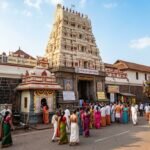
The temple follows the Kalinga architectural style, which is why it looks similar to the Jagannath Temple at Puri. If you’ve seen the Puri shrine, the tall curvilinear spire and the layered porch structure will feel familiar, even if everything is smaller here.
What to look for:
It’s compact, easy to cover in 30 to 45 minutes, and rarely overwhelming. Elderly pilgrims especially appreciate that.
The Sakshi Gopal deity is Lord Krishna in his cowherd form, shown as a flute-playing youth. Radha’s image was added alongside him, and the pair together form the central worship.
The theological idea is simple and powerful: God as a truthful witness. Locals call the whole region Satyabadi, “the land of truth,” which is why a lot of people in the area still take oaths in front of the Gopal.
Aarti at Sakshi Gopal Temple follows the usual Odisha Vaishnava rhythm of morning, midday and evening services, and the evening aarti is the one most visitors enjoy. Exact timings aren’t officially published, so I’d rather not give you a made-up clock time. What devotees generally describe is this:
If aarti is the main reason for your trip, ask a priest or a nearby shopkeeper for the day’s schedule when you reach, because festive days shift everything.
Here’s something many guides mention in half a sentence and then move on. Local tradition says the Sakshi Gopal Temple offers wheat-based food offerings, unlike the rice-heavy offerings in most Vishnu temples, including the famous Mahaprasad of Jagannath Temple Puri, which is rice-centred.
The idea is tied to the Gopal’s journey from the Vidyanagar region, where wheat and other grain-based foods were part of the local diet, so the offering style travelled with the deity. This explanation comes from local belief and not from a written ritual text, so take it as tradition.
Why does it matter? Because it shows how the temple keeps its own identity within Odisha’s rice-and-Mahaprasad food culture. If you get a chance, try the temple’s prasad and compare it with what you ate in Puri town.
The word “Sakshi” also deserves a second thought. In Hindu thought, a sakshi is the silent, ever-present witness, and here God himself takes that role. That’s the emotional core of the temple, more than any carving or spire.
Amla Navami is the most famous festival here, and on this day devotees are allowed to see and touch the feet of Goddess Radha, which are otherwise kept covered. It falls in the Kartika month (around October-November), and the crowd is huge, so go very early if you want a calm darshan.
Other festivals celebrated with great energy:
The temple sits on the Puri-Bhubaneswar Highway in Sakhigopal, which makes it one of the easiest temples to add to a Puri-Bhubaneswar road trip.
The distance from Puri Jagannath Temple to Sakshi Gopal Temple is about 20 km, roughly 30 to 40 minutes by road depending on traffic. One correction here: some travel pages say the temple is only 1.5 km from Puri railway station. That’s wrong. 20 km is the right figure.
From Bhubaneswar, the temple is about 38-40 km, which usually takes under an hour. It’s naturally on your way if you’re heading to Puri.
| From | Approx. distance | Typical travel time |
|---|---|---|
| Puri Jagannath Temple / Puri town | 20 km | 30-40 min |
| Puri Railway Station | 20 km | 30-40 min |
| Bhubaneswar city | 38-40 km | 50-60 min |
| Biju Patnaik Airport, Bhubaneswar | 42-45 km | 1 hr |
| Konark Sun Temple | ~55-60 km | 1.5 hrs |
Since I can’t see where you are, the quickest way is to open Google Maps, search “Sakhigopal temple,” and tap Directions. It gives live traffic, which really matters on weekends and festival days. Searching under one spelling and not finding it? Try the others.
If you’re searching for Sakhigopal temple photos, you’ll mostly find exterior shots, because photography is prohibited inside the temple sanctum. Outside, you can capture:
Please be respectful when clicking pictures of other devotees. Not everyone likes being photographed while praying.
The best time to visit is from October to March, when the weather is pleasant and the coastal heat is low. Summers (April-June) are hot and humid, and the monsoon brings heavy rain, though it also keeps the crowd small.
If you want a really quiet visit, pick a weekday morning. If you want a festive experience, aim for Amla Navami and be ready for crowds.
Generally, the monsoon months outside Rath Yatra (July end to September) and the January-February stretch see lighter crowds. Rath Yatra (June-July), the Christmas-New Year period and major holidays are the busiest. Plan Puri and Sakhigopal together and you’ll feel the difference.
Once you’ve finished at the temple, there’s plenty close by:
Many Puri tour packages already include Sakhigopal on the Puri-Bhubaneswar circuit, so check before booking separately.
A young Brahmin’s promised marriage was denied, so Krishna agreed to be his witness. When the boy looked back, the Lord turned to stone. The image became Sakshi Gopal, “the God who witnessed.”
Sakhigopal is famous for its Krishna temple, the witness legend, the Radha-Krishna idols, the Amla Navami festival and its Kalinga architecture. Many pilgrims treat it as a must-visit stop on their Puri pilgrimage.
The temple is about 20 km from Puri town and the Jagannath Temple. By road it takes roughly 30 to 40 minutes, depending on highway traffic and the time of day.
October to March is ideal because the weather is cooler. For fewer people, go on a weekday morning. For festive energy, visit during Amla Navami, Janmashtami or Holi.
The road distance is about 20 km along the Puri-Bhubaneswar highway. A taxi or bus usually takes between 30 and 40 minutes, depending on traffic and road conditions.
Late monsoon (August-September) and January-February tend to be quieter. Avoid Rath Yatra, Christmas-New Year week and major festival days if you prefer shorter queues.
The temple is generally open from 6:00 AM to 9:00 PM daily. The sanctum may close for a few afternoon hours for rest and bhog, so confirm locally.
It is in Sakhigopal (Satyabadi) village, Puri district, Odisha, on the Puri-Bhubaneswar highway. The pincode is 752014, and the temple lies between Puri and Bhubaneswar.
No, entry is completely free. You may pay for optional special poojas, offerings or footwear storage, but darshan itself doesn’t need a ticket.
Photography is prohibited inside the sanctum. You can usually click pictures of the exterior, the gateway and the surroundings, but it’s polite to ask before photographing people.
It is roughly 38-40 km from Bhubaneswar, around 50 to 60 minutes by car. It sits right on the route to Puri, so it’s easy to include.
The main deity is Lord Krishna as Sakshi Gopal, a flute-playing cowherd. Goddess Radha’s bronze idol stands beside him, and the pair are worshipped together.
According to local tradition, the offerings include wheat-based items, unlike the rice-centred bhog of most Vishnu temples. It’s considered one of the temple’s most distinctive features.
Amla Navami is the most famous. On this day, devotees may see and touch the feet of Goddess Radha, which are covered the rest of the year. Expect big crowds.
A normal darshan and walk around the temple takes 45 minutes to an hour. Add travel time from Puri or Bhubaneswar, and it fits comfortably into a half-day trip.