Physical Address
304 North Cardinal St.
Dorchester Center, MA 02124
Physical Address
304 North Cardinal St.
Dorchester Center, MA 02124

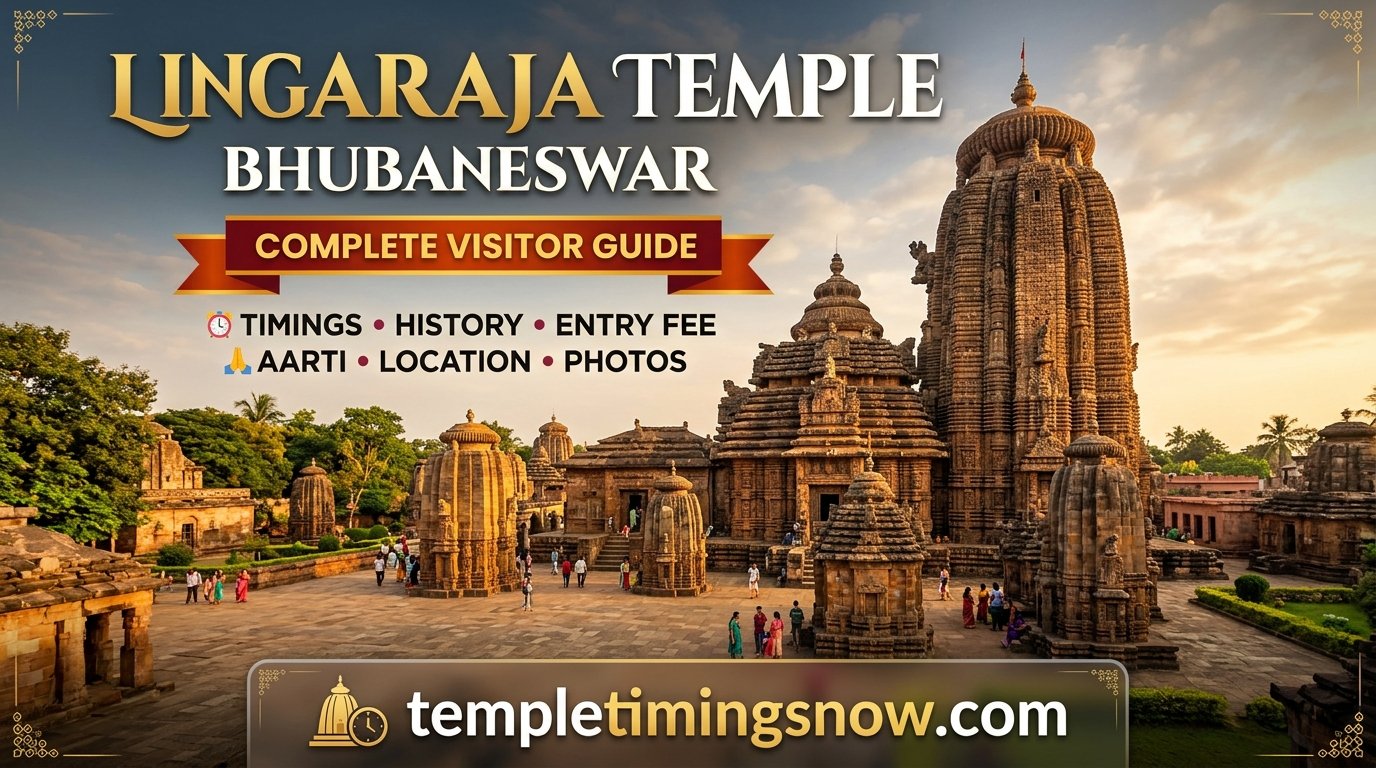
If you ever stand under that 180-foot tower in the old part of Odisha’s capital, you’ll get why people call this place the heart of the Temple City.
The Lingaraja Temple Bhubaneswar isn’t just another shrine on a tourist list. It’s a living, breathing 11th-century monument where the same rituals have been going on for centuries.
This guide covers timings, history, entry fee, images, aarti, location and phone number, plus a few things most blogs skip, like the Harihara story and the non-Hindu viewing platform.
Lingaraj Temple is the largest and most sacred shrine in Bhubaneswar, dedicated to Lord Harihara, a joint form of Vishnu (Hari) and Shiva (Hara). It was built in the 11th century in the Kalinga style of architecture and it’s still an active place of worship today.
Here’s the quick fact sheet, so you dont have to scroll around:
| Detail | Information |
|---|---|
| Temple name | Lingaraj / Lingaraja Temple |
| Presiding deity | Lord Harihara (Shiva + Vishnu) |
| Built in | 11th century (Somvanshi / Kesari dynasty) |
| Style | Kalinga architecture, sandstone and laterite |
| Height of tower | About 180 feet |
| Timings | 6:30 am to 7:30 pm (as per listings) |
| Entry fee | No entry fee |
| Address | Rath Road, Lingaraj Nagar, Old Town, Bhubaneswar, Odisha 751002 |
| Phone | 0674 2340105 |
| Who can enter | Hindus only (platform for non-Hindus) |
The lingaraj temple timings listed for visitors are 6:30 am to 7:30 pm, seven days a week. The temple stays open on all days including weekends and most festivals, so there’s no weekly off to worry about.
Most travel listings show the same slot for every day, Monday to Sunday. Thats the general public darshan window, and it’s what you should plan around. In practice the temple servitors start the day much earlier with private rituals, and the sanctum can pause for a break in the afternoon, so I’d suggest reaching before noon or after 4 pm for a smoother darshan.
Timings can shift a bit during festivals like Mahashivaratri, so ring the temple office on 0674 2340105 before you travel if your plan is tight.
The daily aarti and puja sequence at Lingaraj Temple starts at dawn with the morning rituals and ends in the evening with the closing offerings. Exact slots are decided by the temple’s Sevayat (servitor) calendar, so they aren’t fixed to the minute like a train timetable. Broadly, visitors can expect:
One honest tip: if aarti is the main reason you’re coming, ask the priests at the gate for that day’s schedule. Dont rely on a random website, including this one, for a minute-by-minute timing.
There is no entry fee to visit Lingaraj Temple. Darshan is free for everyone who’s allowed inside. You might pay for optional things like flowers, offerings or special puja, but the temple doesn’t charge a ticket at the gate.
Location: The temple stands on Rath Road, Lingaraj Nagar, in the Old Town area of Bhubaneswar, Odisha 751002. It sits very close to Bindu Sarovar, which makes it easy to combine both in a single visit. Phone: 0674 2340105. Honestly, the phone line isn’t always picked up quick, so a visit to the gate works better than waiting on hold.
Lingaraj Temple was built in the 11th century and is traditionally credited to Jajati Keshari of the Somvanshi dynasty. Some believe the Swayambhu Shivalinga here was worshipped as early as the 7th century, long before the big stone temple came up around it.
The temple was built by the Somvanshi (Soma / Kesari) dynasty, with Jajati Keshari remembered as the king behind it, and the construction was carried forward by his successor Lalatendu Keshari in the later part of the 11th century.
Later rulers, especially the Eastern Ganga kings, added to the complex and strengthened the Vishnu connection, which is why the shrine blends both traditions so smoothly.
The name itself appears in the Brahma Purana, one of the ancient Hindu scriptures, and Bhubaneswar was once known as Ekamra Kshetra, the area of a single mango tree. That old name explains why the garden near the lake is called Ekamra Van.
हिंदी में पढ़ने वालों के लिए, संक्षेप में: लिंगराज मंदिर भुवनेश्वर का सबसे बड़ा और सबसे पवित्र मंदिर है। इसे 11वीं शताब्दी में सोमवंशी राजा ययाति केशरी ने बनवाया माना जाता है। यहाँ स्वयंभू शिवलिंग है, जिसकी पूजा हरिहर (विष्णु और शिव) के रूप में होती है। मंदिर कलिंग शैली में बना है और इसकी ऊँचाई लगभग 180 फीट है। हर साल महाशिवरात्रि पर यहाँ हज़ारों भक्त आते हैं।
According to the legend, Goddess Parvati, in the form of Bhuvaneshwari, killed two demons named Kirti and Vasa near this spot. After the battle she felt very thirsty, so Lord Shiva created the Bindu Sarovar by bringing a drop (bindu) of water from every sacred river and pilgrimage on earth.
Shiva then stayed here as Lingaraj, the king of lingas. Different storytellers tell it a bit differently, but this is the version most locals will tell you.
Lord Harihara, a combined form of Hari (Vishnu) and Hara (Shiva), is worshipped in Lingaraj Temple. The main deity is a self-manifested linga, about 8 feet in diameter and rising 8 inches above the floor.
The word Lingaraj means king of the lingas, and its older form, Tribhuvaneswara, means lord of the three worlds. Bhubaneswar the city actually takes its name from this very title. So when devotees say Lingaraj, they’re pointing to Shiva as the supreme lord of the whole area.
This is where the temple gets really interesting, and where most guides stop short. Lingaraj Temple signifies the meeting of Shaivism and Vaishnavism and you can actually see it in the way worship is done. Offerings of bel leaves (loved by Shiva) and tulsi (loved by Vishnu) are both made to the same linga, which is quite rare in Shiva temples.
The Eastern Ganga rulers, who were devoted to Jagannath of Puri, added Vaishnava elements, and the result is a shrine where two big sects share a single sanctum. During Ashokashtami the deity even visits the Mausi Maa Temple, a custom that echoes the Jagannath tradition of Puri.
Lingaraj Temple is a masterpiece of Kalinga architecture, built with sandstone and laterite and crowned by a 180-foot tower. A massive laterite compound wall, measuring about 22,720 sq. m., surrounds the complex, and the tall main tower easily dominates Bhubaneswar’s skyline.
The temple has four halls that are lined up in one direction and rise in height step by step, from the Bhoga Mandapa up to the Vimana:
The main entrance faces east, with smaller gates to the north and south. The complex also holds around 150 smaller shrines in the courtyard, so allow yourself enough time to wander.
Cameras and electronic gadgets are not allowed inside the temple, so there is no official lingaraj temple inside photo for visitors to click. Whatever pictures you see online are taken from the outside, mostly from the viewing platform or the road near the compound wall.
So what kind of lingaraja temple photos can you realistically take?
As for lingaraj temple god images, the deity is not a sculpted idol with a face. It’s a natural, self-manifested linga, and devotees pray to it as Harihara. Official images you find online are usually artistic pictures of the linga, drawn or edited from temple-approved sources. If you want to see the complete image gallery, check the temple’s official channels and trusted tourism pages rather than random social media posts.
Here are 10 simple lines for students or anyone who needs a quick summary:
The temple really comes alive during festivals, and thousands of devotees show up. Each one has its own flavour.
Mahashivaratri is the most important festival at Lingaraj Temple and is celebrated in the Phalgun month. Many devotees fast all day and break it at night, after the Mahadipa, a big illuminated earthen lamp, is raised on top of the temple. If you can handle the crowd, it’s an unforgettable night.
Chandan Yatra is a 21-day festival that begins on Akshaya Tritiya. The idols of the deities are taken to Bindu Sarovar and floated in decorated narrow boats called Chapa. They’re then sanctified with chandan (sandalwood paste) and water.
Ashokashtami is the annual car festival of Lord Lingaraj, held on the eighth day of Chaitra (March/April). The deity travels in a decorated chariot to the Rameswar Temple, also called Mausi Maa Temple. After four days he’s brought back following a ritual bath at Bindu Sarovar.
The best time to visit Lingaraj Temple is between October and March, when Bhubaneswar’s weather is cool and dry. Summers (April to June) get really hot and humid, and the monsoon brings heavy rain, which can make walking around the complex a bit of a hassle.
For the best darshan experience, go early in the morning on a weekday. If you want the festival atmosphere, plan around Mahashivaratri (February or March), Chandan Yatra (April or May) or Ashokashtami (March or April), but expect long queues and a lot of crowd. A good rule: more atmosphere means less peace.
Lingaraj Temple is in the heart of the Old Town and is easy to reach from the airport, railway station and bus stand by auto, taxi or local bus.
| From | Distance | Approx. Travel Time |
|---|---|---|
| Biju Patnaik International Airport | About 4.4 km | About 10 minutes |
| Bhubaneswar Railway Station | About 4.8 km | About 12 minutes |
| Local city centre | Short ride | Varies with traffic |
Auto rickshaws, private cabs and local buses are all easy to find. Parking is available outside the temple premises. If you’re staying in town for a few days, hiring a car through a local rental company makes temple-hopping a lot easier.
Non-Hindus, cameras, electronic gadgets and footwear are not allowed inside the main temple. Keep these simple rules in mind so your visit goes smoothly:
Entry into the main temple is restricted to Hindus, but a viewing platform has been built outside the complex so non-Hindus can see the temple. The platform is located on the outer side of the compound wall, and from there you get a clear view of the towering Vimana and the carved upper portions. Many locals say it was set up during the colonial period for foreign visitors, though you should treat that as local tradition.
If you’re not a Hindu, don’t feel disappointed. The view from the platform is really good for photography, and you can spend the rest of your time at Bindu Sarovar, Ekamra Van and the other temples nearby. Plus, the Odisha State Museum gives you great context on the region’s temple art.
The area around the temple is packed with things to see, so don’t just run in and run out.
Goddess Parvati killed the demons Kirti and Vasa here, and Shiva created Bindu Sarovar to quench her thirst. Shiva then stayed on as Lingaraj, the king of lingas, and the temple grew around that sacred spot.
The main mystery is the Harihara form, where one self-manifested linga is worshipped as both Shiva and Vishnu. Bel and tulsi leaves are offered together, and locals say Bindu Sarovar holds water from every holy river.
No, they are different temples. Jagannath Temple is in Puri and honours Lord Jagannath, while Lingaraj Temple is in Bhubaneswar and honours Harihara. They share some traditions, but they are separate shrines.
Non-Hindus cannot enter the main temple. Cameras, phones and other electronic gadgets are banned, and footwear is not allowed inside. Visitors should also avoid strangers offering paid puja and approach the temple priests only.
Lingaraj means king of the lingas. The old name Tribhuvaneswara means lord of the three worlds, and Bhubaneswar city gets its own name from it. Devotees see Shiva here as the supreme ruler of the region.
The temple was built in the 11th century, traditionally by Jajati Keshari of the Somvanshi dynasty, and later expanded by the Eastern Ganga rulers. The linga itself is believed to have been worshipped from around the 7th century.
Lord Harihara is worshipped, which is the combined form of Hari (Vishnu) and Hara (Shiva). The deity is a self-manifested Shivalinga, about 8 feet in diameter, that devotees treat as both Shiva and Vishnu.
The temple is listed as open daily from 6:30 am to 7:30 pm, Monday to Sunday. Rituals begin earlier and timings may change during festivals, so check with the temple office before travelling.
No, there is no entry fee. Darshan is free for all devotees who are allowed inside. Only optional offerings, flowers or special puja services may cost something, and these are voluntary.
Non-Hindus cannot enter the main temple, but a viewing platform outside the compound lets them see the tower and carvings. They can also visit Bindu Sarovar, Ekamra Van and nearby temples freely.
October to March is best because the weather is cool and pleasant. Early mornings on weekdays are quietest, while Mahashivaratri brings the biggest crowds and the most spectacular celebrations of the year.
The Somvanshi (Kesari) dynasty built it in the 11th century, with Jajati Keshari credited as the founder and Lalatendu Keshari carrying the work forward. The Eastern Ganga dynasty later added to the complex.
The temple is about 4.4 km from Biju Patnaik International Airport (around 10 minutes) and about 4.8 km from Bhubaneswar railway station (around 12 minutes) by auto or taxi.
No, cameras and electronic gadgets are not allowed inside the premises. You can click lingaraja temple photos from the outside viewing platform and nearby areas like Bindu Sarovar instead.
The listed phone number is 0674 2340105. The address is Rath Road, Lingaraj Nagar, Old Town, Bhubaneswar, Odisha 751002. Calling ahead helps confirm festival timings and darshan arrangements.