Physical Address
304 North Cardinal St.
Dorchester Center, MA 02124
Physical Address
304 North Cardinal St.
Dorchester Center, MA 02124

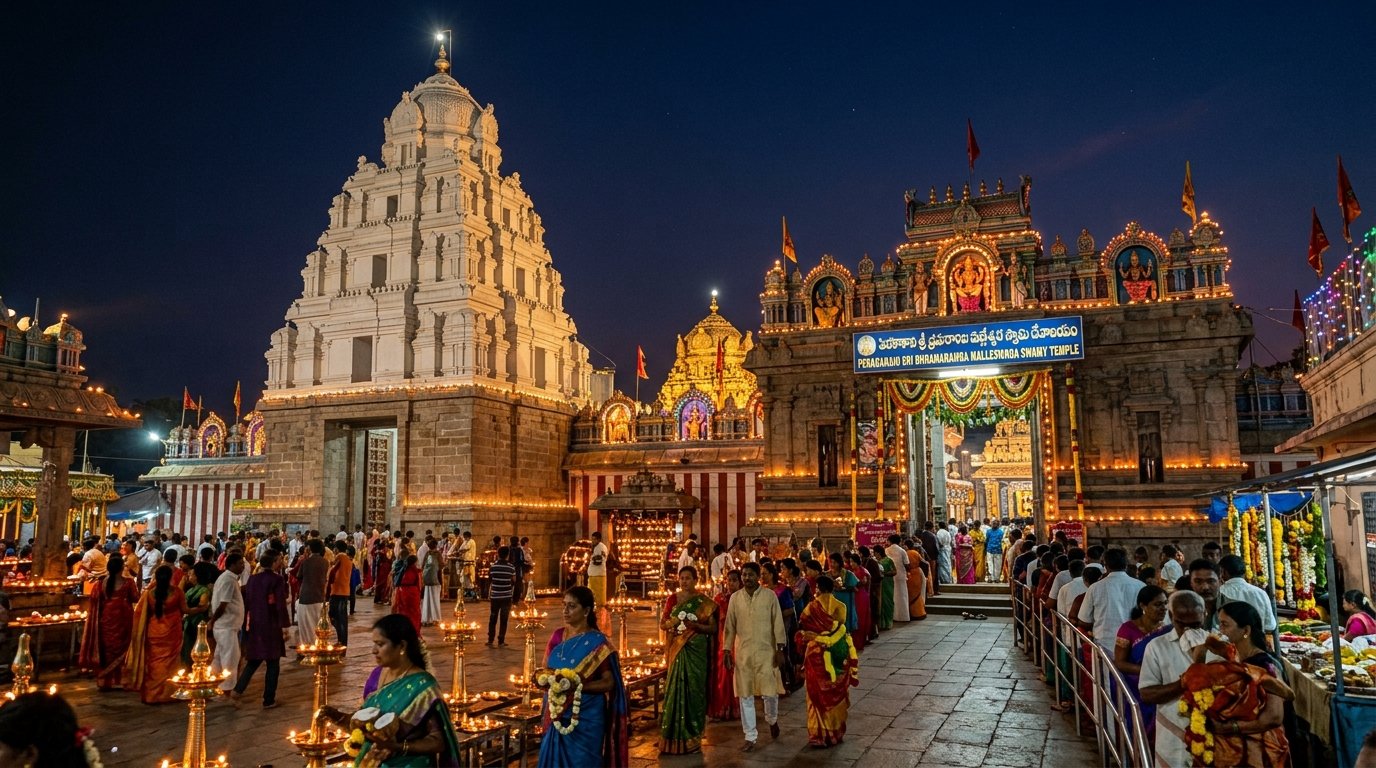
If you’re searching for genuine peace and a solution to those never-ending life problems, the Pedakakani Sri Bhramaramba Malleswara Swamy Temple deserves a spot right at the top of your 2026 pilgrimage list.
Tucked away in Guntur district, this ancient Shiva shrine has slowly become one of the most talked-about temples in Andhra Pradesh, mostly because of its incredibly powerful Rahu Ketu Pooja.
Thousands of devotees travel here every year, not just for darshan but to actually get relief from Kalasarpa Dosha, delayed marriages, career blocks and money troubles that just won’t go away.
In this guide we’ll walk you through everything darshan timings, pooja booking, ticket prices, how to reach, and honestly a lot more that most articles online conveniently skip.
The Pedakakani Temple is an ancient Shiva temple situated in Pedakakani village, Guntur district, and it’s considered among the most spiritually significant temples for Rahu-Ketu related remedies in the whole region.
Local legend (and there’s some historical backing too) says the temple was originally established by Adi Shankaracharya, the great philosopher who basically reshaped Hindu spiritual thought centuries ago.
Later on the temple got a major facelift during the Vijayanagara Empire, with Sri Krishnadevaraya himself contributing to its expansion — which tells you how important this place has been historically, not just religiously.
The presiding deities here are Lord Shiva, worshipped as Sri Malleswara Swamy, and Goddess Bhramaramba Devi, an incarnation of Shakti. Together they’re believed to bring mental peace, stability and long-term relief to anyone who prays here with sincerity.
Architecturally the temple is honestly quite impressive. There’s a majestic 60-foot Rajagopuram that you can spot from a distance, the sacred Dhwajasthambam, and the beautifully carved Addala Mandapam which is a favourite photo spot among visitors.
The whole complex is maintained by the Andhra Pradesh Endowments Department, so things run fairly systematically compared to some smaller unregulated temples.
| Attribute | Details |
|---|---|
| Temple Name | Sri Bhramaramba Malleswara Swamy Temple (Pedakakani Temple) |
| Also Known As | Kakani Temple, Kakani Sivalayam |
| Location | Pedakakani, Guntur District, Andhra Pradesh |
| Deities | Lord Shiva (Malleswara Swamy), Goddess Bhramaramba Devi |
| Architecture | 60-ft Rajagopuram, Dhwajasthambam, Addala Mandapam |
| Managed By | Andhra Pradesh Endowments Department |
| Famous Ritual | Rahu Ketu Pooja |
| Pedakakani Temple Official Website | aptemples.ap.gov.in |
You’ll also notice locals referring to it simply as Kakani Temple or even Kakani Sivalayam — same place, just the regional shorthand people use when giving directions or talking to auto drivers.
The Pedakakani Temple timings follow a fairly consistent daily schedule, though this can shift slightly around big festival days. Knowing this in advance really does save you from standing in unnecessary queues, especially if you’re travelling from another city.
| Schedule | Timings |
|---|---|
| Temple Opening | 5:00 AM |
| Morning Darshan | 5:00 AM – 1:30 PM |
| Afternoon Break | 1:30 PM – 4:00 PM |
| Evening Darshan | 4:00 PM – 8:00 PM |
| Closing Time | 8:00 PM |
During occasions like Maha Shivaratri, Navratri, Kartika Masam, or Amavasya and Poornima days, the temple usually extends hours a bit and brings in extra staff for crowd control. If you’re planning a visit around these dates, it’s worth calling ahead just to confirm, because timing tweaks aren’t always updated online in real time.
This is really the heart of why so many people make the trip. The Rahu Ketu Pooja performed here is believed to significantly reduce the malefic effects caused by the planets Rahu and Ketu in a person’s horoscope — things like sudden setbacks, mental restlessness, career stagnation and relationship troubles.
Here’s something a lot of competitor articles gloss over — they mention Kalasarpa Dosha and Rahu Ketu Dosha constantly but never really explain what they mean. In simple terms, Rahu and Ketu are shadow planets (not physical planets, but the lunar nodes) in Vedic astrology, and when all the seven main planets in a birth chart fall between Rahu and Ketu, it’s called Kalasarpa Dosha.
This positioning is believed to create an energy blockage that manifests as repeated failures, delays and unexplained obstacles — no matter how hard the person tries.
People with this dosha in their kundali (birth chart) often report facing:
The Rahu Ketu Pooja at Pedakakani Temple is specifically designed to pacify these two shadow planets through mantras, homams and offerings performed by trained priests, which devotees say brings noticeable relief over time.
The pooja is conducted mainly during Rahukalam, a specific time window each day considered especially potent for this ritual.
| Day | Pooja Timings | Approx. Rahukalam |
|---|---|---|
| Tuesday | 6:00 AM – 10:30 AM | Around 3:00 PM |
| Saturday | From 6:00 AM onwards | Around 9:00 AM |
| Sunday | 6:00 AM – 10:30 AM | Around 4:00 PM |
Priests here generally recommend arriving at least an hour early on Saturdays and Tuesdays, since those two days tend to get pretty crowded compared to Sundays.
Doing the Pedakakani Temple online booking is genuinely the smartest way to lock in your slot, especially if you’re travelling a long distance and can’t afford to wait around. The whole process is handled through the official AP Temples portal.
Honestly, don’t skip that last step. Temple staff do ask for the confirmation slip at the entry counter, and if your phone battery dies or the screenshot’s blurry, you might end up wasting time re-verifying at the counter.
Pedakakani Temple pooja details cover a wide range of sevas beyond just the Rahu Ketu ritual, and the temple itself provides all necessary materials for each — so you don’t need to run around buying flowers or coconuts separately.
| Seva Name | Ticket Price | Persons Allowed |
|---|---|---|
| Rahu Ketu Pooja | ₹500 | 1 couple |
| Anthralaya Abhishekam | ₹400 | 2 |
| Astothara Archana | ₹50 | 2 |
| Chandi Homam | ₹1500 | 2 |
| Dasara Ubhayam | ₹2500 | 4 |
| Dasara Ubhayam – Mula Nakshatram | ₹3500 | 4 |
| Rudrabhishekam with Mahanyasa | ₹1000 | 2 |
| Navagraha Puja | ₹150 | 2 |
| Naga Pratishta | ₹3000 | 2 |
| Shani Puja | ₹50 | 1 |
| Kartika Masam Paroksha Abhishekam | ₹2000 | 2 |
For high-demand sevas like Rahu Ketu Pooja and Chandi Homam, it’s better to book online in advance rather than walking in and hoping for a slot, particularly on weekends.
Getting to Pedakakani is pretty straightforward since it sits close to Guntur city and is well connected through road, rail and air.
The temple is roughly 10 km from Guntur city, and it’s easily reachable via state buses, private buses, autos or taxis. NH-16 runs nearby too, so travel from surrounding towns is smooth enough even during peak hours.
Guntur Junction is the nearest railway station and connects well to most major cities across Andhra Pradesh and beyond. Once you land at Guntur Junction, it’s just a 15–20 minute ride by auto or cab to reach the temple.
Vijayawada International Airport (VGA) is the closest airport, about 50 km away. From there, taxis and buses run regularly toward Guntur and onward to Pedakakani.
This is another gap most guides don’t bother covering — where do you actually stay if you’re travelling from far and can’t do a same-day trip? Since Pedakakani itself is a small village, most pilgrims prefer staying in Guntur city, which has decent budget lodges as well as mid-range hotels near the bus stand and railway junction area, all within a 15-20 minute drive of the temple.
If you’re planning a broader spiritual trip, a lot of devotees combine their Pedakakani visit with nearby temples in the Guntur-Vijayawada belt, since the region has several old Shiva and Devi shrines worth exploring on the same trip. It genuinely makes sense to plan a 2-day itinerary if you want to avoid rushing through darshan and pooja back-to-back.
The ideal window to visit is between October and March, when the weather stays comfortably cool and you’re not sweating through your darshan queue. A few specific occasions are worth planning around too:
For the calmest experience, try to reach between 5:00 AM and 8:00 AM — that’s honestly when the temple feels the most peaceful, way before the crowds pick up.
Having the right Pedakakani temple phone number handy really helps if you need last-minute clarification on timings, pooja slots, or festival schedules.
| Information | Details |
|---|---|
| Temple Name | Shri Bhramaramba Malleswara Swamy Temple |
| Address | Main Road, Pedakakani, Guntur District, Andhra Pradesh – 522509 |
| Helpline / Kakani Temple Phone Number | +91 98490 05495 |
| endow-edpsec@gov.in | |
| Pedakakani Temple Official Website | aptemples.ap.gov.in |
A quick note here — devotees looking for a dedicated Pedakakani temple room booking phone number should also reach out to this same helpline first, since local accommodation near the temple is limited and the temple office can usually point you toward nearby options or guesthouses that regularly host pilgrims.
Whether you’re visiting purely for spiritual reasons or specifically to perform the Rahu Ketu Pooja for dosha relief, the Pedakakani Sri Bhramaramba Malleswara Swamy Temple offers a well-organised, deeply meaningful experience.
With proper planning around darshan timings, online booking, and ticket prices, your 2026 pilgrimage here can be smooth, peaceful and genuinely fulfilling just make sure to book ahead and reach early, especially on Tuesdays and Saturdays.
The temple stays open daily from 5:00 AM to 8:00 PM, with an afternoon break between 1:30 PM and 4:00 PM for cleaning and ritual preparation.
Rahu Ketu Pooja is conducted mainly on Tuesdays, Saturdays and Sundays, timed around Rahukalam, which is considered the most spiritually potent window.
Visit aptemples.ap.gov.in, log in with your mobile number, search the temple name, select your seva, pick a date and slot, then complete payment online.
The Rahu Ketu Pooja costs ₹500 per couple, and this includes all pooja materials arranged directly by the temple authorities.
You can reach the temple helpline at +91 98490 05495 for pooja bookings, timing confirmations, or general queries.
There’s no separate dedicated line — devotees typically use the same helpline (+91 98490 05495) to ask about nearby accommodation options.
The official website is aptemples.ap.gov.in, managed under the Andhra Pradesh Endowments Department for all booking and information needs.
The temple is believed to be originally established by Adi Shankaracharya, later expanded during the Vijayanagara Empire under Sri Krishnadevaraya.
The temple worships Lord Shiva as Sri Malleswara Swamy and Goddess Shakti as Bhramaramba Devi, both housed within the same sacred complex.
Pedakakani Temple is located approximately 10 km from Guntur city, easily reachable by bus, auto or taxi within 20-25 minutes.
Devotees can also book Chandi Homam, Rudrabhishekam, Navagraha Puja, Astothara Archana, Naga Pratishta, and several other traditional sevas online.
Kalasarpa Dosha occurs when all planets fall between Rahu and Ketu in a birth chart; the pooja pacifies these shadow planets to reduce related obstacles.
Yes, booking at least 7 days in advance is recommended, especially on weekends and during festival seasons when demand is significantly higher.
The best months are October to March, offering pleasant weather, though Shivaratri and Kartika Masam are also spiritually significant times to visit.
From Vijayawada International Airport, it’s about a 50 km drive; taxis and buses are readily available for the journey to the temple.