Physical Address
304 North Cardinal St.
Dorchester Center, MA 02124
Physical Address
304 North Cardinal St.
Dorchester Center, MA 02124

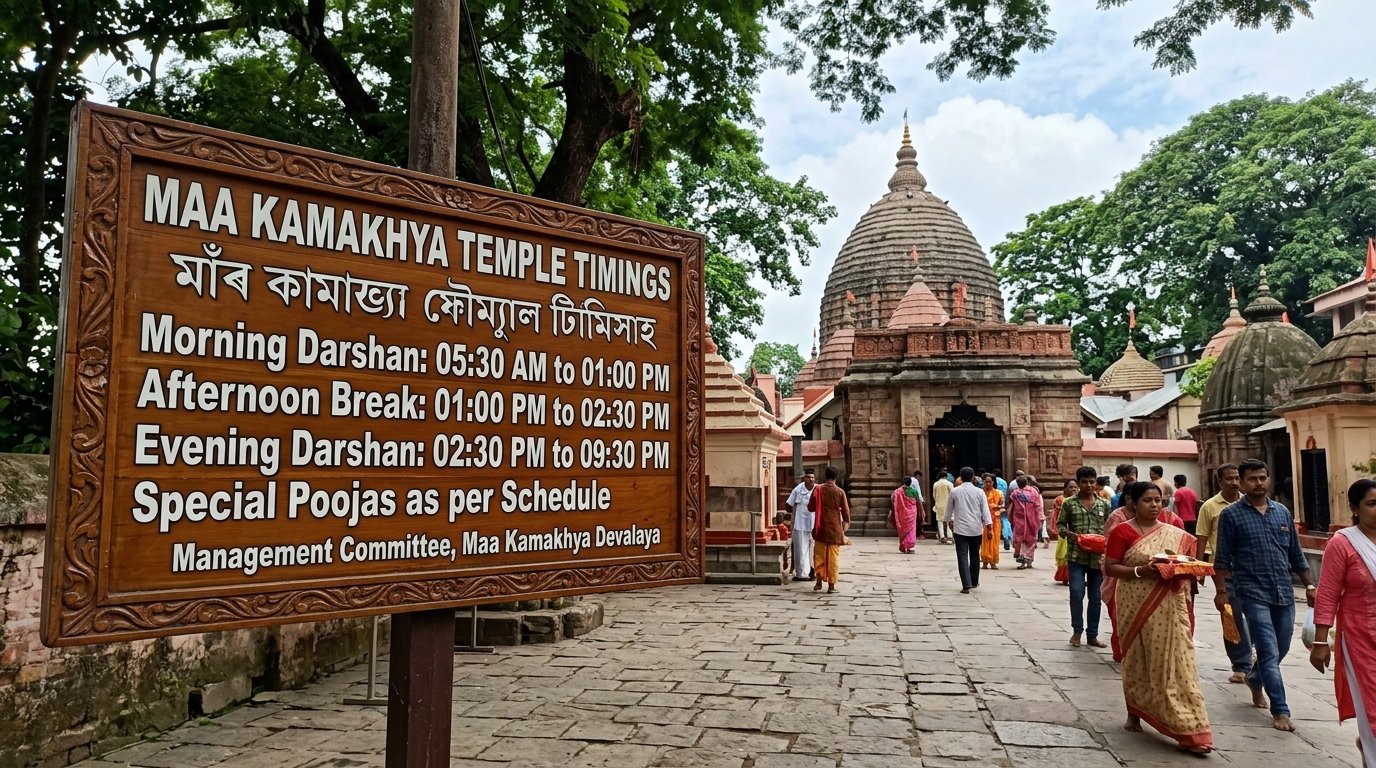
If you’ve been dreaming about a trip to Northeast India, chances are Maa Kamakhya Temple is already on your list and honestly, it should be. Tucked away on the mystical Nilachal Hill in Guwahati, Assam, this isn’t just another stop on a pilgrimage circuit.
It’s one of the oldest and most powerful Shakti Peethas in the country, and getting your Maa Kamakhya Temple timings 2026 sorted out before you go can honestly make or break your whole trip.
In this guide, we’re covering everything darshan hours, puja schedules, the VIP pass drama, festival dates, and a few things competitor blogs conveniently skip over.
Let’s be real, nobody wants to land in Guwahati at 5 AM only to realize the temple’s closed for a festival, or stand in a 7-hour queue when a VIP pass could’ve saved half your day. So grab a chai and let’s break this down properly.
The Maa Kamakhya Temple opening and closing time follows a fairly consistent daily pattern, though it does shift slightly on festival days. Generally speaking, the temple opens around 5:30 AM and remains active till late evening, with a short break in the afternoon.
Here’s a quick table so you don’t have to scroll back and forth:
| Activity | Timings |
|---|---|
| Temple Opens | 5:30 AM |
| Snana (Goddess Bathing Ritual) | 5:30 AM – 6:00 AM |
| Morning Darshan | 6:00 AM – 1:00 PM |
| Afternoon Break | 1:00 PM – 2:30 PM |
| Evening Darshan | 2:30 PM – 5:30 PM |
| Temple Closing | Around 5:30 PM – 6:00 PM (extended hours during peak season) |
Now here’s something a lot of blogs get wrong — during peak pilgrimage season and certain festival weeks, the temple actually stays open till 10:00 PM, especially to accommodate the massive crowds. So if you’re planning a visit during Navratri or a weekend, don’t just rely on the “regular” closing time, it genuinely varies.
Pro Tip: Try to reach before 6:00 AM. Not gonna lie, the crowd builds up FAST after 8 AM, and by noon you’re basically shuffling forward inch by inch.
This is probably the question we get asked the most — what exactly are the Kamakhya Temple VIP darshan timings? Unlike the general queue (which honestly can feel endless), VIP darshan slots are typically scheduled in staggered batches throughout the day, mostly between 6:00 AM and 4:00 PM, aligning with the temple’s active darshan hours.
A few things worth knowing:
If your slot says 9:00 AM, don’t roll up at 9:15 thinking it’s fine — sometimes it isn’t, and you might get pushed to the next available batch, which could mean another hour of waiting around.
Kamakhya Temple doesn’t really follow the loud, grand public aarti format you’d see at temples in North India. Instead, the spiritual energy here flows through structured tantric rituals conducted quietly by resident priests, which honestly gives the whole place a very different, almost mysterious vibe.
| Puja/Ritual | Timings |
|---|---|
| Morning Snana & Puja | 5:30 AM – 6:30 AM |
| Nitya Puja & Bhog Offering | 10:00 AM – 12:30 PM |
| Evening Rituals (Lamp Lighting & Recitation) | 3:00 PM – 4:30 PM |
Apart from these daily rituals, the temple also conducts special Kumari Puja and other tantric ceremonies on auspicious tithis throughout the year. These aren’t advertised loudly, so if you want to witness one, it’s worth asking a local priest or checking with the temple trust office when you arrive.
Honestly, if you can only witness one ritual during your trip, make it the morning Snana. There’s something genuinely different about watching that ceremony unfold in the early morning quiet — it sets a completely different tone for the rest of your day.
The Kamakhya Temple VIP pass exists for one simple reason — to save you from standing in a queue that, on a bad day, can stretch to 7-8 hours. If you’re traveling with elderly parents, young kids, or just don’t have the patience (no judgment), this is basically a lifesaver.
Here’s where a lot of online guides genuinely confuse people, so let’s clear it up. Pricing information has varied across sources, with figures ranging anywhere from ₹500 to ₹501 per person, and payment modes differing between cash-only counters at the temple and online payment gateways for pre-booked slots.
Since pricing and payment policy can be revised by the temple trust without much notice, we’d strongly recommend confirming the exact current fee directly through the official channel before your visit, rather than trusting a fixed number blindly.
ID Proof Required: Aadhaar card is the most commonly accepted ID, though a passport works fine for international visitors too.
Booking your Kamakhya Temple VIP ticket online is honestly one of the smartest things you can do before your trip, purely because it saves you the stress of arranging everything on the spot.
Here’s roughly how the process works:
This is honestly important: there’s been some inconsistency across travel blogs regarding the Kamakhya Temple official website and whether online darshan booking is even officially available. Some sources describe a detailed online portal process, while others claim there is currently no official government-run booking website and that VIP passes must be arranged through authorized temple priests or on-site counters instead.
Our honest advice? Always cross-check directly with the Kamakhya Devalaya Trust or a verified local source right before your trip. Third-party websites claiming to be “official” booking portals have popped up before, and not all of them are legitimate.
Don’t just Google “Kamakhya temple booking” and click the first link — verify it through the temple trust’s own communication channels or a trusted travel agency operating in Guwahati.
If you’re wondering about the Kamakhya Temple online booking time — meaning how far in advance you should book — here’s the general pattern based on devotee experiences:
Basically, if you know your travel dates, book the moment the window opens. Waiting till the last minute during Navratri season is just asking for disappointment.
Planning a 2026 trip? These are the dates you absolutely need on your calendar.
| Festival | Dates (2026) | Notes |
|---|---|---|
| Ambubachi Mela | June 22 – June 25 | Temple closes for the goddess’s sacred cycle, reopens with grand rituals |
| Chaitra Navratri | March 19 – March 27 | Spring Navratri; Ram Navami falls on March 27 |
| Sharad Navratri (Ashwin) | October 11 – October 20 | Major Navratri with elaborate celebrations |
| Durga Puja | October 17 – October 21 | Five-day celebration, huge devotee turnout |
| Diwali (Deepavali) | November 8 | Evening rituals and special worship |
This one deserves its own explanation because it trips up SO many first-time visitors. During Ambubachi Mela, the temple physically closes its doors for three days, symbolizing the goddess’s menstrual cycle — a period linked deeply to fertility and creation in temple mythology. Devotees are not allowed inside during this window at all, regardless of VIP pass or booking status.
The Kamakhya Temple opening time after Ambubachi Mela typically falls on the fourth day (June 25, 2026), and this reopening is a massive event in itself. Thousands of pilgrims gather for the grand reopening ceremony, so if you’re specifically planning to attend this, be prepared for extremely dense crowds, and book your accommodation months in advance.
Real talk — if you’re not specifically going for Ambubachi Mela’s spiritual significance, it might genuinely be easier (and calmer) to plan your trip around it rather than during it.
Okay, this is a section most competitor articles barely touch, and honestly it’s one of the most fascinating parts of visiting this temple. The Kamakhya Temple story goes back to Hindu mythology’s Daksha Yagna legend.
As the story goes, when Sati (Lord Shiva’s consort) immolated herself after her father Daksha insulted Shiva, a devastated Shiva carried her body across the universe in grief. To calm his rage and stop the destruction, Lord Vishnu used his Sudarshan Chakra to cut Sati’s body into pieces, which fell across different locations in the Indian subcontinent. Each of these spots became a Shakti and it’s believed that Sati’s womb and reproductive organs fell precisely at the spot where Kamakhya Temple now stands on Nilachal Hill.
This is exactly why the goddess isn’t worshipped through a traditional idol here. Instead, she’s represented by a naturally formed, yoni-shaped stone, continuously kept moist by an underground spring. → This unique worship method → establishes Kamakhya as one of the most significant fertility and creation-centric shrines in the entire Shakti Peetha network.
The temple’s current structure, with its distinct beehive-shaped shikhara, dates back to reconstruction efforts in the 16th century under King Naranarayana, after the original structure was destroyed centuries earlier. Over time, the temple became deeply associated with Tantric Hinduism, and even today, it remains an active center for tantric practitioners from across India and abroad.
Understanding this backstory genuinely changes how you experience the temple — it’s not just a “photo-stop” pilgrimage site, it’s a place layered with centuries of mythology, feminine reverence, and tantric philosophy.
Since you’re already making the trip, might as well extend it a little. Guwahati has more to offer than just the temple:
While there’s no strict enforcement, showing up in modest, traditional attire is strongly encouraged out of respect for the sanctity of the space.
Maintaining silence and cooperating with security staff isn’t just courtesy, it’s genuinely expected given how sacred this site is considered.
Getting here isn’t complicated at all, Guwahati is well-connected:
For accommodation, several guesthouses and dharamshalas near Nilachal Hill, including ones managed by the temple trust, offer budget-friendly stays for pilgrims.
The temple generally opens at 5:30 AM, with morning darshan till 1:00 PM and evening darshan from 2:30 PM to 5:30 PM, extending later during peak season.
On regular days, the temple opens around 5:30 AM and closes by 5:30-6:00 PM, though this may extend up to 10 PM during festivals.
VIP darshan is typically organized in staggered batches between 6:00 AM and 4:00 PM, with each batch limited to around 200 devotees for smoother movement.
Reported pricing ranges between ₹500-₹501 per person, but always verify the current fee through official temple sources before your visit.
There’s conflicting information on this online; some sources mention official portals while others say no government-run site exists. Confirm directly with the temple trust.
Generally, you register with mobile details, select your date and slot, enter devotee information, and complete payment through the relevant booking platform.
Slots usually open up to 7 days in advance, and popular dates fill up within hours, so early booking is strongly recommended.
The temple stays closed for three days during Ambubachi Mela and typically reopens on the fourth day, around June 25, 2026, with grand rituals.
Legend says Sati’s womb fell here after Vishnu’s Sudarshan Chakra cut her body, making this a Shakti Peetha symbolizing fertility and creation.
Early mornings (6:00-8:00 AM) and the October-March winter season offer the calmest, most pleasant darshan experience.
Yes, the temple conducts tantric rituals, Kumari Puja, and special ceremonies on auspicious tithis, alongside daily Snana and Nitya Puja.
Modest traditional attire is recommended — dhoti-kurta for men, sarees or salwar-kameez for women. Avoid shorts and sleeveless clothing.
The temple is about 7-8 km from Guwahati Railway Station and the airport; cabs, auto-rickshaws, and shared taxis are easily available.
Ambubachi Mela is scheduled from June 22 to June 25, 2026, with the temple closed initially and reopening with major celebrations.
Yes, Umananda Temple, Kamakhya Wildlife Sanctuary, Assam State Museum, and a Brahmaputra River Cruise make great add-ons to your trip.
https://templetimingsnow.com/konark-sun-temple-light-sound-show/
https://templetimingsnow.com/dwarkadhish-temple-darshan-timings/
https://templetimingsnow.com/bet-dwarka-darshan-timings/
https://templetimingsnow.com/iskcon-temple-bangalore-timings/