Physical Address
304 North Cardinal St.
Dorchester Center, MA 02124
Physical Address
304 North Cardinal St.
Dorchester Center, MA 02124

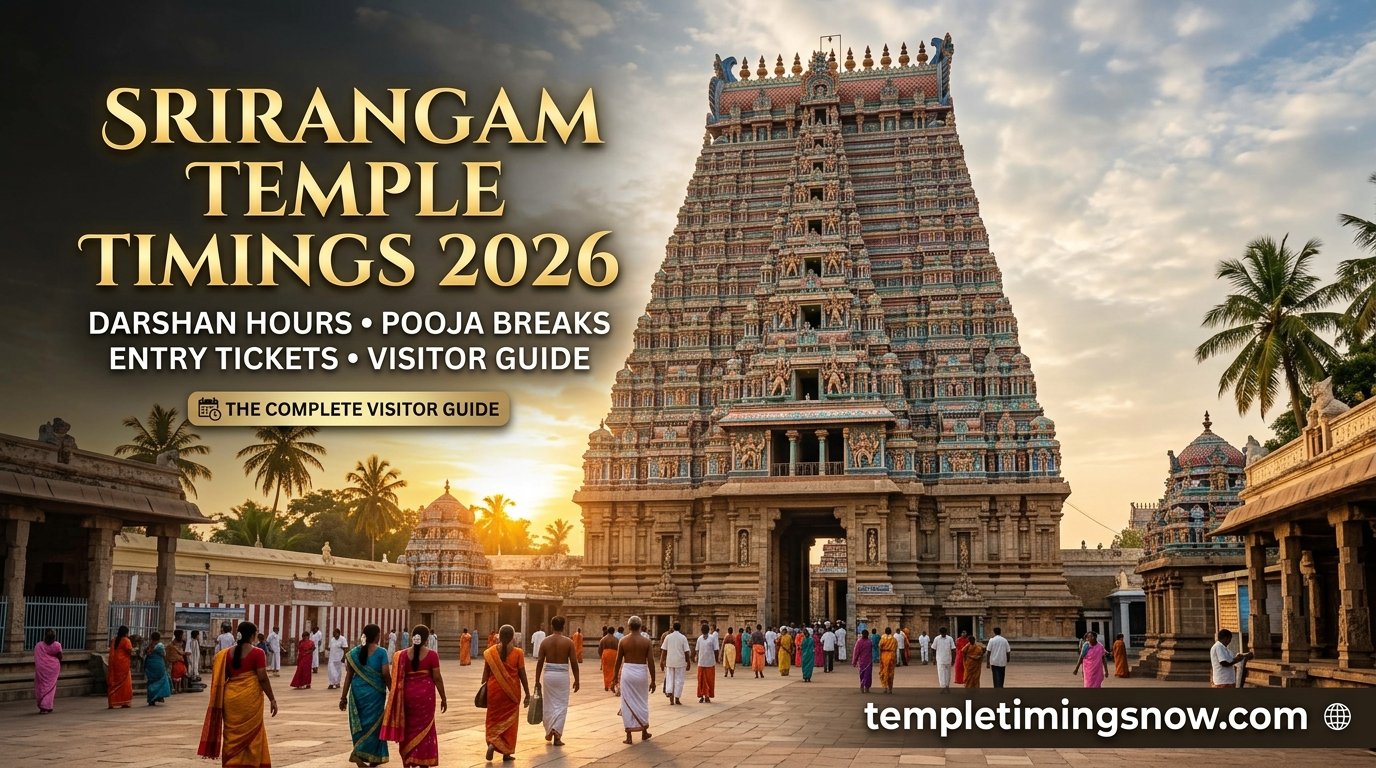
Planning a trip to the biggest functioning Hindu temple in the world and wondering when the doors actually open? Here’s the Srirangam Temple Timings 2026 guide, covering Viswaroopa Darshan, seva windows, pooja breaks, ticket prices and crowd tips for every sannathi.
]The Sri Ranganathaswamy Temple doesn’t run on one single schedule, and that’s where most devotees get confused. Let’s sort it out properly.
Quick note: Timings below are compiled from commonly published temple schedules. They can change on festival days, so double-check with the temple office or the HR&CE portal before you travel.
The temple’s first darshan, Viswaroopa Darshan, starts around 6:00 am, and no darshan happens after 9:00 pm. In between, the doors open in blocks, with short pooja breaks where seva is paused.
Here’s the general Srirangam opening time pattern for the main Viswaroopa Darshan:
| Session | Timing |
|---|---|
| Early morning | 6:00 am – 7:15 am |
| Morning | 9:00 am – 12:00 pm |
| Afternoon–evening | 1:00 pm – 6:00 pm |
| Night | 7:00 pm – 9:00 pm |
Honestly, the gaps between sessions are what trip people up. Land at 8:15 am and you might be standing outside for 45 minutes, so plan around these blocks.
The Srirangam kovil timing you see on Google, YouTube and temple blogs often don’t match. That’s because the complex has multiple shrines, and each sannathi runs its own routine. Ranganathaswamy, Ranganayaki Thayar and Chakarathalvar all follow separate seva and pooja cycles.
Another reason is the difference between darshan (viewing the deity), seva (a ritual service, free or paid) and pooja time (when the sanctum is closed for rituals).
Websites mix these three terms up all the time. When you see “pooja time – no seva”, it means the garbhagriha is being prepared and general darshan stops for a while, not that the temple is closed for the day.
The Sri Ranganathaswamy Sannathi opens at 6:00 am with Viswarooba Seva and keeps running in segments until 9:00 pm. The main deity, Lord Ranganatha reclining on Adisesha, is the heart of the complex.
| Seva | Timing |
|---|---|
| Viswarooba Seva | 6:00 am – 6:30 am |
| Seva | 6:30 am – 7:30 am |
| Pooja time (no seva) | 7:30 am – 8:45 am |
| Morning Seva | 8:45 am – 1:00 pm |
| Pooja time (no seva) | 1:00 pm – 2:30 pm |
| Afternoon Seva | 2:30 pm – 4:15 pm |
| Pooja time (no seva) | 4:00 pm – 5:30 pm |
| After 9:00 pm | No seva |
You may notice the afternoon seva (till 4:15 pm) overlaps with the next pooja break (from 4:00 pm). This is a small inconsistency in the published schedule itself. In practice, the queue usually gets stopped at 4:00 pm sharp, so don’t push your luck by arriving at the last minute.
The Thayar shrine, dedicated to Ranganayaki Thayar (Goddess Lakshmi), keeps a more detailed paid and free seva system. Viswarooba paid seva runs from 6:30 am to 7:15 am, followed by the free Viswarooba seva until 8:00 am. After a pooja break from 8:00 to 8:45 am, paid seva continues through the morning until 12:00 pm, then free seva takes over until 1:00 pm.
The afternoon break runs 1:00 pm to 3:00 pm. Free seva returns from 3:00 to 4:00 pm, paid seva from 4:00 to 6:00 pm, and then a short pooja gap from 6:00 to 6:45 pm. The evening has paid seva from 6:45 to 8:00 pm and free seva from 8:00 to 9:00 pm. Nothing after 9:00 pm.
The general Viswaroopa Darshan windows listed for Thayar are 6:30–8:00 am, 9:00 am–1:00 pm, 3:00–6:00 pm and 6:45–9:00 pm. A special entrance ticket here costs just Rs. 10 per head, which is honestly a bargain if you have a time crunch.
Sri Chakarathalvar Sannathi is open for morning seva from 7:00 am to 9:30 am and evening seva from 6:00 pm to 9:00 pm. There’s a pooja break (no seva) from 6:45 to 7:00 am, and the day wraps up with Mangala Arathi between 9:00 pm and 9:10 pm.
Another listing shows Chakarathalwar Viswaroopa Darshan windows as 6:15–7:30 am, 8:45 am–1:00 pm, 3:00–6:00 pm and 6:45–9:00 pm. If you’re keen on catching the Mangala Arathi, be inside the shrine premises by 8:45 pm, not later.
There’s no fixed rule that says the temple is “closed” on any particular weekday; it’s open every day, with festival-day adjustments. So if you’re typing “Srirangam temple open today” or “Srirangam temple open timings today” into Google, the answer is almost always yes, but the hours can shift.
For today Srirangam temple timings, the standard pattern above applies unless there’s a festival, an eclipse, or a special utsavam going on. During eclipses, for instance, temples commonly alter or close darshan for several hours.
If you’re searching tomorrow Srirangam temple timings or Srirangam temple timings tomorrow, check three things before heading out: is tomorrow a major festival day, an Ekadasi or Amavasya, or a public holiday?
Any of these can push crowds up and change the schedule. A quick phone call to the temple office is the most reliable way, since websites aren’t always updated on time.
Fridays are special for Thayar, the goddess shrine, so expect more devotees (especially women) at the Ranganayaki Thayar Sannathi. The standard seva timings apply, but the Thayar queue can be noticeably longer in the evening. Go in the morning if you want a calmer experience.
Saturdays are busy because the Perumal tradition treats Saturday as an auspicious day for Vishnu worship. The Srirangam temple timings Saturday are the same as the standard schedule, but darshan time stretches. Weekend visits can take 60 to 90 minutes compared to 30 to 45 minutes on weekdays.
The Srirangam temple timings Sunday also follow the regular pattern. Sunday is peak for local families and tour groups from across Tamil Nadu, and the temple can feel packed from about 10 am onward. Reach before 7 am if possible, or choose the Rs. 50 special entrance.
Darshan typically takes 30 to 45 minutes on weekdays and 60 to 90 minutes on weekends. That’s just the darshan though. If you want to see the gopurams, the thousand-pillar hall and the other mandapams, set aside 3 to 4 hours at least.
The best time to visit Srirangam is from September to the first week of June, when the weather is more bearable. Summer in Trichy can get properly hot, and walking barefoot on the stone floors in midday sun is no joke. Early morning slots or the evening window are the most comfortable.
During Dhanurmasam (the Tamil month of Margazhi, roughly mid-December to mid-January), the temple’s schedule changes. Early morning rituals begin much earlier, and the Adhyayana Utsavam (the grand 21-day festival) dominates the calendar. It includes the famous Vaikunta Ekadasi celebrations, when the Paramapada Vasal (the north gate) opens for devotees.
Don’t assume the usual 6:00 am start applies during this period. Dhanurmasam darshan hours often begin earlier and the programme varies each day, so check the festival schedule published by the temple for the exact year.
Purattasi (mid-September to mid-October) is considered extremely sacred for Perumal worship, especially the Saturdays. Many families visit Srirangam during this month, so crowd levels are noticeably higher on all four Saturdays.
The Srirangam temple timings in Purattasi month are broadly the same as the regular schedule, but queue times can run longer than a typical weekend. Arrive early, carry water, and be patient.
The general entrance to Srirangam is free during all seva times, while special entrance costs Rs. 50 per head at the main sannathi and Rs. 10 per head at Thayar. Viswarooba Seva, the very early morning one, is ticketed at Rs. 200 per head.
| Type | Where | Cost |
|---|---|---|
| General entrance | All sannathis | Free |
| Special entrance | Ranganathaswamy | Rs. 50 |
| Special entrance | Ranganayaki Thayar | Rs. 10 |
| Viswarooba Seva | Ranganathaswamy | Rs. 200 |
People often search Srirangam temple timings online booking hoping to reserve a slot. Tamil Nadu’s HR&CE department runs an official portal for many temple services and some special darshan tickets, and Srirangam has had online facilities for certain sevas and festival entries.
Since options get updated from time to time, please verify on the official HR&CE website or the temple’s notice board before paying anywhere. Avoid third-party agents who charge extra fees; this happens quite often around Vaikunta Ekadasi.
For Srirangam temple timings for senior citizens, there’s no separate published window as far as the common schedules show, but the special entrance (Rs. 50, or Rs. 10 at Thayar) is the practical choice, since the queue is far shorter.
The temple complex is huge, with long walks and uneven stone floors. Visit on a weekday morning, ask the staff at the entrance about wheelchair or assistance options, and take frequent rest stops. Policies may change, so confirm locally.
The dress code at Srirangam is simple: wear any decent outfit. Traditional wear like sarees, dhotis, salwar kameez and kurtas is the norm, and many visitors choose it anyway. Shorts, sleeveless tops and ripped clothes are best avoided.
Useful facilities worth knowing:
Remember you’ll be barefoot most of the time, so bring cotton socks for the hot parts in summer if the temple allows it, otherwise keep a wet cloth to cool your feet.
Vaikunta Ekadasi, Vaikunta Dwadasi, the annual festival days, Tamil New Year, 1st January and 2nd January drive the biggest crowds and alter standard timings. The timings published for normal days don’t hold at these times.
The gaps competitors leave here are the ones that matter most, so here are some practical tips:
Expect queue waits of several hours on Vaikunta Ekadasi itself. That’s not an exaggeration, so mentally prepare for it.
When people search Trichy Srirangam temple darshan timings, they usually also want travel info. Srirangam Temple lies about 7 km from Tiruchirapalli, the nearest major city and the usual gateway.
Also worth noting, local buses from Chathiram bus stand head to Srirangam regularly, and autos are easy to find. If you’re driving, expect parking to be tough on festival days, so park a bit farther and walk.
Pooja time suspends seva and darshan temporarily so that daily rituals can happen inside the sanctum. At the Ranganathaswamy Sannathi these breaks fall roughly between 7:30–8:45 am, 1:00–2:30 pm and 4:00–5:30 pm. At Thayar, they run 8:00–8:45 am, 1:00–3:00 pm and 6:00–6:45 pm.
A practical rule: reach each shrine at least 20 to 30 minutes before a session closes. Queue cut-offs are usually enforced before the official time, especially in the last session before 9:00 pm. If you only have one evening, prioritise the main sannathi first, then Thayar, then Chakarathalvar.
Sort out your plan before you go and you’ll save yourself a lot of stress. Start with the Ranganathaswamy darshan, because it’s the main attraction, then go to the Thayar shrine and finish with Chakarathalvar if time permits.
Carry a water bottle, wear light cotton clothes and keep a small pouch for slippers tokens. And please, don’t ignore the posted notices; temple staff change the queue direction quite often, and following their guidance saves everyone time.
Many visitors combine Srirangam with other Trichy-area temples such as the Jambukeswarar Temple at Thiruvanaikaval and the Samayapuram Mariamman Temple.
Both are within an hour’s drive, so a full-day or two-day itinerary works well. Check each temple’s own timings separately because they differ.
The temple generally opens around 6:00 am with Viswaroopa Darshan and closes darshan at 9:00 pm, with pooja breaks in between. Festival days can change this, so confirm with the temple office.
Yes, Srirangam temple is open every day of the year, with sessions split by pooja breaks. Hours may vary on festivals, eclipses or special utsavams, so verify locally before leaving.
Viswaroopa Darshan usually runs 6:00–7:15 am, 9:00 am–12:00 pm, 1:00–6:00 pm and 7:00–9:00 pm. The ticketed Viswarooba Seva at the main shrine costs Rs. 200 per head.
No darshan or seva happens after 9:00 pm at any shrine. Chakarathalvar Sannathi ends with Mangala Arathi from 9:00 to 9:10 pm, so arrive before 8:45 pm.
Darshan takes about 30 to 45 minutes on weekdays and 60 to 90 minutes on weekends. Festival days can stretch to several hours, so plan extra time accordingly.
September to the first week of June is considered best because of comfortable weather. Weekday mornings and evenings usually have smaller crowds than weekends or festival periods.
Any decent outfit is accepted. Traditional clothing like sarees, dhotis and kurtas is preferred, and shorts, sleeveless tops or revealing clothes should be avoided inside the temple complex.
Special entrance costs Rs. 50 per head at the Ranganathaswamy Sannathi and Rs. 10 per head at the Thayar Sannathi. General entrance is free during all seva times.
Some sevas and special entries can be booked via the official HR&CE Tamil Nadu portal. Availability changes, so verify on official websites and avoid unauthorised agents charging extra.
Dhanurmasam, or Margazhi, brings an altered schedule with earlier morning rituals and the Adhyayana Utsavam. Exact timings vary each year, so check the temple’s published festival programme.
Regular timings generally apply, but Purattasi Saturdays draw heavy crowds because of their Perumal significance. Expect longer queues and arrive early in the morning for a smoother darshan.
No separate window is widely published. Seniors usually prefer the Rs. 50 special entrance, weekday mornings and staff assistance. Please confirm any current facilities with the temple office before visiting.
Srirangam is roughly 7 km from Tiruchirapalli city. Buses, autos and taxis connect the two, and the airport and railway junction are both within a short drive.
Yes, a cloakroom is available near the Garuda Mandabam for bags and footwear. Temple guesthouses are also located near the main entrance for pilgrims wanting to stay close.
Vaikunta Ekadasi, Vaikunta Dwadasi, annual festival days, Tamil New Year, 1st and 2nd January, and weekends (especially Purattasi Saturdays) see the heaviest crowds and altered timings.