Physical Address
304 North Cardinal St.
Dorchester Center, MA 02124
Physical Address
304 North Cardinal St.
Dorchester Center, MA 02124

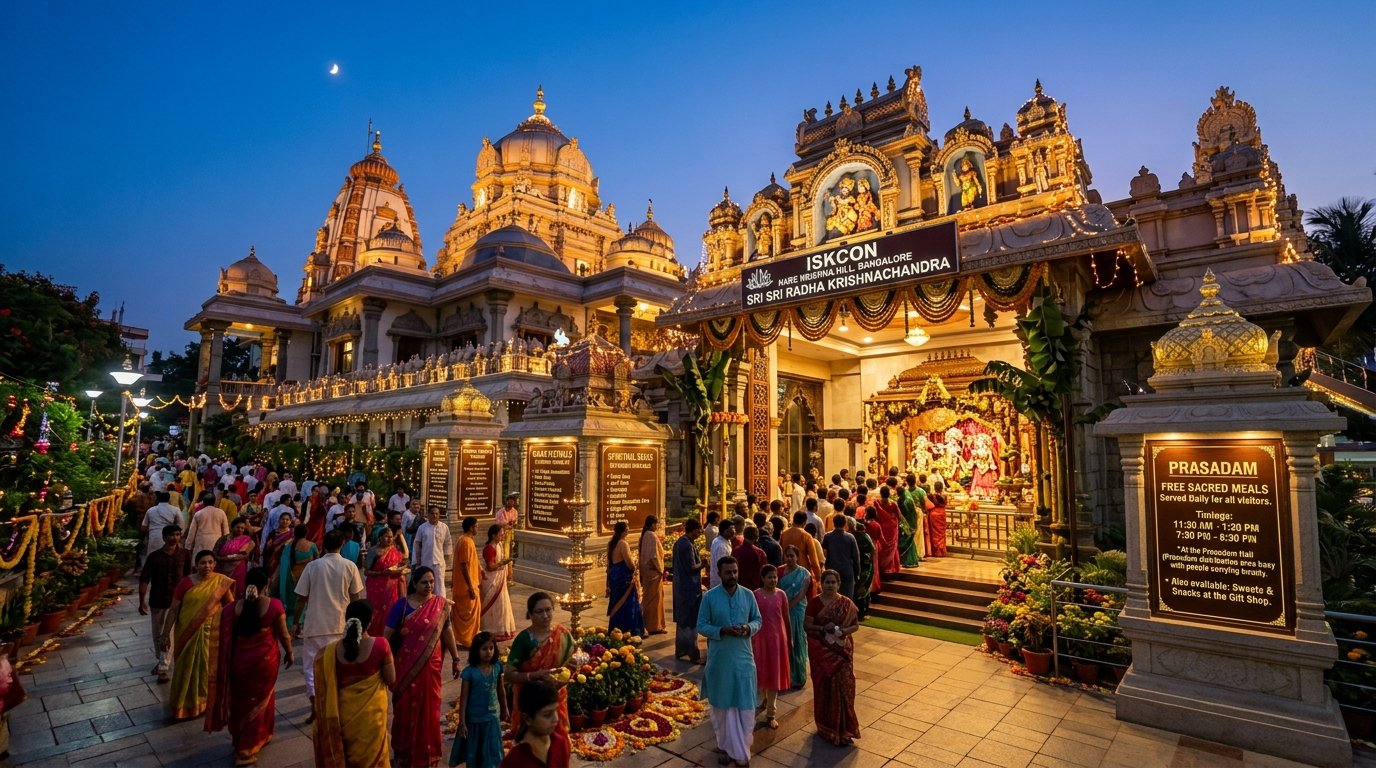
If you’re planning a visit and searching for ISKCON Temple Bangalore timings, festivals, sevas, darshan, prasadam guide, you’ve landed in the right place.
Honestly, this temple isn’t just another tourist stop on your Bangalore itinerary its a full-blown spiritual experience that pulls in lakhs of devotees every single year, and if you don’t plan your visit properly, you might end up standing in a long queue or missing the darshan window entirely.
Perched on Hare Krishna Hill in Rajajinagar, the ISKCON Temple Bangalore (officially the Sri Radha Krishna Temple) is one of those places where devotion, architecture, and community service quietly come together.
Whether your headed there for a quick morning darshan, a festival like Janmashtami, or you’re just curious about the seva timings, we’ve packed everything into this one guide so you don’t have to hunt across ten different websites.
Let’s get into it.
The ISKCON Temple Bangalore, also referred to as the Sri Radha Krishna Temple, is one of the most visited Krishna temples in South India. It’s run under the guidance of Sri Madhu Pandit Dasa, a senior ISKCON leader who has literally shaped the temple’s growth from a small gathering into the massive institution it is today.
Sri Madhu Pandit Dasa → designed and leads → ISKCON Temple Bangalore, and this relationship matters because it explains why the temple’s architecture blends modern engineering with traditional temple design — he’s trained as a civil engineer, not just a spiritual guide.
The temple was inaugurated on 31 May 1997 by the former President of India, Dr. Shankar Dayal Sharma. This wasn’t a small local event, it was actually a milestone for the entire spiritual landscape of Bengaluru. Since then, the temple has grown into a hub for Krishna Consciousness, rooted in the teachings of the Bhagavad Gita and Srimad Bhagavatam.
What makes ISKCON Bangalore stand apart isn’t just the darshan or the beautiful deities — its the way education, charity, and culture are woven into daily temple life. You’ll find spiritual talks, public kirtans, youth programs, and one of the largest food distribution networks in the country operating right out of this temple.
The ISKCON Temple Bangalore opens at 4:15 AM and closes at 8:20 PM daily, with a short midday break between the morning and evening darshan sessions. These timings stay largely consistent through the week, though weekends see the temple open for slightly longer to manage bigger crowds.
| Day | Morning Timings | Day Darshan Timings | Evening Timings |
|---|---|---|---|
| Monday to Sunday | 4:15 AM – 5:00 AM | 7:15 AM – 1:00 PM | 4:15 PM – 8:20 PM |
If your searching for iskcon temple opening time in bangalore, remember that early morning slots (right around Mangala Arati) are usually the least crowded, so if you hate queues, that’s your best bet.
Sunday darshan at ISKCON Bangalore usually stretches from 7:15 AM straight through to 8:20 PM, without the usual midday gap you’ll see on weekdays. This is because Sundays bring in massive footfall — families, tourists, and devotees combine into one huge crowd, so the temple management keeps the doors open continuously to avoid bottlenecks at the entrance.
If you’re planning your visit for a Sunday, honestly go early. Like before 8 AM early. After 10 AM the queue outside can genuinely take 45 minutes to an hour, especially near the main sanctum.
Saturday follows a similar extended pattern to Sunday. The early morning session runs from 4:30 AM to 5:20 AM, and then darshan continues from 7:15 AM to 8:20 PM without a break. Public holidays follow this exact same weekend schedule too, so if a festival falls on a weekday, expect these longer hours instead of the usual weekday split.
To make things dead simple, here’s the weekend vs weekday timing comparison:
The key takeaway here — weekend darshan → runs continuously → without the midday closure that weekdays have. This is intentional, as the temple management wants to avoid overcrowding at reopening time.
A lot of visitors search iskcon temple bangalore timings tomorrow, especially if their trip is planned last-minute. Here’s a practical tip: unless tomorrow happens to fall on a major festival day (Janmashtami, Ratha Yatra, Gaura Purnima, etc.), the timing will simply follow the regular weekday or weekend pattern based on what day it is.
During festival periods though, the temple often extends its evening hours well past 8:20 PM, sometimes up to 10 PM or later, to accommodate the extra crowd. It’s always smart to give the temple office a quick call before heading out if you’re visiting during a festival window.
The ISKCON Temple Bangalore is located at Hare Krishna Hill, Chord Road, Rajajinagar, Bengaluru, Karnataka – 560010. This location, sitting on a hilltop, gives the temple a naturally elevated and peaceful setting away from the noise of the city streets below, even though its actually quite centrally located.
Getting here is fairly straightforward regardless of which part of Bangalore you’re coming from:
If you’re wondering about the iskcon temple bangalore timings metro station, here’s the useful bit — the temple itself doesn’t have timings tied to metro operations obviously, but the nearest metro connectivity does affect how early or late you can comfortably plan your visit.
The Bangalore Metro’s Purple Line serves stations reasonably close to Rajajinagar, and metro trains typically start around 5 AM and run till about 11 PM on regular days.
So if you’re relying on the metro plus a short auto ride, you’ll comfortably make it in time for even the early Mangala Arati at 4:15 AM — though you might need a cab for that very first slot since metro services haven’t started running yet at that hour.
Not many visitors realize there’s actually a second major ISKCON center in Bengaluru — the ISKCON Vaikuntha Hill (Sri Rajadhiraja Govinda Temple), located in Vasanthapura on Kanakapura Road. This temple worships Lord Venkateswara and is built in a traditional stone-carved Dravidian architecture style, which honestly gives it a very different vibe compared to the Rajajinagar temple.
| Detail | Information |
|---|---|
| Temple Name | ISKCON Vaikuntha Hill (Sri Rajadhiraja Govinda Temple) |
| Main Deity | Lord Venkateswara (Sri Rajadhiraja Govinda) |
| Location | Vasanthapura, Kanakapura Road, Bengaluru |
| Opening Hours | 4:15 AM–1:00 PM and 4:15 PM–8:30 PM daily |
| Nearest Metro | Vajarahalli Metro Station (~3.5 km) |
| Food & Prasadam | Govinda’s pure vegetarian restaurant |
This location is a good option if you want a less crowded, more peaceful darshan experience, since most tourists and first-timers head straight to the Rajajinagar temple instead.
Some visitors get confused between “ISKCON Bangalore” and a supposed “ISKCON Temple Yeshwanthpur,” largely because Yeshwanthpur is a well-known railway and transport hub near Rajajinagar.
To clarify — there isn’t a separate, distinct ISKCON temple branded specifically as “Yeshwanthpur.” What people are usually referring to is the main ISKCON Sri Radha Krishna Temple on Hare Krishna Hill, which is accessible via Yeshwanthpur as a nearby railway/transit point.
So if you’re searching for timings “today,” the answer is the same daily schedule listed above — 4:15 AM to 8:20 PM, with the weekday/weekend variation. Always double check with the official ISKCON Bangalore contact numbers if you’re unsure, since local naming confusion is pretty common with such a large temple complex.
Sevas at ISKCON Temple Bangalore → begin with Mangala Arati at 4:15 AM → and conclude with Shayana Arati at 8:15 PM, forming a continuous cycle of worship throughout the day. Each seva has its own spiritual significance, and devotees are welcome to participate in most of them.
| Seva / Ritual | Time |
|---|---|
| Mangala Arati | 4:15 AM |
| Tulasi Puja | 4:45 AM |
| Narasimha Arati | 5:00 AM |
| Suprabhata Seva | 5:10 AM |
| Japa Meditation and Puja | 5:20 AM |
| Shringara Darshana Arati | 7:15 AM |
| Bhagavatam Discourse | 8:30 AM |
| Rajbhog Arati | 12:30 PM |
| Dhupa Arati | 4:15 PM |
| Evening Tulasi Puja | 6:45 PM |
| Sandhya Arati | 7:00 PM |
| Shayana Arati | 8:15 PM |
Some special sevas — particularly around Janmashtami, Ratha Yatra, and Gaura Purnima — require prior booking. We’ll cover exactly how that booking process works in the next section, since most guides tend to skip over this bit entirely.
Most articles just say “sevas require registration” and leave it at that, which honestly isn’t very helpful if you’re actually trying to book one. Here’s how it typically works:
Tip: Book at least a week in advance if you’re targeting a festival date like Janmashtami — slots fill up fast.
Festivals at ISKCON Bangalore → trigger extended darshan hours → and bring in the temple’s biggest crowds of the year. Each festival is tied to a specific event from Krishna or Chaitanya’s life, and the temple goes all out with decorations, kirtans, and free prasadam distribution.
Some of the major festivals include:
During these festival days, expect the temple to remain open well beyond its usual 8:20 PM closing time. Janmashtami in particular can see the temple buzzing till midnight, with special abhishekas and continuous kirtan sessions.
ISKCON Bangalore → operates → the Nitya Annadanam program → in partnership with the Akshaya Patra Foundation, which is genuinely one of the most impressive parts of this temple’s mission. Every single day, the temple serves free nutritious vegetarian meals to visitors and, through Akshaya Patra, to millions of underprivileged schoolchildren across India.
| Program | Timing |
|---|---|
| Nitya Annadanam Lunch | 11:30 AM – 2:00 PM |
Beyond the free meals, there’s also the Krishnamrita prasadam counter, where devotees can get sanctified food, and Govinda’s — a popular pure vegetarian restaurant run by ISKCON that serves proper meals if you want something more substantial after darshan.
The temple houses several beautifully adorned deities, each carrying its own spiritual weight:
| Deity | Significance |
|---|---|
| Sri Radha Krishnachandra | Main deities symbolizing love and devotion |
| Sri Krishna Balarama | Represents brotherhood and strength |
| Sri Nitai Gauranga | Forms of Lord Chaitanya and Nityananda |
| Sri Srinivasa Govinda | A revered form of Lord Vishnu |
| Sri Prahlada Narasimha | Protector of devotees |
This is honestly one of the most overlooked parts of temple-visit planning, and its something we felt needed proper coverage. Here’s what you should know before stepping into ISKCON Temple Bangalore:
Following these simple etiquette points goes a long way in making your visit smoother and honestly, more respectful too.
The best time to visit ISKCON Bangalore is either during major festivals for peak spiritual energy, or early mornings for a quiet, less crowded darshan. If your someone who enjoys the buzz of large gatherings, devotional music, and festive decorations, plan your trip around Janmashtami, Ratha Yatra, or Deepotsava. But if peace and quiet meditation time is more your thing, weekday early mornings (right around Mangala Arati) or weekday evenings work best.
Since you’re already in the area, its worth combining your temple visit with a bit of sightseeing:
Temple Address: Hare Krishna Hill, Chord Road, Rajajinagar, Bengaluru, Karnataka – 560010
Contact Numbers: 080 2347 1956 | 080 2357 8346
If you’re travelling from out of town, here are some accommodation options close to the temple:
Most of these hotels offer easy access to both the temple and Bengaluru’s main city transport routes.
ISKCON’s journey in Bangalore actually started way back in 1978, when it was officially registered under the Karnataka Societies Registration Act, though real momentum only picked up around 1987.
Finding a suitable spot for a permanent temple wasn’t easy — devotees faced multiple setbacks before Hare Krishna Hill in Rajajinagar was finally selected.
Construction began in 1990 and continued for nearly seven years, with more than 600 skilled workers and artisans contributing to what eventually became the grand structure standing today.
Sri Madhu Pandit Dasa, along with chief designer Sri Jagat Chandra Dasa, planned the temple’s unique blend of modern engineering and traditional Vaishnava temple architecture.
Today, the temple stands as far more than just a place of worship — its a genuine symbol of persistence, faith, and community effort.
The temple is open daily from 4:15 AM to 5:00 AM, 7:15 AM to 1:00 PM, and 4:15 PM to 8:20 PM, with extended weekend hours.
No, entry is completely free for all visitors, though donations for sevas and prasadam are optional and welcomed.
On Sundays, darshan runs continuously from 7:15 AM to 8:20 PM, without the usual weekday midday break.
Saturday follows the same extended weekend schedule — early morning session, then continuous darshan from 7:15 AM to 8:20 PM.
Timings follow the standard weekday or weekend pattern unless a major festival falls on that date, in which case hours extend further.
The temple is located at Hare Krishna Hill, Chord Road, Rajajinagar, Bengaluru, Karnataka – 560010.
There isn’t a separate branded “Yeshwanthpur temple” — this typically refers to the main Rajajinagar ISKCON Temple, accessible via Yeshwanthpur transit points.
While not directly at the temple, nearby metro connectivity via the Purple Line makes it reasonably accessible for most darshan timings except the earliest morning slot.
Main deities include Sri Radha Krishna, Krishna Balarama, Nitai Gauranga, Srinivasa Govinda, and Prahlada Narasimha.
Key festivals include Janmashtami, Gaura Purnima, Ratha Yatra, Radhashtami, Deepotsava, and Govardhana Puja.
Yes, devotees can join sevas like Mangala Arati, Tulasi Puja, and meditation sessions; some festival sevas require prior online or in-person registration.
Festival seasons like Janmashtami and Ratha Yatra offer peak spiritual energy, while early mornings are best for quiet, peaceful darshan.
Yes, the temple runs Nitya Annadanam meals daily from 11:30 AM to 2 PM and partners with the Akshaya Patra Foundation for mid-day meal programs.
No, photography is not permitted inside the main sanctum, though some outer courtyard areas may allow it with permission.
It combines spiritual worship, education, cultural events, and large-scale charity, making it one of the most complete devotional experiences in India.