Physical Address
304 North Cardinal St.
Dorchester Center, MA 02124
Physical Address
304 North Cardinal St.
Dorchester Center, MA 02124

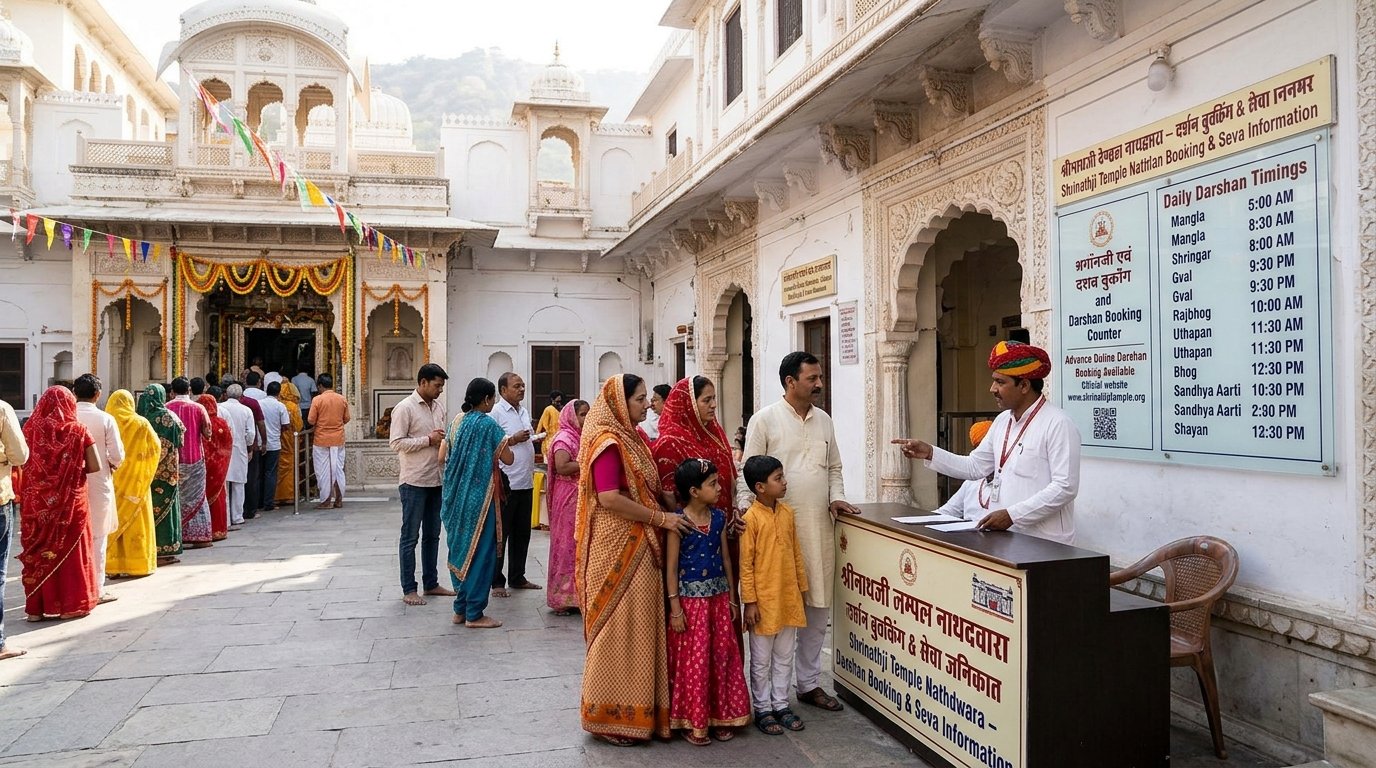
If you’re planning a trip to Shreenathji Nathdwara and you’re a bit confused about how the whole darshan booking thing works, honestly, you’re not alone. Every year lakhs of devotees make their way to this small temple town in Rajasthan, and every year the same questions pop up what’s today’s timing, how do I book online, is there a VIP option, and so on.
This guide is basically an attempt to answer all of that in one place, so you don’t have to go hunting across five different websites before your trip.
Shrinathji Temple Nathdwara darshan booking in 2026 has become a lot more structured than it used to be a few years back, mainly because the crowd numbers have gone up massively.
So whether you’re coming from Udaipur, Ahmedabad, Mumbai or literally anywhere else in India, getting your darshan slot sorted in advance can save you a good few hours of standing around. Let’s get into the details.
The temple generally opens for the first Jhanki — Mangala Darshan — around 5:30 AM, and the last one, Shayan Jhanki, closes by roughly 7:30 PM. That said, timings can shift a little depending on the season and whether there’s a festival happening, so treat “today’s” timing as indicative rather than fixed in stone.
Devotees searching for “nathdwara darshan today” or “shrinathji nathdwara darshan timing today” should always cross-check with the temple’s official notice board or website the morning of their visit, because sometimes a Jhanki gets pushed by 15-20 minutes without much notice.
The entire darshan system at Shrinathji Temple revolves around eight daily Jhankis. Each one represents a part of the deity’s daily “routine,” almost like he’s a living child being cared for — waking up, getting dressed, eating, resting, and so on. It’s quite a unique concept actually, not something you see at most other temples in India.
| Jhanki Name | Approx. Timing | What It Represents |
|---|---|---|
| Mangala Darshan | 5:30 AM – 6:30 AM | Early morning awakening |
| Shringar Jhanki | 7:15 AM – 8:00 AM | Adornment and decoration |
| Gwal Jhanki | 9:15 AM – 9:45 AM | Departure for cow grazing |
| Rajbhog Jhanki | 11:15 AM – 12:15 PM | Main midday bhog offering |
| Utthapan Jhanki | 3:30 PM – 4:00 PM | Waking after afternoon rest |
| Bhog Jhanki | 4:30 PM – 5:15 PM | Evening food offering |
| Sandhya Aarti | 5:15 PM – 6:00 PM | Evening prayer darshan |
| Shayan Jhanki | 6:45 PM – 7:30 PM | Night rest darshan |
Jhanki timings → directly determine → when devotees can enter for darshan, since entry is only allowed within these specific windows and gates close in between. This is one thing a lot of first-timers get wrong — they show up expecting the temple to be “open all day” like a regular tourist spot, and it’s honestly not like that at all.
If you’re checking tomorrow nathdwara darshan timing, the schedule usually stays the same as the table above unless there’s a special seva or festival scheduled. During Janmashtami, Holi, or Annakut week especially, timings can be extended or shifted, sometimes by an hour or more, to manage the extra footfall.
A question we see a lot is about nathdwara darshan timings on Sunday specifically. Sundays tend to be busier than weekdays because a lot of people club it with a weekend trip, but the Jhanki schedule itself doesn’t really change it’s the same eight sessions.
What does change is the crowd size, so if you’re going on a Sunday, get there at least 45 minutes before Mangala or Rajbhog darshan, or you’ll be standing in a fairly long queue.
For those who’d rather skip the general crowd, VIP Darshan at Shrinathji Temple offers a quicker, calmer way to experience the deity up close. It’s not free, but for many devotees, especially elderly ones or those travelling with kids, it’s worth the extra cost.
Some of the popular seva options include:
VIP Darshan and Seva bookings → become extremely popular → during festivals and weekends, mainly because they let devotees bypass the longest queues. That said, availability is genuinely limited, and temple staff do reserve the right to close bookings early if there’s too much demand on a given day.
Here’s roughly what you can expect to pay, though do keep in mind these figures move around depending on season and festival dates:
| Darshan / Seva Type | Approximate Charges |
|---|---|
| Regular Darshan | Free |
| VIP Darshan | ₹300 – ₹500 per person |
| Online Booking Fee | ₹50 – ₹100 |
| Special Group Ticket (up to 5 persons) | ₹1,100 |
A quick note on nathdwara darshan booking charges — regular darshan has always been, and continues to be, free of cost for every devotee. It’s really only the VIP and seva options that involve any payment, and even those are structured more as donations than “tickets” in the commercial sense.
Online darshan booking remains the safest and most recommended route in 2026, particularly if you’re travelling from out of state and can’t afford your trip going sideways because of a full-house day.
Shrinathji Temple Trust → officially manages → both online and offline darshan booking channels, and the only website you should be using is the official one: 👉 nathdwaratemple.org. Avoid third-party agents or random booking apps that claim “guaranteed slots” — there have been cases of devotees getting misled this way.
Here’s the process, broken down:
Online booking → significantly reduces → waiting time and last-minute uncertainty, which is honestly the whole point of doing it in advance rather than winging it.
If you didn’t plan ahead — which happens, life gets busy — offline booking counters are available right near the temple complex. This works fine on regular weekdays, but on festival days these counters often run out of slots by mid-morning, so it’s a bit of a gamble.
Festival days such as Janmashtami, Holi, and Annakut → increase → crowd volume and, in turn, push up the demand for both online and offline slots. If your travel dates happen to fall on one of these, book online well in advance, don’t leave it to chance.
You’ll need to carry:
Valid ID proof combined with the booking slip → acts as → the mandatory verification needed for temple entry, and skipping this, especially for VIP slots, can genuinely get you turned away at the gate.
This is a part most guides gloss over, but honestly it matters a lot for planning your trip properly.
By Air: The nearest airport is Udaipur (Maharana Pratap Airport), roughly 48 km away — about a 1 to 1.5 hour drive depending on traffic. From there, taxis and shared cabs run regularly to Nathdwara.
By Rail: The closest railway station is also Udaipur, well-connected to major cities like Delhi, Mumbai, Ahmedabad, and Jaipur. There are also smaller stations closer to Nathdwara but with far fewer trains stopping.
By Road: Nathdwara sits on National Highway 8 (now part of NH48), making it an easy drive from Udaipur (about an hour), and a reasonably long but doable drive from Ahmedabad (around 4-5 hours) or Jaipur (roughly 6 hours). State transport buses and private operators both run frequent services.
Local Transport: Once you’re in Nathdwara, auto-rickshaws and e-rickshaws are the easiest way to get around, and most hotels/dharamshalas are within a short ride of the temple.
A few things devotees run into fairly often while booking online:
For devotees who cannot travel, Shrinathji live darshan app options and nathdwara live darshan today streams have become genuinely popular over the last couple of years. Several official and semi-official channels now stream select Jhankis live, which is honestly a nice option for elderly devotees or those living abroad who still want that daily connection.
That said, live streaming is not a replacement for physical darshan when it comes to booking your visit — it’s more of a supplementary option, and quality/availability can vary depending on the source you’re using.
To respect the sanctity of the temple, a few rules are strictly enforced:
For a peaceful experience, weekdays (Monday to Thursday) combined with early morning Jhankis like Mangala Darshan tend to be the quietest. If you want the festival atmosphere instead, Janmashtami, Annakut, and Holi bring huge devotional energy but also very heavy crowds — so pick based on what kind of experience you’re after.
Weather-wise, October to March is ideal since Rajasthan summers can get brutally hot, and standing in outdoor queues in May-June isn’t fun for anyone.
| Accommodation Type | Distance from Temple | Best Suited For |
|---|---|---|
| Dharamshalas | Walking distance | Budget pilgrims |
| Budget Hotels | 1-2 km | Families, short stays |
| Mid-range Hotels | 2-4 km | Comfortable longer stays |
| Premium Hotels | 5-8 km | Luxury travellers |
Booking a room in advance is a good idea, especially if you plan to attend Mangala Darshan since that means waking up really early and you don’t want to be rushing from far away.
Always rely on these official channels only, third-party numbers and websites floating around online can be unreliable or outright fraudulent.
Planning a visit to Shrinathji Temple Nathdwara doesn’t need to be stressful once you understand how the Jhanki system, booking process, and VIP options all fit together. Whether you go with online darshan booking for peace of mind or take your chances offline, a little preparation goes a long way toward making the trip feel like what it’s meant to be — a calm, meaningful, and deeply personal darshan experience.
Timings generally run from 5:30 AM (Mangala Darshan) to around 7:30 PM (Shayan Jhanki), though exact slots can shift slightly. Always confirm on the official website before travelling.
Sunday follows the same eight-Jhanki schedule as any other day. The main difference is crowd size, so arrive earlier than usual to avoid long queues.
Yes, general darshan is completely free. Only VIP darshan and special sevas involve donation-based charges, which vary by season and demand.
The only official website is nathdwaratemple.org. Avoid third-party sites or agents claiming guaranteed slots, as these are often unreliable.
There are eight daily Jhankis, starting with Mangala Darshan in the morning and ending with Shayan Jhanki at night, each representing a part of the deity’s routine.
VIP darshan typically costs ₹300–₹500 per person, while online booking fees range around ₹50–₹100, subject to change during festivals.
Yes, several channels offer live streaming of select Jhankis for devotees who cannot travel, though this shouldn’t replace physical darshan planning.
Some apps and platforms offer live darshan streaming, though availability and quality vary. Always verify authenticity before relying on any third-party app.
A valid government photo ID (Aadhaar, PAN, or Passport) along with your booking confirmation slip is mandatory for entry verification.
No, mobile phones are strictly prohibited inside the temple complex, along with photography and videography of any kind.
Weekday mornings, especially during Mangala or Shringar Jhanki, tend to be the least crowded and most peaceful times to visit.
Nathdwara is about 48 km from Udaipur, roughly a 1 to 1.5 hour drive by road, with taxis and buses available regularly.
Yes, timings often shift during Janmashtami, Holi, and Annakut, sometimes extended by an hour or more to manage the larger crowds.
Yes, offline booking counters exist near the temple, but slots are limited and often sell out early during festivals and weekends.
Timings usually stay consistent with the standard schedule unless a festival or special seva is happening, so check the website the evening before your visit.