Physical Address
304 North Cardinal St.
Dorchester Center, MA 02124
Physical Address
304 North Cardinal St.
Dorchester Center, MA 02124

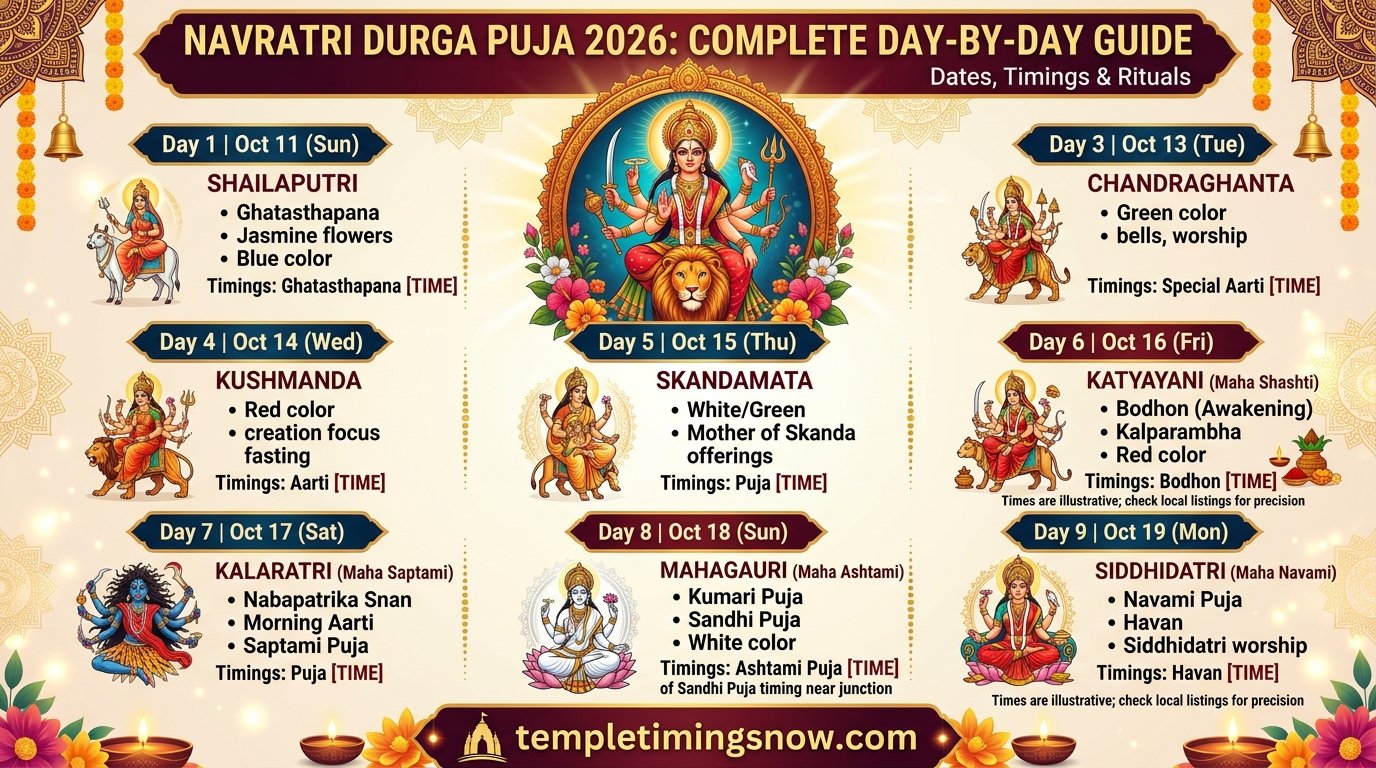
Wondering when the nine nights actually begin this year? Navratri Durga Puja 2026: Dates, Puja Timings & Rituals is a lot to keep track of, so here’s the short version.
Sharad Navratri 2026 starts on Sunday, 11 October 2026 with Ghatasthapana and ends with Vijayadashami (Dussehra) on Tuesday, 20 October 2026.
Below you’ll find every date, colour, tithi, ritual and puja window you need, plus answers to the questions people keep asking.
Heads up: all dates and tithis here are calculated for New Delhi. They can shift by a day in other cities, so check your local panchang before fixing any muhurat.
Navratri 2026 (Sharad or Ashwin Navratri) runs from 11 October to 19 October 2026, and Dussehra falls on 20 October 2026. If you searched “navratri kab hai”, that’s your answer: it begins this Sunday, just six days from today (5 October).
Sharad Navratri is the most widely celebrated of the four Navratris in a year. It falls in the Ashwin Shukla Paksha, the bright fortnight after Mahalaya. In Gujarat the nights belong to garba and dandiya, in the north to fasting and Kanya Pujan, and in Bengal, Odisha and Assam they merge into Durga Puja. Same Goddess, different flavours.
The headline facts, in one place:
The Navratri day-wise calendar for 2026 assigns one Navadurga form, one tithi and one colour to each of the nine nights. Each day’s tithi decides which Devi you worship, and each colour is worn that day as a mark of devotion.
| Day | Date | Tithi | Devi | Colour |
|---|---|---|---|---|
| Day 1 | Sun, 11 Oct | Pratipada · Ghatasthapana | Shailaputri | Orange |
| Day 2 | Mon, 12 Oct | Dwitiya | Brahmacharini | White |
| Day 3 | Tue, 13 Oct | Tritiya | Chandraghanta | Red |
| Day 4 | Wed, 14 Oct | Chaturthi | Kushmanda | Royal Blue |
| Day 5 | Thu, 15 Oct | Panchami | Skandamata | Yellow |
| Day 6 | Fri, 16 Oct | Shashthi | Katyayani | Green |
| Day 7 | Sat, 17 Oct | Saptami | Kalaratri | Grey |
| Day 8 | Sun, 18 Oct | Ashtami · Durga Ashtami · Sandhi Puja | Mahagauri | Purple |
| Day 9 | Mon, 19 Oct | Navami · Maha Navami · Navami Homa | Siddhidatri | Peacock Green |
| Day 10 | Tue, 20 Oct | Dashami | Vijayadashami (Dussehra) | n/a |
The colours of Navratri 2026 follow the weekday on which each night falls, and each shade is linked to the energy of that day’s Devi. That’s why the Navratri 2026 colours with date in October look different from last year’s list: when the weekdays shift, the colours shift with them.
Here’s the thinking behind some of them. Orange on Day 1 stands for energy and the fire of devotion that Shailaputri, the daughter of the mountain, embodies. White on Day 2 suits Brahmacharini, who is all about penance and purity.
Red on Day 3 reflects the courage of Chandraghanta, the warrior form with the bell-shaped moon on her forehead. Royal Blue on Day 4 fits Kushmanda, the creator of the cosmos.
Yellow on Day 5 brings the warmth of Skandamata, the mother of Kartikeya. Green on Day 6 is for growth and for Katyayani, the slayer of Mahishasura. Grey on Day 7 represents the restraint of Kalaratri, the fiercest form, who removes fear.
Purple on Day 8 matches Mahagauri’s serene, graceful energy. Peacock Green on Day 9 suits Siddhidatri, who grants siddhis, or spiritual accomplishments.
Nobody’s going to fine you for wearing the wrong colour, to be honest. It’s a tradition of devotion, not a dress code. But lots of families, offices and garba groups coordinate outfits, so it helps to plan ahead.
Ghatasthapana is the opening ritual of Navratri, performed on Pratipada (11 October 2026), where a kalash representing the Goddess is installed in the puja space. Everything else in the nine nights hangs off this one rite, so timing matters.
The best time is the morning of 11 October, during Pratipada tithi, after sunrise and before the tithi ends. The Abhijit muhurat, which comes around midday (roughly 11:45 am to 12:30 pm in Delhi, though it differs by city), is considered a very fortunate backup window.
I’d treat these as approximate. Your local panchang or temple will give the exact minutes for your location, and you should go with those.
The kalash sthapana vidhi is simple enough that most households do it without a priest. This is the common sequence:
Sprinkle a little water on the barley each day. By Dashami, you’ll see green shoots, and families use them as prasad or put them behind the ear as a blessing.
Navratri puja timings follow the tithi, not the clock, so each day’s best window is during its tithi, usually in the morning after sunrise and again at dusk. The two special windows to mark are Sandhi Puja and Navami Homa.
Sandhi Puja is performed at the junction (sandhi) of Ashtami and Navami, specifically in the last 24 minutes of Ashtami and the first 24 minutes of Navami, a 48-minute window. It marks the moment when Goddess Chamunda is said to have slain the demons Chanda and Munda.
In Bengal, 108 lamps are lit and 108 lotuses offered. The exact Sandhi Puja time for 18 October will be published in your regional panchang, and it changes city to city.
Navami Homa takes place on Maha Navami (19 October) and traditionally closes the nine days of worship with a havan. Ghee, sesame, barley and herbs are offered into the sacred fire with mantras. Many temples hold it in the morning, and families follow with Kanya Pujan.
For everyday worship, a simple routine works fine: morning puja with flowers, incense and a lamp, then an evening aarti, with the Durga Saptashati recited in between if you can.
The Navadurga are the nine forms of Durga worshipped on the nine nights of Navratri, from Shailaputri on Day 1 to Siddhidatri on Day 9. The Durga Saptashati (also called Devi Mahatmya or Chandi Path) describes the Goddess’s victories and is the main text recited.
In every case, one night is tied to one Devi, and the whole sequence is meant to move the devotee from raw energy toward wisdom.
Durga Ashtami falls on Sunday, 18 October 2026, and Maha Navami on Monday, 19 October 2026. These are the two heaviest days of Navratri, and for many families they are the only days when full rituals are done.
On Ashtami, devotees worship Mahagauri, and the Sandhi Puja happens at the day’s end. A lot of households hold Kanya Pujan here, where nine young girls (and sometimes a little boy as Batuk Bhairav) are fed puri, halwa and kala chana, given gifts and have their feet washed.
Maha Navami is dedicated to Siddhidatri. The Navami Homa is performed, books and tools are sometimes worshipped (Ayudha Puja in the south), and the nine-day fast is broken by those who observed it.
No. In 2026, Navami is on 19 October and Dussehra is on 20 October, so they’re on consecutive days. In some years the two tithis overlap and people get confused, but this time the calendar is clear. Some regions keep Navami late into the evening, so check locally.
The Navratri 2026 garba start date is the evening of 11 October 2026, the same day as Ghatasthapana. Garba and dandiya nights continue through the nine nights, typically ending on 19 October. Big events in Ahmedabad, Mumbai, Vadodara and Delhi announce their schedules early, so book passes soon if you’re planning to attend.
A quick word on Navratri fasting (vrat) rules. Fasting is optional but common, and the style depends on the family:
Please don’t push through a strict fast if you’ve got a health condition or you’re pregnant. Devotion is not about suffering, and a lighter fast counts just as much.
Durga Puja is a five-day festival in the eastern states, running from Maha Shashthi to Vijayadashami. In 2026 that stretches from 16 October to 20 October. So if someone asks about the “5 days of Durga Puja”, this is it.
| Day | Date | Observance |
|---|---|---|
| Maha Shashthi | Fri, 16 Oct | Bodhon, Amantran and Adhivas; the Goddess is welcomed and the pandals open |
| Maha Saptami | Sat, 17 Oct | Kalabou (Nabapatrika) snan and main puja begins |
| Maha Ashtami | Sun, 18 Oct | Anjali, Kumari Puja and Sandhi Puja |
| Maha Navami | Mon, 19 Oct | Navami puja and homa; the festival’s emotional peak |
| Vijayadashami | Tue, 20 Oct | Sindoor Khela and idol immersion (Visarjan) |
The real date of Durga Puja in 2026 is therefore 16-20 October, with the main days being Saptami to Dashami. The festival is preceded by Mahalaya (around 10 October), when Bengalis wake early to hear the Mahishasura Mardini recitation. Mahalaya also marks the start of Devi Paksha.
Counting “how many dates are in Durga Puja”, the answer is five core days, though Bengal’s celebrations in practice begin on Mahalaya, and some people count Shashthi to Dashami as the “ten-day” feast when adding Chaturthi and Panchami pandal viewing.
The vahan (vehicle) on which Maa Durga arrives is decided by the weekday on which Navratri begins. Because Navratri 2026 starts on a Sunday, many panchangs say the Goddess arrives on an elephant (gaja), which is traditionally linked with good rainfall, a strong harvest and prosperity.
The Bengal tradition counts from Maha Shashthi instead. Shashthi falls on a Friday this year, which most Bengali almanacs link with arrival by doli (palanquin). So you might see two different answers online, depending on the tradition quoted. Neither is wrong; they follow different calculation systems.
Her departure, based on the Dashami weekday (Tuesday), is traditionally said to be on a rooster (murga), and some folk readings treat that as a sign to stay careful about public matters. Take these as traditional beliefs, not predictions, and enjoy the festival.
Vijayadashami (Dussehra) on Tuesday, 20 October 2026 celebrates the victory of good over evil. Two stories sit behind it: Rama’s victory over Ravana, and Durga’s victory over Mahishasura.
North India burns giant effigies of Ravana, Meghnad and Kumbhkarna at dusk, while the east immerses Durga idols after Sindoor Khela. Dussehra is also seen as an auspicious day to start new ventures, and Shami puja and Aparajita puja are performed in many homes.
Planning your festival calendar? Diwali 2026 falls on Sunday, 8 November 2026, which is about 19 days after Dussehra.
So Navratri 2026 and Diwali 2026 are separated by just under three weeks, with Sharad Purnima, Karwa Chauth, Dhanteras and Govardhan Puja filling the gap. That’s a busy stretch, so many families begin shopping and cleaning right after Dussehra.
Sometimes people want to compare years, so here’s a quick look. The Navratri 2025 date was 22 September to 1 October 2025, with Dussehra on 2 October 2025.
That means Navratri 2026 arrives roughly three weeks later than it did in 2025, which is normal because the Hindu lunisolar calendar shifts against the Gregorian one, with an extra month (adhik maas) added periodically to correct it. In 2026 the extra month pushed festivals later.
For Navratri 2027, expect Sharad Navratri to begin around the start of October 2027 and Dussehra to fall around 9-10 October 2027. These are approximate, since exact tithis are only fixed by panchang closer to the time. The Durga Puja 2027 days are therefore roughly one year from now.
Most Navratri pages stop at the table of dates. A few things deserve a proper explanation, because that’s what devotees really want to know.
Why is the Durga Saptashati recited? The Durga Saptashati has 700 verses in 13 chapters, and reading it during Navratri is believed to invoke the Goddess’s protection. Many people read one chapter a day, or a shortened form, if full recitation isn’t possible. Starting with the Devi Kavacham, Argala Stotram and Keelakam is the usual practice.
What’s the significance of sowing barley? Barley is among the first grains in the Vedic tradition. Seeds sprouting by Dashami are read as a sign of a prosperous year ahead. Sparse growth or yellowish shoots are, by tradition, a hint to pray more and nothing to panic about.
What is the Devi mantra everyone knows? Ya Devi Sarvabhuteshu Shakti-Rupena Samsthita, Namastasyai Namastasyai Namastasyai Namo Namah. It means: “To the Goddess who dwells in all beings in the form of power, I bow to her again and again.” Chanting it 108 times during the evening aarti is common.
Which regional variations exist? Gujarat celebrates through garba, Tamil Nadu and Karnataka with Golu (doll display), Himachal’s Kullu with Dussehra processions, and Bengal with community pandals. Same nine nights, completely different atmospheres.
One more tip: whatever you do, begin and end with a sincere heart. As the line goes, “may the Great Mother give her darshan and her blessings.”
The nine days run from 11 to 19 October 2026: Pratipada, Dwitiya, Tritiya, Chaturthi, Panchami, Shashthi, Saptami, Ashtami and Navami. Dussehra follows on 20 October 2026.
The main Durga Puja in 2026 runs from Maha Shashthi on 16 October to Vijayadashami on 20 October. Maha Ashtami is on 18 October and Maha Navami on 19 October.
That refers to Chaitra Navratri, not Sharad Navratri. Most panchangs list Chaitra Durga Ashtami on 26 March 2026, though a few show 25 March depending on tithi timing. Confirm with your local calendar.
As of 5 October 2026, Maha Shashthi is about 11 days away, on 16 October. Navratri begins in 6 days, and Vijayadashami falls 15 days from today.
Durga Puja itself is five days, but the nine-day Navratri period includes the forms Shailaputri, Brahmacharini, Chandraghanta, Kushmanda, Skandamata, Katyayani, Kalaratri, Mahagauri and Siddhidatri, worshipped in that order.
No. Maha Navami falls on Monday, 19 October 2026, and Dussehra (Vijayadashami) falls on Tuesday, 20 October 2026. They are on consecutive days this year.
The five days are Maha Shashthi, Maha Saptami, Maha Ashtami, Maha Navami and Vijayadashami. In 2026 they fall from 16 to 20 October, ending with Sindoor Khela and idol immersion.
Because Navratri starts on a Sunday, the Goddess is said to arrive on an elephant. Bengal’s tradition, counting from a Friday Shashthi, says palanquin. Departure is said to be by rooster.
Durga Puja has five main dates: 16, 17, 18, 19 and 20 October 2026. Celebrations in Bengal also begin earlier with Mahalaya, around 10 October 2026.
From 5 October 2026, Durga Puja 2027 is roughly a year away. It should start around early October 2027, though exact dates will depend on the 2027 panchang.
Navratri 2026 starts on Sunday, 11 October 2026. Ghatasthapana is performed that morning during Pratipada, ideally after sunrise, with the Abhijit muhurat around midday as a fallback window.
Diwali 2026 is on Sunday, 8 November 2026, about 19 days after Dussehra on 20 October. Dhanteras and other pre-Diwali festivals fall in between.
Orange, white, red, royal blue, yellow, green, grey, purple and peacock green, from Day 1 (11 October) to Day 9 (19 October). Dussehra has no assigned colour.
Garba begins on the evening of 11 October 2026, the same day as Ghatasthapana, and continues nightly until Maha Navami on 19 October. Check local organisers for exact event timings.
Sandhi Puja is performed in the last 24 minutes of Ashtami and first 24 minutes of Navami, around 18 October. The exact minute varies by city, so consult your regional panchang.
https://templetimingsnow.com/bangalore-to-tirupati-nri-darshan-package-by-car/
https://templetimingsnow.com/tirupati-to-arunachalam-distance/
https://templetimingsnow.com/tirupati-to-tirumala-distance/
https://templetimingsnow.com/padmavati-temple-tirupati/
https://templetimingsnow.com/senior-citizen-darshan-at-tirumala/