Physical Address
304 North Cardinal St.
Dorchester Center, MA 02124
Physical Address
304 North Cardinal St.
Dorchester Center, MA 02124

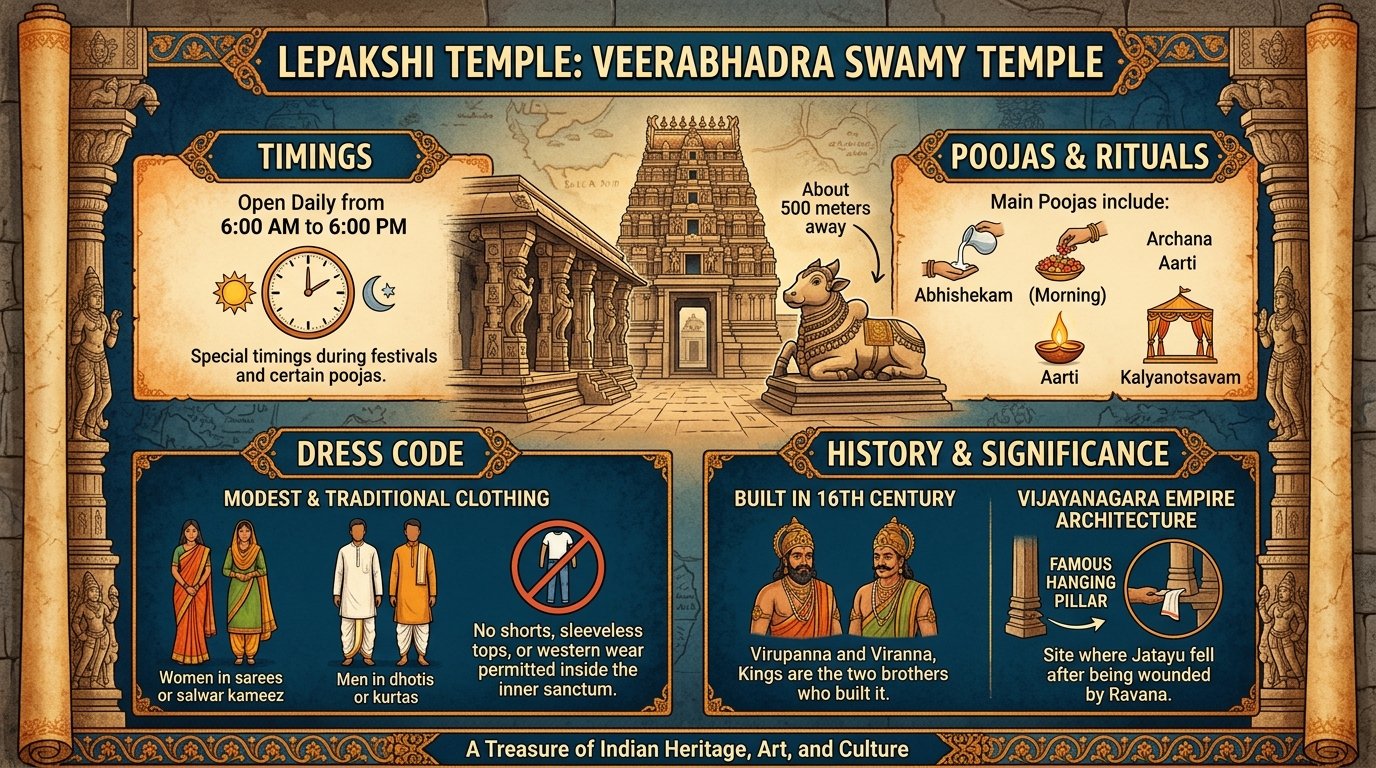
Planning a trip to this mysterious 16th-century shrine? Honestly, most travel blogs just skim the surface, but there’s so much more to unpack here. If you’re searching for accurate Lepakshi Temple timings, the correct dress code, or just want to understand why this place is such a big deal historically, you’ve landed on the right guide.
Lepakshi Temple, dedicated to the fierce deity Veerabhadra, sits quietly in a small village in Andhra Pradesh, yet it holds some of the most fascinating architectural puzzles in South India including a pillar that genuinely floats above the ground. Let’s get into it.
Lepakshi Temple is situated in the small village of Lepakshi, in the Anantapur district of Andhra Pradesh. So if you were wondering “lepakshi temple in which district,” now you know — it’s Anantapur, and this district is actually well known for its cluster of Vijayanagara-era monuments.
The temple rests partly on a low, rocky hill known as Kurmasailam, which literally translates to “tortoise hill” in Telugu (the rock formation genuinely does resemble a tortoise shell if you look at it from a distance, which is kind of neat).
This unique positioning gives the temple its distinct, elevated character compared to plains-based temples elsewhere in the region.
The Lepakshi Temple history dates back to somewhere between 1530-1540 AD, constructed during the reign of the Vijayanagara Empire, specifically under King Achutarya. Two brothers, Virupanna and Viranna, who served as administrators under the Vijayanagara Kings, are widely credited with commissioning the temple.
Virupanna and Viranna → constructed → Lepakshi Temple, using funds that were reportedly drawn from the state treasury. This decision, as legend has it, didn’t sit well with the King.
According to popular legend, when King Achutarya learned that Virupanna had used royal treasury funds without prior authorization, he became furious and ordered Virupanna to be blinded as punishment. Rather than face the humiliation of being blinded by soldiers, Virupanna is said to have blinded himself on the spot.
You can actually still see two reddish stains on an inner wall of the temple that locals claim came from this act — whether that’s historically accurate or just folklore passed down for centuries, nobody really knows for sure, but it adds a heavy emotional weight to the site.
There’s also a Puranic version of events worth mentioning. Some texts, including references drawn from the Skanda Purana, suggest the temple was originally founded by the sage Agastya, long before the Vijayanagara-era construction took place. In this narrative, Lepakshi is classified among the divyakshetras — a term used in Shaivite tradition to describe sacred pilgrimage sites specifically associated with Lord Shiva.
Basically, divyakshetras are considered divinely significant grounds where the presence of Shiva is believed to be especially potent, and Lepakshi finds mention alongside a handful of other such revered locations across South India.
So really, you’ve got two overlapping stories: one rooted in verified 16th-century architecture and inscriptions, and another rooted in much older Puranic mythology. Most historians lean toward the Vijayanagara-era construction as the factually documented version, while the Agastya legend is treated more as devotional tradition.
Built in classic Vijayanagara style architecture, the temple complex features around 70 intricately carved pillars, most of which depict mythological scenes, deities, and dancers. The craftsmanship here genuinely rivals some of the better-known temples of Hampi, and honestly it doesn’t get nearly enough credit for that.
The temple has three separate Mandapas (halls), each serving a distinct purpose:
Nobody really knows for certain why the Kalyana Mandapa was never completed. Some say it’s connected to the Virupanna tragedy, since construction reportedly halted after his punishment, though this isn’t confirmed by inscriptions.
One of the most talked-about features is the Aakaasa Sthambha, or Hanging Column. This particular pillar doesn’t rest fully on the ground — there’s a visible, thin gap between its base and the floor. Visitors often slide a piece of cloth or paper through the gap just to prove to themselves it’s real (and it is, this isn’t a trick of the eye).
During the British colonial period, an engineer reportedly tried to investigate how the pillar was suspended by attempting to move it slightly. This attempt actually caused the pillar to shift out of its original position, and to this day, it remains slightly dislodged. Structural engineers today generally attribute the hanging pillar to sophisticated load-balancing and interlocking stone techniques used by Vijayanagara-era architects, though the exact engineering method is still debated among historians.
While most visitors come specifically to see the hanging pillar, the temple also houses a striking depiction of the Nagalinga — a massive multi-hooded serpent sculpture with three coils and seven hoods, shielding a Shivalinga underneath. This is considered the largest Nagalinga sculpture in India, and it stands right beside a huge carved Ganesha idol in the temple’s outer enclosure.
Regarding the Lepakshi Temple Garuda, the temple complex and its surrounding mythology reference Garuda-related iconography common to Vaishnavite and Shaivite temple traditions of the era, appearing in carved panels alongside other divine vahanas (vehicles of the gods) throughout the pillared halls.
These carvings, much like the Nagalinga, reflect the broader Vijayanagara devotion to depicting mythological guardianship figures throughout their temple complexes.
About a mile before you even reach the main temple, you’ll come across a massive stone bull. This is the monolithic Nandi, reputed to be India’s largest single-stone Nandi statue, measuring roughly 27 feet in length and 15 feet in height. It’s genuinely a sight to behold and honestly worth stopping for even if you’re short on time.
The Monolithic Nandi → faces → the Shivalinga, which is itself guarded by the large serpent sculpture mentioned earlier. This alignment isn’t accidental — in Shaivite temple design, Nandi (Shiva’s bull vehicle) is traditionally positioned facing the sanctum to represent eternal devotion and vigilance.
So, “how is Lepakshi related to Ramayana,” you ask? Within the temple premises lies a footprint etched into the stone floor, believed by devotees to belong to Goddess Sita. According to local legend, this footprint was imprinted during the moment Ravana was forcibly carrying Sita to Lanka.
There’s also a connected, though separate, popular belief tying the region to Jatayu, the mythical vulture-king from the Ramayana who attempted to rescue Sita from Ravana. While the more widely accepted Jatayu legend is centered around Jatayu Nature Park in Kerala, some local Andhra folklore loosely associates the Lepakshi region’s name with the phrase
“Le Pakshi” — meaning “rise, bird” in Telugu — supposedly spoken by Lord Rama to the fallen, injured Jatayu. It’s worth noting this is a regional oral tradition rather than a documented historical claim, so take it with the understanding that it’s folklore, not verified scripture.
If you’re planning your trip, here’s the practical stuff you actually came here for.
| Detail | Information |
|---|---|
| Temple Timings | 6:00 AM – 6:00 PM (daily) |
| Entry Fee | No fee (free entry) |
| Main Deity | Veerabhadra |
| Photography | Allowed |
| Nearest Airport | Sri Sathya Sai Airport, Puttaparthi |
| District | Anantapur, Andhra Pradesh |
The temple stays open all seven days of the week, though temple timings may shift slightly during major festivals, eclipses, or special ritual days, so it’s worth calling ahead or checking locally if you’re visiting during a festival period.
For those interested in witnessing rituals, the Abhishekam (ceremonial bathing of the deity) generally takes place between 7:00 AM and 7:30 AM. First, the Shivalinga is worshipped, followed by rituals dedicated to Lord Veerabhadra.
Interestingly, the deity’s appearance is believed to transform throughout the day — appearing as a youthful figure (Bala Rupa) in the morning and gradually taking on the appearance of a moustached warrior by evening. Devotees → offer → Sarkarai Pongal Nivedhana, a sweet rice pudding, as part of the temple offerings, and clothes are also offered to the deities during Abhishekam.
Betel leaf is distributed as prasad, and much like in many Vishnu temples elsewhere, devotees here also receive the Sadari blessing.
This is one area where a lot of first-time visitors get caught off guard, so pay attention here. The Lepakshi Temple dress code requires visitors to wear modest, traditional clothing.
So to directly answer “can we wear jeans in Lepakshi Temple” — technically enforcement can vary depending on the day and crowd levels, but officially, temple authorities discourage jeans and Western casual wear, so it’s safer to just stick with traditional clothing to avoid any awkward situations at the entrance.
The temple really comes alive during festival season, honestly it’s a completely different experience compared to a regular weekday visit.
Most guides mention the temple’s paintings only in passing, but honestly, the murals here deserve way more attention than they usually get. The temple houses some of the finest surviving examples of Vijayanagara-era fresco work in South India, painted using natural mineral pigments on a lime-plastered surface — a technique that has allowed the colors to survive for nearly five centuries, albeit with visible fading in places.
One particularly striking panel depicts the marriage of Shiva and Parvati, showing Parvati seated on a raised platform surrounded by six attending maidens, painted in intricate detail with elaborate jewelry and clothing patterns typical of the era’s royal aesthetics. Other panels narrate scenes from the Mahabharata, Ramayana, and Puranic literature, essentially turning the temple ceiling into a visual storytelling archive.
These paintings were first formally documented by the archaeologist A.H. Longhurst during 1912-13, who recognized their historical value and catalogued a number of the panels. Unfortunately, years of water leakage and lack of consistent conservation efforts have caused noticeable deterioration to several sections since then.
Conservation bodies including the Archaeological Survey of India have periodically undertaken restoration work, though experts generally agree that more sustained preservation funding is needed to protect what remains.
Here’s something most articles gloss over entirely — the mythological origin of Veerabhadra himself, and why this cult was so significant during the Vijayanagara period.
According to Puranic legend, Sati’s self-immolation → enraged → Lord Shiva, prompting him to tear a lock of his own hair from his head in grief and fury. From this single lock emerged two powerful beings: the fierce warrior-deity Veerabhadra and Goddess Kali.
Veerabhadra was historically worshipped as a warrior god during wartime in both ancient and medieval periods, which explains why so many temples dedicated to him, including this one, carry a distinctly martial, intense character in their sculptures.
Interestingly, the existence of the Uddana Veerabhadra Temple in Hampi provides additional evidence that the people of the Vijayanagara Empire had a broader devotional practice of worshipping deities in their fierce, ferocious forms — not just at Lepakshi, but across multiple sites tied to the empire’s religious identity.
Getting here isn’t too complicated, though public transport options are somewhat limited, so planning ahead helps.
By Road: Lepakshi has decent road connectivity via Hindupur, with both government and private buses connecting Hindupur to major nearby cities. Hiring a taxi is also a comfortable option, especially if you’re traveling with family.
By Rail: The nearest railway station is Hindupur, located approximately 12 km from the temple.
By Air: The nearest airport is Sri Sathya Sai Airport in Puttaparthi, roughly 58 km away.
A lot of travelers ask specifically about the Lepakshi Temple from Bangalore route, since it’s a popular weekend getaway for Bengaluru residents. The temple is roughly 120-125 km from Bangalore, and the drive typically takes about 2.5 to 3 hours depending on traffic, via the Bangalore-Hyderabad Highway (NH44). Plenty of people do it as a day trip, leaving early morning and returning by evening, which honestly works out pretty well given the temple’s convenient opening hours.
| From City | Approximate Distance |
|---|---|
| Bangalore | ~120-125 km |
| Hindupur | ~12 km |
| Puttaparthi (Airport) | ~58 km |
| Anantapur (District HQ) | ~85 km |
If you’ve made the trip out here, it’s worth extending your visit to see a few nearby sites connected to the same Veerabhadra mythology.
If you’re hunting for good Lepakshi Temple photos or planning to take your own, know that photography is officially permitted inside the complex, which is honestly rare for a lot of Indian temples. The best shots tend to come from:
Just remember to dress appropriately even while taking photos, since it is still an active place of worship, not just a tourist monument.
The temple itself doesn’t have an on-site guesthouse, but there are a handful of budget-friendly options nearby:
For food, local restaurants like Annapoorna and Ghuma Ghumalu Restaurant serve both vegetarian and non-vegetarian South Indian dishes, along with North Indian options for those who prefer it.
The biggest mystery is the Aakaasa Sthambha, a hanging pillar that doesn’t fully touch the ground. Historians still debate exactly how Vijayanagara-era engineers achieved this balancing feat without modern tools.
Legend says Virupanna, who built the temple using treasury funds, blinded himself after King Achutarya ordered his punishment. The name also connects to Ramayana folklore involving Jatayu.
It’s a 16th-century Vijayanagara-era temple in Anantapur district, Andhra Pradesh, dedicated primarily to Lord Veerabhadra, with shrines also honoring Shiva and Vishnu.
The footprint inside the temple premises is believed by devotees to belong to Goddess Sita, said to have been imprinted while Ravana carried her toward Lanka.
The temple is known for its hanging pillar, the giant Nagalinga sculpture, India’s largest monolithic Nandi, and stunning Vijayanagara-style frescoes depicting mythological scenes.
The primary deity worshipped is Veerabhadra, the fierce warrior form of Shiva, though the temple also houses shrines for Shiva and Vishnu.
Only one pillar, known as the Aakaasa Sthambha, is the famous “hanging” one. The temple complex has around 70 pillars total.
Local legend ties the temple to Sita’s footprint left during her abduction, and regional folklore also loosely links the village’s name to the fallen bird Jatayu.
Partially, yes. The temple stands on a low rocky hill called Kurmasailam, meaning “tortoise hill” in Telugu, due to its tortoise-shaped rock formation.
Early morning, right after the 6:00 AM opening, is ideal to avoid crowds and heat. October to March also offers cooler, more comfortable weather for sightseeing.
Key attractions include the hanging pillar, the monolithic Nandi statue, the Nagalinga sculpture, Sita’s footprint, and the beautifully painted ceiling frescoes.
You can reach Lepakshi by road via Hindupur, by train to Hindupur railway station (12 km away), or by air via Sri Sathya Sai Airport, about 58 km from the site.
The pillar appears to float without full ground contact. A British engineer’s attempt to investigate it during colonial times reportedly dislodged it slightly from its original spot.
Officially, jeans and other Western casual wear like shorts or t-shirts are discouraged. Traditional attire is recommended to respect temple customs and avoid entry issues.
This connection comes from regional oral folklore, not verified scripture. Some believe the name “Lepakshi” (rise, bird) relates to Rama addressing the fallen Jatayu here.
https://templetimingsnow.com/bet-dwarka-darshan-timings/
https://templetimingsnow.com/iskcon-temple-bangalore-timings/
https://templetimingsnow.com/maa-kamakhya-temple-timings/
https://templetimingsnow.com/shivoham-shiva-temple-bengaluru/
https://templetimingsnow.com/khatu-shyam-temple-timings/