Physical Address
304 North Cardinal St.
Dorchester Center, MA 02124
Physical Address
304 North Cardinal St.
Dorchester Center, MA 02124

Planning a trip to one of India’s 12 Jyotirlingas and wondering when the doors actually open? You’re not alone.
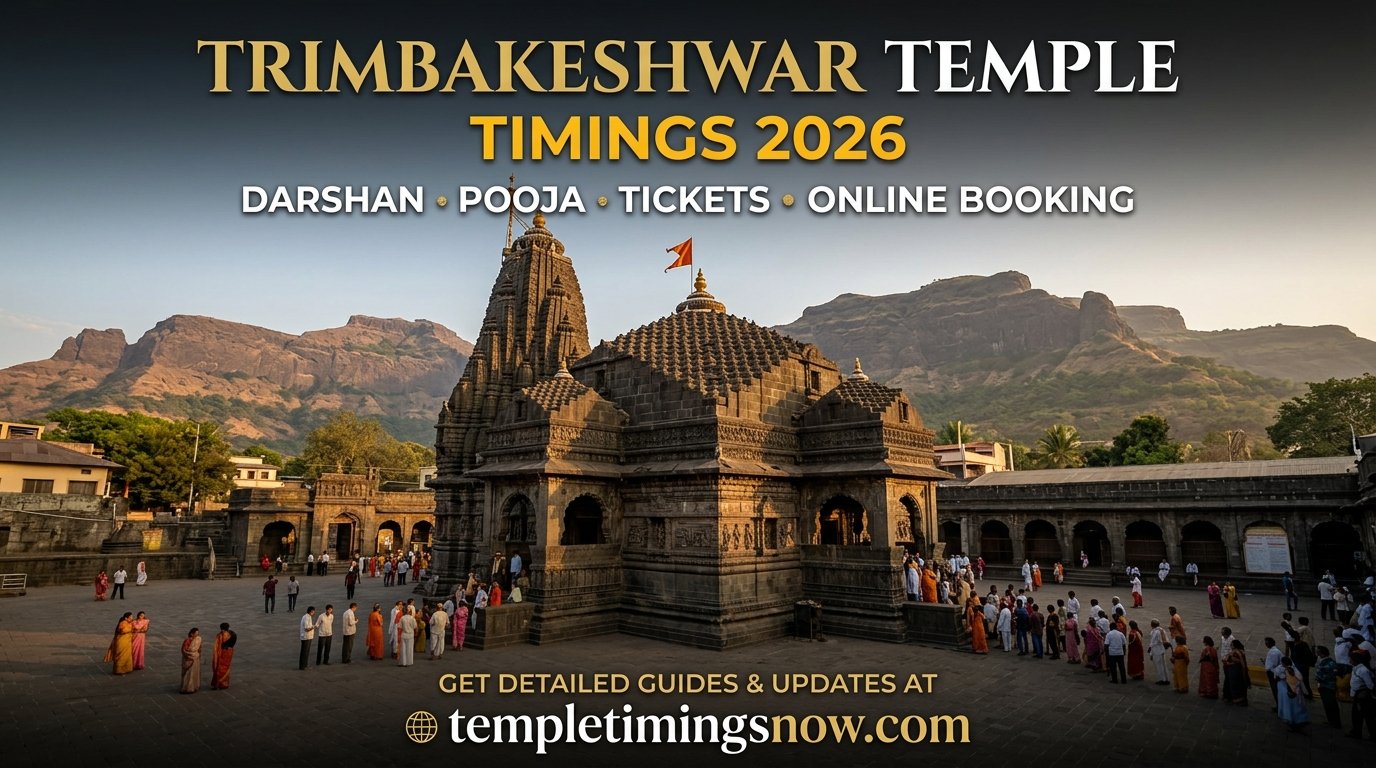
Trimbakeshwar Temple timings 2026: darshan, pooja, tickets & online booking is one of the most searched topics among Maharashtra pilgrims, mostly because the queues here can get seriously long. The good news is a bit of planning saves hours.
This guide covers opening and closing time, aarti schedule, pooja types, ticket options, booking steps, how to reach, and the rules you should know before you go.
The Trimbakeshwar Temple generally opens around 5:30 AM and closes around 9:00 PM every day, including weekends and most festivals. Timings can shift a little on special occasions, so treat the table below as a planning guide, not gospel.
| Activity | Approximate Time |
|---|---|
| Temple opening | 5:30 AM |
| Morning aarti & early darshan | 5:30 AM – 7:00 AM |
| Abhishek / Rudrabhishek slots | Morning hours (booked slots) |
| General darshan | Through the day |
| Afternoon pooja & naivedya | Around midday |
| Evening aarti | Around 7:00 PM |
| Temple closing | 9:00 PM |
Honestly, the best window is early morning, right after opening. Crowds are thin, the air is cool, and you don’t get that afternoon rush of tour buses from Nashik and Shirdi.
General darshan runs for most of the day, but entry into the inner sanctum (garbhagriha) is limited to specific hours to manage the crowd. The Trimbakeshwar Jyotirlinga is unusual, it’s a small depression in the ground holding three tiny lingams that represent Brahma, Vishnu and Shiva. Because the sanctum is so small, devotees move in groups and you only get a few seconds. Don’t expect a long, quiet moment there.
The daily rituals begin with the early morning aarti and continue through abhishek, afternoon naivedya, and the evening aarti. Morning abhishek is the most popular ritual, and priests usually allot slots, so reach early. In the evening, the temple lamps and bells make it a really peaceful experience, even if you aren’t doing a pooja yourself.
Trimbakeshwar Temple is a Jyotirlinga shrine near Nashik, Maharashtra, built at the foothills of the Brahmagiri hills, and it’s the source of the Godavari river. The name comes from “Tryambakam”, the three-eyed Lord Shiva.
The black-stone temple is generally credited to Peshwa Balaji Baji Rao (Nanasaheb) in the 18th century, with its Hemadpanthi-style stonework still impressive today.
Right near the temple is Kushavarta Kund, a sacred tank where pilgrims take a dip. Many devotees combine darshan with rituals here, and some trek up Brahmagiri to see the origin point of the Godavari.
Trimbakeshwar is especially known for ancestral and astrological rituals, apart from regular abhishek. Priests (purohits) conduct these, and you usually need to book in advance.
Many of these need a full day or more, so don’t try squeezing them into a quick stopover. Ask the trust or an authorised purohit about the exact duration and samagri (materials) before you arrive.
Trimbakeshwar offers a free general darshan queue and a paid fast-track (special) darshan line. The paid ticket is generally priced at a modest amount per person, and it can cut waiting time a lot on crowded days. Fees do get revised from time to time, so confirm the current rate at the counter or the official website.
A small tip: keep your ID handy even for the paid queue. Staff sometimes ask for it, and fumbling around at the gate with a line behind you is no fun.
Online booking for Trimbakeshwar darshan and pooja is handled through the temple trust’s official portal. Always use the official website only, because fake booking sites are a real problem around popular temples.
If the portal doesn’t show a slot for your date, it’s probably full. Try the next day or switch to a weekday, they’re way less crowded.
Many pilgrims plan Trimbakeshwar and Pandharpur in the same Maharashtra yatra, so here’s a short, useful comparison. The Pandharpur Sri Vitthal Rukmini Temple is run by its own temple trust, and the booking process is separate from Trimbakeshwar’s.
Pandharpur temple darshan tickets online booking is available 24×7 through the official Vitthal Rukmini Mandir portal (vitthalrukminimandir.org). You log in with your mobile number, enter the OTP, pick “Online Services”, and choose Darshan or Pooja. Pick a date from the calendar, where green shows availability and red shows closed slots, then fill in the details and pay if it’s a chargeable pooja.
The special darshan pass at Pandharpur is free of cost, while only pooja tickets are chargeable. So when people search “vitthal rukmini online darshan pass booking price”, the honest answer is that the pass itself costs nothing, you pay only for pooja services like Nitya Pooja, Tulasi Archan, Padya Pooja, Chandan Uti Pooja and Maha Naivedya. A single transaction allows a maximum of 6 persons.
People often search for the Pandharpur VIP darshan pass, Pandharpur VIP darshan pass booking and whether the Pandharpur VIP darshan pass is open now. The temple’s official system calls it a “Special Darshan Pass”, and its availability depends on the date calendar on the portal.
If a date shows red, it’s closed. Check the live calendar instead of trusting random social media posts claiming “open now”.
For e pooja Pandharpur online booking, log in, choose Pooja under Online Services, select your ritual and date, and complete payment. Download the receipt afterwards and show your original ID at the reporting gate.
The temple itself opens at around 4:00 AM, with the first pooja at 4:15 AM and Kakad aarti from 4:30 AM to 5:30 AM. General darshan continues through the day until roughly 11:15 PM.
This is what people mean when they search Pandharpur darshan online booking timings, although the portal itself is accessible round the clock.
If you want the Pandharpur darshan online booking contact number, please take it only from the official portal’s “Contact Us” page. I’d avoid numbers from random blogs or ads since scammers love posting fake helplines.
| Feature | Trimbakeshwar | Pandharpur Vitthal Rukmini |
|---|---|---|
| Deity | Lord Shiva (Jyotirlinga) | Vitthal (Krishna) and Rukmini |
| Opening time | ~5:30 AM | ~4:00 AM |
| Closing time | ~9:00 PM | Late night (~11:15 PM) |
| Booking | Official trust portal | vitthalrukminimandir.org |
| Special darshan | Paid fast-track option | Free pass, pooja is chargeable |
Trimbakeshwar has dharamshalas and lodges around the temple, plus plenty of hotels in nearby Nashik. If you’re visiting during Shravan or a Kumbh year, book your room well in advance, because rooms vanish quickly.
At Pandharpur, the temple trust runs Bhakti Niwas guest houses with AC and Non-AC rooms. AC rooms start around ₹1,000 and go up to ₹3,000 for multi-bed rooms, and Non-AC rooms run from about ₹300 to ₹750.
One important rule: accommodation bookings there are non-refundable once confirmed, and you’ll need the original ID proof and booking receipt at check-in.
Trimbakeshwar is about 28–30 km from Nashik city and roughly 170–180 km from Mumbai. Most travellers come via Nashik.
The best time to visit Trimbakeshwar is on a weekday morning outside festival periods, between October and February when the weather is pleasant. Monsoon is also beautiful because Brahmagiri turns green, but expect slippery paths and heavy rain.
Crowds spike on these occasions:
On a regular weekday, free darshan may take 1 to 2 hours. On peak days it can stretch way beyond that, so paid darshan or an early start is a smart move.
Modest, traditional clothing is expected at Trimbakeshwar, and mobile phones and cameras are generally not allowed inside the sanctum. For certain rituals and sanctum entry, men are often asked to wear a dhoti or similar traditional attire, and women usually wear a saree or salwar kameez. Rules can differ for specific rituals, so ask at the counter.
A few more practical points:
Seniors and differently-abled pilgrims often get some priority or assistance, but it varies by crowd level. Ask the temple staff at the entrance, and consider the paid darshan line if walking in a long queue would be hard. Wheelchairs and help might be available, though don’t count on it during major festivals.
Carry your original ID, a copy of your booking receipt, some cash for small offerings, and water. Reach before sunrise if you can. Keep valuables minimal, since crowds mean pickpockets. And leave a buffer in your schedule because temple days rarely run on exact time.
The temple generally opens around 5:30 AM and closes at about 9:00 PM daily. Timings may change on festivals, so confirm with the official trust before travelling.
Yes, the temple trust offers online booking for special darshan and certain poojas through its official portal. Choose a date, enter devotee details, pay, and download your receipt.
Paid fast-track darshan is usually a modest per-person fee, but rates get revised occasionally. Check the official website or ticket counter for the current price before your visit.
Yes, general darshan is free for everyone. A separate paid line exists for faster entry. Free queues can be long on Mondays, Shravan and Mahashivratri.
Early weekday mornings between October and February are ideal. Crowds are lighter, weather is comfortable, and you can complete darshan without rushing or waiting through heavy afternoon queues.
Mobile phones and cameras are generally not permitted inside the sanctum. Use the cloakroom or locker facility if available, and keep valuables minimal to avoid hassles at the gate.
Dress modestly and traditionally. Men may need a dhoti for certain rituals or sanctum entry, while women typically wear sarees or salwar suits. Confirm specific requirements at the counter.
Popular services include Rudrabhishek, Narayan Nagbali, Kalsarpa Shanti, Tripindi Shraddha and Mahamrityunjaya Jaap. Many require advance booking and a full day, so plan accordingly with a purohit.
Trimbakeshwar is roughly 28 to 30 kilometres from Nashik city. A bus or cab usually takes around 45 minutes to an hour depending on traffic and road conditions.
Take a road trip or train to Nashik and continue by cab or bus. Mumbai is around 170-180 km away, and Pune is roughly 200 km or more.
Visit vitthalrukminimandir.org, log in with your mobile number and OTP, select Online Services, pick Darshan or Pooja, choose a date, enter details, and download the receipt after confirmation.
The special darshan pass at Pandharpur is free, while pooja tickets are chargeable. Up to six people can be booked in one transaction using valid ID details.
No, accommodation bookings at Pandharpur’s Bhakti Niwas are non-cancellable and non-refundable. Carry the original ID proof and booking receipt at the reporting time for check-in.
Always get the helpline number from the official Vitthal Rukmini Mandir website’s contact page. Avoid numbers from unverified blogs or social posts, since fake helplines are common.
Yes, but they’re in different parts of Maharashtra, so allow at least 3 to 4 days. Plan Nashik, Trimbakeshwar and Shirdi first, then travel onward to Pandharpur by train or bus.