Physical Address
304 North Cardinal St.
Dorchester Center, MA 02124
Physical Address
304 North Cardinal St.
Dorchester Center, MA 02124

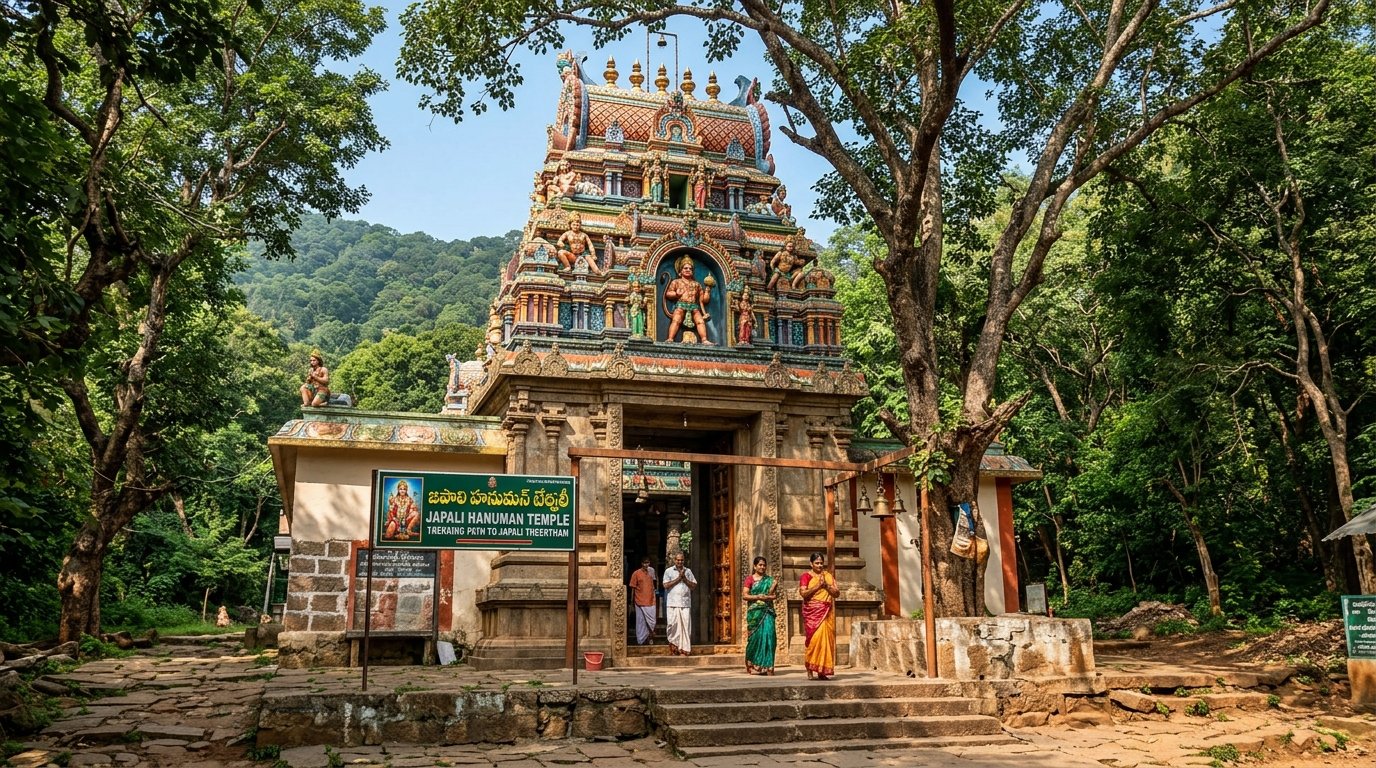
Most pilgrims come to Tirumala for one thing, the darshan of Lord Venkateswara, and head home. That’s a shame, because about 5 kilometres away, tucked inside the Seshachalam forest, there’s a quiet shrine where the crowd noise just disappears.
The Japali Hanuman Temple is a self-manifested Hanuman shrine linked to the Ramayana, reached by a short forest walk, and it costs nothing to enter.
In this guide I’ll cover its history, the legends, timings, distance from Tirupati, how to reach it, what to expect, and how to fit it around the famous Tirumala sevas, since a lot of people plan both together.
The Japali Hanuman Temple (also called Japali Anjaneya Swamy Temple) is an ancient forest shrine in the Seshachalam hills, about 5 km from the Sri Venkateswara Temple in Tirumala, Andhra Pradesh. Its main deity is a Swayambhu (self-manifested) idol of Lord Hanuman.
Japali is both the name of the sage and the shorthand locals use for the whole area, including the Japali Theertham, the sacred pond next to the shrine. Unlike the busy main temple, there’s no queue complex here and no VIP line. You walk in through trees, remove your footwear, and stand before the Lord in a very simple sanctum.
Sage Japali (also spelled Jabali) performed intense penance in the Seshachalam hills, and Lord Hanuman appeared there as a Swayambhu idol in response.
The temple takes its name from him. Tradition says the sage came to this forested hilltop looking for the grace of Hanuman, and the deity was so pleased that he chose to stay on as a self-formed image rather than a carved one.
That’s a big deal for devotees. A Swayambhu murti isn’t sculpted or installed by anyone, so it’s considered to hold a naturally powerful presence. Many Hanuman bhaktas say they feel that presence the moment they step into the small sanctum.
Lord Rama, Sita and Lakshmana are believed to have stayed at Japali during their 14-year Aranyavasa (forest exile), using the spring now known as Rama Kund for their daily needs. Hanuman is said to have been with them. Locals point to the water source, which never seems to dry up, as proof that this place has always been sacred.
There’s a second legend that I personally find more moving. After finding Sita in Lanka, Hanuman came back this way, torn between joy at finding her and rage at Ravana’s cruelty. He sat here in penance to calm his mind, and the peace he felt made him bless the place.
The belief is that anyone who prays here with a sincere heart gets that same calm and clarity. That’s the reason most people call Japali a spiritual retreat rather than just another temple stop.
The Japali Hanuman Temple is generally open to devotees from morning until about 6:00 PM, but the forest gate near Gogarbham Dam opens around 6:30 AM and the sanctum doors around 7:30 AM, so plan your arrival after that.
The timing confusion is real. Some websites say “6 AM to 6 PM,” which sounds like you can walk in at sunrise. In practice the forest access gate and the temple staff follow their own schedule. So here’s how I’d plan it:
Timings are set by TTD and the forest department and can change without much notice, so check with the TTD information centre in Tirumala the day before.
The Tirupati to Japali distance is roughly 27 to 30 km: about 22 km from Tirupati up the ghat road to Tirumala, plus another 5 km or so to the Japali forest entrance. It’s about 45 to 60 minutes of driving depending on traffic at the toll gate and the ghat road.
| Route | Approx. distance | Notes |
|---|---|---|
| Tirupati → Tirumala (ghat road) | ~22 km | 40 to 60 minutes by bus or car |
| Tirumala → Japali entrance | ~5 km | On the way to Papavinasanam Theertham |
| Japali entrance → temple (on foot) | ~1 km | About 150 steps, 12 to 16 minutes |
The distance from the Venkateswara temple gets quoted as anything from 4 to 7 km. It’s a bit inconsistent because different sources measure from different points, like the main temple, the bus stand or Gogarbham. Just treat it as “around 5 km” and you’ll be fine.
APSRTC runs a “Travel as you like” bus service from Tirumala every 30 minutes or so, covering Japali Theertham, Papavinasanam, Akasha Ganga and other spots. These buses stop at the Japali entrance, and from there you walk. It’s the cheapest way and honestly the most relaxed, since you don’t have to worry about parking.
You can hire a taxi from Tirumala or drive your own vehicle to the trailhead. Parking is available near the start of the path. Two-wheelers can also use a dirt road, though most people prefer the stepped path since it’s more scenic and, well, more atmospheric.
The trek from the entrance to the temple is about 1 km with roughly 150 steps and takes 12 to 16 minutes at a normal pace. It’s a shaded path through banyan trees, medicinal plants and oak-type canopy. Keep your eyes open, because the Seshachalam forest is home to rare red giant squirrels, and locals consider spotting one a good omen.
How difficult is it? Moderate at most. Fit seniors can manage it slowly with a few rests. People with knee problems or trouble with steps may struggle, so think twice about it.
The temple faces east and has no Rajagopuram (gateway tower) or Dhwajastambham (flag post), which gives it a plain, hermitage-like look. Here’s what to look for:
Lots of visitors search for Japali Hanuman Temple photos before they go, so let me be clear. Photography and mobile phones are not allowed inside the temple premises. That’s why you’ll find very few images of the sanctum online.
What you can usually photograph is the forest path, the trees on the way, and the surroundings outside the restricted zone. My honest advice? Put the phone in your bag, take a few pictures on the trail, and keep the sanctum as a memory rather than a photo.
Most large South Indian temples announce themselves with a tall gopuram and a golden flag post. Japali doesn’t, and there are two ways to understand it.
First, this is an aranya (forest) kshetra tied to a sage’s tapas, more a hermitage than a temple city, so towers and flag masts were never part of the design. Second, temple elders say the shrine’s power comes from the Swayambhu form itself, so there was no need for grand architecture to “add” to it.
Whatever your view, the plain structure is exactly what lets the meditative feel come through. I’d say that’s part of why people leave feeling so calm.
Temple lore says devotees once hesitated to worship here because there was no Ganesha idol, which is traditionally where prayers begin. In response, Ganesha is said to have revealed himself in the banyan tree at the entrance.
Today the tree base shows a natural form that people recognise as Ganesha, so you can offer your first prayer there before going in. It’s a small detail, but it explains why devotees pause at the tree before heading to the sanctum.
If you’ve read other blogs, you’ve probably seen mismatched figures. Here’s a quick reconciliation to help:
| What sources say | What to actually do |
|---|---|
| “Temple open 6 AM to 6 PM” | Treat 7:30 AM as the practical start, since the forest gate opens about 6:30 AM |
| “4 to 7 km from Tirumala” | Plan for about 5 km by road plus a 1 km walk |
| “Book online” or “no booking” | No online darshan booking for Japali; it’s first come, first served |
Devotees often ask about bathing in the theertham. Rules and water levels vary with the season and forest department guidance, so follow the instructions of the staff on duty. If a dip is allowed on the day you go, bring a towel and a change of clothes, and be careful on slippery stones, especially in monsoon.
Japali is believed to grant mental peace, purification, protection from negative energies and relief from planetary doshas. Devotees mention these most often:
Most celebrations fall on Pournami (full moon) days. Hanuman Jayanti, usually in April or May, is the biggest and brings large crowds. Other notable occasions include Ksheerabdi Dwadasi in Kartika Masa, Magha Pournami, Phalguna Pournami and Pushya Pournami. If you want a quiet visit, avoid these days. If you want the festive energy, they’re worth planning around.
October to February is the best time, thanks to cool weather and lush forest after the rains. Monsoon (June to September) is beautiful but slippery, so watch your footing. Summer (March to May) means hot mornings, so start early. Weekday mornings are the calmest at any time of year.
Here’s where a lot of pilgrims get their planning wrong. Japali is a morning-heavy trip, and most Arjitha sevas at the main temple are booked for specific slots, so you need to sequence your day. Below is a quick overview of the sevas people commonly ask about. Note that fees and slots change, so check the official TTD website before booking.
The Tirumala seva list includes daily, weekly and periodic sevas performed for Lord Venkateswara, such as Suprabhatam, Thomala Seva, Archana, Kalyanotsavam, Unjal Seva, Arjitha Brahmotsavam, Sahasra Deepalankara Seva, Vasantotsavam and Abhishekam.
Weekly ones like Vishesha Pooja, Sahasra Kalasabhishekam and Tiruppavada run only on specific weekdays. The early-morning sevas are mostly available through the TTD lucky dip system.
Tirumala seva timings run from the pre-dawn Suprabhatam Seva (around 3:00 AM) through the evening sevas, and TTD seva timings and cost differ for each seva. Here’s a rough guide based on commonly published figures. Treat the numbers as approximate.
| Seva | Approx. timing | Approx. ticket cost |
|---|---|---|
| Unjal Seva (Dolotsavam) | Afternoon | ~₹1,000 |
| Arjitha Brahmotsavam | Afternoon | ~₹1,000 |
| Sahasra Deepalankara Seva | Evening | ~₹1,000 |
| Kalyanotsavam | Late morning | ~₹1,000 |
Since TTD revises prices and slots, always look at the official portal on the day you book.
Arjitha Brahmotsavam is a daily seva in which the utsava murtis of Lord Malayappa Swamy with his consorts are taken out on vahanas, giving devotees a miniature version of the annual Brahmotsavam festival.
The annual Brahmotsavam runs nine days once a year, but this seva lets pilgrims see a similar ritual any day of the year. It’s booked as a ticketed seva, and the deities are usually taken in procession to the Dwajastambha Mandapam area within the temple.
Arjitha Brahmotsavam seva timings in Tirumala are typically in the afternoon, around 3:00 PM, though this can vary. Since it’s in the afternoon, it fits neatly after a morning Japali trip. Have lunch in Tirumala and freshen up before reporting for the seva.
Unjal Seva (Dolotsavam) is a swing ceremony in which Lord Malayappa Swamy and his consorts are seated on a decorated swing while priests chant Vedic hymns and musicians perform.
Devotees believe it brings marital harmony, family happiness, peace of mind and blessings for a stable home life, which is why many couples choose it. The Unjal Seva ticket price is commonly listed at around ₹1,000 through the TTD ticketing system, though you should confirm the current rate and how many people the ticket admits.
Sahasra Deepalankara Seva timings in Tirumala are in the evening, usually around sunset (roughly 5:30 PM onward). In this seva, the utsava murtis are placed on a swing surrounded by a thousand oil lamps at the Dwajastambha Mandapam.
It’s a glowing sight, and one of the most photogenic-feeling sevas even though photography isn’t allowed. If you’re staying overnight, it makes a beautiful end to a Japali-and-darshan day.
What to wear: traditional clothing is preferred. Men can wear a dhoti and angavastram, women sarees or churidars. Skip shorts and sleeveless tops.
What to carry: water, light snacks, comfortable footwear (you’ll remove it at the temple, so keep it easy to slip off), and a towel if you plan a dip. There are no food stalls at the temple, so eat beforehand.
Safety and etiquette:
Entry fee and stay: Darshan is completely free. There’s no accommodation at Japali, but Tirumala has TTD guest houses and private lodges you can book in advance.
Japali sits on the Papavinasanam route, so it’s easy to build a small circuit around it:
It’s in the Seshachalam forest near Tirumala, Andhra Pradesh, about 5 km from the Sri Venkateswara Temple, along the road to Papavinasanam Theertham. A short 1 km forest walk leads from the entrance.
No. Darshan at Japali is free for everyone. There are no tickets or paid entry queues, and poojas can be arranged directly at the temple at modest offering costs.
The forest gate opens around 6:30 AM and the sanctum around 7:30 AM, with darshan continuing until about 6:00 PM. Timings may change, so confirm locally with TTD.
Roughly 27 to 30 km in total: about 22 km from Tirupati to Tirumala, then around 5 km to the Japali entrance, followed by a 1 km walk.
The trek is about 1 km with approximately 150 steps and typically takes 12 to 16 minutes at a comfortable pace, a bit longer for seniors or young children.
Photography and mobile phones aren’t allowed inside the temple premises. You can usually take pictures along the forest path and outside the restricted area, but follow staff instructions.
No. There’s no online booking. Darshan is on a first-come, first-served basis during temple hours, and special poojas are arranged on site.
October to February is ideal for cool weather. Weekday mornings between 7:30 and 10:00 AM are the least crowded, while Hanuman Jayanti brings big crowds.
Healthy seniors can manage it slowly, but the 150 steps and uneven forest path can be difficult for anyone with knee, heart or mobility problems.
Devotees believe Unjal Seva brings marital harmony, family peace and mental calm. It’s a swing ceremony for Lord Malayappa Swamy and his consorts with Vedic chanting and music.
It’s commonly listed at around ₹1,000, though TTD can revise fees. Always check the official TTD website for the current price and the number of persons allowed per ticket.
It’s a daily ticketed seva where Lord Malayappa Swamy and his consorts are taken on vahanas, giving pilgrims a miniature version of the annual Brahmotsavam festival on any day of the year.
It’s generally performed in the evening around sunset, roughly from 5:30 PM. The deities sit on a swing surrounded by a thousand lamps. Check TTD for the latest slot.
The official TTD website and app list every seva, its timing, cost and booking method. Prices and slots change, so verify there rather than relying on older blogs.
There’s no food stall or lodging at Japali. Eat in Tirumala before you go, carry water and snacks, and book TTD or private accommodation in Tirumala or Tirupati.
The Japali Hanuman Temple proves that some of the most powerful places aren’t the loudest ones. Between the Swayambhu Hanuman, the Ramayana legends, the quiet Rama Kund and Seeta Kund, and a forest walk that feels like a small pilgrimage in itself, it deserves a couple of hours in your Tirumala plan.
Go early, dress simply, leave the phone in your bag, and let the place do its thing. Pair it with an afternoon or evening seva and you’ll walk away with a much fuller Tirumala experience than the usual queue-and-leave routine.
https://templetimingsnow.com/time-slotted-sarva-darshan/
https://templetimingsnow.com/tirupati-nri-darshan/
https://templetimingsnow.com/khatu-shyam-ji-registration/
https://templetimingsnow.com/tirupati-sri-padmavati-temple/