Physical Address
304 North Cardinal St.
Dorchester Center, MA 02124
Physical Address
304 North Cardinal St.
Dorchester Center, MA 02124

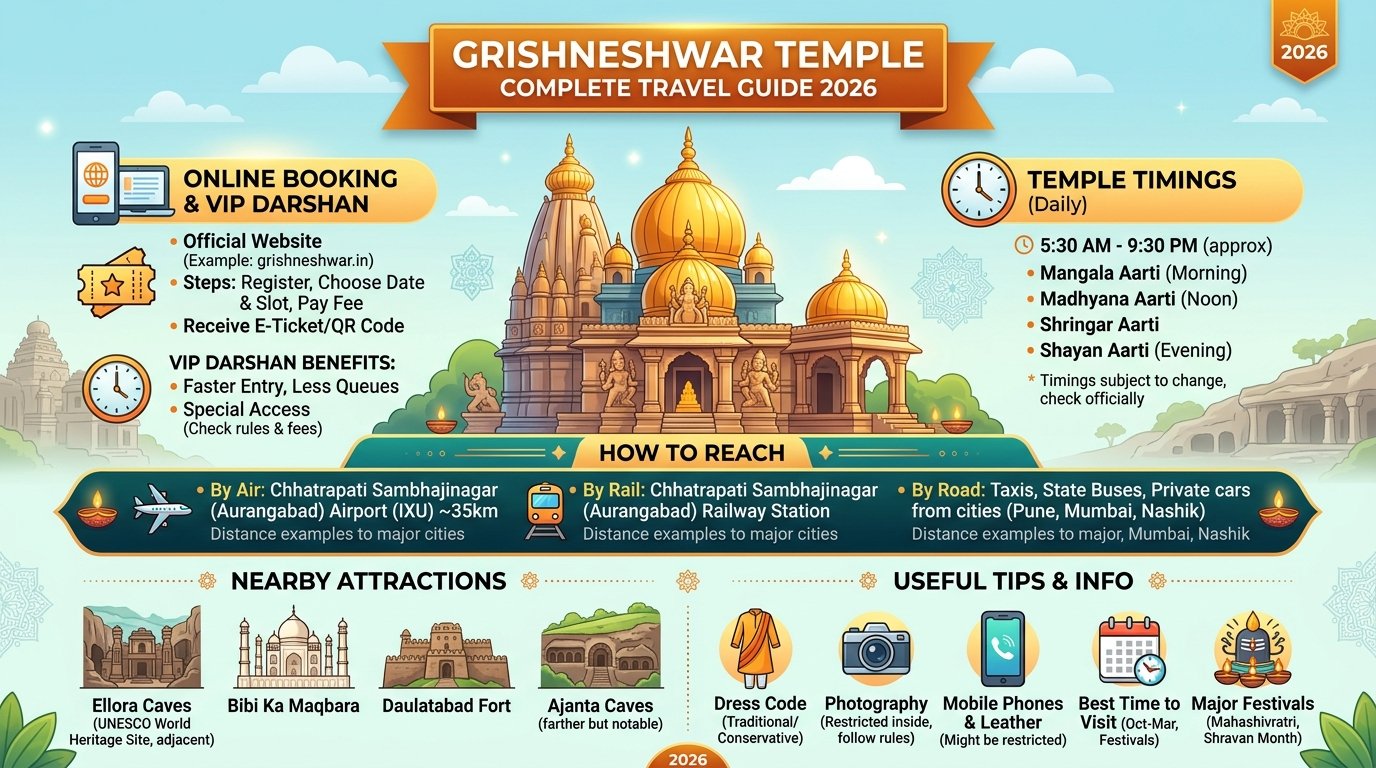
If you’re trying to plan a peaceful, well-organised visit to one of Lord Shiva’s holiest shrines, this guide is basically everything you’ll need.
Grishneshwar Temple online booking, VIP Darshan pricing, daily timings, Abhishekam slots, dress code, how to reach we’ve covered it all in one place so you don’t have to jump between ten different websites (like we did while researching this, honestly).
The Grishneshwar Jyotirlinga Temple, tucked away near the world-famous Ellora Caves in Maharashtra, is the twelfth and final Jyotirlinga mentioned in the Shiva Purana. Lakhs of devotees travel here every year, especially during Shravan and Maha Shivratri, to seek blessings from Lord Shiva.
Whether you’re planning a quick day trip or combining it with an Ellora Caves tour, knowing the correct timings, ticket options and travel logistics in advance makes a huge difference to how smooth your pilgrimage turns out to be.
Let’s get into the details.
Here’s a snapshot of the most important details before we go deeper into each section.
| Details | Information |
|---|---|
| Temple Name | Grishneshwar Jyotirlinga Temple |
| Deity | Lord Shiva |
| Location | Verul, Sambhajinagar (Aurangabad), Maharashtra |
| Darshan Timings | 5:30 AM – 3:00 PM, 7:30 PM – 9:30 PM |
| Entry Fee | Free for General Darshan |
| VIP Darshan Price | ₹500 – ₹700 approx. |
| Best Months | July–August (Shravan), Feb–March (Maha Shivratri) |
| Ideal Visit Duration | 1–2 hours |
| Nearest Attraction | Ellora Caves (1 km) |
| Dress Code | Traditional Indian attire |
The temple stays open from early morning to late night, split into two darshan sessions so pilgrims aren’t stuck waiting around during the mid-day break.
During Shravan Month, the temple often opens as early as 3:00 AM because of the sheer crowd rush. On Maha Shivratri, darshan hours get extended and the temple frequently stays open past midnight for the special night-long rituals. If you’re visiting on these dates, honestly just get there early — the queue outside can get really long by 7-8 AM itself.
The temple follows a strict daily ritual schedule, with each aarti carrying its own significance.
| Ritual | Timing |
|---|---|
| Mangal Aarti | 4:00 AM |
| Morning Jalhari Pooja | 8:00 AM |
| Maha Prasad | 12:00 PM |
| Evening Jalhari Pooja | 4:00 PM |
| Sandhya Aarti | 7:30 PM |
| Shej Aarti | 10:00 PM |
Most first-time visitors are told to catch the Sandhya Aarti. It’s genuinely the most atmospheric ritual of the day — the bells, the chanting, lamps being lit all around the sanctum — it kind of gives you goosebumps if you’re into that sort of spiritual moment.
On a regular weekday, darshan usually takes anywhere between 20 to 40 minutes. But don’t count on that during weekends, Shravan, or Maha Shivratri — the wait can stretch to 1-3 hours because of the volume of devotees. If you want a quicker experience, opting for VIP or Special Darshan cuts this time down significantly, since you skip the general queue entirely.
Abhishekam at the Grishneshwar Jyotirlinga Temple involves offering milk, curd, honey, bilva leaves, and holy water directly onto the Shiva Linga while priests chant Vedic mantras. Devotees believe this ritual → removes negativity → and invites prosperity and inner peace.
Abhishekam Timings 2026:
The approximate charge is ₹551 per person, which usually covers all the offerings you’ll need for the ritual — though this is obviously subject to change depending on temple management updates, so it’s worth confirming on arrival.
Currently, Abhishekam booking is offline only, done directly at the temple counter. Online booking for Abhishekam is expected to roll out soon based on recent temple announcements, but there’s no confirmed date yet.
This is probably the section most of you are here for, so let’s break it down properly.
The Grishneshwar temple VIP Darshan booking price typically falls between ₹500 to ₹700 per person. This VIP category (sometimes clubbed with Abhishekam access) gives you:
There’s also a mid-tier Special Darshan option priced around ₹200–₹500, which is a good middle ground for families, senior citizens, or anyone who just doesn’t have hours to spend standing in line.
| Ticket Type | Price | Features |
|---|---|---|
| General Darshan | Free | Regular Queue |
| Special Darshan | ₹200 – ₹500 | Faster Entry |
| VIP Darshan / Abhishekam | ₹500 – ₹700 | Priority Access + Abhishekam Participation |
Do keep in mind that prices can fluctuate slightly around festival season, so it’s always smart to double-check the current rate before you travel.
Good news for anyone dreading the long queues — Special Darshan online booking is currently active, and VIP Darshan slots are gradually being integrated into the same portals. Here’s how the process generally works:
Important tip: book at least a few days in advance during Shravan and Maha Shivratri because slots fill up crazy fast. Also try to reach 30-45 minutes before your allotted slot time, otherwise you might lose your spot to someone else in line.
At the moment, the temple management hasn’t published one single, standardised official booking helpline that’s widely verified across sources — this is honestly one gap in the official communication that pilgrims run into a lot. The safest route is to:
We’d recommend not relying on random third-party numbers floating around online — a lot of them are outdated or, worse, scam operators posing as booking agents. Always cross-verify through the official temple trust website before making any payment over a call.
Devotees who wish to contribute towards temple maintenance, daily rituals, or annadanam (food seva) can make an online donation through the official temple trust portal, where donation categories are usually listed for different purposes general temple fund, Abhishekam sponsorship, or festival seva contributions.
Physical donation boxes are also available at the temple premises for those who prefer to donate in person. As online donation infrastructure for the temple is still being expanded, it’s best to verify payment gateway authenticity directly on the official government or trust website before transferring any amount, just to avoid any fraudulent third-party links.
This is another area competitors barely touch on, so let’s fill that gap properly. The Grishneshwar Temple Trust does provide basic accommodation facilities for pilgrims, particularly useful during high-footfall periods like Shravan and Maha Shivratri when hotel prices in nearby Aurangabad tend to spike.
Booking accommodation in advance is strongly advised during peak season — rooms near the temple genuinely get sold out days ahead of Maha Shivratri.
The temple is well-connected via air, rail, and road, which makes travel fairly convenient no matter where you’re coming from in India.
By Air: The nearest airport is Aurangabad Airport, roughly 30 km away. Taxis and app cabs are easily available outside, and the drive takes around 45-50 minutes depending on traffic.
By Train: Aurangabad Railway Station is the nearest major station, about 29 km from the temple. From there, auto-rickshaws, state buses, and private taxis run frequently toward Verul and Ellora.
By Road: This is honestly the most flexible option. Regular buses connect from Aurangabad, Pune, and Mumbai, and private taxis or shared jeeps are widely available too.
Temple Address: Grishneshwar Jyotirlinga Mandir, Verul, Sambhajinagar (Aurangabad), Maharashtra – 431102
Since Ellora Caves is just 1 km away, most travellers club both destinations into a single day trip — makes total sense given how close they are.
Shravan Month (July–August) is considered the most auspicious period, drawing massive crowds who come to perform Abhishekam and offer prayers. Expect longer queues and extended temple hours through this month.
Maha Shivratri is the biggest festival celebrated here, featuring night-long aartis and special rituals — a great pick if you love festival energy and don’t mind the crowd.
For a calmer, less rushed darshan, weekday mornings are your best bet. Shorter queues, minimal waiting, and a genuinely peaceful atmosphere inside the Garbhagriha.
The dress code is strictly traditional, especially within the inner sanctum (Garbhagriha).
For men: Dhoti or traditional attire is preferred. Shirts and T-shirts aren’t allowed inside the Garbhagriha — men are required to remove their upper garment before entering.
For women: Sarees, salwar kameez, or any modest traditional Indian outfit are acceptable. Western clothing may not be permitted near the sanctum area.
Following the dress code isn’t just a formality — it’s a way of respecting the temple’s centuries-old customs, so it’s worth planning your outfit ahead of time.
Grishneshwar Temple → holds the distinction of being → the 12th and final Jyotirlinga of Lord Shiva described in the Shiva Purana. The structure standing today was rebuilt in the 18th century by Ahilyabai Holkar, the revered Maratha queen who also restored other major shrines including Kashi Vishwanath and Somnath.
According to legend, the temple’s origins trace back to Kusuma, a deeply devoted follower of Lord Shiva. Her unwavering devotion and sincere prayers → moved Shiva → to manifest himself in the form of a Jyotirlinga at this very spot. It’s one of those stories that really underlines how devotion, not grandeur, is at the heart of this shrine’s spiritual power.
Built using strong red basalt stone, the temple showcases intricate carvings depicting mythological legends across its walls. The Garbhagriha itself carries a calm, almost heavy sense of divine energy that a lot of visitors describe feeling the moment they step inside.
This traditional Maratha-era architecture, paired with the temple’s quiet surroundings, is part of why it draws thousands of pilgrims every single year.
You can book through the official Grishneshwar Temple portal or authorised government pilgrimage platforms offering Special and VIP Darshan slots in advance for a smoother visit.
The VIP Darshan booking price generally ranges between ₹500 to ₹700 per person, offering priority access and Abhishekam participation, though rates may vary slightly during festivals.
No single official number is universally verified currently; check the temple’s official website or MTDC helpline directly to avoid third-party scam contacts.
The temple opens from 5:30 AM to 3:00 PM and again from 7:30 PM to 9:30 PM daily, with extended hours during Shravan and Maha Shivratri.
Normal days take around 20-40 minutes, while weekends and festivals like Shravan or Maha Shivratri can stretch darshan time to 1-3 hours.
Yes, devotees can donate online through the official temple trust portal for various purposes including annadanam seva, Abhishekam sponsorship, and general maintenance funds.
Yes, basic dharamshala-style rooms are available near the temple, along with nearby MTDC guest houses and private hotels in Aurangabad city.
Yes, both Special Darshan and VIP Darshan/Abhishekam tickets are available, offering faster entry and priority access compared to the free general queue.
No, mobile phones, cameras, and leather items are strictly prohibited inside the temple premises for security and religious sanctity reasons.
Yes, unlike many other Jyotirlinga temples, women are permitted to enter the Garbhagriha here for close darshan of the Shiva Linga.
Men must remove their upper garment before entering; women should wear sarees, salwar kameez, or other modest traditional Indian attire.
The temple is just about 1 km from Ellora Caves, making it easy for tourists to cover both landmarks comfortably in a single day trip.
Aurangabad Railway Station is the nearest major station, located roughly 29 km away, with taxis and buses connecting frequently to the temple.
Early mornings and weekdays are ideal for a peaceful visit, while Shravan month and Maha Shivratri offer the most spiritually charged, festive atmosphere.
No, photography is strictly prohibited inside the temple premises, and visitors are advised to store cameras and phones in the locker facility available near the entrance.