Physical Address
304 North Cardinal St.
Dorchester Center, MA 02124
Physical Address
304 North Cardinal St.
Dorchester Center, MA 02124

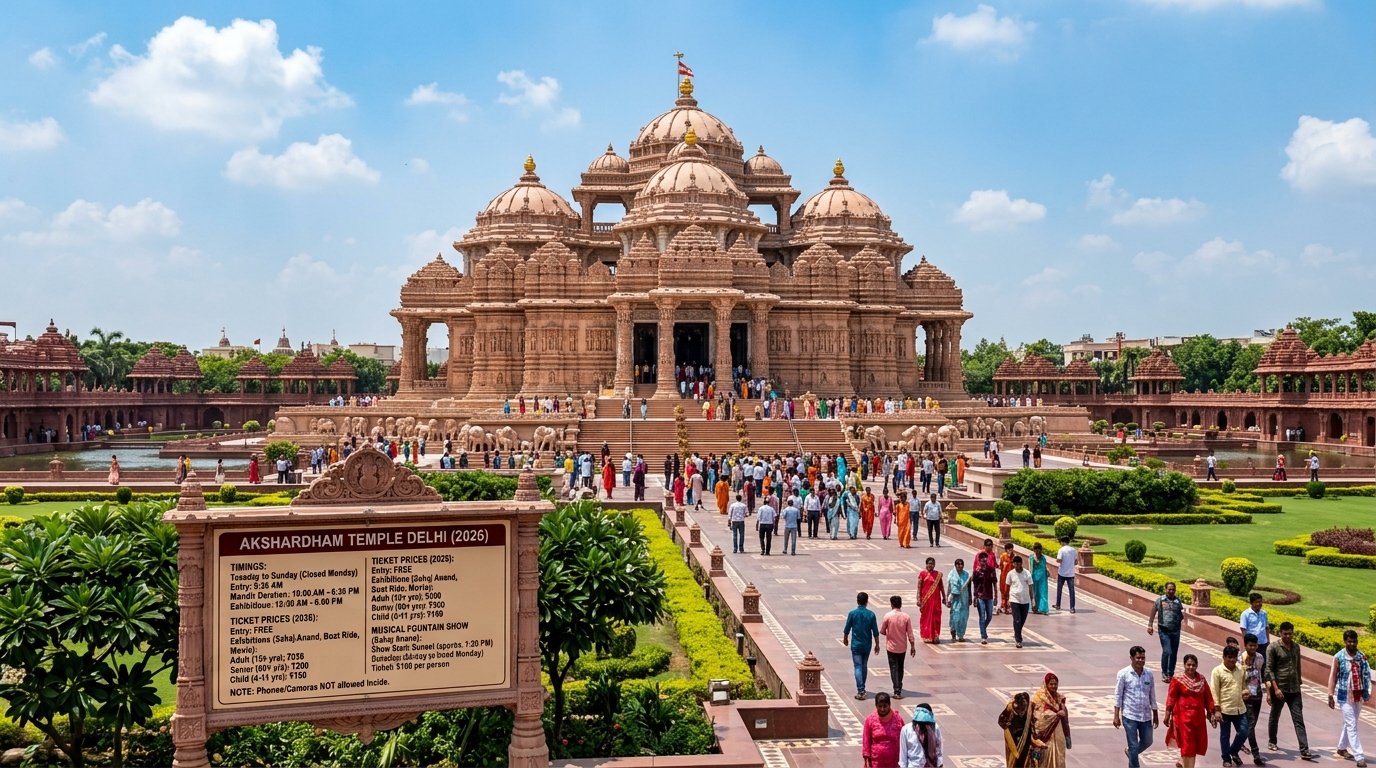
If you’re planning a trip and typing “timing of Akshardham Temple Delhi” into Google right before you leave the house, you’re honestly not alone thousands of people do it every single week.
Swaminarayan Akshardham Temple Delhi remains one of the most searched, most visited, and most talked-about spiritual landmarks in India even in 2026, and for good reason.
It’s not just a temple, it’s basically a full day out architecture, history, a boat ride, a food court, and a fountain show that genuinely surprises first-timers with how good it is.
This guide covers everything Akshardham temple Delhi timings, entry fee, the full Akshardham water show ticket price breakdown, how to reach the place, dress code, and a bunch of details competitors usually skip, like accessibility for elderly visitors and whether group bookings are even possible. Let’s get into it.
Swaminarayan Akshardham is a spiritual-cum-cultural complex situated in East Delhi, right near the Noida border along the Yamuna riverbank. It was opened to the public on 6 November 2005, and honestly, walking through it still feels fresh even two decades later, which says a lot about how it was built.
The Akshardham temple history goes back to the vision of Yogiji Maharaj, who first imagined a place like this decades before it ever existed. That vision → was carried forward by → Pramukh Swami Maharaj, and the actual construction was executed under the BAPS Swaminarayan Sanstha.
The temple is primarily dedicated to Bhagwan Swaminarayan, though you’ll also find idols of Sita-Rama, Radha-Krishna, Shiva-Parvati, and Lakshmi-Narayan inside, which kind of reflects how the whole place is built around unity rather than a single narrow tradition.
Here’s something a lot of visitors don’t realise until they’re standing in front of it: the Akshardham Mandir was built without a single piece of steel. Everything follows ancient Vastu Shastra and Pancharatra Shastra guidelines, using pink sandstone from Rajasthan and white marble. It’s the kind of detail that, once you know it, changes how you look at every pillar and carving.
Akshardham temple delhi timings for 2026 run from 10:00 AM to 8:00 PM, Tuesday through Sunday, with the temple staying shut every Monday.
Since security checks here are pretty thorough (and can genuinely take a while during peak season), it’s smart to plan around the official schedule rather than showing up whenever. Below is the full breakdown:
| Program | Timing | Days |
|---|---|---|
| Akshardham Mandir Entry Time | 10:00 AM – 8:00 PM | Tuesday to Sunday |
| Morning Aarti | 10:30 AM | Tuesday to Sunday |
| Evening Aarti | 6:00 PM | Tuesday to Sunday |
| Ticket Counter Hours | 11:00 AM – 6:00 PM | Tuesday to Sunday |
| Musical Fountain Show | ~7:00 PM – 7:45 PM | Tuesday to Sunday |
| Weekly Off | Closed | Monday |
A quick but important note: entry into the complex typically stops before the official closing time, so don’t cut it too close. If you’re wondering about Akshardham timing Sunday specifically — good news, Sunday follows the exact same schedule as the rest of the week (Tue–Sun), so there’s no separate Sunday adjustment to worry about.
Yes, it stays open on most public holidays except Monday, which is the fixed weekly closure — this applies year-round, holiday season included.
Here’s the part everyone wants to know first: entry into the main Akshardham Mandir is completely free. Darshan of Bhagwan Swaminarayan doesn’t cost a rupee. Where the Akshardham temple delhi entry fee actually applies is on the optional attractions — the exhibitions, the boat ride, and of course the fountain show.
Akshardham Exhibition Tickets (2026)
| Category | Price |
|---|---|
| Adults (12+) | ₹250 – ₹255 |
| Senior Citizens (60+) | ₹200 – ₹205 |
| Children (4–11 yrs) | ₹150 – ₹155 |
| Children below 4 | Free |
These exhibitions — including Sahajanand Darshan and Nilkanth Darshan — are honestly worth the ticket. They’re less “museum” and more “immersive storytelling,” with animatronics and film that keep even restless kids engaged.
The Sahaj Anand Water Show, commonly called the musical fountain show, is arguably the single most talked-about attraction here. It’s held after sunset at the Yagnapurush Kund, and it does something clever — it presents an episode from the Kena Upanishad through water jets, lasers, underwater flames, and surround sound. Sounds like a lot, but it flows together really smoothly, not gimmicky at all.
Akshardham Water Show Ticket Price 2026:
Now, about Akshardham water show ticket price online booking — as of the 2026 update, online booking simply isn’t available. Everything, whether it’s the exhibition, the boat ride, or the water show, is sold only at the on-site counters. So if you were hoping to book from home the night before, that’s not an option right now, unfortunately. Arrive early instead, because seats fill fast on weekends.
The show itself runs roughly 24 minutes and is conducted in Hindi. During winters and public holidays, the management usually runs multiple shows back-to-back to handle the crowd, so don’t panic if you miss the first slot.
A lot of people search “Akshardham tickets online” hoping to skip the queue, and it’s a fair expectation given how digital everything else has become. But right now, that’s simply not how this temple operates. Every ticket — exhibitions, Abhishek Mandap, the water show — is issued only at physical counters near the entrance, on a first-come-first-served basis.
Here’s the step-by-step for how it actually works:
For ₹50 per person, visitors can take part in the Abhishek Mandap ritual, a calm and personal offering experience inside the complex. It’s a nice, quieter alternative if the crowds elsewhere feel a bit much.
We touched on this above, but it deserves its own moment because it’s genuinely the reason a lot of tourists come back a second time. The Musical Fountain Show → blends → spirituality and technology in a way that’s rare for a religious site. Laser projection, water screens, and narrative voiceover all work together to tell a story most Indians grew up hearing in some form, just presented completely differently.
The campus is genuinely huge, so knowing what’s inside beforehand helps you plan your day properly instead of wandering aimlessly (which, trust me, happens to a lot of first-time visitors).
October to March is, hands down, the best window — the Delhi heat isn’t an issue and you can actually enjoy walking around the gardens without melting. Mornings are better for peaceful darshan, evenings are better for the fountain show. And honestly, weekdays beat weekends by a mile if you’re bringing elderly family members or small kids who don’t do well with crowds.
Modesty is taken seriously here, so keep this in mind before you pack:
The Akshardham temple delhi nearest metro station is, unsurprisingly, named Akshardham, and it sits right on the Blue Line — literally a short walk from the entrance gate. Honestly this is the easiest and most reliable way to get there, especially given Delhi traffic can be unpredictable.
Plan for 3 to 4 hours minimum if you want to cover darshan, the exhibitions, the boat ride, gardens, and the fountain show without rushing. If you’re someone who likes to soak everything in slowly, block out half a day — it’s genuinely worth it.
Most guides online skim past two things that actually matter a lot to families and school groups — so let’s actually answer them properly.
For school trips, NGOs, or larger tourist groups, Akshardham does accommodate group visits, but it’s not an automated online process. Groups are advised to contact the temple office in advance — via phone or email — to coordinate entry timing and, where possible, arrange a guide for the exhibitions.
There isn’t a published “group discount” rate publicly listed, so it’s best to confirm current group rules directly with the temple administration before finalising a large trip, especially for school excursions during peak winter season when footfall is already high.
While senior citizens do get a slightly discounted exhibition and water show ticket, the campus itself is fairly walkable and has ramps at key access points, along with wheelchair availability at the entrance for those who need it.
That said, given the sheer size of the complex, elderly visitors or those with mobility challenges should ideally plan a slower pace and prioritise the main mandir darshan and one or two exhibitions rather than trying to cover everything in one go. Staff at the entrance can usually guide you toward the most accessible route once you mention any specific requirement.
A fair number of visitors search “Delhi Akshardham room charges” assuming there might be guest rooms or a dharamshala-style stay option, similar to some other pilgrimage sites in India. To clarify — Akshardham Temple Delhi does not offer on-site accommodation or guest rooms for visitors. It functions purely as a day-visit spiritual and cultural complex, not a residential facility. If you’re travelling from out of town, you’ll need to book a hotel or guesthouse elsewhere in Delhi or Noida, both of which have plenty of options within a short drive of the temple.
This is a search term that trips up a lot of people, so it’s worth addressing directly. The terror attack that people often reference happened in 2002 at the Akshardham Temple in Gandhinagar, Gujarat — not the Delhi temple, which wasn’t even built yet at that time (Delhi’s Akshardham opened only in 2005). Security at the Delhi complex today is understandably strict, partly informed by that history, which is why phones, bags, and electronics face tight scrutiny at entry. But there has been no such incident at the Delhi Akshardham itself.
If you’ve got a full day in Delhi, pair your Akshardham visit with:
Whether you’re going for pure devotion, the architecture, or just to catch that fountain show everyone keeps talking about, Swaminarayan Akshardham Temple Delhi genuinely delivers on all fronts. Just remember — no online tickets yet, no on-site rooms, and Mondays are a no-go. Plan around that, get there early on weekends, and you’re set for a smooth visit.
The temple is open 10:00 AM to 8:00 PM, Tuesday through Sunday. It’s closed every Monday, so double-check your visit day beforehand to avoid disappointment.
Yes, darshan of the main mandir is completely free for everyone. Tickets are only needed for exhibitions, the water show, and the Abhishek Mandap ritual separately.
Adults pay ₹90–₹95, children (4–11 years) pay ₹60–₹65, and kids below 4 enter free. Tickets are sold only at on-site counters currently.
No, as of 2026, online booking isn’t available for exhibitions, the water show, or Abhishek Mandap. All tickets are purchased in person at the temple counters.
Akshardham Metro Station on the Blue Line is the closest, just a short walk away. It’s honestly the easiest way to reach without worrying about Delhi traffic.
The show usually starts after sunset, around 7:00 PM to 7:45 PM. Timings shift slightly with the season, so arriving a little early is wise.
A complete visit covering darshan, exhibitions, the boat ride, and the fountain show takes about 3 to 4 hours. Half a day works better for a relaxed pace.
No, mobile phones, cameras, and smartwatches aren’t permitted inside. Lockers are available near the entrance to store your belongings safely.
Exhibition tickets cost around ₹250 for adults, ₹200 for senior citizens, and ₹150 for children (4–11 years). Kids under 4 get free entry.
Yes, the temple remains closed every Monday, without exception. All other days follow the regular 10 AM to 8 PM schedule.
No, the 2002 attack occurred at Akshardham Temple in Gandhinagar, Gujarat, not Delhi. The Delhi complex opened only in 2005, after that incident.
No, Akshardham Delhi doesn’t offer on-site rooms or lodging. Visitors need to book hotels separately in Delhi or Noida for overnight stays.
Yes, group visits are possible, but require advance coordination with the temple office via phone or email, since there’s no automated online group booking system.
October to March offers the most comfortable weather. Weekday mornings or evenings are ideal, especially for families and senior citizens.
It’s known for its steel-free architecture, immersive exhibitions, the Sanskruti Vihar boat ride, and the Sahaj Anand musical fountain show held after sunset daily.