Physical Address
304 North Cardinal St.
Dorchester Center, MA 02124
Physical Address
304 North Cardinal St.
Dorchester Center, MA 02124

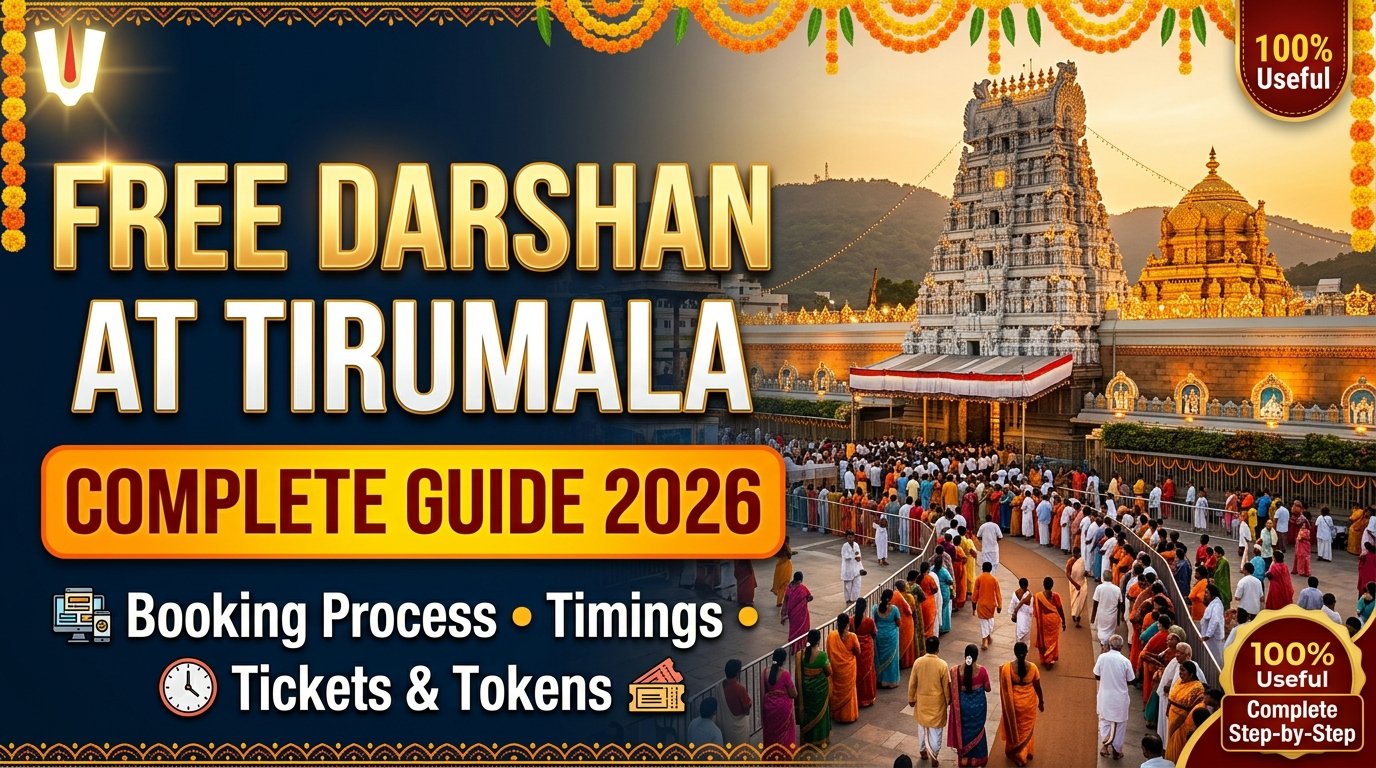
Every year, millions of devotees climb, drive and queue their way up to the seven hills to see Lord Venkateswara, and a huge number of them never pay a single rupee for it.
Free darshan at Tirumala is run by the Tirumala Tirupati Devasthanams (TTD) through three systems: Sarva Darshan, Slotted Sarva Darshan and Divya Darshan.
This guide covers the booking process, timings, token counters, waiting times and walking routes in plain language, so you can plan the trip without running around confused on the day.
Free darshan at Tirumala means no-cost entry to see Lord Venkateswara (Srivari) at the hill temple, with no ticket fee. TTD offers it through three channels: Sarva Darshan (the open queue), Slotted Sarva Darshan (SSD) (a time-slot token) and Divya Darshan (for pilgrims who walk up).
TTD manages all three systems, and every one of them ends at the sanctum sanctorum (Garbhagriha). The only real difference is how you wait. Some people stand in a long hall for hours, others get a time slot, and some walk the hill and get a faster line as a reward. Nobody is turned away for not having money, which is the whole point.
| Darshan Type | Cost | Where to Start | Typical Wait (Normal Days) | Best For |
|---|---|---|---|---|
| Sarva Darshan | Free | Vaikuntham Queue Complex II | 6-10 hours, 15-20+ in peak season | Devotees with plenty of time |
| Slotted Sarva Darshan | Free | Token counters in Tirupati (Srinivasam, Bhudevi) | Much shorter once your slot arrives | Elders, families with kids, tight schedules |
| Divya Darshan | Free | Alipiri or Srivari Mettu footpath | Faster line after the climb | Fit devotees who want to walk |
| Rs. 300 Special Entry Darshan | Paid | Booked online on the TTD website | Usually 2-4 hours | People wanting a predictable, quicker slot |
The paid Rs. 300 option is here only for comparison. The free routes get you the same darshan, just with different waiting patterns.
Sarva Darshan is the first-come-first-served free queue where devotees join at the Vaikuntham Queue Complex II without any booking. You just show up, enter the compartments and wait your turn. It’s the oldest system and probably still the most used one.
Waiting is the catch. On ordinary weekdays you may stand or sit for 6 to 10 hours, and during Brahmotsavam or Vaikunta Ekadasi it can stretch to 15-20 hours or more. Many pilgrims actually like this, honestly, because the long hours become time for chanting and prayer.
The compartments have drinking water, food counters (TTD serves milk, tea and Annaprasadam at regular intervals) and toilets, so it’s not as rough as people imagine.
Devotees are let into the Vaikuntham Queue Complex and held in numbered compartments. When one compartment is released, the crowd moves forward to the next, and finally to the temple.
This is how TTD does crowd management with lakhs of people in a month. If you hear someone say “20 compartments are full”, that is a rough indicator of the current wait.
Slotted Sarva Darshan is a free darshan system where each devotee gets a token with a specific time slot, so they only join the queue at that time. It was brought in to cut unpredictable waits, and for most families it’s the best free option going.
Tokens are given out at counters in Tirupati town, mainly the Srinivasam Complex and the Bhudevi Complex, and sometimes at other counters near the railway station and bus stand. Each token shows a date and time window.
Until then, you’re free to rest at your accommodation in Tirumala or Tirupati, visit nearby temples, or just eat a decent meal. When the time comes, you go straight to the entry point and your standing time drops a lot.
Slotted Sarva Darshan reduces waiting time and queue unpredictability, and that’s why senior citizens, parents with small kids and anyone on a tight schedule prefer it.
Divya Darshan is reserved for devotees who walk up to Tirumala via the Alipiri footpath or the Srivari Mettu pathway. Free tokens are issued at a checkpoint during the walk, and these give a faster entry once you reach the top. Many consider it the most satisfying way, since the effort feels like part of the prayer.
There’s no single official “map” image everyone uses, so here’s the route logic in words. For the Tirumala free darshan route map, picture two paths climbing the same hill:
| Feature | Alipiri Footpath | Srivari Mettu |
|---|---|---|
| Starting point | Alipiri, Tirupati | Near Chandragiri (Srinivasa Mangapuram) |
| Distance | Long (roughly 9-11 km) | Short (around 2-3 km of steps) |
| Climb time | Approx. 3-5 hours for most people | Approx. 1.5-2.5 hours |
| Timings | Open 24 hours | Daytime only |
| Terrain | Steady steps with covered sections | Steeper, more direct |
| Suitable for | Families, first-timers | Fitter, faster walkers |
The exact distance, step count and token checkpoint locations are things TTD updates now and then, so check the TTD official website or the signboards at the start of the path before you begin. On both routes, TTD provides rest stations, medical facilities and refreshment points, which helps a lot if you’re not used to climbing.
This is where most competitors say very little, so let’s go slowly. Sarva Darshan needs no booking, Slotted Sarva Darshan needs a token from a counter (and sometimes an online release), and Divya Darshan tokens are issued during the walk.
Slotted Sarva Darshan token process:
For Divya Darshan, start the climb, collect your free token at the designated checkpoint along the path, and keep it safe until you reach the temple queue. Don’t lose it, because no token means no fast entry.
Many people search for TTD free darshan online booking availability, and the straight answer is that it’s limited. Paid options like the Rs. 300 Special Entry Darshan are booked online through the TTD website and app.
Free tokens, on the other hand, are mostly counter-based, though TTD has tried online or app-based quotas for some slots from time to time. Rules change, so verify on the official TTD website before you travel. Never pay an agent or a random website for “free” tickets; that is a scam, and there are plenty of them.
Temple timings at Tirumala run almost round the clock, but the day starts early. The temple opens in the early hours with Suprabhatam Seva, and general darshan for the public continues through the day until late night, ending with Ekantha Seva. There are also breaks for cleaning and special rituals, so the line pauses now and then.
If you search today Tirumala darshan timings or Tirupati darshan timings today, remember that timings aren’t fixed every single day. On Fridays, festival days and special occasions (like Koil Alwar Tirumanjanam, which is a temple cleaning ritual), darshan may start late or pause for hours. Always confirm the current schedule on the official TTD website or the TTD mobile app on the morning of your visit.
Many pilgrims keep asking about Tirumala free darshan token timings today and Tirupati free darshan token timings. Token counters in Tirupati generally begin issuing early in the morning, and some counters work in the afternoon or night depending on demand.
But here’s the thing: slots for popular days fill up very quickly, sometimes before noon. So reach early, and don’t assume the counter will still be giving tokens at 4 PM.
Tirumala darshan waiting time changes every hour, so the only reliable number is the one TTD shows live. Anything written in an article, including this one, is only a normal range.
When people search Tirumala darshan waiting time today, Tirupati free darshan waiting time today or Tirumala free darshan time today live, they want a live number. Here’s where to find it:
Compartment counts are the usual indicator. If most of the compartments are full and the line extends outside, expect a long day.
For Tirumala darshan waiting time tomorrow or Tirupati free darshan waiting time tomorrow, nobody can promise an exact number. But you can predict it roughly. Weekends, school holidays, long weekends, Saturdays (considered auspicious for Lord Venkateswara) and the Brahmotsavam period are always heavy.
Tuesdays to Thursdays are usually lighter. If your dates are flexible, pick a weekday outside festival season and you might save several hours.
The best time for free darshan is a mid-week day outside festivals and school vacations. Early monsoon and the winter months excluding Vaikunta Ekadasi tend to be calmer.
Summer holidays (April to June) and the festival season push crowds up big time, and Brahmotsavam (usually in September-October) is the heaviest period of the year. If you’re reading this in October 2026, check the festival calendar first, since crowds around Brahmotsavam can change everything.
Think about your health, time and group. Here’s a simple way to decide:
Every devotee who completes free darshan receives one free laddu prasadam at the laddu distribution counter by showing their token. These are made in the temple’s own kitchens with traditional recipes, and the Tirupati laddu even has a GI tag.
Extra laddus can be bought at the counters for a small price, and people usually carry a bunch home for relatives. Pack them well, because they’re delicate.
TTD requires traditional attire and valid ID for darshan. Men typically wear dhoti, kurta-pyjama or neat formal wear, and women wear sarees, churidars or salwar kameez with a dupatta. Shorts, sleeveless tops and jeans can get you stopped at the entrance.
Before you go, sort out these essentials:
Also book your accommodation in Tirumala or Tirupati early. TTD guest houses, Padmavathi and Srinivasam complexes and private hotels fill up fast during peak weeks.
TTD updates its rules frequently, so the guidelines for 2026 can differ from last year. Recent years have seen changes to token distribution, Aadhaar-linked verification, quota releases and crowd control measures.
Whatever you read in a blog (this one too), the official TTD website is the final word. Look for notices about temporary closures, festival darshan rules and any pause in token issuing before you finalise travel tickets.
A few practical things that make life easier:
Yes. TTD offers Sarva Darshan, Slotted Sarva Darshan and Divya Darshan at no cost. You only pay if you choose paid services like the Rs. 300 Special Entry Darshan or special sevas.
It changes hourly. Normal days see roughly 6-10 hours in Sarva Darshan, but festivals can reach 15-20 hours. Check the TTD website, app or SVBC channel for the live figure.
Use the official TTD website or mobile app, watch SVBC live, or look at display boards at Vaikuntham Queue Complex. These show compartment status, which gives a good idea of the current wait.
Not exactly. You can only estimate using the day of the week, holidays and festivals. Weekends and festival days are crowded, while mid-week days are usually lighter and quicker.
The temple generally opens before dawn with Suprabhatam and runs through the night until Ekantha Seva, with short breaks. Timings can change on festival days, so confirm on the TTD website daily.
Tokens are issued at counters in Tirupati like Srinivasam Complex and Bhudevi Complex. You need valid ID, usually Aadhaar, and all group members generally must be present when collecting them.
Mostly no. Free tokens are largely counter-based, though TTD sometimes releases limited online slots. Paid tickets are booked online. Always verify availability on the official TTD website to avoid scams.
Counters in Tirupati usually start early in the morning and may continue through the day, depending on demand. Slots for busy days can finish early, so reach as soon as possible.
Divya Darshan tokens are given at checkpoints along the footpath, so timing depends on when you walk. Alipiri is open 24 hours, while Srivari Mettu works only in daytime.
Two routes lead up: the long Alipiri footpath from Tirupati and the shorter Srivari Mettu near Chandragiri. Signboards and TTD staff at the start guide you along the way.
Most devotees need around 3-5 hours depending on fitness and breaks. It’s open 24 hours, with rest stations and medical facilities along the path, so you can climb at your own pace.
Yes. Each devotee gets one complimentary laddu prasadam at the distribution counter by showing their token. Extra laddus can be bought at a small additional price.
Traditional attire is mandatory. Men wear dhoti or kurta-pyjama, and women wear sarees or salwar kameez with dupatta. Western outfits like shorts, sleeveless tops and jeans are generally not allowed.
Slotted Sarva Darshan suits seniors best because waiting time is shorter and predictable. Also ask TTD about special arrangements for elders, as separate facilities are sometimes available.
Mid-week days outside school holidays and festivals have the shortest queues. Avoid Brahmotsavam, Vaikunta Ekadasi, summer vacations and weekends if you want a faster, calmer darshan.