Physical Address
304 North Cardinal St.
Dorchester Center, MA 02124
Physical Address
304 North Cardinal St.
Dorchester Center, MA 02124

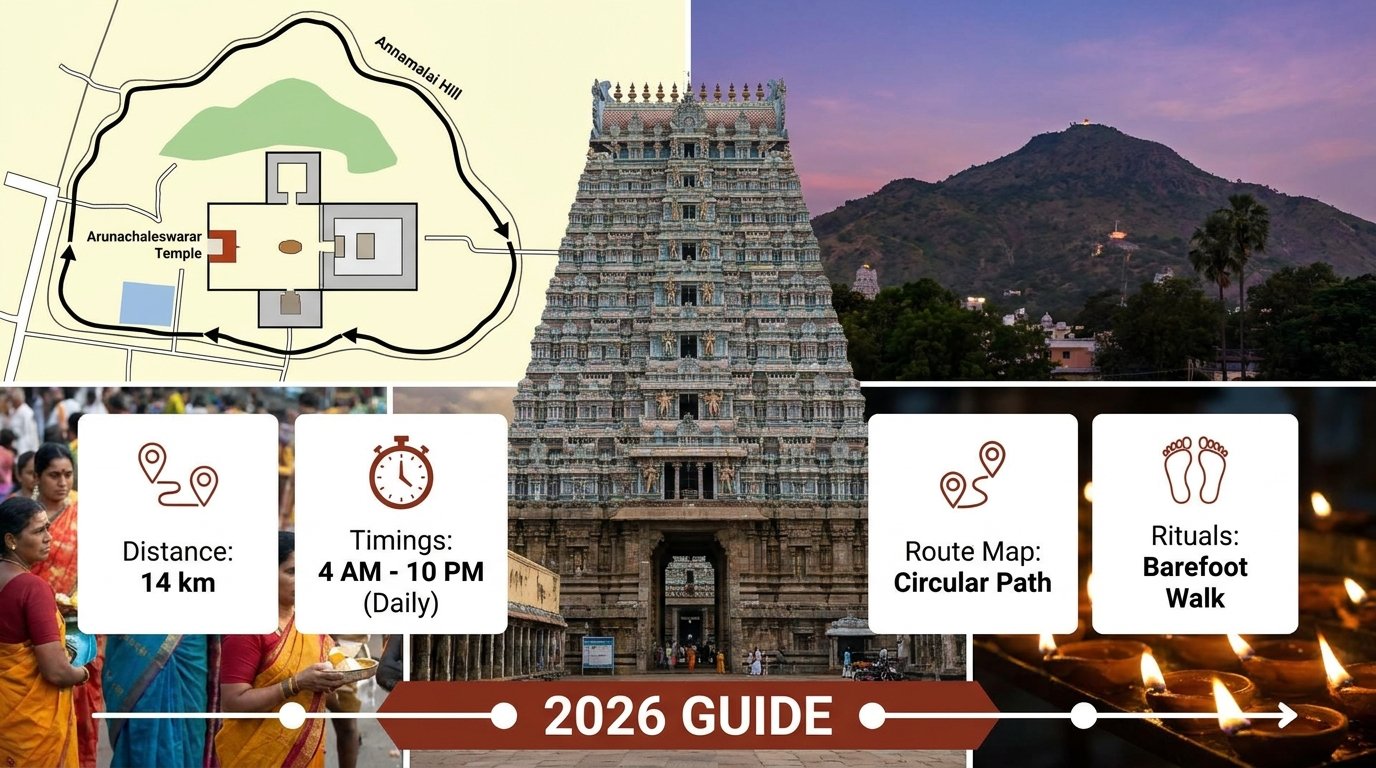
If you’ve ever wondered why thousands of people walk barefoot around a hill in the middle of the night in Tamil Nadu, you’re not alone. The Arunachaleswarar Temple Giripradakshina is one of those experiences that’s hard to explain until you’ve actually done it.
This guide covers everything — the exact arunachalam giri pradakshina distance and time, the best starting point, the route map, upcoming 2026 dates, and the deeper rituals behind it. Honestly, most articles online just skim the surface, so we’ve tried to dig a bit deeper here.
Giripradakshina, often just called giripradakshina arunachalam or Giri Valam by locals, is the practice of walking a full circle around the sacred Arunachala Hill in Tiruvannamalai. The word itself basically means “walking around the mountain,” and it’s considered one of the most powerful forms of devotion in Shaivism.
Arunachala Hill → is regarded as → the physical embodiment of Lord Shiva, specifically as the Agni Lingam, one of the five Pancha Bhoota Sthalas representing fire. So when devotees do this walk, they’re not just taking a stroll — they believe they are literally circling Shiva himself. Saints like Sri Ramana Maharshi, who lived most of his life at the foot of this hill, called this walk a form of living meditation, where every step is basically a prayer in motion.
The full route covers roughly 14 kilometers, and most people take somewhere between 3 to 5 hours to finish it, depending on how fast they walk and how many stops they make at the shrines along the way.
A few quick pointers on the arunachalam giri pradakshina distance:
The path is mostly flat with a few gentle inclines, so it’s manageable for most people, though your feet will definitely feel it by kilometer ten if you’re walking barefoot.
Most devotees begin the arunachalam temple giri pradakshina starting point right from the main entrance (the Eastern Rajagopuram) of the Arunachaleswarar Temple itself. From there, you move in a clockwise direction (this is important — always keep the hill on your right side, this is called Pradakshina direction and it’s non-negotiable in tradition).
Some people prefer starting from the Ramanasramam side if they’re staying near there, but the traditional and most common arunachalam giri pradakshina starting point remains the temple’s main tower. It’s easier to find, there’s better lighting at night, and you’ll usually find fellow pilgrims starting from the same spot, which honestly makes the walk feel less lonely, especially if you’re going solo at 4 AM.
The arunachalam giri pradakshina route map takes you in a full loop around Arunachala Hill, passing through several small townships, shrines, and the famous Ashta Lingams — eight Shiva Lingams placed in eight directions around the hill.
| Lingam Name | Direction | Significance |
|---|---|---|
| Indra Lingam | East | Grants prosperity and protection |
| Agni Lingam | South-East | Removes ignorance, symbol of fire |
| Yama Lingam | South | Overcomes fear and obstacles |
| Niruthi Lingam | South-West | Clears negative energy |
| Varuna Lingam | West | Balances emotions, symbol of water |
| Vayu Lingam | North-West | Enhances vitality, symbol of air |
| Kubera Lingam | North | Brings wealth and abundance |
| Eesanya Lingam | North-East | Spiritual awakening |
Along the way, you’ll also pass Sri Ramanasramam (the ashram of Sri Ramana Maharshi), the Durga Temple, Gautama Ashram, and Chandikeswara Temple. Each of these spots is worth a short pause, not just for rest but for the quiet energy they carry. If you’re using a phone map for reference, most navigation apps now have the Girivalam path marked clearly, so getting lost really isn’t much of an issue anymore.
There’s technically no fixed time to perform Girivalam — the path stays open round the clock. That said, here’s when most people prefer to go:
For arunachalam temple giri pradakshina timings related to darshan at the main temple itself (after your walk), the temple is open:
While the path is open every single day, certain dates carry far greater spiritual weight. For arunachalam temple giri pradakshina dates 2026, keep an eye on the monthly Pournami (Full Moon) calendar since these dates shift slightly each year based on the lunar cycle. It’s best to check the temple’s official website or a Tamil panchangam calendar closer to each month for the exact date, but broadly, expect one Pournami Girivalam night every month throughout 2026.
The two biggest dates to mark on your calendar:
Beyond these, Maha Shivaratri, Pradosham days, Arudra Darshan, and Chitra Pournami are also considered auspicious for this walk, though crowds tend to be much smaller compared to the monthly Full Moon nights.
This isn’t just a fitness walk dressed up in spirituality — for most devotees, it’s genuinely transformative. Here’s why people keep coming back, year after year.
Hindu scripture holds that sincere Girivalam → leads to → Moksha, or liberation from the cycle of birth and rebirth. Some devotees even say a single walk done with true faith is enough to please Lord Shiva.
Walking around the hill is believed to dissolve accumulated karma. Barefoot walking + chanting “Om Namah Shivaya” → results in → cleansing of past sins, according to long-standing tradition passed down through generations of pilgrims.
Even if you set the religious angle aside for a second, there’s something genuinely calming about walking in silence for hours, surrounded by hills and quiet chanting. Many first-timers report feeling mentally lighter after just one round, regardless of their personal beliefs.
The 14 km barefoot walk builds endurance and, frankly, it’s a decent workout too. It connects you with nature in a way that a gym treadmill never really can.
Most guides stop at “carry water and wear comfortable clothes,” but there’s more to planning this trip properly, especially around arunachalam giri pradakshina map directions and the practical side of things.
Parking and Vehicle Access: During Pournami nights and especially Karthigai Deepam, vehicle movement gets restricted near the main route. Local authorities usually set up designated parking zones a few kilometers out, so plan to walk a bit extra just to reach the starting point on big nights. If you’re driving down from Chennai or Bangalore, aim to park your vehicle by early evening — spots fill up fast.
Crowd Density: On a regular weekday, the path is fairly peaceful, maybe a few hundred walkers. On Pournami nights, this number can swell into the tens of thousands, and during Karthigai Deepam, it genuinely feels like a small city has descended on Tiruvannamalai. If you prefer a quieter walk, avoid weekends close to the Full Moon.
Accessibility for Elderly or Differently-Abled Devotees: This part rarely gets mentioned, but it matters. Some sections of the path near the temple entrance are relatively wheelchair-friendly with paved roads, though the full 14 km loop does have uneven patches in certain stretches. A few local services offer cycle-rickshaws or small carts for elderly pilgrims who want to attempt the full circuit without walking the entire distance — worth asking around locally or at your accommodation.
Entry Fees: There’s no entry fee for the Girivalam path itself since it’s a public road. Temple darshan inside Arunachaleswarar Temple is also free, though special/VIP darshan tickets (if offered) may carry a nominal charge during festival season.
Walking 14 km, often at night, does need a bit of common sense:
Getting there is fairly straightforward given the town’s connectivity to major South Indian cities.
By Air: Chennai International Airport is about 190 km away (4-5 hours by road), while Puducherry Airport is closer at roughly 110 km (2.5-3 hours).
By Train: Tiruvannamalai Railway Station connects directly with Chennai, Bangalore, Madurai, and Hyderabad, making rail travel a comfortable option for most pilgrims.
By Road: From Chennai it’s about 195 km (4-5 hours), from Bangalore around 210 km (5-6 hours), and from Puducherry just 110 km (roughly 3 hours). Regular government and private buses run throughout the day, plus taxis are easy to book.
The full route is about 14 kilometers around Arunachala Hill, and it typically takes anywhere from 3 to 6 hours depending on your pace and how many stops you make along the way.
It’s the sacred practice of circumambulating Arunachala Hill in Tiruvannamalai, walked clockwise, usually barefoot, as a form of devotion to Lord Shiva believed to reside within the hill itself.
Most devotees begin from the Eastern Rajagopuram (main tower) of Arunachaleswarar Temple, then proceed clockwise around the hill, keeping it on their right side throughout.
The path is open 24/7, but most people prefer early morning (4-7 AM) or evening (after 6 PM) to avoid heat. Temple darshan runs 5:30 AM-12:30 PM and 3:30-9:30 PM.
Yes, most navigation apps now mark the Girivalam path clearly. It passes the Ashta Lingams, Sri Ramanasramam, Durga Temple, and several smaller shrines along the loop.
Monthly Pournami nights are the main dates, shifting slightly each month per the lunar calendar. Karthigai Deepam, expected around November-December 2026, is the grandest occasion.
Yes, though soft sandals are perfectly acceptable if you’re not used to barefoot walking. Tradition favors bare feet, but comfort and safety should come first, especially for longer stretches.
There are eight Ashta Lingams — Indra, Agni, Yama, Niruthi, Varuna, Vayu, Kubera, and Eesanya — each placed in a specific direction around Arunachala Hill.
Devotees believe it cleanses karma, brings inner peace, and leads toward Moksha. Physically, it also builds endurance and offers a meditative break from daily stress and noise.
Generally yes, especially on Pournami nights when the path is well-lit and crowded. Solo walkers should still stay alert and stick to well-populated stretches of the route.
By air via Chennai (190 km) or Puducherry (110 km), by train via Tiruvannamalai station, or by road from Chennai, Bangalore, or Puducherry, all well-connected by bus and taxi.
Yes, small shops, drinking water points, and shaded resting areas are available throughout the route, though facilities are more crowded during Pournami and festival nights.
Light cotton clothing works best, along with a shawl if walking at night. Comfortable, breathable fabric helps a lot given the distance and typical Tamil Nadu heat.
It’s not compulsory, but many devotees prefer light, simple vegetarian food before starting, believing it keeps the body and mind lighter for the walk ahead.
October to March offers the coolest, most pleasant weather for the walk. Summer months can get quite harsh, especially during midday hours on the exposed stretches.