Physical Address
304 North Cardinal St.
Dorchester Center, MA 02124
Physical Address
304 North Cardinal St.
Dorchester Center, MA 02124

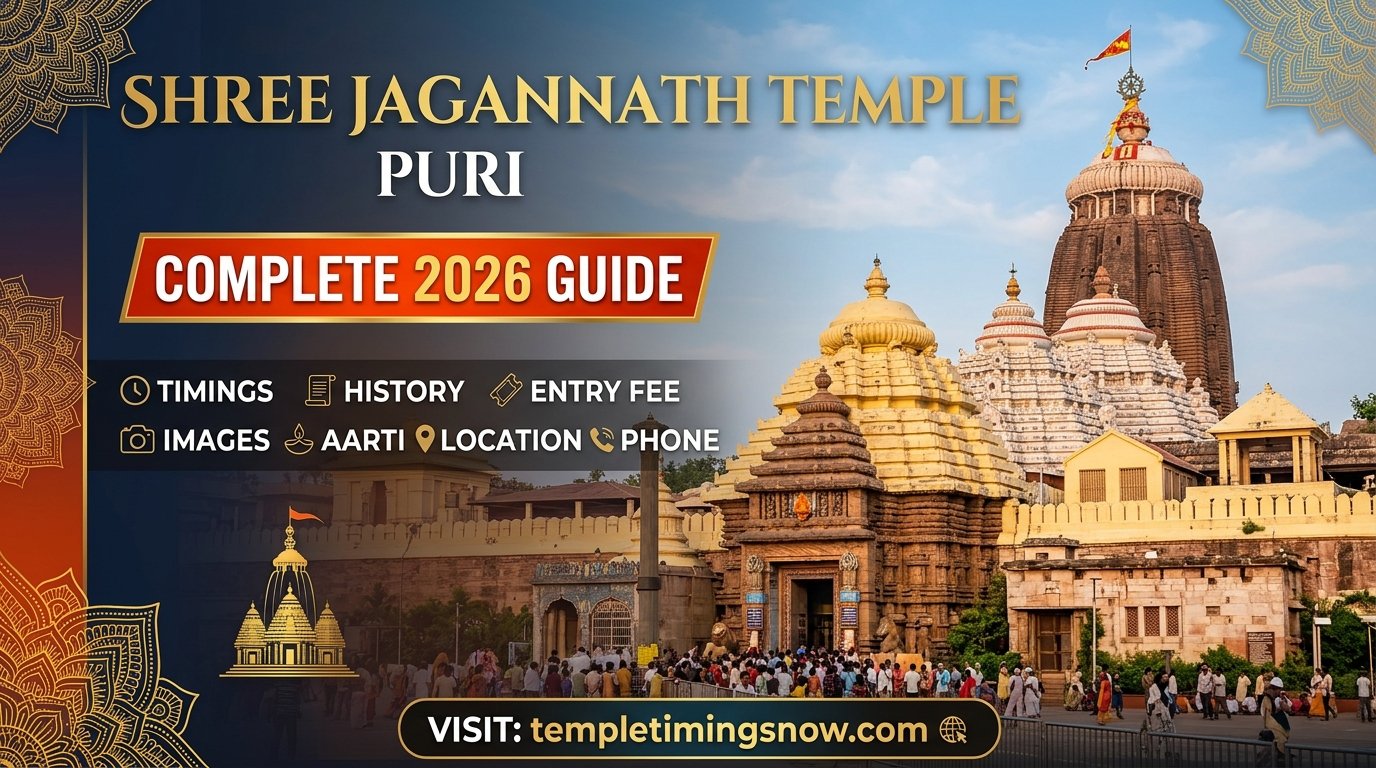
Few places in India pull in crowds the way the Shree Jagannath Temple Puri does. Millions of pilgrims arrive here every year, some on foot from villages hundreds of kilometres away, others on a quick weekend train from Kolkata or Bhubaneswar.
This guide covers everything in one place: Puri Jagannath temple timings, the daily aarti schedule, history, entry fee, photos, location, phone details and the practical stuff most blogs skip. Read it before you go, it’ll save you a lot of confusion at the gate.
The Shree Jagannath Temple is a 12th-century Hindu shrine in Puri, Odisha, dedicated to Lord Jagannath, a form of Vishnu. It is one of the four Char Dham pilgrimage sites of India.
| Detail | Information |
|---|---|
| Entry fee | No entry fee (free for Hindu devotees) |
| Address | Shri Jagannath Temple, Chief Administration Office, Grand Road, Puri, Odisha 752001 |
| General darshan hours | Approx. 5:30 am to 9:00 pm, every day |
| Phone | No reliable public helpline listed (see contact section) |
| Main deities | Jagannath, Balabhadra, Subhadra |
| Architecture | Kalinga style, with Rekha Deula and Pitha Deula |
| Photography | Not allowed inside the temple |
The temple stands on the Grand Road (Bada Danda), and it’s busy from early morning till very late at night. Honestly, even on an ordinary Tuesday there’s a crowd, so plan accordingly.
The Puri Jagannath temple timings are roughly 5:30 am to 9:00 pm daily, although the rituals inside continue until about midnight. The doors open at around 5:30 am, but devotees are allowed in for darshan only after the Mangala Aarti is over.
People searching for Puri temple timings or Puri mandir timing often get confused, because the temple doesn’t work like a museum with a fixed open and close. Darshan is paused several times during the day whenever a private ritual takes place. The gaps are normal, nothing is wrong.
The rough pattern, which can shift a little on festival days, looks like this:
The word aarti gets used loosely online, but the temple runs on dozens of small rituals called niti. The main ones are shown below.
| Ritual | Approx. time |
|---|---|
| Dwarapitha & Mangala Aarti | 5:00 am |
| Mailam / Abakash | 6:00 to 6:30 am |
| Sahanamela | 7:00 to 8:00 am |
| Beshalagi / Surya Puja | 8:00 to 8:30 am |
| Gopala Ballava Puja | 9:00 am |
| Sakala Dhupa (morning food offering) | 10:00 am |
| Madhyanha Dhupa (afternoon offering) | 11:00 am to 1:00 pm |
| Madhyanha Pahuda | 1:00 to 1:30 pm |
| Sandhya Aarti | 5:30 pm |
| Sandhya Dhupa | 7:00 to 8:00 pm |
| Chandana Lagi | 8:30 pm |
| Badashringara Vesha & Bhoga | 9:30 to 10:30 pm |
| Khata Seja Lagi & Pahuda (rest ritual) | Around midnight |
A small warning: the timing of each ritual moves a bit depending on the season, festival calendar and the sevayats’ schedule. Treat the table as a guide, not a train timetable.
There is no entry fee for the Jagannath Temple. Entering and having darshan of the deities is free of charge. Nobody at the gate should ask you for a ticket. If someone does, politely say no and keep walking.
One thing that people often ask about is the entry rule. Non-Hindus are not allowed to enter the temple, and that rule has stood for centuries. Visitors who can’t go inside still have options, which we cover in the gaps section below.
King Anantavarman Chodagangadeva of the Eastern Ganga dynasty started building the present Jagannath Temple in the 12th century AD, and it was completed in 1230 AD under Anangabhima Deva III, who also installed the deities.
Long before that, according to folklore, the Lord was worshipped as Purushottama, the creator, protector and destroyer of the world. The name “Jagannath” literally means Lord of the Universe. Over the centuries the temple has seen invasions, repairs, and a lot of devotion, and somehow it’s still going strong today.
The Puri Jagannath temple idols story is one of the most loved legends in Hindu tradition, and honestly it’s worth knowing before you step inside.
According to the tale, King Indradyumna of Avanti was told in a dream to find the sacred form of Vishnu, known as Nilamadhava, worshipped in secret by a tribal chief called Viswavasu. The king later got a divine log of wood (Daru Brahma) washed ashore at Puri. Vishwakarma, the divine architect, agreed to carve the idols, but he set one strict condition: nobody should disturb him for 21 days.
Queen Gundicha got worried when she heard no sound from the closed room, and the door was opened before time. Vishwakarma disappeared, leaving the idols unfinished, with no proper hands or legs.
That’s why Lord Jagannath, Balabhadra and Subhadra look the way they do, with large round eyes and a simple wooden form. Devotees see this “incompleteness” as perfection itself, and that’s the whole beauty of the Jagannath Puri story.
Nabakalebara is a ritual in which the wooden idols of Jagannath, Balabhadra and Subhadra are replaced with new ones, and it takes place when a special astrological year comes around, typically at 8, 11, 12 or 19 year intervals. The word means “new body”.
The process has about twelve stages: a search party goes into the forest, they identify the sacred neem trees (daru) by specific signs, then the wood is cut, brought to Puri, carved, and the new idols are installed.
The old ones are buried in the temple premises at Koili Baikuntha. The last Nabakalebara was in 2015, and the next one is expected around 2034. Millions attend, which tells you how big a deal it is.
About twelve major festivals are observed with great enthusiasm here, collectively called the Dvadasa Yatras. They include Snana Yatra, Dola Yatra, Chandana Yatra, Akshaya Tritiya, Makar Sankranti and Damanaka Chaturdashi, among others. Smaller observances like Holi, Ram Navami, Ganesh Chaturthi and Jhulan Yatra are also celebrated.
Rath Yatra is the annual Chariot Festival in which the idols of Jagannath, Balabhadra and Subhadra are taken in three giant chariots from the Jagannath Temple to the Gundicha Temple, about a few kilometres away. It falls on the second day of the Asadha month in the Hindu calendar.
The chariots are built fresh every year. On the 10th day, the deities return in the Bahuda Yatra. The Gundicha Temple is called the “aunt’s house” of the Lord. If you plan to go during Rath Yatra, book your train and stay months ahead, because the town gets absolutely packed and prices double.
The temple is built in the Kalinga architectural style and has four main parts: Vimana (the sanctum), Jagamohana (assembly hall), Nata Mandapa (dance hall) and Bhoga Mandapa (offering hall). The Vimana follows the Rekha Deula style with a curved spire, while the Jagamohana follows the Pitha Deula style.
Inside the Vimana, the three deities sit on a stone pedestal called Ratna Singhasana. The entire complex is surrounded by two walls: the inner Kurma Prachira and the taller outer Meghanada Prachira, which rises about 20 to 24 feet.
The outer wall has four main gates, each with its own guardian symbol:
Near the Singha Dwara, a single image of Lord Jagannath called Patitapabana (saviour of the fallen) is carved so that people who can’t enter the temple can still have a darshan. In front of it stands the 16-sided Aruna Stambha, a monolith pillar about 34 feet tall, brought from the Konark Sun Temple. Just inside, the famous Baisi Pahacha, the 22 steps, lead into the inner compound, though only about 17 are visible now.
The inner compound (Bhitara Bedha) holds about 76 small shrines. Some you shouldn’t miss:
The outer compound (Bahara Bedha) has about 45 key spots, including the Snana Mandapa (the bathing pavilion) and the kitchen we’ll talk about next.
The Roshaghara, the temple kitchen, prepares the Mahaprasad and is believed to be the largest kitchen in the world, with around 250 hearths (chulis). Everything is cooked in earthen pots over wood fires, and only the temple servitors (Suaras) are allowed inside.
Roughly 600 cooks and 400 assistants work here daily. Around 56 different food offerings (Chhappan Bhog) are made, feeding about 20,000 people on a normal day and up to 50,000 on special occasions. A well-known detail is that pots are stacked on top of each other, and the topmost pot cooks first.
Visitors can’t enter the kitchen, but you can buy the Mahaprasad (Abhada) at Ananda Bazaar, which is inside the premises, and eat it right there. Trust me, eating it sitting on the floor with strangers is a memory in itself.
Photography is not allowed inside the Jagannath Temple, so all photos of the temple are taken from outside, from rooftops nearby, or during festivals from the Grand Road. That’s why Jagannath temple puri photos look mostly the same: the towering spire with the Nilachakra and the flag.
For good shots, try these spots:
If you want Jagannath temple puri photos HD for a blog or presentation, don’t just copy from random websites. Use free-licence sources like Wikimedia Commons, or the official Odisha Tourism media, and give credit properly. Also, a tip: when you upload your own pictures, rename the files with descriptive names like “jagannath-temple-puri-singha-dwara.jpg”, it helps for image search.
This is the section most travel blogs just copy-paste, so let’s try to be more careful. Many “mysteries” are repeated widely, but they’re traditional beliefs, and not all can be verified.
The commonly mentioned claims are:
The daily flag-changing ritual is the one thing you can actually watch and verify. Every evening around sunset, a priest from a hereditary family climbs the temple wall barefoot, without safety gear, to replace the flag. The height is compared to a 45-storey building, and the practice is said to go back over 800 years. It’s honestly breathtaking, and you’ll see crowds gather just to watch it.
The Jagannath Puri location is on the Grand Road in the heart of Puri town, Odisha, at roughly 19.80° N, 85.82° E, around 3 km from the sea beach. The address is Shri Jagannath Temple, Chief Administration Office, Grand Road, Puri, Odisha 752001.
| From | Approx. distance | Mode |
|---|---|---|
| Puri Railway Station | 2.8 km | Auto, cycle rickshaw, taxi |
| Puri Bus Stand | 1.9 km | Auto, rickshaw |
| Bhubaneswar (Biju Patnaik International Airport) | About 60 km | Taxi, train, bus |
| Konark Sun Temple | About 35 km | Taxi, bus |
The easiest way is the train. For Jagannath temple puri tickets train bookings, search for the station code PURI on the IRCTC website or app. Several express and superfast trains connect Puri with Delhi, Kolkata (Howrah), Mumbai, Chennai, Bengaluru and other cities. The Howrah–Puri Shatabdi and the Purushottam Express are among the popular choices. Reserve early, since the tickets for Rath Yatra and winter weekends fill up weeks ahead.
From Bhubaneswar, a train, bus or taxi takes about an hour and a half to two hours depending on traffic. Once you reach town, the temple is close enough that many people just walk or take a quick cycle rickshaw ride.
There’s no officially confirmed “VIP darshan online booking” system for the Jagannath Temple that general visitors can use through random websites. This is a key point and a lot of people lose money here.
Fake websites and agents claim to sell “VIP darshan tickets”, and they’re best avoided. Since entry is free, any website charging money for a basic darshan slot should ring alarm bells.
For special darshan, priority access or any sevas, check the Shree Jagannath Temple official website (run by the Shree Jagannath Temple Administration, SJTA, at shreejagannatha.in; please verify the address yourself through Odisha government links) and ask only at the official Temple Administration office.
The temple administration’s official website lists notices, festival updates and contact details. As for the phone number, the competitor listings show “N/A”, and I’d rather not give you an unverified number.
Use the contact page on the official website, or visit the Chief Administration Office on Grand Road for current information. If you book a package or stay through a third party, always confirm that they’re genuine before paying.
Most pages give the timings and stop there, but real planning needs a bit more. Here’s a simple way to do it.
Since entry is restricted, non-Hindu visitors can still enjoy the surroundings. You can see the temple from the Raghunandan Library rooftop opposite the Singha Dwara, look at the Patitapabana image at the lion gate, walk the Grand Road, and visit the Gundicha Temple (usually open to all).
You can also watch Rath Yatra from the street, which is a really special experience on its own. Remember that rules and access can change, so it’s wise to ask locally.
After darshan, don’t just rush back to the hotel. The Grand Road market sells handicrafts, palm-leaf paintings, small Jagannath idols and Puri sweets like khaja. There’s a newly developed garden and walkway around the temple where you can sit and relax.
Many people also continue to the Puri beach for sunset, then visit the Konark Sun Temple the next day. If you’re travelling with family, a 2 or 3 day plan covering Puri, Konark and Bhubaneswar works well.
The Shree Jagannath Temple Puri is more than a famous monument. It’s a living tradition, with its daily rituals, giant kitchen, ancient legends and festivals that haven’t changed in centuries.
Know the Puri Jagannath temple timings, respect the rules, avoid fake VIP darshan offers and go with an open mind. Do that and your visit will probably be one of the most memorable pilgrimages you’ll ever make.
The temple generally opens around 5:30 am and general darshan continues until about 9:00 pm. Rituals go on until midnight, and darshan pauses briefly during certain pujas, so timings can vary slightly.
Evening darshan runs from roughly 2 pm to 5:30 pm, followed by the Sandhya Aarti. The final darshan of the day happens from about 8 pm to 9 pm, ending after Chandana Lagi.
No, there’s no entry fee. Darshan of Lord Jagannath is completely free for Hindu devotees. Be careful of touts or websites asking for money for basic entry into the temple.
No, non-Hindus are not permitted inside. They can view the temple from the Raghunandan Library rooftop, see the Patitapabana image at Singha Dwara, and attend Rath Yatra from outside.
No, phones, cameras, footwear and leather items are prohibited inside. Free cloakrooms and shoe stands are available nearby, so deposit everything there before heading in for darshan.
The temple sits on Grand Road (Bada Danda) in Puri, Odisha, around 2.8 km from Puri Railway Station and 1.9 km from the bus stand. Its postal code is 752001.
Use the IRCTC website or app and search for station code PURI. Many express trains connect Puri with Delhi, Kolkata, Mumbai and Chennai, so book weeks ahead during festivals.
There is no widely confirmed official online VIP booking for general visitors. Since entry is free, avoid unofficial websites and confirm any special darshan through the temple administration’s official channels only.
The Shree Jagannath Temple Administration (SJTA) runs the official website, commonly listed as shreejagannatha.in. Always verify it through Odisha government sources before trusting any booking, donation or notice.
King Indradyumna had the idols carved from a divine log by Vishwakarma, who left unfinished when Queen Gundicha opened the door early. That’s why the idols lack hands and feet.
Since photography is banned inside, use free-licence sources like Wikimedia Commons or official Odisha Tourism galleries. Always credit the photographer, and check licence terms before using any image commercially.
Nabakalebara means “new embodiment”. It’s a ritual where the wooden idols of Jagannath, Balabhadra and Subhadra are replaced with new ones, occurring at special astrological years, with the last one held in 2015.
Rath Yatra is held on the second day of the Asadha month in the Hindu calendar, usually June or July. The deities travel to Gundicha Temple and return on Bahuda Yatra.
It’s widely believed to be the largest, with about 250 hearths and around 1,000 workers. Meals are cooked in earthen pots, and the Mahaprasad is sold at Ananda Bazaar.
October to March offers pleasant weather, and weekday mornings or afternoons are less crowded. Avoid summer heat if you can, and expect heavy crowds during Rath Yatra and other major festivals.