Physical Address
304 North Cardinal St.
Dorchester Center, MA 02124
Physical Address
304 North Cardinal St.
Dorchester Center, MA 02124

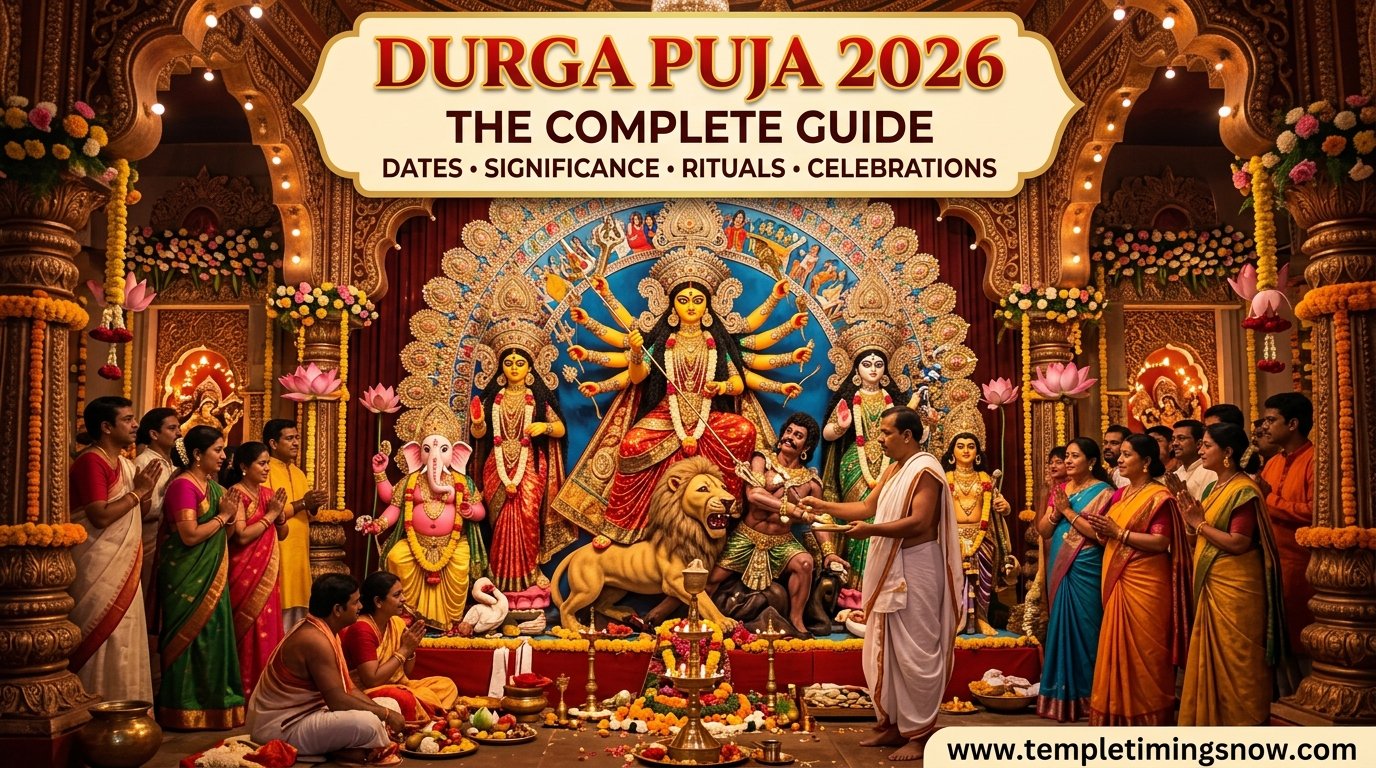
Every autumn, Bengal changes its mood overnight. The air gets lighter, kaash flowers sway by the roadside, and the sound of the dhak starts floating out from somewhere.
If you’re wondering when all of it kicks off, Durga Puja 2026 begins with Mahalaya on 10 October and the main festival runs from Shashthi on 16 October to Vijaya Dashami on 21 October.
This guide covers the Durga Puja 2026 start date and end date, the legends, the rituals, the pandals, the food, and what makes the festival so special to people who grew up with it.
Durga Puja 2026 starts on Shashthi, 16 October 2026, and ends on Bijoya Dashami, 21 October 2026. Mahalaya falls earlier, on 10 October, and marks the start of Devi Paksha. These are the Durga Puja dates 2026 most Bengali calendars are following, and they’re what people search for when they ask for the Durga Puja date 2026.
The table below gives the tithi breakdown:
| Day | Date (2026) | Weekday | Tithi Begins | Tithi Ends |
|---|---|---|---|---|
| Mahalaya (start of Devi Paksha) | 10 October | Saturday | 9 Oct, 9:37 PM | 10 Oct, 9:20 PM |
| Maha Shashthi | 16 October | Friday | 16 Oct, 3:25 AM | 17 Oct, 5:55 AM |
| Maha Saptami | 18 October | Sunday | 17 Oct, 5:55 AM | 18 Oct, 8:29 AM |
| Maha Ashtami | 19 October | Monday | 18 Oct, 8:29 AM | 19 Oct, 10:52 AM |
| Maha Navami | 20 October | Tuesday | 19 Oct, 10:52 AM | 20 Oct, 12:51 PM |
| Bijoya Dashami | 21 October | Wednesday | 20 Oct, 12:51 PM | 21 Oct, 2:12 PM |
A quick heads-up: tithis don’t line up neatly with calendar days, so one tithi can span two dates. The Shashthi window above runs into 17 October, for example.
Timings for Sandhi Puja, Kumari Puja, Anjali and Bodhon also shift a little between Panjikas and between cities, so please check your local Panchang or your neighbourhood puja committee’s schedule before you plan anything around a specific minute.
Durga Puja dates are determined by the Hindu lunar calendar, which is why the festival jumps around on the Gregorian calendar. It usually lands in September or October, in the bright fortnight of the month of Ashwin.
A year with an extra (adhik) lunar month pushes everything later, and 2026 is one of those years, which explains the mid-October timing instead of an earlier one.
The core legend is simple: Goddess Durga killed the buffalo demon Mahishasura, and the festival celebrates that victory of good over evil. But Bengal layers a second, very human story on top, and honestly that’s the one that makes people tear up on Dashami.
Mahishasura was a demon king who’d earned a boon that made him nearly unbeatable. No god or man could kill him. He grew arrogant, drove the gods out of heaven, and ruled the three worlds.
In desperation the gods turned to the trinity, and Brahma, Vishnu and Shiva pooled their energies to create Goddess Durga. Every deity then handed her a weapon: Shiva’s trident, Vishnu’s chakra, Indra’s thunderbolt, and so on. She rode a lion into battle.
The fight is said to have lasted nine days. Durga killed Mahishasura on Vijaya Dashami, which is why that day carries the meaning of triumph. The form of the goddess slaying the demon is called Mahishasuramardini, and the same name belongs to the famous pre-dawn radio programme that Bengalis tune into on Mahalaya morning.
In Bengal, Durga is not only a warrior. She’s Uma, a daughter who comes home to her parents for a few days each year, bringing her children Lakshmi, Saraswati, Kartikeya and Ganesha with her. After five days she returns to her husband Shiva on Mount Kailash.
That’s why the mood on Dashami is so tender. Families aren’t just saying goodbye to an idol, they’re saying goodbye to a daughter, and many people honestly get teary during the final aarti.
Durga Puja 2026 Mahalaya falls on 10 October 2026, the new moon day that begins Devi Paksha, the “fortnight of the Goddess.” Mahalaya is when the goddess is believed to start her journey from Kailash to earth. It’s also the end of Pitri Paksha, so many Bengalis offer Tarpan, water and sesame offerings to their ancestors, usually on the banks of the Ganga.
For countless households, Mahalaya starts at around 4 AM with the radio. The Sanskrit chants and devotional songs of Mahishasuramardini, in the legendary voice of Birendra Krishna Bhadra, have been a ritual for decades.
Many families still listen on old radios even though they could stream it on a phone. It’s also the day when the sculptors of Kumartuli traditionally paint the eyes onto the idols, a ritual called Chokkhu Daan, which brings the clay figure to life symbolically.
Navadurga refers to the nine forms of Goddess Durga, each worshipped on one of the nine nights of Navratri. This is the part where Durga Puja and Navratri overlap in belief, even though the way they’re celebrated is different.
| Day | Form | What She Represents |
|---|---|---|
| 1 | Shailaputri | Daughter of the mountains |
| 2 | Brahmacharini | Devotion and determination |
| 3 | Chandraghanta | Courage and strength |
| 4 | Kushmanda | Energy, light and creation |
| 5 | Skandamata | Mother of Kartikeya (Skanda) |
| 6 | Katyayani | The warrior who fights evil |
| 7 | Kalaratri | The fierce protector |
| 8 | Mahagauri | Peace and purity |
| 9 | Siddhidatri | Wisdom and blessings |
People often search for Durga Puja 2026 Navratri together because the two festivals sit in the same lunar fortnight. Navratri is widely observed in northern and western India as nine nights of fasting, Garba and Dandiya.
Bengal’s Durga Puja concentrates the celebration into the last five days, from Shashthi to Dashami, with the focus on the goddess’s arrival, pandals, and community feasting. Same goddess, very different energy. Also worth knowing: Navadurga’s daily worship follows the Navratri pattern, while Bengal’s puja rituals follow their own sequence, which we’ll walk through next.
The five days of Durga Puja are Shashthi, Saptami, Ashtami, Navami and Vijaya Dashami, and each has its own rituals and its own mood. Here’s how it flows in Kolkata and across Bengal.
Durga Pujo officially begins on Shashthi with Bodhon, when the priest chants mantras to awaken the goddess. Think of it as a ceremonial wake-up call. The idol’s face is unveiled, the dhaks start beating in earnest, and people step out in new clothes. In many places it’s the first evening of real pandal visits.
Early on Saptami, the Nabapatrika (Kola Bou) Snan happens. Nine plants are bound together, bathed in the river or in sacred water, draped in a saree and carried to the pandal.
After that, the priest performs Pran Pratishtha, invoking the life force of Maa Durga into the idol. From this point, the idol is considered fully alive and the festival really gets going. Crowds at pandals start building from this day.
Maha Ashtami is the most significant day of the festival. The Durga Puja 2026 Ashtami date is Monday, 19 October. People fast until the morning Pushpanjali, offering flowers together with mantras, and the pandals are packed with families in their best traditional clothes.
Ashtami also hosts Sandhi Puja and, in many places, Kumari Puja. If you can only attend one day, make it this one.
Navami brings the Maha Homa, aarti, and often Kumari Puja at some pandals. Since it’s the last full day before the goddess leaves, people squeeze in as much pandal hopping and feasting as possible. Many families cook mutton on this day. The night often feels bittersweet, because everyone knows what comes next.
The Dashami Durga Puja 2026 celebrations fall on Wednesday, 21 October. Married women perform Sindoor Khela, applying vermilion to the goddess and then to each other.
Then the idols are carried out in procession for visarjan, immersion in a river or pond. Afterwards, people greet elders with a pranam and everyone else with “Shubho Bijoya,” followed by sweets. It’s beautiful and a little heartbreaking at the same time.
Durga Puja isn’t just a religious event, it’s a social, artistic and cultural one rolled into one. To really get the festival, it helps to look at its three big pieces: the pandals, the idols, and the rituals.
Pandals are temporary structures built by local clubs to house the Durga idol. Many are real works of art. Themes are inspired by ancient temples, historic landmarks, Bengal’s folk crafts, or even social issues like climate change and migration. Artists, carpenters, lighting designers and craftspeople work for months to pull one off.
Pandal hopping is what most people mean when they say they’re “going out for Pujo.” Families and friends hop from one pandal to another, admiring the idol, the artwork, and the lights. Stalls and small fairs pop up nearby, so the whole experience feels like a street carnival.
Most of Kolkata’s idols come from Kumartuli, the old potters’ neighbourhood in North Kolkata where artisan families have been making images for generations. The process starts with a straw and bamboo frame, covered in layers of clay, then painted and dressed.
The traditional image shows Durga slaying Mahishasura, flanked by Lakshmi, Saraswati, Kartikeya and Ganesha, and this arrangement is called the ek-chala or family frame in many places. Theme pandals sometimes commission completely new designs, which gives sculptors room to experiment.
Every day of the festival has its own set of rites. The big ones:
This is the part most guides skip, so let’s slow down a bit.
Why nine plants in the Nabapatrika? The bundle includes banana, colocasia, turmeric, jayanti, bel, pomegranate, ashoka, arum and rice paddy. Each is linked to a different form of the goddess, so together they represent her presence in nature.
It’s basically an agricultural and ecological idea: the goddess is worshipped as the force that feeds and sustains. That’s why Nabapatrika is called Kola Bou even though it’s not a bride in the literal sense, just a banana plant dressed as one.
Why is Sandhi Puja so powerful? Legend says that at this precise junction, the goddess took the fierce form of Chamunda and killed the demons Chanda and Munda. That’s why the ritual starts in the last 24 minutes of Ashtami and finishes in the first 24 of Navami.
The 108 lamps and lotuses reflect the sacred number 108 in Hindu tradition, the number of beads on a mala. Many pandals also use a cannon-like sound or a ceremonial drum roll to mark the start, so you’ll really feel the moment.
Why worship a young girl in Kumari Puja? The idea is that divine feminine energy (Shakti) exists in every woman, and a young girl represents it in its purest, most untouched form. The ritual at Belur Math, started by Swami Vivekananda in 1901, is the most widely known.
What do the goddess’s weapons and lion mean? Each weapon was gifted by a different god, symbolising that Durga is the combined power of the whole pantheon. The lion (or tiger) stands for courage and control over wild instincts, and the demon underfoot is a reminder of ego and ignorance being crushed.
Pandal hopping sounds like pure fun, and it is, but without a plan you’ll end up stuck in traffic at midnight. A little preparation goes a long way.
Know the clusters. Kolkata’s pandals fall roughly into a few zones:
Pick your timing. Evenings from Saptami to Navami are the busiest, and Ashtami night is chaos in the best way. If you hate crowds, go in the morning or early afternoon, or visit on Shashthi and Saptami. Late at night, after 11 PM, the lines at famous pandals thin out a little, though the roads are still busy.
Plan your transport. The metro runs extended hours during Pujo and is easily the best way to move around. Cabs and app rides surge massively, and parts of the city have traffic restrictions. Walk between nearby pandals, wear comfortable shoes, and carry a power bank.
If you’re coming in from another city, book your trains or buses early because everything fills up. Themes for 2026 are usually revealed by committees only a few weeks before the festival, so check their social media pages in late September and early October.
Searches for Durga Puja 2026 photo spike every year, and for good reason: Pujo is a photographer’s dream. Some things that work:
Remember that some pandals ban tripods and flash, so check signs. And honestly, put the camera down for a bit too. Some moments are better when you’re just there.
Durga Puja isn’t limited to one place. The core story is the same everywhere, but local flavours make each celebration unique.
Durga Puja in Kolkata was added to UNESCO’s Intangible Cultural Heritage list in 2021, recognised as a festival that brings communities together across religion, class and background.
Durga Puja 2026 in Kolkata will see the usual explosion of themed pandals, lights and crowds. Preparations start weeks ahead, usually after Vishwakarma Puja in September.
There are two main types of pujas. Barowari (community) pujas are funded by neighbourhood clubs and are known for their grand themes.
Bonedi pujas are held by old aristocratic families in their ancestral homes, and they keep alive rituals that go back 200 to 300 years. Both are worth seeing, though they feel completely different.
In Dhaka, Durga Puja is the biggest festival for the Hindu community in Bangladesh. Mandaps pop up across the city, including the historic Dhakeshwari Temple, where people gather for worship, anjali and cultural programmes. On Dashami, processions and immersions mark the end of the festival, often along the Buriganga river.
Assam blends its own culture into the celebrations. In Guwahati, pandals are often inspired by famous monuments or built using bamboo and cane craft. Folk performances like Bagurumba, Karbi and Dimasa dances add local colour. Idols are immersed in the Brahmaputra on Dashami.
Odisha has distinct traditions of its own. At some Shakti Peethas the worship goes on for 16 days starting from Mulashtami. In Cuttack, the festival is famous for chandi medha, ornate backdrops behind the idols made with delicate silver filigree (tarakasi) work. The scale of the Cuttack processions on Dashami is hard to describe.
Bengali communities carry the festival wherever they go. In Delhi, Chittaranjan Park (CR Park) and Kashmere Gate pujas are among the most famous. Mumbai has the Bengal Club at Shivaji Park and Lokhandwala Durgotsav, and in Bengaluru, Kolaj Durga Puja is a popular community event.
These pujas bring Bengali families together for traditional rituals, bhog and cultural shows, a taste of home when you’re far from it.
Food is half the fun of Durga Puja. Unlike Navratri, there’s no rule that everyone eats vegetarian during these days, which surprises many visitors.
Durga Puja 2026 is shaping up to be another huge one, starting with Mahalaya on 10 October and running from Shashthi on 16 October to Vijaya Dashami on 21 October.
Whether you’re there for the legend of Mahishasuramardini, the heartfelt idea of Uma coming home, the art of the pandals, or just the food, the festival has something for everyone.
If you’re planning to experience it in Kolkata, book your travel and stay early, check local Panjikas for exact timings, and leave enough time to wander without a strict schedule. Some of the best Pujo moments happen when you take a random lane and follow the sound of the dhak.
Durga Puja 2026 officially starts on Shashthi, 16 October, and ends on Vijaya Dashami, 21 October. Mahalaya, which marks the beginning of Devi Paksha, is observed earlier on 10 October 2026.
Both honour Goddess Durga, but Navratri is a nine-night festival focused on fasting, Garba and Dandiya, while Durga Puja is a five-day Bengali celebration known for pandals, bhog, Dhunuchi dance and Sindoor Khela.
It honours Goddess Durga’s victory over the demon Mahishasura, symbolising good triumphing over evil. In Bengal, it also celebrates Uma returning to her parental home with her children for five days.
The festival follows the Hindu lunar calendar and its tithis, not the Gregorian one. Because lunar months don’t align with the English calendar, the dates shift each year, usually falling in September or October.
Mahalaya begins Devi Paksha and marks Goddess Durga’s arrival on earth. Bengalis offer Tarpan to ancestors and wake early to listen to the traditional Mahishasuramardini radio broadcast, a custom many families treasure.
No. Biswakarma Puja is a separate festival honouring Lord Vishwakarma, the divine architect. It’s celebrated a few weeks before Durga Puja in Bengal and often signals that Pujo is approaching.
Maha Ashtami in 2026 falls on Monday, 19 October. It is the most important day of Durga Puja, featuring Pushpanjali, Kumari Puja and the sacred Sandhi Puja at the Ashtami–Navami junction.
Bijoya Dashami is on Wednesday, 21 October 2026. The day includes Sindoor Khela, the immersion procession (visarjan) and the exchange of “Shubho Bijoya” greetings and sweets among family and friends.
Sandhi Puja is held at the exact moment Ashtami ends and Navami begins. It lasts 48 minutes, with 108 lamps lit and 108 lotuses offered, and is believed to be the goddess’s most powerful moment.
Kumari Puja is a ritual in which a young girl is worshipped as the living embodiment of Goddess Durga. It is usually performed on Maha Ashtami or Navami and symbolises the sacred feminine energy, Shakti.
Sindoor Khela is a Dashami ritual where married women offer vermilion to the goddess and then apply it on one another. It symbolises marital happiness, sisterhood and a joyful farewell before the idol’s immersion.
Popular areas include North Kolkata for traditional pujas, South Kolkata for large theme pandals, and Bonedi bari pujas like Sovabazar Rajbari. Kumartuli is great for seeing idols before the festival.
Kumartuli is a potters’ neighbourhood in North Kolkata where artisan families have crafted clay idols for generations. Most of the city’s Durga idols are made there using straw, clay and paint.
UNESCO added Durga Puja in Kolkata to its Intangible Cultural Heritage list in 2021, recognising it as a festival that unites communities through art, craft, ritual and large-scale public participation.
Pujo bhog includes khichuri, labra, begun bhaja and payesh. Families also enjoy luchi, cholar dal, kosha mangsho, biryani, egg rolls, fish fry and rosogolla during the five days of celebrations.
https://templetimingsnow.com/bangalore-to-tirupati-nri-darshan-package-by-car/
https://templetimingsnow.com/tirupati-to-arunachalam-distance/
https://templetimingsnow.com/tirupati-to-tirumala-distance/
https://templetimingsnow.com/padmavati-temple-tirupati/
https://templetimingsnow.com/senior-citizen-darshan-at-tirumala/