Physical Address
304 North Cardinal St.
Dorchester Center, MA 02124
Physical Address
304 North Cardinal St.
Dorchester Center, MA 02124

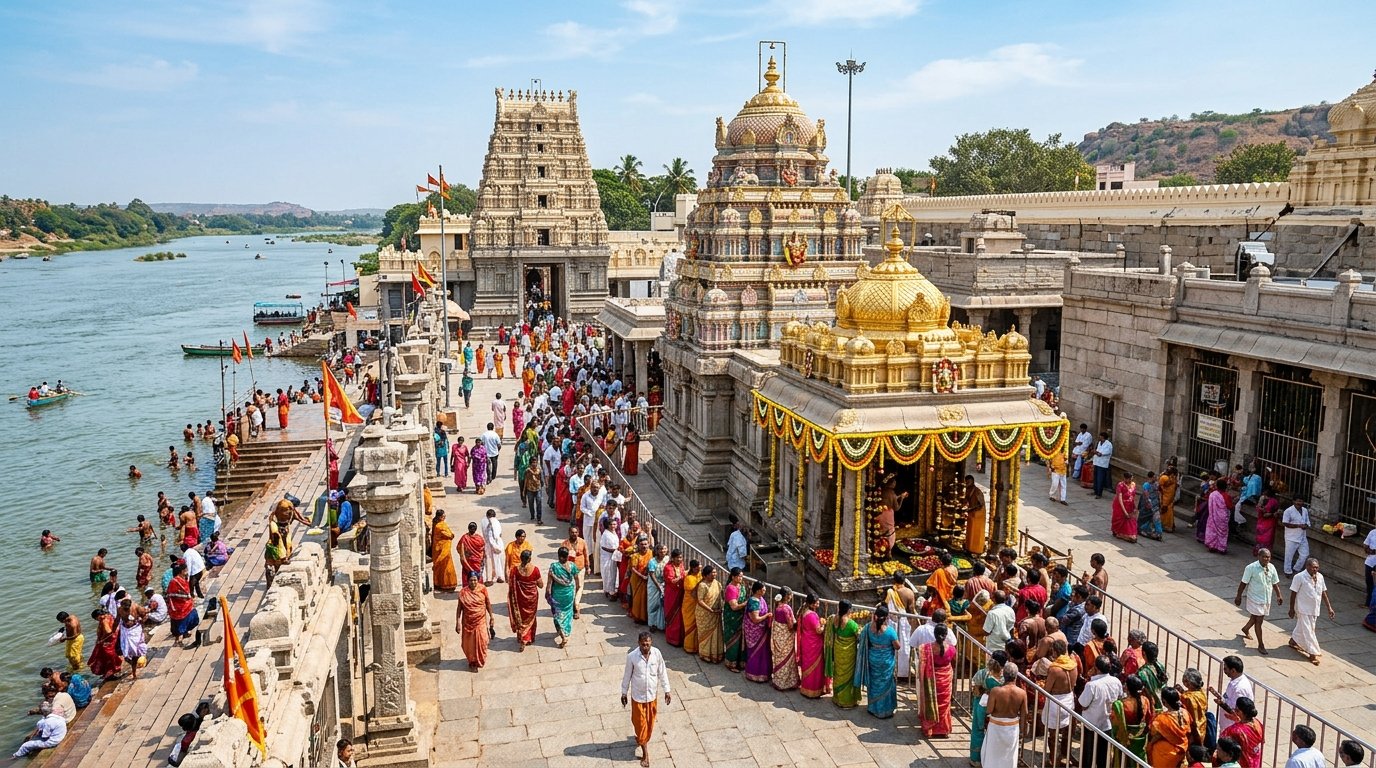
If you’re planning a trip to one of South India’s most revered spiritual destinations, getting your Mantralayam temple timings right is honestly the first thing you should sort out before anything else.
Home to the sacred Brindavan of Sri Raghavendra Swamy, Mantralayam Temple draws lakhs of devotees every year who come seeking blessings, peace, and sometimes just a bit of quiet away from city life.
This guide covers darshan hours, food timings, the temple’s fascinating history, seva booking, dress code, and accommodation basically everything a first-time (or even a fifth-time) pilgrim would want to know.
Before we dive deep, here’s a snapshot of the essentials so you can plan your visit without scrolling through the whole article.
| Detail | Information |
|---|---|
| Deity | Sri Raghavendra Swamy (Rayaru) |
| Location | Mantralayam, Kurnool district, Andhra Pradesh |
| River | Banks of the Tungabhadra River |
| Entry Fee | Free for general darshan |
| Best Time to Visit | August to March (August–September for festivals) |
| Main Poojas | Annadanam, Vastra Samarpana, Sankalpa Seva |
| Major Festivals | Maharathostavam, Aradhanostavam |
| General Temple Timing | 6:00 AM to 9:00 PM (approx.) |
Mantralayam isn’t a huge town by any means, it’s more of a pilgrim village really, but the spiritual energy there is something you kind of have to feel for yourself.
The Mantralayam temple timings run from early morning to late evening, with a short gap in between for rituals and cleaning. Generally, the temple opens around 6:00 AM and closes near 9:00 PM, though this can shift slightly during festival season.
Here’s the breakdown of the daily darshan and ritual schedule that most pilgrims follow:
| Ritual/Event | Timing |
|---|---|
| Brindavan Cleansing (Abhisheka) | 6:00 AM |
| Morning Darshan | 6:00 AM – 2:00 PM |
| Seva Sankalpa | 8:00 AM – 9:00 AM |
| Mantrashakta (special ritual) | 10:00 AM – 11:30 AM |
| Mahapooja (Moola Rama, Mukhyaprana, Brindavana) | 12:00 PM (Noon) |
| Tirtha Prasada (Lunch) | 1:00 PM – 3:00 PM |
| Evening Darshan | 4:00 PM – 9:00 PM |
| Swamiji Darshan | 6:30 PM – 8:30 PM |
Note that these timings can vary a little depending on the day of the week or if there’s a special seva scheduled by another devotee.
If you’re wondering about Mantralayam temple timings tomorrow, it’s honestly best to call the temple office or check the official Sri Raghavendra Swamy Mutt website a day in advance, since timings occasionally get adjusted for Ekadasi, Aradhana days, or unforeseen circumstances.
I don’t have access to live, day-specific scheduling data, so please treat the table above as the standard routine rather than a guarantee for a particular date.
Every single day at 6:00 AM, the priests perform the cleansing of the Raghavendra Brindavan with holy water this is followed by the Mangala Aarti, where the deity is anointed and adorned with jewels and fresh clothing.
This is considered one of the most auspicious moments of the day, and quite a few devotees actually try to time their arrival specifically for this ritual.
The Mantralayam temple food timings are pretty structured, and the good news is that meals (prasadam) are provided free of cost to all visiting devotees, which is a huge relief for anyone travelling long distance.
The Mantralayam temple lunch timings, officially called Tirtha Prasada, run from 1:00 PM to 3:00 PM. Meals are served in a large dining hall located to the left of the main sanctum, and it’s a simple vegetarian spread but honestly quite filling and tasty.
Dinner, referred to locally as Sandhya Bhoga, is served occasionally after 8:00 PM. If you happen to be around at night and dinner isn’t being served that day, you can still purchase prasadam like puliogare and pongal from the mutt’s counter, known as Annadaata. It’s a nice fallback option for late arrivals.
Mantralayam Temple is dedicated to Sri Raghavendra Swamy, a revered Vaishnava saint who lived during the 16th century. He is widely believed to be an incarnation of Prahlad, the great devotee of Lord Vishnu mentioned in Hindu mythology. This belief adds a layer of divine significance to everything associated with the temple.
Sri Raghavendra Swamy → is considered → an incarnation of Prahlad, and this lineage is a major part of why devotees hold him in such high regard even centuries after his samadhi.
Before taking up sainthood, Raghavendra Swamy was actually a family man he had a wife and a son, living a fairly ordinary domestic life. On the very day of his transformation into a saint, his wife reportedly rushed to see him one final time, but in her haste she fell into an abandoned well and passed away.
Because her death was sudden and her wish unfulfilled, she is said to have become a restless spirit who later visited the saint.
Raghavendra Swamy, sensing her presence, sprinkled holy water on her and relieved her from the cycle of birth and death. It’s one of those stories that gets told and retold across generations, and whether you take it literally or symbolically, it does say a lot about the compassion attributed to the saint.
Sudhindra Tirtha is recognized as the Gurudeva of Raghavendra Swamy. The teachings passed down through this lineage are rooted in the Vaishnava cult, the Dvaita philosophy, and the broader preaching of Madhvacharya. Mantralayam Temple → follows → Dvaita philosophy, which was originally founded by Madhvacharya and emphasizes the eternal distinction between the individual soul and the Supreme Being.
Raghavendra Swamy was a dedicated devotee of Sri Moola Rama and Sri Panchamukhi Mukhya Prana Devaru. Legend has it that the five-faced Hanuman (Panchamukha) appeared to the saint while he was performing intense penance at a place called Panchamukhi, which is near present-day Raichur.
Panchamukhi Hanuman → appeared during → Raghavendra’s penance → at → Panchamukhi, and this event is considered one of the most sacred episodes in his spiritual journey.
Over the years, Sri Raghavendra is believed to have performed numerous miracles, many of which are still narrated by local guides and priests at the mutt even today.
Mantralayam Raghavendra Swamy Temple isn’t just a memorial to the saint, it also honours Lord Hari, Vayu, and Rayaru (another name devotees use for Raghavendra Swamy himself). The temple complex houses three spectacular chariots made from sandalwood and decorated with fresh, colorful flowers.
Every day, the deities are placed on these chariots and carried around the temple in a beautiful procession, which is honestly one of the highlights if you happen to catch it.
The town itself carries deep symbolic weight too — it’s said that the name “Mantralaya” comes from the beautiful mantras that poured forth from the saint’s holy mind, and that’s why devotees consider this place spiritually charged even beyond the physical temple structure.
Yes, there is a fairly strict dress code, and it’s enforced pretty seriously at the entrance.
Devotees are also expected to speak softly and walk in an orderly queue to maintain the overall tranquility of the space — it’s a small thing, but it really does add to the atmosphere.
Sevas and poojas → fulfil → the wishes and well-being of devotees, and this is actually a huge part of what draws pilgrims back to Mantralayam Temple year after year. Regular worship of Sri Moola Ramadevara is conducted whenever HH Sri Swamiji is present at the temple.
Some of the key sevas offered include:
These special endowment worships are generally not performed on Ekadasi, Grahana (eclipse) days, or on Sri Krishna Janmashtami, so it’s worth keeping that in mind while planning a seva.
This is one area where a lot of guides fall short, so let’s actually break it down properly. Devotees who cannot travel to Mantralayam personally have the option to book sevas remotely.
Since booking portals, exact fee structures, and payment gateways do get updated from time to time, I’d genuinely recommend double-checking directly on the official Mantralayam Devasthanam website or by calling the temple office before making any payment — I don’t have live access to verify current online booking charges or portal changes.
For accommodation, the Devasthanam (temple trust) runs guest houses right within the temple complex, and honestly, this is the most convenient option for most pilgrims.
Regarding Mantralayam temple rooms price, rates do vary depending on whether you choose a standard non-AC room, an AC room, or a cottage tied to a seva booking, and these prices are periodically revised by the trust.
Rather than quoting a specific figure that might be outdated, I’d suggest confirming current rates directly through the official booking counter or website since accommodation pricing is exactly the kind of detail that changes without much notice.
Getting to Mantralayam is fairly straightforward once you know the routes.
By Air: The nearest major airport is in Hyderabad, roughly 236 km away. From there, you can hire a cab or take a bus to reach the temple.
By Train: The closest railway station is Mantralayam Road, about 12 km from the town. Trains like the Dadar Madras Mail, Bombay Mail, and the Udayan Express from Bangalore all stop here. Mantralaya lies conveniently along the Mumbai-Chennai, Delhi-Bangalore, and Hyderabad-Tirupati railway routes, making it accessible from most major South Indian cities.
By Road: Regular bus services connect Mantralayam with Bangalore, Mangalore, Chennai, Mysore, Hyderabad, Tirupati, and Bellary. The distance is about 595 km from Chennai and roughly 690 km from Mumbai, so plan your travel time accordingly if you’re driving.
For the most accurate, up-to-date Mantralayam temple contact number, seva enquiries, or accommodation booking assistance, it’s best to check the official Sri Raghavendra Swamy Mutt website directly, since contact details for temple trusts do get updated occasionally.
I don’t have verified live access to confirm the current helpline number, so please treat any number found elsewhere online with a bit of caution and cross-check it before calling.
Quick answer: Mantralayam Temple falls under Kurnool district in Andhra Pradesh, situated right on the banks of the Tungabhadra River, near the border of Karnataka state. This location is actually part of why the temple sees pilgrims from both Andhra Pradesh and Karnataka in almost equal numbers.
Apart from the Devasthanam guest houses, there are a handful of decent vegetarian eateries around the temple. Places like Gulbarga Brothers, Brahmins Tiffin Center, and Sri Udipi Krishna are popular for lunch, while SR Tiffins is a go-to for quick snacks.
Hotel Pannaga is also known for maintaining good hygiene standards, which matters a lot when you’re travelling with family.
If you have extra time, these nearby spots are worth exploring:
You can also enjoy a peaceful boat ride on the Tungabhadra River in traditional round boats called coracles or putti, which is a fairly unique experience you won’t easily find elsewhere.
Mantralayam Temple houses the sacred Brindavan of Sri Raghavendra Swamy, a 16th-century saint believed to be Prahlad’s incarnation, known for miracles, blessings, and deep Vaishnava traditions.
Mantralayam Temple is located in Andhra Pradesh, specifically in Kurnool district, on the banks of the Tungabhadra River near the Karnataka border.
Yes, devotees can stay overnight at the Devasthanam’s guest houses within the complex, which include both AC and non-AC rooms, bookable online or at the counter.
The temple primarily honours Sri Raghavendra Swamy, along with worship of Lord Hari, Vayu, Sri Moola Rama, and Sri Panchamukhi Mukhya Prana Devaru.
He’s credited with numerous miracles, including relieving his deceased wife’s spirit through holy water and blessing countless devotees with healing, prosperity, and fulfilled wishes over centuries.
Raghavendra Brindavan, Nava Brindavan, Panchamukhi Temple in Raichur, the temple’s chariot procession area, and the Tungabhadra riverbank for coracle rides.
Yes, historical records and mutt archives document his life, teachings, family background, and eventual samadhi (entering the Brindavan alive), rooted in Dvaita philosophy and Madhvacharya’s teachings.
Women are generally expected to wear a sari or salwar kameez; sarees aren’t strictly compulsory, but modest traditional attire is mandatory for temple entry.
Sri Raghavendra Swamy is believed to have primarily spoken Kannada and Sanskrit, reflecting the region and scholarly Vaishnava traditions he was trained in.
The town is famous for the Brindavan of Raghavendra Swamy, its Vaishnava sevas, the Tungabhadra riverbank, coracle rides, and its spiritually charged atmosphere.
Sudhindra Tirtha is recognized as the Gurudeva of Raghavendra Swamy, guiding him through the Dvaita philosophy and Madhva tradition before his sainthood.
Mantralayam is a sacred pilgrim village in Kurnool district, Andhra Pradesh, known for the Vrindavana of Raghavendra Swamy and its location along the Tungabhadra River.
It’s famous for housing Raghavendra Swamy’s sacred Brindavan; the town’s name itself comes from the powerful mantras believed to have poured from the saint’s mind.
The temple generally opens at 6:00 AM and closes around 9:00 PM daily, with specific darshan, pooja, and meal slots throughout the day.
Lunch (Tirtha Prasada) is served from 1:00 PM to 3:00 PM daily, while dinner (Sandhya Bhoga) is offered occasionally after 8:00 PM.
https://templetimingsnow.com/bet-dwarka-darshan-timings/
https://templetimingsnow.com/iskcon-temple-bangalore-timings/
https://templetimingsnow.com/maa-kamakhya-temple-timings/
https://templetimingsnow.com/shivoham-shiva-temple-bengaluru/
https://templetimingsnow.com/khatu-shyam-temple-timings/