Physical Address
304 North Cardinal St.
Dorchester Center, MA 02124
Physical Address
304 North Cardinal St.
Dorchester Center, MA 02124

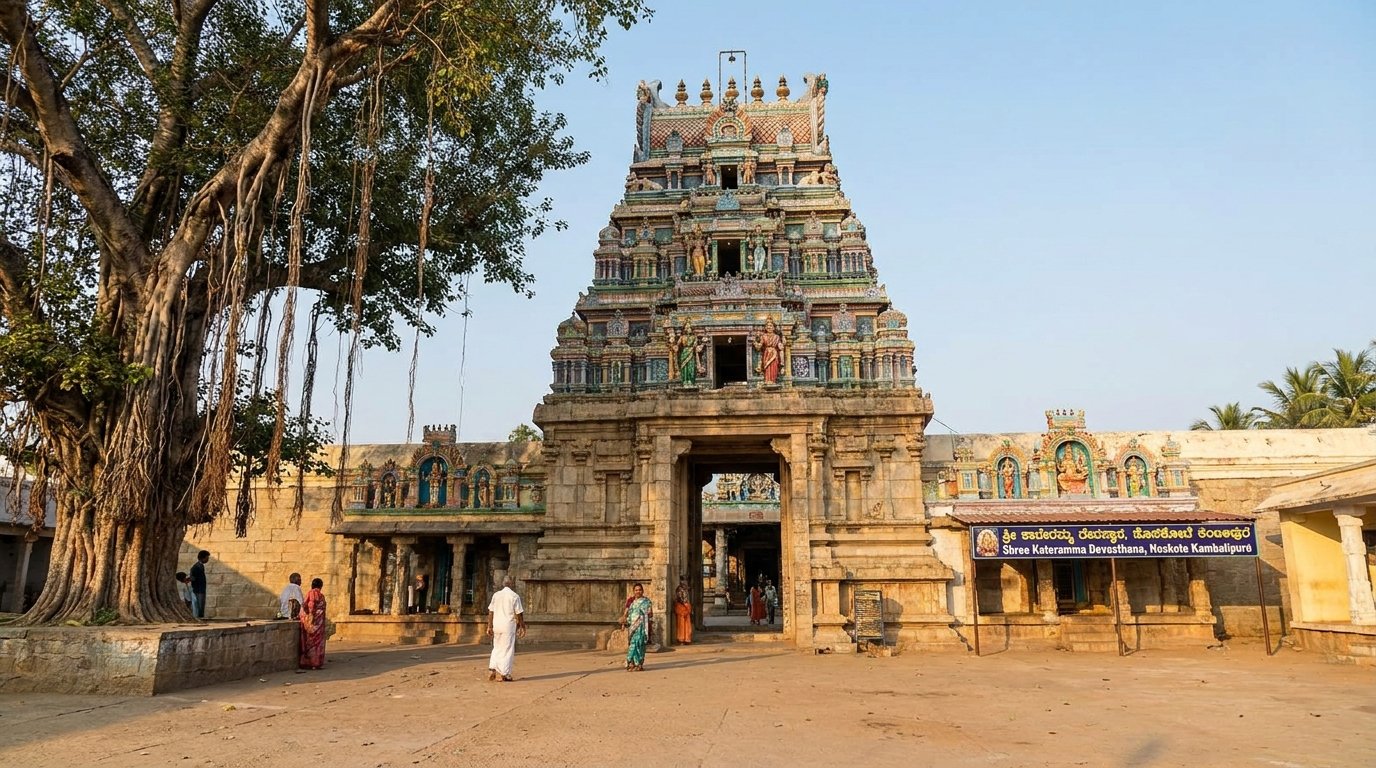
If you’ve been searching for Kateramma Temple Hoskote timings today, or you’re just curious about the goddess behind this quietly powerful shrine near Bengaluru, you’re in the right place.
Tucked away in the small village of Kambalipura, close to Hoskote in Karnataka, the Kateramma Temple has become one of those places people talk about in hushed, respectful tones a spot where locals swear their prayers actually get answered.
This guide walks you through the temple’s history, its darshan and closing timings, the daily rituals, festivals, and everything else you’d want to know before you plan a visit.
Goddess Kateramma is a village deity, believed by devotees to be the transformed spirit of a real woman named Kateri who once lived in the region generations ago. Her story isn’t written in ancient scripture — it’s passed down the old-fashioned way, mouth to mouth, grandmother to grandchild, which is honestly part of what makes it feel so alive.
According to the local folklore, Kateri was known through the village for her devotion and her kindness, someone who prayed sincerely to the Divine Mother every single day.
But because she never had children, the social customs of that era turned cruel on her she was mocked, isolated, and made to feel like an outsider in her own community. Unable to bear the constant humiliation, she left the village behind and walked into the surrounding forest, never to return.
Time passed. The villagers, as people do, mostly forgot her. But then strange, almost eerie happenings started around that same forest patch, and nobody could quite explain them.
A shepherd grazing his cattle near the forest one day noticed something odd — a soft, glowing light coming from beneath a large tree. Curiosity got the better of him (as it usually does in these stories), and when he went closer he found a beautifully carved sacred idol of a goddess sitting right there.
Word spread fast. The villagers gathered around the spot and came to believe, almost instantly, that this idol was Kateri herself — no longer a rejected woman, but a divine guardian goddess who had transformed through the sheer power of her devotion. That’s the moment Kateri → transformed into → Goddess Kateramma, and from there her worship began.
This single belief is really the heart of why thousands travel here every year. Devotees hold a strong, almost unshakeable faith that Goddess Kateramma protects her followers from hardships, misfortune, and negative energies, while also blessing them with courage and inner strength during tough phases of life.
People come to the temple carrying all sorts of prayers, and honestly the range is pretty broad:
Devotees believe that if you approach her with sincerity — not just going through the motions — she listens and responds. Many locals will tell you personal stories of vows fulfilled, and while none of this is “proven” in a scientific sense, the emotional and cultural weight of these testimonies is exactly what keeps the temple’s reputation growing year after year.
Let’s get to the practical part, since this is what most people actually land on this page for.
The Kateramma Temple generally stays open through most of the day, though there is some variation depending on which day of the week you’re visiting and whether a festival is going on.
General Temple Timings:
On regular weekdays — this covers your Kateramma Temple Hoskote Thursday timings query too — darshan is usually available from 6:30 AM to 7:30 PM. There’s a slightly shorter window compared to weekends simply because footfall is lower on weekdays, so the priests keep a more relaxed schedule.
Weekends see a noticeably bigger crowd, and the temple management extends the darshan hours accordingly. For Kateramma Temple Hoskote Saturday timings and Sunday visits, darshan generally runs from 6:00 AM to 8:00 PM, matching the full opening window.
If you’re planning a weekend trip, it’s genuinely smarter to arrive right at opening time by mid-morning the queue can get long, especially if it’s near a Friday or festival.
To answer it plainly: the Kateramma Temple Hoskote closing time is 8:00 PM on most days, though on weekdays the sanctum may wind down darshan around 7:30 PM. During major festivals like the annual jatre or Navaratri, closing time is often pushed later to accommodate the extra crowd, so it’s always worth double-checking locally if you’re travelling during festival season.
| Day/Occasion | Opening Time | Closing/Darshan End |
|---|---|---|
| Weekdays (incl. Thursday) | 6:30 AM | 7:30 PM |
| Weekends (incl. Saturday) | 6:00 AM | 8:00 PM |
| Festivals / Navaratri | 6:00 AM | Extended hours (varies) |
Quick tip: timings at small village temples like this one can shift a little without much notice, especially around festival dates, so if you’re travelling from far it doesn’t hurt to call ahead or check with someone local before you set out.
One of the most searched questions is simply — how far, and how do I actually get there. The temple sits close enough to Bengaluru that it works nicely as a half-day trip, not something that eats your whole weekend.
The Kateramma Temple Kambalipura distance from central Bengaluru is roughly 35–40 km, depending on which part of the city you’re starting from, and the drive typically takes somewhere between 1 to 1.5 hours by road, traffic depending (and let’s be honest, in Bengaluru, traffic is always a variable you can’t fully control).
The temple is well connected by road from both Hoskote town and Bengaluru city, and you can reach it comfortably via:
Some visitors also search for the route through Kallahalli, a nearby village that connects to Kambalipura — this is a commonly used approach road for people coming from certain parts of Hoskote taluk, so if your map app suggests routing you through Kallahalli, that’s a perfectly normal path and not a wrong turn.
If you prefer rail, the nearest railway station is K R Puram Railway Station, from where you’d need to take a cab or local transport for the remaining distance to Kambalipura.
Flying in? The nearest airport is Kempegowda International Airport, and from there it’s a fairly straightforward road journey down to the temple, though again budget extra time for Bengaluru’s traffic patterns.
The temple runs on a rhythm that’s honestly quite similar to how most traditional Karnataka village temples function — structured, devotional, and deeply rooted in local custom rather than pan-Indian scripture.
The day begins early with a set of rituals meant to “wake” and welcome the goddess:
Priests perform a special aarati during these early hours, and many devotees specifically time their visit for this window because it’s considered the most spiritually charged part of the day.
Midday is when the naivedyam (food offerings) is presented to the goddess. Coconuts and lemons are common offerings brought by devotees, and this is also when devotional songs are sung and special family prayers get conducted.
A lot of personal vows — things people promised the goddess in exchange for a wish being granted — are also fulfilled during this slot.
If you can only make it for one part of the day, honestly, try to catch the evening aarati. It’s the most visually and spiritually vibrant part of the temple’s daily schedule, with:
The lit-up temple premises during this hour genuinely creates a peaceful yet electric atmosphere — it’s the kind of moment that photos never quite do justice to.
Fridays are considered highly auspicious for worshipping Goddess Kateramma, similar to how many other village goddesses across South India are honored on this day.
Women devotees especially make it a point to visit on Fridays, bringing turmeric, kumkum, fresh flowers, and sarees as offerings for the goddess. If your travel dates are flexible, planning your visit around a Friday can actually give you a richer, more festive darshan experience than a regular weekday.
The annual jatre is, without question, the biggest event on the temple calendar. It transforms the entire village into a hub of activity, with:
Thousands of devotees pour in from surrounding villages and even from Bengaluru during this period, so if crowds aren’t your thing, you may want to time your regular darshan around it rather than during it.
Navaratri is celebrated over nine days with daily poojas, special decorations, and cultural programs. This is a lovely time to visit if you enjoy the festive, community side of temple culture rather than a quiet solo darshan.
Most articles online mention “vows and offerings” in passing and just leave it there, which honestly doesn’t help anyone who’s actually planning to do one. Here’s a more grounded breakdown of how this typically works at village temples like Kateramma’s.
A manata (vow) is essentially a personal promise made to the deity — you ask for something specific (a job, recovery from illness, a child, a marriage proposal to go through) and promise to offer something back once it’s fulfilled. It’s less transactional than it sounds; for devotees it’s more an expression of trust that the goddess is listening.
Common steps devotees follow:
Typical offering items include coconuts, lemons, bangles, sarees, turmeric, kumkum, and in some cases sponsoring the naivedyam for the day. None of this needs to be expensive — devotees genuinely believe sincerity matters more than the size of the offering.
This is a subtopic most write-ups skip entirely, but it actually adds a lot of context. Goddess Kateramma belongs to a broader tradition of Gramadevata (village deity) worship that’s extremely common across Karnataka and South India think of goddesses like Mariamma, Yellamma, and Bannari Amman, all of whom share a similar pattern:
a woman who suffered social injustice or hardship in her human life, and who later becomes divine through her spiritual power or through a miraculous discovery of an idol.
This pattern isn’t a coincidence it reflects a deep-rooted rural belief system where feminine suffering transforms into feminine divine power, and these goddesses are typically seen as fierce protectors of their village rather than distant, abstract deities.
Kateramma fits neatly into this lineage, and understanding that context actually makes her story feel less like an isolated legend and more like part of a living, breathing regional tradition that stretches across hundreds of village temples in the state.
Beyond the rituals and the festival calendar, the temple carries a broader symbolic weight for the local community. It represents:
Locals will often say the goddess “watches over” the village — protecting it from misfortune, disputes, and hardship — and that belief genuinely shapes how the community organizes itself around the temple calendar.
If you’re weighing when to go, here’s a quick breakdown:
A few practical pointers before you head out:
The Kateramma Temple in Kambalipura is one of those places that proves you don’t need grand architecture or ancient scriptures to build a deeply meaningful spiritual site sometimes it’s just a story, a community’s faith, and generations of unwavering belief that do the job.
From the legend of Kateri’s transformation into a guardian goddess, to the daily rhythm of morning aaratis and evening bhajans, to the color and noise of the annual jatre, this temple offers a genuine slice of rural Karnataka’s folk spirituality.
Whether you’re going for the Friday specials, planning around Navaratri, or just curious about the Kateramma Temple Hoskote timings today, it’s a trip that rewards patience, respect, and an open mind.
The temple is located in Kambalipura village, near Hoskote town in Karnataka, roughly 35–40 km from central Bengaluru, making it an easy half-day trip from the city.
On a regular day, the temple opens at 6:00 AM and closes at 8:00 PM, with weekday darshan generally running from 6:30 AM to 7:30 PM.
The temple typically closes by 8:00 PM, though weekday darshan may end slightly earlier around 7:30 PM. Festival days often see extended closing hours.
On Saturdays, darshan usually runs from 6:00 AM to 8:00 PM, matching the extended weekend schedule due to higher devotee footfall.
Thursday follows standard weekday hours — darshan from 6:30 AM to 7:30 PM, though this can vary slightly during special pooja days.
The distance is approximately 35–40 km, and the journey typically takes 1 to 1.5 hours by road depending on traffic conditions.
Kallahalli is a nearby village that connects to Kambalipura by road; some devotees coming from certain parts of Hoskote taluk use this route as a natural approach path.
She is believed to be the divine transformation of Kateri, a devoted woman who faced social rejection and later became a guardian village deity after her sacred idol was discovered in a forest.
Devotees believe she protects them from hardships and blesses them with health, marriage, childbirth, financial stability, and family welfare when approached with sincere devotion.
Fridays are considered highly auspicious for Goddess Kateramma; women devotees especially visit to offer turmeric, kumkum, flowers, and sarees.
The major festivals include the annual temple jatre, featuring processions and cultural performances, and the nine-day Navaratri celebrations with daily poojas.
Devotees state their wish at the sanctum, choose an offering like a saree or coconuts, and return to fulfill the promised offering once the wish is granted.
Yes, she shares a pattern common to goddesses like Mariamma and Yellamma — women who faced hardship in life and became divine protectors after death or transformation.
The annual jatre, Navaratri, Fridays, and Amavasya days are considered the most spiritually significant times, while winter offers the most comfortable weather.
The nearest railway station is K R Puram, and the nearest airport is Kempegowda International Airport, both requiring further road travel to reach Kambalipura.
https://templetimingsnow.com/mahakaleshwar-jyotirlinga-timings-today/
https://templetimingsnow.com/navratri-durga-puja-2026-date/
https://templetimingsnow.com/vijayawada-temple-timings/
https://templetimingsnow.com/palani-murugan-temple-timings/
https://templetimingsnow.com/durga-puja/