Physical Address
304 North Cardinal St.
Dorchester Center, MA 02124
Physical Address
304 North Cardinal St.
Dorchester Center, MA 02124

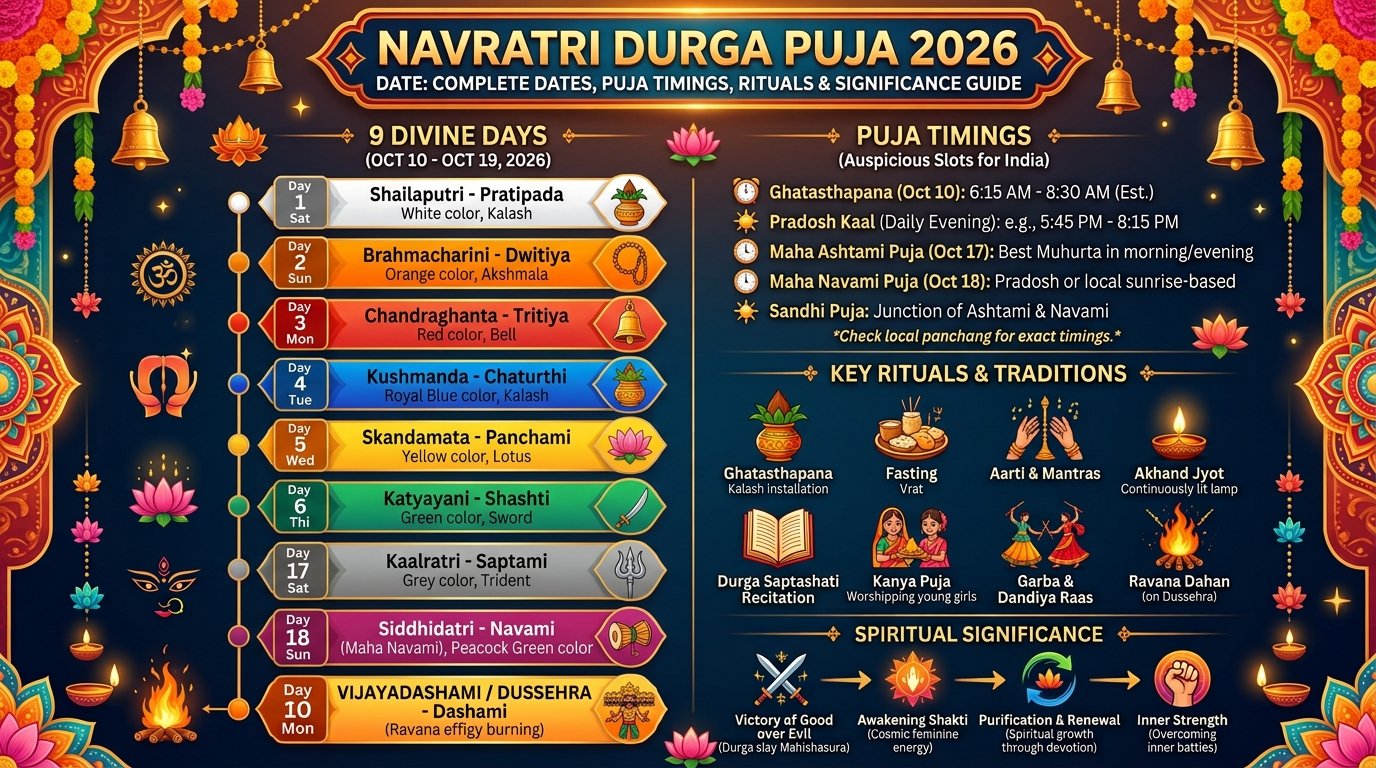
Yā Devī sarvabhūteṣu śakti-rūpeṇa saṃsthitā to the Goddess who resides in all beings as power, we bow again and again. If you’re searching for Navratri 2026 date, exact puja timings, or simply want to know navratri kab se start hai, you’ve landed in the right place.
This year’s Navratri Durga Puja 2026 date promises to be an especially auspicious stretch, packed with nine nights of devotion, colour, fasting, and festivity that culminates in the roar of Dussehra.
Honestly, planning around Navratri can get confusing what with tithis shifting and regional dates changing a bit, so we’ve broken it all down for you in one place.
Whether your family does elaborate Kalash Sthapana at home, you’re prepping for Garba nights, or you’re simply curious about 2026 में नवरात्रि कब है, this guide covers dates, rituals, mythology, and every FAQ you could possibly have.
Sharad Navratri 2026 begins on Sunday, 11 October 2026 with Ghatasthapana, and it concludes with Vijayadashami (Dussehra) on Tuesday, 20 October 2026. That gives us a full nine nights of worship dedicated to the nine forms of the Goddess, known collectively as the Navadurga.
A quick note before we dive in these dates, weekdays, and tithis have been worked out for New Delhi. Depending on where you live, the tithi timing might shift by a day, so it’s always smart to double check with your local panchang too.
Here’s the complete breakdown of all 10 days of Durga Puja — the nine nights plus Vijayadashami — including tithi, the presiding Devi, and the traditional colour associated with each day.
| Day | Date | Tithi | Devi | Colour |
|---|---|---|---|---|
| Day 1 | Sun, 11 Oct | Pratipada · Ghatasthapana | Shailaputri | Orange |
| Day 2 | Mon, 12 Oct | Dwitiya | Brahmacharini | White |
| Day 3 | Tue, 13 Oct | Tritiya | Chandraghanta | Red |
| Day 4 | Wed, 14 Oct | Chaturthi | Kushmanda | Royal Blue |
| Day 5 | Thu, 15 Oct | Panchami | Skandamata | Yellow |
| Day 6 | Fri, 16 Oct | Shashthi | Katyayani | Green |
| Day 7 | Sat, 17 Oct | Saptami | Kalaratri | Grey |
| Day 8 | Sun, 18 Oct | Ashtami · Durga Ashtami · Sandhi Puja | Mahagauri | Purple |
| Day 9 | Mon, 19 Oct | Navami · Maha Navami · Navami Homa | Siddhidatri | Peacock Green |
| Day 10 | Tue, 20 Oct | Dashami | Vijayadashami — Dussehra | — |
So to directly answer “what is Navaratri day 1 to 9” — it moves from Shailaputri (the mountain-born goddess) all the way to Siddhidatri (the giver of spiritual perfection), with each day representing a different stage of the Devi’s power and journey.
Ghatasthapana is the ceremonial installation of the sacred Kalash (a metal or clay pot filled with water, mango leaves, and a coconut) that marks the formal beginning of Navratri worship. This isn’t just a symbolic act the Kalash represents the Goddess herself, and the muhurat (auspicious window) for setting it up matters a lot to devotees.
On Day 1, priests generally recommend performing Ghatasthapana during the Pratipada tithi, ideally in the morning hours after sunrise, avoiding the Rahu Kaal for that day. Many households also prefer the Abhijit Muhurat, which typically falls around midday and is considered universally auspicious for starting any new ritual.
Since exact minute-to-minute timings vary by city and by year’s panchang calculations, it’s best to confirm with a local priest or trusted panchang app closer to 11 October 2026 but broadly, sunrise to late morning is the safest window.
Sandhi Puja falls at the junction of Ashtami and Navami tithis this year that’s between Day 8 (Sun, 18 Oct) and Day 9 (Mon, 19 Oct). This 48-minute window is considered the most powerful moment of the entire festival, since it’s believed this is when Goddess Durga defeated the demons Chanda and Munda.
Kanya Pujan (worship of young girls as living forms of the Devi) is also commonly performed on Ashtami morning, though some families prefer Navami. Again, exact clock timings should be verified locally, since they shift slightly year to year.
Navratri is celebrated for nine days because each night is dedicated to a different manifestation of Shakti, the divine feminine energy that governs creation, preservation, and transformation.
The number nine itself carries spiritual weight in Hindu cosmology it represents completeness and the nine stages a devotee’s consciousness passes through on the path toward the divine.
Each of the Navadurga forms Shailaputri, Brahmacharini, Chandraghanta, Kushmanda, Skandamata, Katyayani, Kalaratri, Mahagauri, and Siddhidatri embodies a distinct quality, from purity and penance to fierce protection and ultimate grace.
Devotees progress through these nine energies over the nine nights, which is really the whole point of the festival, not just the puja rituals themselves. It’s kind of like a spiritual journey packed into nine days rather than just one long celebration.
The story of Durga Puja traces back to the battle between the Goddess and the buffalo-demon Mahishasura. According to the Devi Mahatmyam (part of the Markandeya Purana), Mahishasura had received a boon that no man or god could kill him.
So the gods, unable to defeat him, combined their collective energies to create Durga a warrior goddess armed with weapons from each deity.
Durga fought Mahishasura for nine days and nights, finally slaying him on the tenth day, which we now celebrate as Vijayadashami.
This victory of good over evil is central to why Navratri → leads to → Dussehra, and it’s also the same broad mythological thread connected to Lord Rama’s victory over Ravana, which is celebrated on the same day in North India. Two different stories, same message really dharma winning over adharma.
Beyond Ghatasthapana, several other rituals define the nine nights:
These rituals aren’t just ceremonial for the sake of it Durga Saptashati recitation → is believed to → invoke the protective and destructive powers of the Goddess against negative forces, which is why it’s taken so seriously by devotees across regions.
Dussehra 2026 falls on Tuesday, 20 October, immediately after the nine nights conclude. Vijayadashami literally means “the victorious tenth,” marking Durga’s triumph over Mahishasura and, in North India, Rama’s victory over Ravana.
Massive effigies of Ravana, Meghnad, and Kumbhakarna are burnt in public grounds, while in Bengal, this day sees the emotional Sindoor Khela and immersion (visarjan) of Durga idols in rivers and seas a beautiful yet bittersweet farewell to the Goddess for another year.
This is honestly one thing a lot of articles skip over. While North India focuses heavily on fasting, Garba, and Dandiya nights during Navratri, Durga Puja in October 2026 especially in West Bengal, Odisha, Assam, and Tripura is a much bigger community and cultural event centered around elaborately decorated pandals, artistic idol-making, cultural programs, and communal feasting rather than fasting.
Both traditions honour the same Navadurga and the same core mythology, just expressed through very different cultural lenses which honestly makes Navratri one of the most fascinatingly diverse festivals in the whole country.
The 9 days honour Shailaputri, Brahmacharini, Chandraghanta, Kushmanda, Skandamata, Katyayani, Kalaratri, Mahagauri, and Siddhidatri — each representing a distinct form of Goddess Durga’s power and grace.
Durga Puja is a Hindu religious festival, so it’s not typically observed by Muslims as worship. However, many Muslims participate culturally by visiting pandals, enjoying festivities, and even contributing to community celebrations in some regions.
Kanya Pujan is usually performed on Ashtami morning, 18 October 2026, though exact muhurat timing varies by city. Check your local panchang closer to the date for precise auspicious hours.
Start with Ghatasthapana on Day 1, install the Kalash, sow barley seeds, light a diya daily, recite Durga Saptashati, offer flowers and prasad, and conclude with Navami Homa and Kanya Pujan before Vijayadashami.
Day 1 is Shailaputri, Day 2 Brahmacharini, Day 3 Chandraghanta, Day 4 Kushmanda, Day 5 Skandamata, Day 6 Katyayani, Day 7 Kalaratri, Day 8 Mahagauri, and Day 9 Siddhidatri.
They run from 11 October (Shailaputri) to 19 October 2026 (Siddhidatri), followed by Vijayadashami/Dussehra on 20 October, completing the full ten-day cycle.
Wear the designated colour for each day — Orange, White, Red, Royal Blue, Yellow, Green, Grey, Purple, and Peacock Green respectively — as it’s believed to align devotees with each Devi’s energy.
Divide the 13 chapters across the nine nights, reciting a few chapters daily, or complete a full “Saptashati Path” once on Ashtami or Navami if a daily split isn’t feasible for you.
The colours are Orange, White, Red, Royal Blue, Yellow, Green, Grey, Purple, and Peacock Green, worn sequentially from Day 1 through Day 9 to honour each Devi form.
Ashtami, particularly the Sandhi Puja window bridging Ashtami and Navami, is widely considered the most spiritually powerful moment, symbolizing Durga’s defeat of demons Chanda and Munda.
Following the 2026 calendar: Orange (11 Oct), White (12 Oct), Red (13 Oct), Royal Blue (14 Oct), Yellow (15 Oct), Green (16 Oct), Grey (17 Oct), Purple (18 Oct), Peacock Green (19 Oct).
The nine avatars, or Navadurga, are Shailaputri, Brahmacharini, Chandraghanta, Kushmanda, Skandamata, Katyayani, Kalaratri, Mahagauri, and Siddhidatri, each symbolizing a unique divine attribute.
Devotees observing vrat typically avoid non-vegetarian food, alcohol, onion, garlic, regular grains (using buckwheat/singhara flour instead), and refrain from cutting hair or nails during the fasting period.
The nine nights represent the worship period from Pratipada to Navami tithi, during which each night is dedicated to invoking one specific form of the Navadurga through puja and reflection.
Many devotees eat only fruits, milk, and singhara/buckwheat-based food once or twice daily, avoiding grains, onion, and garlic. Some fast fully on Ashtami/Navami and break the fast after Kanya Pujan.
Perform Ghatasthapana, light a daily diya, offer flowers matching the day’s colour, recite Durga Saptashati or Devi mantras, and conclude with Navami Homa followed by Kanya Pujan and visarjan.
https://templetimingsnow.com/onam/
https://templetimingsnow.com/shrinathji-temple-nathdwara-timings/
https://templetimingsnow.com/jyotirlingas/
https://templetimingsnow.com/mahakaleshwar-jyotirlinga-timings-today/