Physical Address
304 North Cardinal St.
Dorchester Center, MA 02124
Physical Address
304 North Cardinal St.
Dorchester Center, MA 02124

If you’re planning a trip to one of India’s holiest shrines, you’ve probably typed “Shri Somnath Jyotirlinga Temple 2026 Guide” into Google at least once already, and honestly, that’s a good instinct.
This temple isn’t just another stop on a pilgrimage circuit it’s the first of the 12 Jyotirlingas dedicated to Lord Shiva, sitting quietly (and quite dramatically) on the edge of the Arabian Sea in Prabhas Patan, Gujarat.
Whether you’re going for the first time or you’re a repeat devotee, this guide covers everything darshan timings, aarti schedule, VIP darshan booking, seva options, and yes, even the parts most guides skip over, like the temple’s turbulent history.
Let’s get into it.
Shri Somnath Mahadev Temple is more than a structure of stone and gold it’s a living symbol of faith that has literally refused to disappear, no matter how many times history tried to erase it.
Managed today by the Shree Somnath Trust, the temple continues to draw millions of devotees each year who come not just for darshan, but for the raw spiritual energy that seems to hang in the sea air around it.
Here’s a quick snapshot of the essentials:
| Feature | Details |
|---|---|
| Location | Prabhas Patan, near Veraval, Gujarat, India |
| Jyotirlinga Significance | 1st among the 12 sacred Jyotirlingas of Lord Shiva |
| Architecture Style | Chalukya-style with Māru-Gurjara influence |
| Temple Management | Shree Somnath Trust |
| Somnath Temple Official Website | somnath.org |
| Dress Code | Modest, traditional attire preferred |
| VIP Darshan | Available for quicker, more comfortable entry |
Visiting Somnath gives you that rare mix — organized facilities on one hand, and deep, almost overwhelming spirituality on the other. It’s genuinely one of those places photos don’t do justice to (though we’ll talk about Somnath Temple photos a bit later too).
This is where most guides get lazy, so let’s actually dig in. The Somnath Temple history is, frankly, one of the most dramatic stories in Indian temple architecture — a tale of destruction, rebuilding, and stubborn devotion repeated across centuries.
The old Somnath Temple is believed to have existed in some form since ancient times, mentioned in texts like the Skanda Purana. But its most well-known and painful chapter began in 1024 CE, when Mahmud of Ghazni raided the temple, looting its wealth and destroying the structure.
That wasn’t the last attack either — the temple was damaged and rebuilt multiple times over the following centuries by different rulers, including reconstructions attributed to the Solanki dynasty and later restoration efforts.
The temple we see today, though, is the modern reconstruction, and this part deserves proper credit. After India’s independence, it was Sardar Vallabhbhai Patel who led the initiative to rebuild Somnath Temple, viewing it as a symbol of national unity and resilience.
Construction of the present structure began in 1950, and the temple was formally consecrated in 1951, with President Rajendra Prasad performing the ceremony himself. The current Chalukya-style architecture with Māru-Gurjara influence you see today reflects that mid-20th-century rebuild, engineered to last.
So when people ask “how old is Somnath Temple really,” the honest answer is layered: ancient in origin, repeatedly destroyed, and reborn in its current form less than a century ago — which somehow makes it even more remarkable that it feels so timeless.
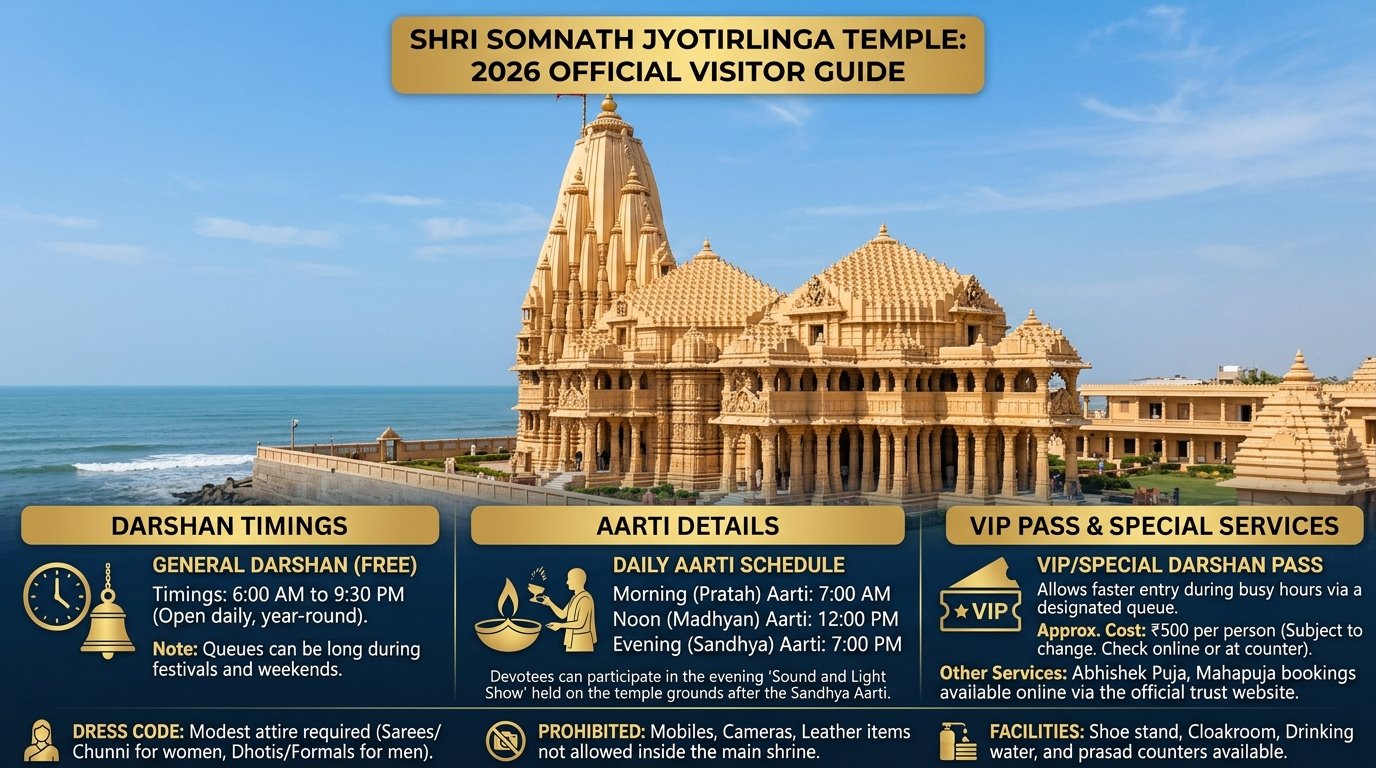
Somnath Temple timings stay pretty consistent throughout the year, which is genuinely helpful for planning.
| Day | Opening Time | Closing Time |
|---|---|---|
| Monday to Sunday | 6:00 AM | 9:00 PM |
The temple is open daily, no weekly off, which devotees really appreciate. A few practical tips from experience:
Timings might shift slightly during major festivals, so it’s always smart to double-check on the Somnath Temple official website before you travel, especially if you’re coming from far away.
The aarti at Somnath isn’t something you just watch — you kind of get pulled into it. The bells, the chanting, the smell of camphor mixing with the sea breeze… it’s an experience that stays with you long after you’ve left Gujarat.
| Aarti Name | Timing |
|---|---|
| Morning Aarti | 7:00 AM |
| Midday Aarti | 12:00 PM |
| Evening Aarti | 7:00 PM |
| Night (Shayan) Aarti | 8:00 PM |
Each aarti session follows traditional Vedic rituals, and honestly, the evening aarti tends to be the most crowded (and most beautiful) since it coincides with sunset over the Arabian Sea. Aarti timings → anchor → your darshan schedule, so plan your visit slots around them if you want the full experience rather than just a quick walk-through.
Let’s talk money, because this is usually the first thing people search for. The Somnath darshan booking price structure is actually pretty affordable compared to other major temples in India.
VIP darshan at Somnath Temple exists specifically to help devotees skip the general queue, which can get long during weekends and festivals.
| VIP Type | Approximate Price |
|---|---|
| Regular VIP Darshan | ₹50–₹100 |
| Premium / Peak Days VIP | ₹200–₹250 |
You’ve got two solid options here:
VIP Darshan Ticket → reduces → queue waiting time, and that single fact is why so many devotees now book it as a default rather than a luxury.
Booking online is simple, but it needs to be done through the right channel — this bit matters more than people realize.
The somnath.org website is the only trusted platform for online bookings. Third-party apps or “quick booking” links on social media are frequently scams, so please, don’t fall for those — devotees have reported losing money to fake booking pages that mimic the official site.
Beyond regular darshan, participating in seva adds a whole other layer of meaning to the pilgrimage. These aren’t just formalities — they’re genuine acts of devotion many families plan their entire trip around.
| Seva / Ritual | Description |
|---|---|
| Rudrabhishek | Sacred chanting and worship ritual with holy offerings for peace and spiritual growth |
| Jal Abhishek | Pouring holy water over the Jyotirlinga for blessings and inner purification |
| Panchopchar Pooja | Traditional worship offering five essential elements |
| Maha Mrityunjay Jap | Powerful chanting ritual believed to aid health, longevity, and mental peace |
Most of these require advance booking, particularly during peak season, so check with the temple counter or the official site before you arrive expecting a walk-in slot.
A lot of visitors search for Somnath Temple photos before they travel, just to get a feel of the place, and fair enough — it genuinely helps with planning. The temple’s golden spire (shikhara) against the backdrop of the Arabian Sea makes for one of the most photographed temple views in Gujarat, especially during sunrise and the evening aarti.
A few notes if you’re planning to click pictures yourself:
This is one of those extras that people almost skip but really shouldn’t. The evening Light & Sound Show narrates the temple’s dramatic journey — from destruction to rebirth — in a way that’s genuinely engaging, even for kids.
| Feature | Details |
|---|---|
| Timing | 8:00 PM – 9:00 PM (daily) |
| Ticket Price | ₹30–₹50 (may vary) |
| Seasonal Note | May not run during heavy monsoon rains |
Getting to Somnath is more convenient than people assume, honestly.
By Train: Veraval Junction is the nearest railway station, roughly 7 km away, with direct connectivity from Ahmedabad, Rajkot, and Mumbai.
By Air: Diu Airport (~85 km) is the closest, followed by Rajkot Airport (~195 km) and Ahmedabad Airport (~400 km), which has the best flight connectivity overall.
By Road: Private cabs and Gujarat State Transport buses run regularly from Ahmedabad, Rajkot, Junagadh, Dwarka, and Porbandar, and honestly the coastal drive itself is worth the trip.
Your trip doesn’t have to end at the temple gates. A few nearby spots worth adding to your itinerary:
A few practical things that’ll actually make your visit smoother:
The temple is open daily from 6:00 AM to 9:00 PM, with no weekly closures. Early morning slots between 6–8 AM tend to have the shortest queues for a peaceful darshan.
The only trusted official website is somnath.org, used for VIP darshan booking, seva reservations, and accommodation. Avoid third-party sites claiming similar services.
Aarti happens four times daily — Morning at 7 AM, Midday at 12 PM, Evening at 7 PM, and Night (Shayan) Aarti at 8 PM, each following Vedic rituals.
Regular VIP darshan costs roughly ₹50–₹100, while premium or peak-day VIP tickets range between ₹200–₹250, depending on season and demand.
You can book VIP darshan at Somnath Temple either on-site at dedicated counters or online through somnath.org, with online booking recommended during festivals.
The Somnath Temple history dates back centuries, marked by repeated destruction and reconstruction, most notably after Mahmud of Ghazni’s 1024 CE raid, and modern rebuilding led by Sardar Patel post-independence.
No, the old Somnath Temple was destroyed multiple times through history. The present structure was rebuilt in the 1950s and consecrated in 1951 under Sardar Patel’s initiative.
Reliable Somnath Temple photos are available on the official website and verified travel platforms, showing the temple’s golden shikhara against the Arabian Sea backdrop.
Modest and traditional clothing is strongly recommended out of respect for the temple’s sanctity, and it’s genuinely appreciated by temple staff and fellow devotees.
Yes, it runs daily from 8:00 PM to 9:00 PM, narrating the temple’s history through visuals and narration, though it may pause during heavy monsoon rains.
Veraval Junction, located about 7 km away, is the nearest railway station with strong connectivity to Ahmedabad, Rajkot, and Mumbai.
Diu Airport, roughly 85 km away, is the nearest, though Ahmedabad Airport offers the widest domestic flight connectivity at around 400 km.
Yes, popular sevas include Rudrabhishek, Jal Abhishek, Panchopchar Pooja, and Maha Mrityunjay Jap, most requiring advance booking during peak seasons.
October to March offers the most pleasant weather, making darshan and sightseeing far more comfortable compared to Gujarat’s hot summer months.
Yes, the temple provides wheelchair access, lift facilities, and assistance for elderly or differently-abled devotees, ensuring a comfortable pilgrimage experience for everyone.