Physical Address
304 North Cardinal St.
Dorchester Center, MA 02124
Physical Address
304 North Cardinal St.
Dorchester Center, MA 02124

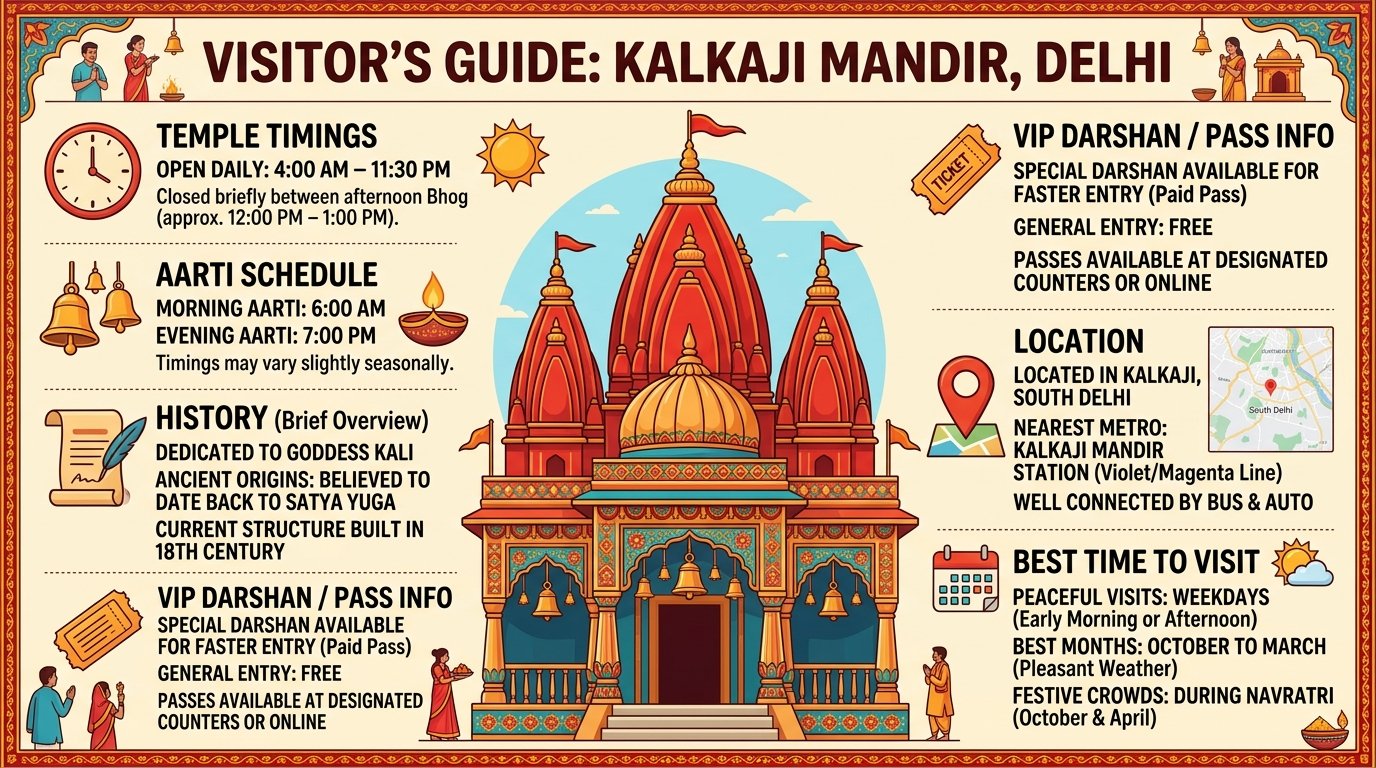
If you’ve been typing “Kalkaji Mandir Delhi” into Google trying to figure out when to go, how to get there, or whether it’s really worth the trip you’re in the right place. This temple isn’t just another stop on a South Delhi sightseeing list; it’s one of the most powerful Shaktipeeth shrines in North India, and honestly, once you’ve stood in that marble sanctum with the aarti bells ringing, you’ll understand why lakhs of people make the trip every single year.
In this guide we’ll walk through everything timings, history, the VIP darshan pass, aarti schedule, exact location, and the best time to plan your visit so you don’t end up stuck in a two-hour queue on a Tuesday evening.
Kalkaji Mandir is located in Block 9, Kalkaji, South Delhi, directly opposite the world-famous Lotus Temple and just a short walk from Nehru Place. The Kalkaji Delhi location places it in one of the busiest and most well-connected parts of the capital, which is exactly why it sees such heavy footfall throughout the week.
| Detail | Information |
|---|---|
| Temple Name | Kalkaji Mandir |
| Full Address | Block 9, Kalkaji, New Delhi, Delhi 110019 |
| Landmark | Opposite Lotus Temple, Near Nehru Place |
| Area | South Delhi |
| Nearest Metro | Kalkaji Mandir Metro Station |
If you’re checking the Kalkaji Mandir location map before heading out, just search “Kalkaji Mandir” on Google Maps — it’s pinned right next to the Lotus Temple compound wall, so honestly it’s hard to miss once you’re in the area.
Kalkaji Mandir is open daily from 4:00 AM to 11:30 PM, including weekends and public holidays. There’s no weekly off day here, which is a bit unusual compared to some other temples in the city, but it means you can genuinely plan a visit whenever it suits you.
| Timing | Hours |
|---|---|
| Morning Opening | 4:00 AM |
| Closing Time | 11:30 PM |
| Darshan Availability | All day (brief pauses during aarti and cleaning) |
During major occasions like Navratri, Ashtami, and the holy Chaitra and Kartik months, the doors often stay open way past the usual closing hour, sometimes running into overnight jagrans where devotees sit through the night singing bhajans. So if your trip lines up with one of these dates, don’t be surprised to see the place buzzing at 2 AM.
The aarti at Kalkaji Mandir isn’t just a ritual, it’s genuinely one of the more moving experiences you’ll have at any Delhi temple — the conch shells, the bells, the smell of camphor, all of it comes together in a way photos never really capture.
| Aarti | Timing |
|---|---|
| Mangala Aarti (Morning) | 4:30 AM |
| Bhog Aarti (Noon) | 12:00 PM |
| Sandhya Aarti (Evening) | 7:00 PM |
| Shayan Aarti (Night) | 10:30 PM |
Sandhya Aarti, held at 7 PM, tends to be the most crowded and arguably the most beautiful, especially once the temple lights come on. During Navratri, expect these aartis to stretch longer with live devotional singing — if you can, try to catch at least one evening session during festival week, it’s worth the crowd.
Yes, Kalkaji Mandir is recognized as one of the significant Shaktipeeths in North India. It’s dedicated to Maa Kalka, considered a fierce and powerful manifestation of Goddess Durga, and the temple is believed to be self-manifested (Swayambhu), meaning the idol wasn’t carved or installed by human hands but appeared on its own. This belief is a big part of why devotees consider the energy here so strong.
The shrine also carries two other names that you’ll hear locals use — Jayanti Peetha and Manokamna Siddha Peetha, the latter literally meaning “the peetha that fulfills wishes.” So when people say Kalkaji Mandir is a Siddha Peetha, they mean it’s a place where sincere prayers are believed to actually get answered, which is a huge draw for people coming from outside Delhi too.
The VIP Darshan Pass at Kalkaji Mandir costs between ₹150 and ₹300 per person and is mainly sold during Navratri and other high-footfall festival periods to help devotees skip the general queue.
| Feature | Details |
|---|---|
| VIP Pass Price | ₹150 – ₹300 per person |
| Availability | On-site counters during Navratri/major festivals |
| Online Booking | Not currently available |
| Best For | Elderly visitors, families, large groups |
A few honest tips here — always buy the pass from the official counters inside the temple premises, there’s unfortunately a small number of touts near the entrance who try to sell “fast darshan” access at inflated prices, and it’s not legit. Since online booking isn’t available yet, you literally have to be at the temple to grab one, so plan your arrival time accordingly if you know it’s going to be a festival day.
Crowd levels at Kalkaji Mandir change quite a bit depending on the day and season, and this is probably the most searched practical question by first-time visitors.
If you’re wondering about the Kalkaji Mandir Delhi crowd today before stepping out, a safe rule of thumb is: weekday early mornings = light crowd, weekend evenings and festival dates = heavy crowd. There isn’t an official live crowd tracker, so locals mostly go by these patterns.
The best time to visit Kalkaji Mandir really depends on whether you want peace and quiet or you want to soak in the festive energy.
Basically, if devotion and quiet reflection is your priority, go early morning. If you want to feel the full festive atmosphere with music and crowds, plan around Navratri evenings instead.
Getting to the temple is genuinely one of the easiest parts of the whole trip, thanks to how well South Delhi is connected.
The nearest metro station is Kalkaji Mandir Metro Station, served by both the Violet Line and Magenta Line, and it’s roughly a 5-minute walk straight to the temple entrance. Honestly, this is the most convenient and traffic-free way to reach the temple, especially during festival season when the roads around Nehru Place get badly jammed.
If you’re arriving by train, Hazrat Nizamuddin Railway Station is the nearest major railway station, located about 7 km from the temple. From there, you can easily grab an auto-rickshaw, cab, or connect via metro to reach Kalkaji.
| Mode | Details |
|---|---|
| Metro | Kalkaji Mandir Station (Violet & Magenta Lines) – 5 min walk |
| Railway | Hazrat Nizamuddin Station – 7 km away |
| Airport | Indira Gandhi International Airport – 20 km away |
| Local Transport | Autos, taxis, e-rickshaws from Nehru Place & Govindpuri |
The current structure of Kalkaji Mandir was built around 1764 AD by the Marathas, and was later expanded in 1816 by Mirza Raja Kidar Nath, who served as treasurer under the Mughal ruler Akbar Shah II. Over the decades, continuous donations from devotees helped the temple grow into the grand structure we see today.
But local folklore actually pushes the temple’s story back much further. It’s believed that during the era of the Mahabharata, the Pandavas and Kauravas performed rituals at this very site, and many devotees hold the belief that Maa Kalka herself was born here, which is part of why the site is considered so spiritually significant even beyond its recorded history.
Interestingly, the land the temple sits on officially belongs to the Thok Jogians and Shamlat Thok Brahmins, two groups who to this day continue conducting the daily poojas, keeping centuries-old ritual practices alive without much disruption.
Maa Kalka is worshipped as a fierce form of Goddess Durga (Kali), known for her dark complexion, commanding presence, and role as a protector against negativity and evil. Devotees see her not just as a deity of power but as a guardian figure who listens closely to heartfelt prayers.
This is really where the name Manokamna Siddha Peetha comes from — “manokamna” translates to wish or heartfelt desire, and the belief is that prayers made here with true devotion don’t go unanswered. It’s this reputation, passed down generation after generation, that keeps bringing first-time visitors and lifelong devotees back to Kalkaji again and again.
The temple is a genuinely striking example of traditional Indian marble craftsmanship. The structure is built on a brick foundation, plastered and finished entirely in white marble, topped with a pyramid-shaped tower that gives it a distinct silhouette against the Delhi skyline.
The central chamber follows a unique 12-sided design, with each side measuring 24 feet and opening into its own entrance. These entrances lead into a marble gallery about eight feet nine inches wide, ending in three arched doorways per side — that’s 36 exterior arches in total, all working together to create a really symmetrical, almost meditative layout.
At the very center sits a marble pedestal holding the carved stone idol of Maa Kali, her name inscribed in Hindi beside her. A stone trident stands guard in front of the idol, and on either side you’ll notice red sandstone tiger statues, symbolizing raw strength and courage. If you enter from the eastern doors, you get the clearest, most direct view of this whole setup — it’s honestly one of the best angles for that first darshan glimpse.
A lot of first-time visitors search for Kalkaji Mandir photos before going, just to get a sense of the place. What photographs typically capture is the gleaming white marble exterior, the pyramid-shaped shikhara catching the evening light, and the crowded but colorful courtyard during Navratri when the entire complex is decorated with flowers and lights.
That said, photography inside the actual sanctum where the idol is placed is generally discouraged out of respect for the sanctity of the space, so most photos you’ll find online are of the outer structure, gates, and courtyard rather than the deity itself.
This is something a lot of guides skip over, but it matters if it’s your first visit. Kalkaji Mandir, like most major Delhi temples, has security checks at the entrance, including frisking and bag scanning, especially during festival periods. Here’s what you should keep in mind:
Basically — travel light, keep your phone handy but be mindful near the sanctum, and don’t expect to breeze through security with a big bag during peak season.
To respect the sanctity of Kalkaji Mandir, devotees are expected to follow a few simple, unwritten but widely observed rules:
A few practical, tested tips that genuinely make a difference:
Kalkaji Mandir is one of those places in Delhi that manages to feel both grand and intimate at the same time — a huge historic Shaktipeeth that still somehow feels personal once you’re inside praying. Whether you’re coming for a quick weekday darshan, planning your Navratri visit around the VIP pass, or just curious about the temple’s Mahabharata-era folklore, knowing the timings, aarti schedule, and best visiting hours will genuinely make your trip smoother.
Dress modestly, plan around the crowd patterns we’ve covered above, and you’re set for a peaceful, memorable visit.
Jai Maa Kalka! 🙏
The temple stays open daily from 4:00 AM to 11:30 PM, including weekends and public holidays, with brief pauses only during aarti and cleaning times.
Yes, Kalkaji Mandir is recognized as an important Shaktipeeth and Siddha Peetha dedicated to Maa Kalka, a fierce form of Goddess Durga, believed to be self-manifested.
Take the Violet or Magenta Line to Kalkaji Mandir Metro Station, then walk approximately 5 minutes to reach the temple entrance directly.
Hazrat Nizamuddin Railway Station is the nearest major railway station, located about 7 km away, with easy auto and taxi connections from there.
Mangala Aarti at 4:30 AM, Bhog Aarti at 12:00 PM, Sandhya Aarti at 7:00 PM, and Shayan Aarti at 10:30 PM daily.
The VIP Darshan Pass costs between ₹150 and ₹300 per person, available only at on-site counters during Navratri and major festivals.
No, online booking isn’t available yet; passes must be purchased in person at official counters inside the temple during festival periods.
Early morning between 5:00 AM and 7:00 AM, or after 8:00 PM in the evening, are the calmest windows to avoid heavy footfall.
Crowds vary daily; Tuesdays, Sundays, and festival dates are typically the busiest, while weekday mornings tend to be much quieter.
The temple is located in Block 9, Kalkaji, New Delhi 110019, directly opposite the Lotus Temple and close to Nehru Place.
The current structure was built around 1764 AD by the Marathas and expanded in 1816, though folklore ties the site back to the Mahabharata era.
The temple features a 12-sided marble structure with 36 exterior arches, a pyramid-shaped tower, and a central idol of Maa Kali carved in stone.
Yes, modest traditional Indian attire is recommended; visitors are asked to avoid shorts, sleeveless tops, or other revealing western clothing.
Photography near the sanctum sanctorum is generally discouraged, and large bags may need to be left outside, especially during festival crowds.
Navratri (Chaitra and Sharad), Ashtami, and the Kartik and Chaitra months bring the largest crowds, often with extended or overnight darshan hours.