Physical Address
304 North Cardinal St.
Dorchester Center, MA 02124
Physical Address
304 North Cardinal St.
Dorchester Center, MA 02124

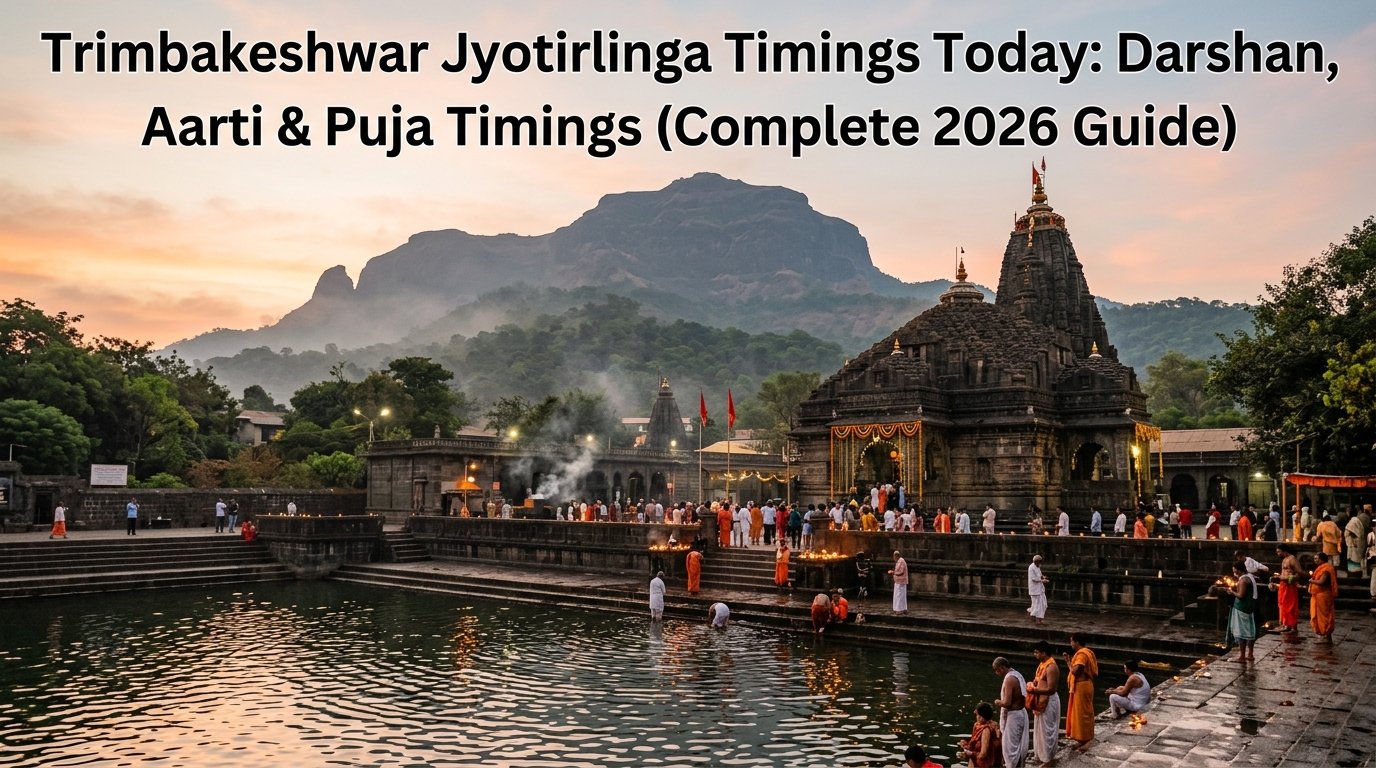
Planning a trip to one of the holiest Shiva shrines in India and wondering what time the doors open? You’re not alone. Trimbakeshwar Jyotirlinga timings today are the first thing most pilgrims search, because one wrong guess can mean standing outside a closed gate with your family.
This guide covers darshan, aarti and puja timings, ticket costs, VIP options, crowd levels and the small rules nobody tells you until you’re already in the queue.
A quick heads-up before we start: temple schedules change, especially around festivals. Treat everything below as a planning guide and confirm with the official Trimbakeshwar Devasthan Trust before you travel.
The Trimbakeshwar temple opens at 5:30 AM and closes at 9:00 PM on regular days. Published schedules split darshan into a morning window (5:30 AM to 12:00 PM) and an evening window (4:00 PM to 9:00 PM). Festival days like Maha Shivaratri and Shravan Mondays can extend these hours.
| Session | Start | End | Status / Notes |
|---|---|---|---|
| Temple opening | 5:30 AM | – | Open on general days |
| Morning darshan | 5:30 AM | 12:00 PM | Busiest before mid-morning |
| Midday break (as listed) | 12:00 PM | 4:00 PM | Rituals and cleaning, verify on the day |
| Evening darshan | 4:00 PM | 9:00 PM | Open |
| Temple closing | – | 9:00 PM | Closed |
The Trimbakeshwar Devasthan Samiti manages the temple, so its notices are the final word on any change.
The Trimbakeshwar temple opening time is 5:30 AM, and the first rituals start in the early hours, before the general queue even forms. If you want a calm darshan, reaching the temple around 5:00 AM works well, since the queue is short and the Trimbak air is cool and quiet.
Closing happens at 9:00 PM, and the last entry into the queue is usually a little earlier, so don’t show up at 8:55 and expect miracles.
Here’s the part where I want to be upfront. Many online listings show a fixed afternoon gap, but in practice some days see the temple running with only short ritual pauses.
Rules differ by season and by crowd. So whenever possible, plan your day around the evening window starting at 4:00 PM, and treat anything earlier as a bonus.
If you’re asking “Trimbakeshwar temple open or closed right now?”, the most reliable method is calling the Devasthan office or checking the official trust website on the morning of your visit.
Google listings often lag behind real changes, and third-party timing sites copy each other’s mistakes (some even print the district name twice, which tells you how much care went into them).
A temple is most likely to be closed or restricted during eclipses (the sanctum is usually shut for the Sutak period), during some special abhishek preparations, and during crowd-control measures on big festival nights. Lunar eclipse days in particular can change everything, so look at the Hindu calendar (Panchang) first.
The Trimbakeshwar darshan time is easy to remember if you think in two blocks. Morning is 5:30 AM to 12:00 PM, evening is 4:00 PM to 9:00 PM. Morning darshan is the favourite among families who want to finish early and then visit Kushavarta Kund and the nearby Brahmagiri hill.
Evening darshan feels more atmospheric, with lamps lit, bells ringing and fewer day-trippers from Nashik.
Which is better? Honestly it depends on what you want. For a peaceful visit, go early on a weekday. For a festive vibe, try the evening, but expect a longer line.
The Trimbakeshwar Shiva temple timings stay broadly the same Monday through Sunday, though Mondays are special because they’re dedicated to Lord Shiva.
Mondays in Shravan month (July/August in most years) pull in huge crowds, and the temple extends hours to handle them. Sundays see local weekend traffic from Nashik and Pune, so the afternoon queue can get long.
Can you visit on a Sunday afternoon? Yes, but check the listed midday break first, and expect the evening window to be packed.
Many sites promise aarti timings and then skip them. Here’s a practical outline of the daily rhythm. Exact minutes shift with seasons and priests’ schedules, so treat the times below as approximate and confirm locally.
The Trimbakeshwar aarti timing follows the classic Shaiva pattern. The day begins with early-morning rituals and abhishek (ritual bathing of the lingam), followed by the main morning aarti. The evening aarti takes place around sunset, and the day ends with a closing aarti before the 9:00 PM shutdown.
The Trimbakeshwar Jyotirlinga is a swayambhu lingam, which is unusual for another reason too: it’s three small lingams representing Brahma, Vishnu and Shiva, sitting in a hollow in the stone.
The Trimbakeshwar shringar timing is one of those things people ask about and rarely find answered. Shringar means the decorative adornment of the deity. The famous jewelled crown (mukut), reportedly studded with diamonds, emeralds and other stones, is placed on the lingam during the late-afternoon shringar, generally around 4:00 PM to 5:00 PM, and it’s a real highlight.
On Mondays, a palanquin procession (palkhi) carrying the deity’s face goes to Kushavarta Kund. Timings here can differ, so ask a priest or the Devasthan office for that particular week.
Trimbakeshwar darshan waiting time today is typically 30 to 90 minutes in the free general queue on normal days. On Mondays, weekends and holidays it can stretch to several hours, and during Shravan or Maha Shivaratri you might queue for half a day. That’s not an exaggeration; the lines can go out of the temple gate and through the street.
For the lowest wait, try these:
Nobody can predict it exactly, but you can guess well. Check whether tomorrow is a Monday, a weekend, an amavasya or full-moon day, a festival, or a school holiday. If it’s any of those, say yes, it’ll be crowded. A regular Tuesday to Thursday outside festival season is usually the lightest.
Trimbakeshwar temple online darshan booking is available through the Trimbakeshwar Devasthan Trust’s official website, and it’s the safest route because it avoids touts and fake agents. Booking lets you pick a slot and cuts down on confusion at the gate. Free general darshan, though, stays walk-in only, because no one needs a ticket for it.
Never pay a stranger who approaches you near the bus stand offering “special tickets”. Bookings should be done only through the trust’s official channels.
The Trimbakeshwar temple VIP darshan booking option is basically a paid fast-track queue. Instead of waiting in the free line, you buy an entry ticket and go through a shorter line.
The Trimbakeshwar temple VIP pass is a different thing in some people’s minds, since it’s sometimes used for officially approved guests and dignitaries, so don’t confuse the two.
How much is VIP darshan in Trimbakeshwar? The paid darshan fee has been reported at around ₹200 per person in recent years, but fees are revised from time to time, so check the official portal for the current amount.
It’s worth it on a busy Monday when the free queue is moving slowly, and honestly, for elderly parents it can be a lifesaver.
Many pilgrims search Nashik temple timings because Trimbak is only about 28 to 30 km from Nashik city. A common plan is Trimbakeshwar in the morning, then Panchavati, Kalaram Temple and Sita Gufa in the afternoon.
Most Nashik temples open early and close around 9:00 PM to 10:00 PM, though each one has its own schedule, so confirm before you leave.
Trimbak is known worldwide for specific rituals that are tied to the temple’s sacred geography near the source of the Godavari river. The table below uses competitor-listed ranges, so please treat them as ballpark figures and confirm with the trust.
| Puja | Duration | Approx. cost |
|---|---|---|
| Rudrabhishek | Morning, about 1 hour | ₹500 – ₹3,000 |
| Kalsarpa Shanti | Morning, appointment needed | ₹2,000 – ₹10,000 |
| Narayan Nagbali | 3 days | ₹10,000+ |
The most famous are Narayan Nagbali and Kalsarpa Shanti. Narayan Nagbali is a three-day ancestral ritual performed at Trimbakeshwar to address pitru dosha, and it’s said to be performed at very few places. Kalsarpa Shanti is a planetary remedy puja most associated with Trimbakeshwar. Both need advance booking and a priest’s guidance.
Roughly ₹500 to ₹3,000, depending on the type (individual or group) and the materials used. Rudrabhishek is the sacred bathing of the lingam with Vedic chanting, usually done in the morning. Always ask the priest what’s included before paying so there’s no surprise later.
Typically ₹2,000 to ₹10,000, with the variation coming from the priest team, the samagri and the package. Be careful of anyone quoting wildly different prices, and prefer the Devasthan-approved route.
A lot of sites list headings like “dress code” and “parking” and then leave the answers blank. Here’s the actual practical stuff.
Competitor sites claim that non-Brahmins can only view from the doorway, and that Brahmin priests control the inner sanctum (garbhagriha).
The priests do conduct the rituals, but access rules for the sanctum have varied over time, with devotees usually allowed in at set hours and in traditional attire for certain rituals. Because this claim is quoted widely without proof, check the current rule with the Devasthan office rather than relying on blogs.
For general darshan, modest, clean clothes are accepted, and many visitors do wear jeans. For pujas and the sanctum, traditional clothing is expected, like dhoti or kurta-pyjama for men and sarees or salwar suits for women. Shorts, sleeveless tops and ripped clothing aren’t welcome. When in doubt, dress traditionally.
Phones and cameras are generally not allowed inside the sanctum, and photography of the lingam is restricted. Leave your phone and bags at your hotel or use the cloakroom or locker facilities near the entrance. It saves a lot of stress at the security check.
Parking is available around the temple area and in designated lots in Trimbak town, though it fills up fast on weekends and festival days. Wheelchair and elder-friendly arrangements exist in parts of the complex, but the lanes get congested, so ask the staff for the easiest entry path.
The best time to visit is October to February, when the weather is pleasant, and weekday mornings give you the shortest queues. Monsoon (June to September) turns the Brahmagiri hills lush and green but also brings slippery roads and Shravan crowds. Summer afternoons can feel harsh, so if you travel then, stick to early morning.
Festival dates move every year with the Hindu calendar. Nashik Kumbh Mela 2027 will bring extended temple timings and heavy crowds, so book your stay months ahead if you plan to be there.
Devotees receive vibhuti (sacred ash from the Jyotirlinga puja) and tirth (holy water) from Kushavarta Kund, which is regarded as the source of the Godavari river. Kushavarta Kund is the source of the Godavari river and the origin of the temple’s tirth. Both are usually offered free, so skip anyone trying to sell you “special” versions.
Check the timings that morning, reach early, carry a valid ID, dress modestly and keep your phone away from the sanctum. Book pujas ahead, especially Narayan Nagbali, since it needs three days. And remember that crowd levels matter as much as timings.
A perfectly timed visit on a Monday in Shravan can still take half a day, so patience goes a long way.
The temple opens at 5:30 AM and closes at 9:00 PM on regular days. Timings can change on festival days, so confirm with the Devasthan Trust before you travel.
Morning darshan runs from 5:30 AM to 12:00 PM and evening darshan from 4:00 PM to 9:00 PM. Some listings show a midday break, so plan your arrival accordingly.
The first darshan begins at 5:30 AM when the temple opens. Early rituals and abhishek start around that time, and arriving a bit earlier helps you avoid the queue.
You can, but check the midday break shown in published schedules. Sundays are crowded, so the evening window from 4:00 PM is usually the safer plan.
Paid darshan has been reported at roughly ₹200 per person, though fees get revised. Check the official Devasthan website for the current amount before booking.
Darshan is generally 5:30 AM to 12:00 PM in the morning and 4:00 PM to 9:00 PM in the evening. Festivals like Shravan Mondays may extend these hours.
It depends on the day. Mondays, weekends, full-moon days, festivals and school holidays are crowded. Tuesday to Thursday outside festival season is usually calmer, especially in the early morning.
October to February offers pleasant weather, and weekday mornings before 6:00 AM have the shortest queues. Avoid Shravan Mondays and Maha Shivaratri if you prefer a quiet darshan.
Use the official Trimbakeshwar Devasthan Trust website to choose a service, pick a slot, enter devotee details and pay online. Free general darshan doesn’t need booking.
Jeans are usually accepted for general darshan if they’re modest. For puja and sanctum entry, traditional clothes are expected. Avoid shorts, sleeveless tops and ripped outfits.
Rudrabhishek generally costs ₹500 to ₹3,000, depending on the type and materials. Confirm what’s included with the priest or the trust office before paying.
Mobiles and cameras are generally restricted inside the sanctum. Leave them at your hotel or in lockers near the entrance to avoid trouble at security.
Narayan Nagbali and Kalsarpa Shanti are the most famous. Narayan Nagbali is a three-day ancestral ritual, while Kalsarpa Shanti is a planetary remedy puja.
Kaal Sarp puja typically costs between ₹2,000 and ₹10,000, depending on the package and priests. Book through official or Devasthan-approved channels to avoid overcharging.
Parts of the complex offer wheelchair and elder-friendly access, but lanes get crowded. Ask temple staff about the easiest entry route, and visit on a weekday morning for comfort.
https://templetimingsnow.com/srirangam-ranganathaswamy-temple-timings/
https://templetimingsnow.com/samayapuram-mariamman-temple-timings/
https://templetimingsnow.com/ahobilam-narasimha-swamy-temple-timings/