Physical Address
304 North Cardinal St.
Dorchester Center, MA 02124
Physical Address
304 North Cardinal St.
Dorchester Center, MA 02124

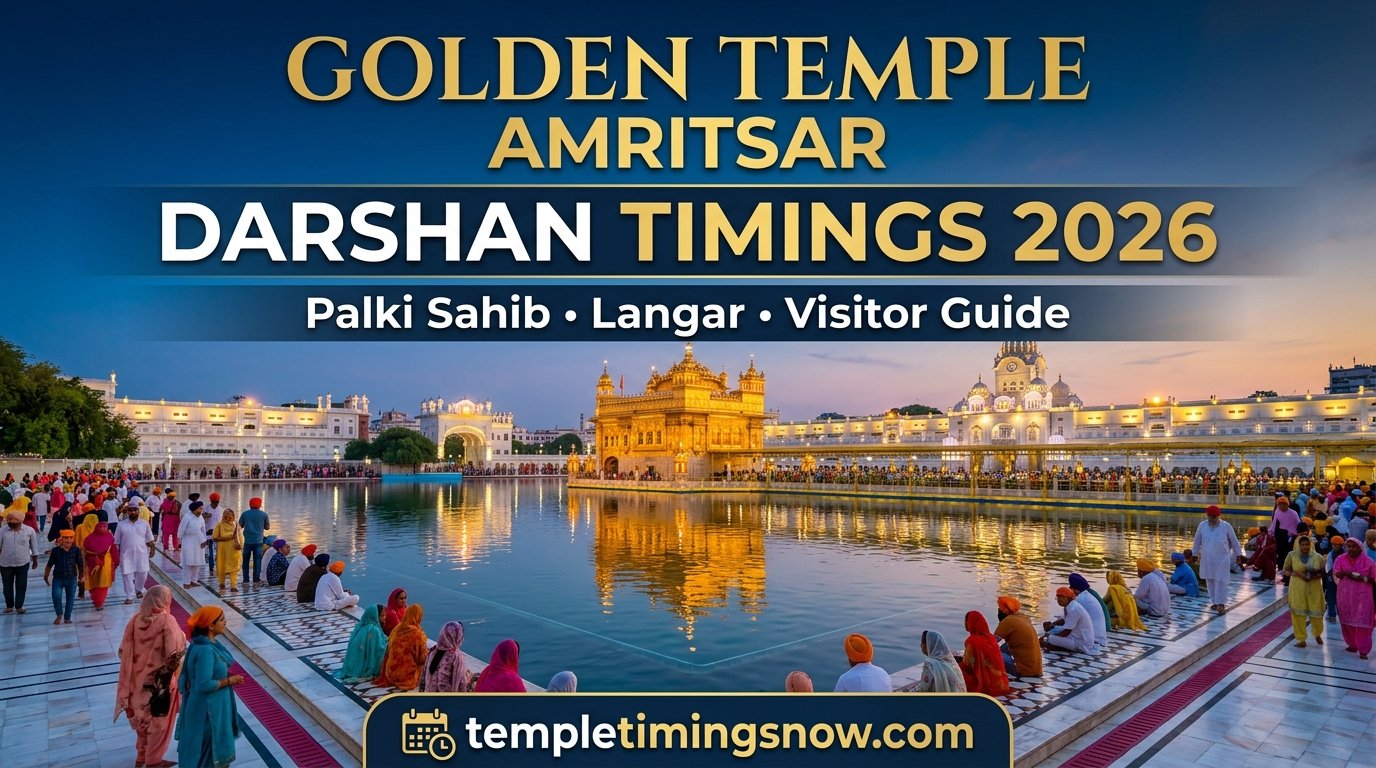
The Golden Temple Sri Harmandir Sahib in Amritsar is the holiest shrine of Sikhism and one of the most visited religious sites on earth.
Millions of devotees and travellers walk its marble parikrama every year, and the experience is unlike any other temple visit: there are no tickets, no priests demanding fees, and no barriers of faith.
Everyone Sikh, Hindu, Muslim, Christian, or simply curious is welcome. All that is asked of you is a covered head, bare feet, and respectful conduct.
This guide covers everything a first-time visitor needs: daily darshan and ceremony timings, the Palki Sahib procession, the world’s largest free community kitchen, entry rules, how to reach, and the best time to visit.
The complex is effectively open 24 hours a day, 365 days a year but the heart of the temple, the sanctum of Sri Harmandir Sahib, follows a daily routine (maryada) set by the SGPC. The exact timings shift with the season, because pre-dawn opening and the night closing move with daylight. Confirm the month-wise schedule on the official SGPC site before your visit. Approximate timings:
| Ceremony | Summer (approx.) | Winter (approx.) |
|---|---|---|
| Kiwad (portals) opening | 2:00 AM | 3:00 AM |
| Kirtan at Amrit Vela (pre-dawn hymns) | 2:00 AM | 3:00 AM |
| Palki Sahib departs from Sri Akal Takht (morning procession) | 4:00 AM | 5:00 AM |
| First Hukamnama (reading of the day) | 4:30 AM | 5:30 AM |
| First Ardas (Sikh prayer) | 5:00 AM | 6:00 AM |
| Rehras Sahib (evening prayer) | At sunset | At sunset |
| Night Hukamnama | 10:15–10:30 PM | 9:30 PM |
| Palki Sahib returns to Akal Takht (night procession / Sukhasan) | 10:30–10:45 PM | 9:45 PM |
During the day, continuous Gurbani kirtan (hymn singing) fills the sanctum from morning opening until the night ceremony. After the night procession, the sanctum is closed for cleaning for a couple of hours, though the complex itself remains open for walking, reflection, and langar through the night.
Entry is completely free — there are no darshan tickets. Unlike most major Hindu temples, the Golden Temple has no entry fee, no special darshan ticket, and no VIP queue. No prior booking is required. Everyone joins the same orderly queue managed by volunteers (sevadars). Beware of touts near the entrance offering “fast darshan” for money — there is no legitimate shortcut.
The langar (community kitchen) is the world’s largest free kitchen, called Guru Ram Das Langar after the fourth Sikh Guru. It serves roughly 50,000 to 100,000 free meals a day — rising to 200,000 or more on weekends and festival days — 24 hours a day, 365 days a year, to anyone regardless of religion, caste, or nationality.
The meal is simple and vegetarian: dal, seasonal sabzi, roti, rice, and kheer, served in two large halls where everyone sits cross-legged on the floor in rows (pangat). Just join the queue at the langar entrance; you will be given a plate, and volunteers serve continuously. Drinking water and chai are available nearby. You may also volunteer in the kitchen or dining hall as seva — chopping vegetables, rolling rotis, serving food, or washing dishes.
Free facilities at the complex: shoe storage at the Jora Ghar counters (tokens are issued), free head scarves at the entrances, free wheelchairs at main entrances, washrooms at several points, and lockers for small bags [VERIFY — confirm locker and wheelchair details at entrance].
SGPC also runs pilgrim guesthouses (sarais) nearby; rooms can be booked online through the official SGPC sarai portal or allotted at the counter on a first-come, first-served basis.
Palki Sahib (Prakash) — morning procession: The Guru Granth Sahib, the eternal Guru of Sikhism, is ceremonially carried in a golden palanquin (Palki Sahib) from Sri Akal Takht — where it rests overnight — to the sanctum of Harmandir Sahib at dawn.
Devotees line the causeway, chanting “Waheguru,” and men in the congregation take turns supporting the palanquin on their shoulders. This is the most sacred moment of the morning.
Amrit Vela kirtan: The pre-dawn hymns beginning at opening are the quietest, most meditative part of the day. The golden dome glows against the dark sky reflected in the Amrit Sarovar, and the queue for the inner sanctum is at its shortest (often 15–30 minutes).
First Hukamnama and Ardas: After the morning procession, the Hukamnama — the “order of the day,” a hymn read from the Guru Granth Sahib — is recited, followed by the Ardas prayer. Karah Prasad (sweet holy offering) is then distributed to devotees.
Rehras Sahib — evening prayer: Recited at sunset, when the temple is illuminated and its reflection shimmers in the sarovar. This is the most photographed and most crowded hour.
Palki Sahib (Sukhasan) — night procession: Late at night, after the evening Hukamnama, the Guru Granth Sahib is carried back to Sri Akal Takht for the night in the same golden palanquin procession, amid chanting. Witnessing this is deeply moving and marks the formal close of the day’s routine.
This is a Sikh shrine, not a Hindu temple, and its etiquette is strict. Follow it precisely:
By air: Sri Guru Ram Dass Jee International Airport (ATQ) is about 11–13 km from the temple. It connects to Delhi, Mumbai, Bangalore, Srinagar, and international destinations including London, Birmingham, Dubai, and Singapore. Pre-paid taxis and app cabs take 20–30 minutes to the temple. A free SGPC bus service also runs from the airport [VERIFY — confirm free SGPC airport bus still operates].
By train: Amritsar Junction (ASR) is about 2 km from the temple. It is well connected — the Shatabdi Express from New Delhi takes about 6 hours 15 minutes, and the Golden Temple Mail runs daily from Mumbai. SGPC runs a free bus service from the station to the temple every 15–20 minutes; autos and cycle-rickshaws are also available.
By road: Amritsar sits on National Highway 44 (Grand Trunk Road). Delhi is about 450 km (7–8 hours), Chandigarh about 230 km (4–5 hours), Ludhiana about 140 km, and Jammu about 215 km. Regular state and private Volvo buses connect Delhi, Chandigarh, and Jammu to the Amritsar bus stand, about 2 km from the temple. The temple is in the old city; parking is extremely limited, so staying within walking distance is best.
Nearby: Jallianwala Bagh is about 300 metres from the temple (entry free). The Wagah–Attari border ceremony is about 28 km away and makes an excellent evening trip.
Best months: October to March, when Punjab’s weather is pleasant (mornings can be foggy and cold in December–January, so carry warm layers). Avoid the May–June heat if possible.
Best time of day: For a peaceful visit with short queues, come for Amrit Vela (around 3–6 AM, depending on the season) or late at night after 10 PM. For the temple’s most beautiful face, visit at sunset for Rehras Sahib. Weekday mornings are calmer than Sundays and festival days.
Festivals: Vaisakhi (April 13–14), Guru Nanak Gurpurab (24 November 2026), and Bandi Chhor Divas/Diwali (8 November 2026) are spectacular but extremely crowded — book trains and accommodation well in advance.
Tips:
– Arrive with your head already covered and shoes easy to slip off — you will sail through the entrance.
– Plan 3–4 hours: inner sanctum darshan, the parikrama walk, the Sikh museum near the clock tower entrance, Akal Takht, and langar.
– Carry a water bottle and a small bag only; keep your hands free for the queue.
– Try the kulcha and other Amritsar street food outside the complex — but nothing non-vegetarian or intoxicating goes inside.
– Donations are welcome at official SGPC counters only; never pay individuals or “agents.”
1. What are the Golden Temple darshan timings?
The complex is open 24 hours, 365 days. The sanctum’s daily routine typically runs from about 2–3 AM (Kiwad opening and Amrit Vela kirtan) until 9:30–11 PM (the night Palki Sahib/Sukhasan procession), with timings shifting by season. Check the SGPC’s month-wise schedule before visiting.
2. Is there an entry fee or darshan ticket?
No. Entry is completely free, no darshan ticket or online booking is required, and there is no VIP queue. Everyone joins the same queue. Be cautious of anyone offering paid “fast darshan” — it is not legitimate.
3. What are the langar timings?
The Guru Ram Das Langar hall serves free vegetarian meals 24 hours a day, every day of the year, to roughly 50,000–100,000 people daily. Just join the queue; no registration or payment is needed.
4. What should I wear to the Golden Temple?
Cover your head (a scarf, dupatta, or handkerchief — free ones are available at entrances), dress modestly with shoulders and knees covered, and remove shoes and socks before entering. Wash your feet at the entrance pools.
5. When is the Palki Sahib ceremony?
Twice daily: at dawn (around 4–5 AM depending on the season), when the Guru Granth Sahib is carried in a golden palanquin from Akal Takht to the sanctum, and at night (around 9:45–10:45 PM), when it is carried back. These are the two most sacred moments to witness.
6. How do I reach the Golden Temple from the railway station or airport?
Amritsar Junction railway station is about 2 km away; Sri Guru Ram Dass Jee International Airport is about 11–13 km away. SGPC operates a free bus service from both, and autos, cycle-rickshaws, and app cabs are readily available.