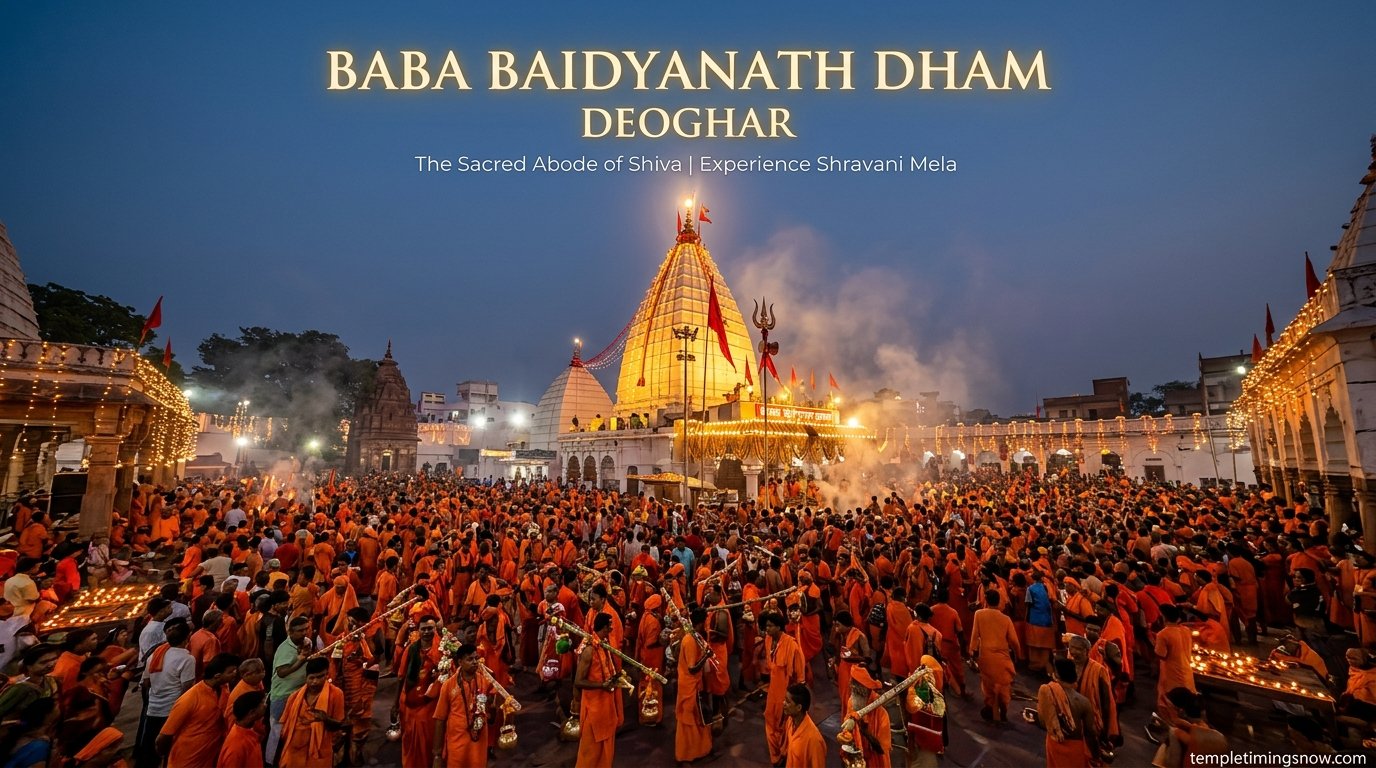
Baba Baidyanath Dham in Deoghar, Jharkhand, is one of the twelve Jyotirlingas of Lord Shiva and the only one that is also a Shakti Peeth.
Every year, lakhs of devotees pour water and milk directly onto the Jyotirlinga with their own hands, something few Jyotirlinga temples allow.
This guide covers everything a pilgrim needs: daily darshan and aarti timings, ticket types and prices, how to book online, the Shravani Mela, key sevas, and how to reach Deoghar.
Baba Baidyanath Dham: Darshan & Aarti Timings
The temple opens early and follows a ritual-driven schedule. Darshan happens in two main windows — morning and evening — with a midday break.
Daily schedule:
- 4:00 AM — Mangal / Kakad Aarti, temple doors open. The day begins with the morning aarti.
- 4:10 AM — Kancha Jal. The first water offering to the lingam.
- 4:15 – 5:30 AM — Abhishekam & Shodashopachar (Sarkari Puja). Priests perform the formal bathing and 16-step worship. General devotees usually cannot enter during this ritual.
- 5:30 AM – 3:30 PM — General morning darshan. This is the main darshan window. Devotees can touch the lingam and offer jal, flowers, and bel leaves themselves.
- ~12:00 PM — Bhog / midday offering. Brief pause for the deity’s food offering.
- 2:00 / 3:30 PM – 6:00 PM — Temple closes for cleaning and rest. The exact midday closing time varies by season and crowd — many sources show 2:00–3:30 PM as the break window.
- 6:00 PM — Doors re-open, Sandhya (evening) Aarti. Evening darshan begins.
- 6:10 – 7:30 PM — Shringar Puja. The deity is decorated; the evening aarti follows.
- 8:00 – 9:00 PM — Shayan Aarti and closing. The temple closes for the night after the final aarti.
What to know: Morning darshan (before ~9:00 AM) is the most meaningful slot — this is when jalabhishek by pilgrims is easiest. The evening slot after Shringar Puja is darshan-only; direct abhishek is generally not permitted then. Timings shift during Shravani Mela and Maha Shivratri, so confirm with the temple office (06432-232295) or babadham.org before travelling.
Ticket Types, Prices & Online Booking
General darshan is completely free. You simply join the queue. On normal days the wait can be anywhere from under an hour to 3–4 hours; on Mondays, weekends, and festival days it gets much longer.
Shighra / VIP Darshan pass: A paid “quick darshan” pass is normally available at official counters inside the temple premises. Note: during the Shravan 2026 mela, VIP/VVIP/out-of-turn darshan was completely suspended, and the normal Shighra Darshanam coupon (₹300) was raised to ₹600 (Tue–Fri) and suspended on Sun–Mon — confirm the current post-mela status and price on babadham.org before visiting [VERIFY]. This shortens the wait to roughly 20–40 minutes on normal days, but during Shravan even the VIP line can take hours.
Step-by-step online booking:
- Go to the official temple website babadham.org (online darshan registration has been handled through darshan.babadham.org).
- Look for the booking / registration section and create an account with your name, email, and mobile number.
- Log in and choose the service — Shighra Darshanam or a special puja such as Rudrabhishek.
- Select the date and available time slot, then enter the devotee details.
- Pay online and save or print the booking confirmation.
- Carry a photo ID matching the booking to the temple gate.
Important notes: The old free e-pass system is no longer in use — don’t follow old blog posts telling you to download an e-pass. During Shravan, many slots fill up weeks ahead; book early and cross-check the current procedure on the official site, as it changes between seasons [VERIFY — confirm the exact live booking page before publishing, as the temple’s online flow has changed in the past]. Avoid touts; use only official counters or the temple website.
Shravani Mela: Dates, What to Expect & Tips
The Shravani Mela (also called Sawan Mela or Shravan Mela) is the biggest event at Baidyanath Dham and one of India’s largest religious gatherings. Through the Hindu month of Shravan (roughly July–August), Kanwariya pilgrims collect holy Ganga water at Sultanganj in Bihar, where the Ganga flows northward, and carry it barefoot for about 105 km to Deoghar, chanting “Bol Bam,” to pour over the Jyotirlinga.
Dates: In 2026, Shravani Mela ran from 30 July to 28 August 2026 (Shravan Purnima / Raksha Bandhan). It runs for the full month of Shravan every year — expect roughly late July to late August in 2027, with exact dates set by the lunar calendar [VERIFY].
What changes during the mela:
- Crowds: Millions of devotees arrive. Reports from the final Shravan Monday of 2026 estimated over 3 lakh devotees in a single day, with the queue stretching more than 4 km. Over 55 lakh devotees visited during the 2026 Shravan month.
- Mondays (Sawan Somvar) and Sawan Shivratri are the peak rush days. Avoid these unless you specifically want that experience.
- External Argha system: To manage the enormous crowd, Kanwariyas pour their Ganga water into an external Argha (channel) outside the sanctum, through which it flows directly onto the Jyotirlinga — direct entry into the inner sanctum is heavily restricted during peak days.
- Mobile phones were barred from the temple complex during the 2026 mela as a security and crowd-management measure — carry only essentials.
- Prices multiply. Rooms that cost ₹1,000 normally can go to ₹5,000 or more; meals cost more too. Budget double or triple your normal expenses.
- Special arrangements: The Jharkhand government and district administration run temporary infrastructure, medical camps, drinking water, and security along the route and around the temple.
Tips for visiting during Shravan: Book accommodation weeks ahead. Reach the temple before 4 AM to beat the biggest wave. Stay hydrated, carry basic medicines, and keep elders and children out of peak Monday crowds. Follow volunteer and police directions in queues — the system is designed for volume, not comfort.
Important Sevas & Poojas
- Rudrabhishek: The most popular special puja at the temple, performed early morning with Vedic chanting. One 2026 guide lists Rudrabhishek at ₹4,000 (2 pandits) / ₹6,500 (4 pandits) — confirm current rates at the official counter or website before paying [VERIFY].
- Jalabhishek: Devotees pour water, milk, and panchamrit on the lingam themselves during the morning darshan window — this is the signature Baidyanath experience, since touching the Jyotirlinga is permitted here.
- Shringar Puja: The evening decoration ritual of the deity, followed by Sandhya Aarti.
- Monday abhishek: Considered especially auspicious; Mondays draw the heaviest crowds.
Many devotees also visit Basukinath Temple, about 43 km from Deoghar — a Shiva temple spiritually linked to Baidyanath, and tradition holds that darshan at Baidyanath is incomplete without visiting Basukinath.
How to Reach Baidyanath Dham
- By air: Deoghar Airport (DGH) is the nearest, roughly 8–12 km from the temple — a 20–30 minute taxi ride. Flight options are still limited on some routes, so also consider Ranchi (IXR) or Patna (PAT) airports [VERIFY — check current flight schedules].
- By train: Jasidih Junction (JSME) is the main railhead, about 7 km from the temple, well connected to Kolkata, Delhi, Patna, and Ranchi. Deoghar station and Baidyanathdham station serve local trains.
- By road: Deoghar is well connected by NH-114A and NH-333. Regular buses and taxis run from Ranchi, Patna, Bhagalpur, and Kolkata.
The temple is in the heart of Deoghar town — most hotels and dharamshalas are within walking distance or a short auto ride. The temple’s administrative office is at Baba Mandir Campus, Shivganga Muhalla, Deoghar – 814112.
Best Time to Visit & Practical Tips
- Best months: October to March. Cool, dry weather (10–25°C) and manageable crowds make this ideal for families, seniors, and first-time visitors.
- July–August (Shravan): Spiritually the most powerful time but extremely crowded and humid. Go only if you want the mela experience.
- Maha Shivratri (February/March): Grand night-long worship with massive crowds — book early.
- Dress code: No strict uniform is enforced, but dress modestly — covered shoulders and knees; men often wear dhoti-kurta or full-length pants, women saree or salwar suit. Saffron clothing is common during Shravan.
- Rules: Remove footwear before entering. Photography and mobile phones are prohibited inside the main sanctum and restricted in the premises. Don’t carry large bags, leather items, or food packets into the inner temple; cloakroom/locker facilities are available near the entrance.
- Carry: Photo ID, small change for offerings, a water bottle, and basic medicines. Avoid unauthorised touts — use official counters only.
- The temple complex also houses the Jayadurga Shakti Peeth shrine (where Sati’s heart is believed to have fallen), attached to the main temple — don’t miss it.
Frequently Asked Questions
What are Baba Baidyanath Dham’s darshan timings?
The temple is open roughly 4:00 AM to 3:30 PM and 6:00 PM to 9:00 PM daily. Doors open at 4:00 AM with the Mangal Aarti, close midday for cleaning and rest, reopen at 6:00 PM, and close after the Shayan Aarti around 9:00 PM. Confirm timings before visiting during Shravan or Maha Shivratri.
Is there an entry fee for Baidyanath Dham darshan?
General darshan is free for everyone. A paid Shighra/VIP darshan pass is normally available at official counters to shorten the queue — prices and availability change seasonally (VIP darshan was suspended during the Shravan 2026 mela), so confirm on babadham.org before visiting [VERIFY].
How do I book Baidyanath Dham darshan online?
Book through the official temple website babadham.org (darshan registration has been handled via darshan.babadham.org): register, choose your service and date, pay online, and carry your confirmation plus photo ID. The old free e-pass system is discontinued.
When is the Shravani Mela?
It runs through the Hindu month of Shravan, roughly July–August each year. In 2026 it was held from 30 July to 28 August. During the mela, millions of Kanwariyas walk ~105 km from Sultanganj carrying Ganga water to the temple.
Can devotees touch the Jyotirlinga at Deoghar?
Yes. Baidyanath Dham is one of the few Jyotirlinga temples where devotees are allowed to touch the lingam and perform jalabhishek themselves during the morning darshan window. During peak Shravan days, water is offered through an external Argha system instead.
How do I reach Baidyanath Dham from the nearest railway station and airport?
The nearest railway station is Jasidih Junction (~7 km) and the nearest airport is Deoghar Airport (~8–12 km). Auto-rickshaws and taxis to the temple are easily available from both.