Physical Address
304 North Cardinal St.
Dorchester Center, MA 02124
Physical Address
304 North Cardinal St.
Dorchester Center, MA 02124

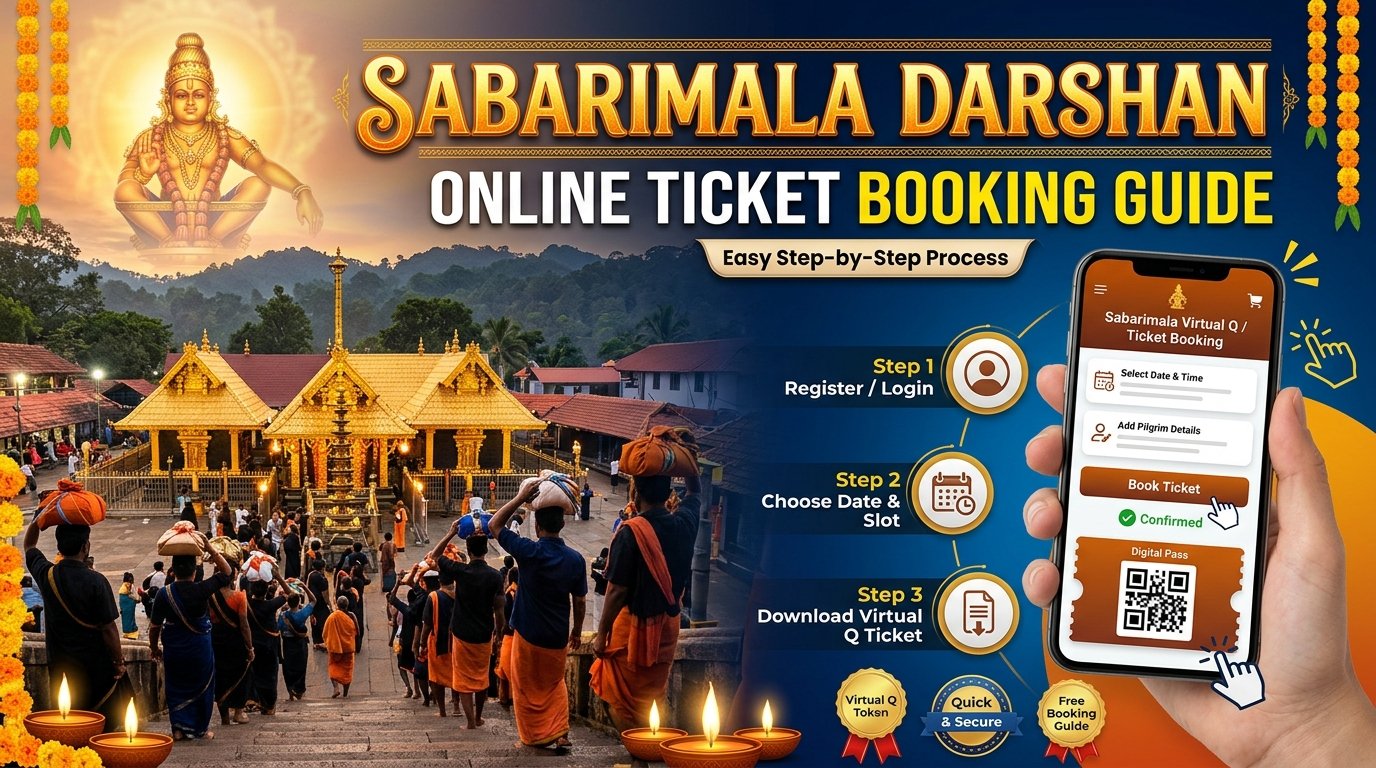
Every year lakhs of devotees head to the hills for Lord Ayyappa, and every year a good number of them waste hours because they didnt book properly.
This Sabarimala Darshan Online Ticket Booking Guide 2026: Step-by-Step Process walks you through the virtual queue, spot booking, documents, timing, refunds and on-site logistics in plain language. Read it once before the Mandalam-Makaravilakku season starts, and you’ll save yourself alot of stress.
Quick note: Rules, daily slot limits and portal links change every season. Treat the figures below as a planning guide and confirm them on the official Travancore Devaswom Board (TDB) and Kerala Police announcements before you travel.
Sabarimala darshan online booking is the process of reserving a dated, time-slotted entry for the Sabarimala Sree Dharma Sastha Temple through the official Kerala Police Virtual Queue portal. The system manages crowd flow at Sannidhanam, the main temple complex, by assigning each pilgrim a specific day and arrival window.
The virtual queue exists because the shrine sees huge numbers of devotees in the Mandalam-Makaravilakku season, and the forest route from Pamba is narrow. Without slot control, queues at the 18 Holy Steps (Pathinettampadi) can stretch for many hours. So the Virtual Queue → regulates → pilgrim crowd at Sannidhanam, and thats the whole logic behind it.
One thing people mix up: unlike some temples where you buy a paid ticket, Sabarimala’s virtual queue registration has traditionally been a free booking, not a priced ticket. Priced offerings like special poojas and accommodation are separate. More on that later.
The main pilgrimage season generally begins in mid-November with the Malayalam month of Vrischikam and runs through Mandalam Pooja in December to Makaravilakku in mid-January. The temple also opens for a few days each Malayalam month for monthly poojas, and those dates are far less crowded.
Booking windows usually open well ahead of the season, often a couple of months before. Because slot availability drops fast on weekends, holidays and the days around Mandalam Pooja and Makaravilakku, you should book early if you have fixed travel dates. Honestly, if your group is flexible, weekdays in early December or monthly pooja days are the smartest picks.
Best time to go, quick take:
The official Kerala Police Virtual Queue portal (sabarimalaonline.org, as listed by the authorities) is the trusted channel for Sabarimala darshan booking. The Official Website → is the only trusted channel for → Darshan Booking, and anything else should make you suspicious.
This matters because every big temple season brings fake booking sites and third-party links promising “VIP” or “guaranteed” slots. Sabarimala has no paid shortcut to the sanctum through random websites. Here is a short verification checklist to avoid scams:
If something feels off, close the page. Its not worth the risk.
You can complete the booking in roughly seven steps, and it usually takes under ten minutes if your documents are ready. Here is the step-by-step booking process:
The Photo ID Upload → is required to complete → Booking Registration, and the Online Payment or registration step → triggers delivery of → the QR Code Confirmation Ticket where applicable for add-on services. For the standard virtual queue, the confirmation itself is your entry pass.
You need a valid government photo ID for each pilgrim, a working mobile number and a recent photo, and nothing more complicated than that. The common documents are:
Keep the same ID you used while booking when you reach the checkpoint. If the name on your ID doesnt match the booking, you can face delays or even be refused entry at the verification counter.
Virtual queue booking is the preferred and faster route, while spot booking is a limited backup available at designated counters. The table below compares the two.
| Feature | Virtual Queue (Online) | Spot Booking (On-site) |
|---|---|---|
| Where to book | Official portal, from home | Designated counters such as Nilakkal, Pamba and some other centres |
| Waiting time | Usually shorter with a fixed slot | Can be long, depends on daily quota |
| Certainty | High once confirmed | Not guaranteed, limited daily slots |
| Documents | Upload ID online | Show ID and photo at counter |
| Best for | Planned trips, families, elderly | Last-minute pilgrims |
Daily caps on both categories are set by the authorities and have been revised in past seasons, so check the latest numbers. In short, spot booking → serves → pilgrims without advance reservation, but you shouldn’t depend on it during peak weeks.
Standard virtual queue registration is free, but certain services like special poojas, accommodation and prasadam have their own charges. The TDB publishes rates for offerings such as Ghee Abhishekam, Padi Pooja, Ashtabhishekam and room bookings at Sannidhanam and Pamba.
People often ask about a ticket price per person because other famous temples sell tiered tickets. For comparison, the Mahakaleshwar VIP darshan ticket price in Ujjain was listed as Rs 250 per person in 2025, and Garbh Grah Darshan was Rs 750 per person.
So at Mahakal, Garbh Grah Darshan → costs more than → VIP Darshan. Sabarimala doesnt work on that model for the regular queue. Any website selling a “Sabarimala VIP ticket” at a fixed price is a red flag.
Both temples use official government-run portals, but their booking logic is quite different. If you have done a Mahakal VIP darshan booking before, this section helps you see what’s new at Sabarimala.
At Ujjain Mahakaleshwar, devotees book through the official .nic.in site: find the VIP Darshan section, pick a date and time slot, enter details, upload photo ID, pay by card or net banking, and save the QR confirmation.
People search for the Ujjain Mahakaleshwar ticket or VIP darshan Mahakal option because slots fill very quickly during Savan. In fact, Savan season → reduces → time slot availability at Mahakal, just like the Mandalam-Makaravilakku season does at Sabarimala.
The big difference is price and purpose. Mahakal’s system sells priority tickets, whereas Sabarimala’s virtual queue is mainly crowd control, with no paid priority lane. Prices at Mahakal generally stay fixed during festivals, but availability is tougher, so always check the fare before booking, as the local guidance says.
Where a payment is involved (poojas, rooms, offerings), you can typically pay via UPI, debit card, credit card or net banking through the official payment gateway. The virtual queue itself doesn’t need payment, which keeps things simple.
After booking you get a booking confirmation email and an SMS. Do these three things right away:
If your payment fails but money is deducted, it is usually auto-reversed by the bank within several working days, so dont pay twice in panic. Wait for the status message, check your booking history on the portal, and keep the transaction reference number handy.
For cancellations and rescheduling, rules differ between the free virtual queue and paid services. Generally, you should cancel or change your slot through your login at least a day in advance when the portal allows it, so the slot can go to another devotee.
If you booked a paid room or pooja and cant travel, contact the TDB helpdesk with your booking ID. Refund timelines and charges vary, so read the terms on the confirmation page.
What to do if you spot an error in your booking:
If the name, age or ID number is wrong, fix it through the portal’s edit option if available, or contact the helpline listed on the site. Dont wait until you reach Nilakkal, since it can get messy there.
Plan to reach Nilakkal or Pamba within your allotted time window, carry your QR ticket and ID, and budget a full day for the trek and darshan. Here is how a typical journey flows.
Most pilgrims reach Pamba by road, with Nilakkal serving as the base parking and checkpoint where private vehicles stop and KSRTC buses shuttle devotees up. From Pamba you trek roughly 4-5 km uphill to Sannidhanam.
Elderly pilgrims and those with children can use the dolis (palanquin service) or the designated slower routes. Senior-citizen and differently-abled devotees may also find separate queue provisions, and the TDB sometimes announces special arrangements, so check ahead.
Tips that actually help:
Group bookings are usually allowed up to a fixed number of pilgrims per booking, and every member needs their own ID details. Check the current limit on the portal.
Many devotees combine southern pilgrimages like Sabarimala with northern ones in Rajasthan, and the Khatu Shyam and Salasar Balaji pair is a popular choice. If thats your plan, here are rough numbers (always verify on a live map before travel).
| Route | Approx. Distance | Typical Travel Time | Notes |
|---|---|---|---|
| Khatu Shyam to Salasar Balaji (by road) | About 80-90 km | 1.5-2.5 hours | Easiest by car or taxi |
| Jaipur to Khatu Shyam | About 80 km | 2-2.5 hours | Frequent buses |
| Jaipur to Salasar Balaji | About 170-180 km | 3.5-4.5 hours | Direct buses available |
| Khatu Shyam to Salasar Balaji (by train) | No direct link; needs a change | 3-5 hours plus road leg | Ringas Junction is the main railhead near Khatu |
The Khatu Shyam to Salasar Balaji temple distance by road is the simplest to plan, since you can hire a cab or take a state bus. For the Khatu Shyam to Salasar Balaji distance by train, you generally travel via Ringas Junction and nearby rail towns and then finish by road, as the temples sit in different rail corridors.
Looking at the Khatu Shyam to Salasar Balaji distance map, the route runs through the Shekhawati region and roughly follows the Sikar belt.
For the Jaipur to Khatu Shyam to Salasar Balaji distance as a single day circuit, plan roughly 170-180 km one way with Khatu as a stop on the way, so its a very long day if you also return the same night. Most travellers split it into two days.
Bus travel: People often search Khatu to Salasar Balaji bus options. Rajasthan roadways and private buses run on this corridor, often with a change at Sikar. The Khatu Shyam to Salasar Balaji distance by bus fare typically falls in a modest range, roughly Rs 100-250 depending on the bus type, but fares vary, so ask at the stand.
For Khatu to Salasar Balaji by private cab, expect a higher cost but far more comfort. Also, Jaipur to Salasar Balaji distance by direct bus is simple, as buses run from Jaipur’s Sindhi Camp and other stands.
The most common mistakes are booking late, using unofficial websites, mismatching IDs and ignoring the slot timing. Avoid these and your trip goes much smoother.
To sum up, the safest way to get Sabarimala darshan in 2026 is to book early through the official virtual queue, keep your ID and QR code ready, and plan your travel around the season’s crowd cycle. Do that and the whole thing feels manageable, even in the rush of December.
And if you’re stretching your pilgrimage plans to other temples, check the official sites for each one, whether its Mahakal, Khatu Shyam or Salasar. Jai Swamiye Saranam Ayyappa.
Virtual queue booking is strongly encouraged and often treated as the main entry route during the season. Spot booking exists as a limited backup, so confirm current rules on the official portal before travelling.
The Kerala Police Virtual Queue portal is used for darshan booking. Always verify the web address through TDB or official Kerala Police announcements, and avoid third-party links that look similar.
Standard virtual queue registration is generally free. Charges apply to extra services like special poojas, accommodation and prasadam, so check rates published by the Travancore Devaswom Board.
You need a valid government photo ID like Aadhaar or Voter ID, a mobile number for OTP verification, and sometimes a photo. Every pilgrim in the group needs their own details.
Yes, group bookings are usually allowed up to a fixed limit per booking. Each member must enter personal details and ID information, so keep everyones documents ready before starting.
Virtual queue is booked online in advance for a fixed slot, while spot booking is done at designated counters like Nilakkal with limited daily quota and longer, less certain waiting times.
The main Mandalam-Makaravilakku season generally begins in mid-November and continues till mid-January. The temple also opens briefly every Malayalam month, so check official dates for your preferred visit.
Book as soon as the portal opens, especially for weekends, Mandalam Pooja and Makaravilakku. Peak dates fill within days, while monthly pooja days and weekdays usually have more availability.
Dont pay again immediately. Wait for the bank’s status, note the transaction reference, and check your booking history. Deducted amounts are normally reversed automatically within a few working days.
Many portals allow cancellation or slot changes through your login before the slot date. Rules differ for free queue bookings and paid services, so read the terms on your confirmation page.
Printing is not always mandatory, but its wise. Network and battery issues are common on the hill route, so carry a printout plus a screenshot of your QR confirmation.
As per 2025 information, Mahakaleshwar VIP darshan was Rs 250 per person and Garbh Grah darshan was Rs 750 per person. Prices can change, so confirm on the official Ujjain website.
The road distance is roughly 80-90 km, taking about 1.5 to 2.5 hours depending on traffic. Check a live map for the exact route and current road conditions.
Jaipur to Salasar Balaji is around 170-180 km by road, typically 3.5 to 4.5 hours. Direct buses and taxis run regularly, and Khatu Shyam can be added as a stop.
Direct services can be limited, and many travellers change at Sikar or nearby towns. Fares are usually modest, but check timings and rates at the local bus stand or roadways website.