Physical Address
304 North Cardinal St.
Dorchester Center, MA 02124
Physical Address
304 North Cardinal St.
Dorchester Center, MA 02124
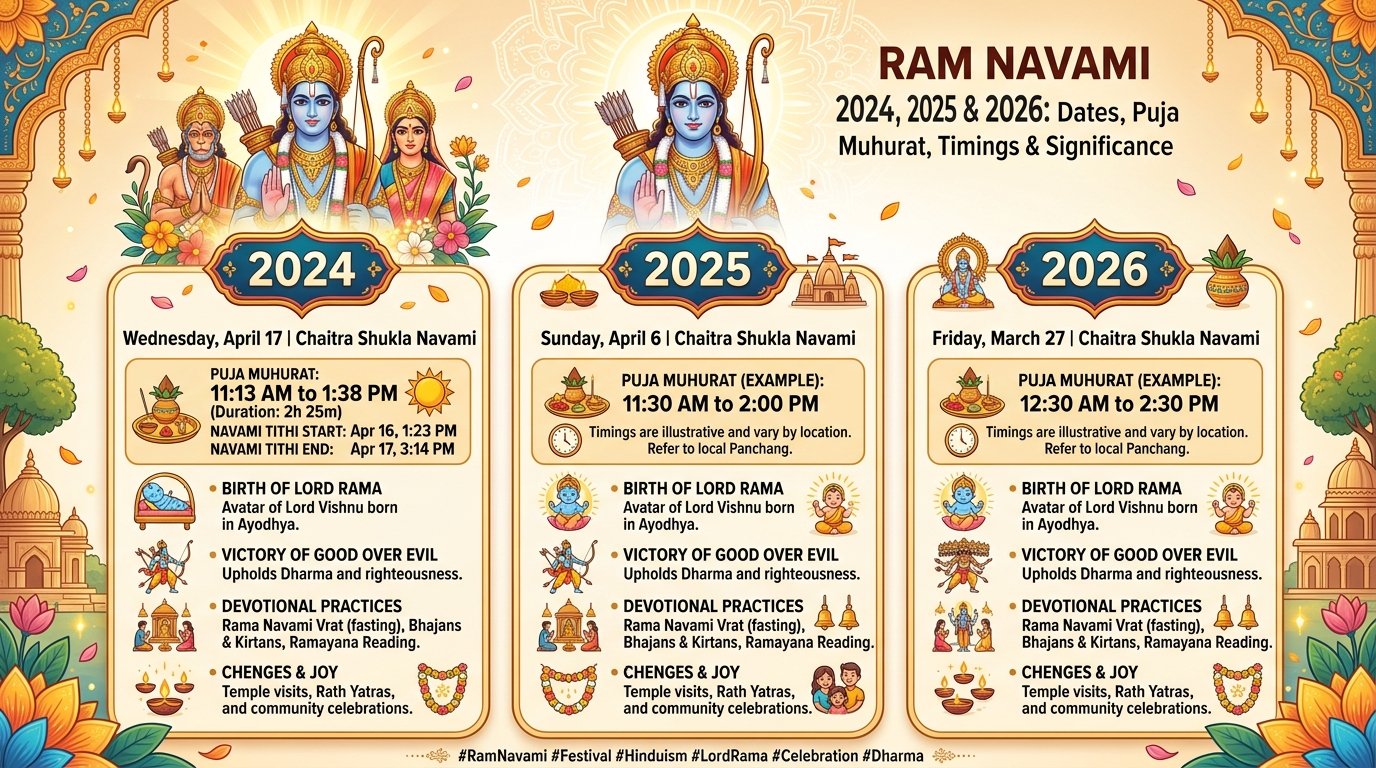
Ram Navami 2024, 2025 & 2026: Dates, Puja Muhurat, Timings & Significance is what thousands of devotees search for every year, and it’s easy to see why. The date never stays the same.
One year it’s mid-April, the next it’s early April, and then suddenly it lands in late March. On top of that, the puja window is only a couple of hours long, and every website seems to quote a slightly different time.
Ram Navami celebrates the birth of Lord Rama, the seventh avatar of Lord Vishnu, on the ninth day of Chaitra Shukla Paksha. The best time for puja is the midday Madhyahna Muhurat. So let’s get into the dates, the rituals and the reasons behind this festival.
Ram Navami falls on the ninth day (Navami) of the waxing moon in the Hindu month of Chaitra, so the Gregorian date changes every year. It was April 17 in 2024, April 6 in 2025 and March 26 in 2026. Because the Hindu calendar follows the moon, the festival slides about 11 days earlier each year, then jumps back when an extra month is added.
| Year | Date & Day | Navami Tithi (approx.) | Madhyahna Puja Muhurat (approx.) |
|---|---|---|---|
| 2024 | Wednesday, April 17 | Apr 16, ~12:11 PM to Apr 17, ~1:23 PM | 11:03 AM – 1:38 PM |
| 2025 | Sunday, April 6 | Apr 5, ~7:26 PM to Apr 6, ~7:22 PM | ~11:08 AM – 1:39 PM |
| 2026 | Thursday, March 26 | Mar 26, ~11:48 AM to Mar 27, ~10:06 AM | ~11:15 AM – 1:40 PM* |
| 2027 | ~Thursday, April 15 (expected) | To be confirmed | To be confirmed |
*Times are approximate and vary by city. Always cross-check a local panchang before you plan your puja.
A quick word on 2026, because you’ll see two dates floating around online. Navami tithi began around late morning on March 26 and ran into the morning of March 27. Since the puja is tied to midday, most panchangs marked March 26 as the day. Some older listings (including a few that just copied the raw tithi) show March 27, and that’s where the confusion comes from.
The Navami tithi starts a few hours to a full day before the festival date itself, and that’s what people usually mean by the “start date”. In 2024 it began around noon on April 16, in 2025 it began in the evening of April 5, and in 2026 it began around late morning on March 26. The festival isn’t celebrated on the day the tithi starts, though. It’s celebrated on the day Navami covers madhyahna (midday).
Some folks also read “start date” as the start of the Chaitra Navratri festival, which opens with Gudi Padwa / Ugadi. That was April 9 in 2024, March 30 in 2025 and March 19 in 2026. Ram Navami then lands roughly a week later and concludes the Navratri fasts.
The 2024 edition was kinda special. It was the first Ram Navami after the Pran-Pratishtha at the Ram Mandir in Ayodhya on January 22, 2024, so the whole country’s eyes were on the city. Temples were packed, TV channels ran live coverage, and even people who usually skip the fast were glued to their screens.
Ram Navami celebrates the birth of Lord Rama, known as Maryada Purushottam, the ideal human who never wavered from dharma. According to the Valmiki Ramayana, Rama was born to King Dashrath and Queen Kausalya in Ayodhya, at midday on the Navami of Chaitra.
Traditional accounts say the planets were beautifully placed and the whole world felt at peace. That “born at noon” detail is the reason the main puja happens at midday and not at sunrise like most festivals.
Spiritually, the day is about more than cake-and-candles style celebration. It’s a chance to reflect on truth, duty, compassion and keeping your word, even when it costs you.
Rama gave up a kingdom because of a promise his father made, and people still talk about that thousands of years later. Many devotees also believe the day brings a fresh start, which is why some families begin new ventures or read the Ramayana afresh on this date.
The ideal puja time is the Madhyahna Muhurat, roughly 11 AM to 1:30 PM. In 2024 it ran from 11:03 AM to 1:38 PM, with the exact midday moment (when Rama’s birth is symbolically celebrated) at about 12:20 PM. You don’t have to finish everything in that window. Just try to start the main puja and aarti while Navami tithi is running and the sun is at its highest.
Don’t stress if you miss it by a few minutes, because nobody’s checking your stopwatch. Devotion matters more than perfect timing, though it’s still worth planning around the muhurat if you can.
This is where most guides fall short, so here’s a simple home puja vidhi you can actually follow:
For puja samagri, keep these ready: a chowki, red or yellow cloth, roli, akshat (rice), flowers, tulsi, camphor, ghee diya, incense, Ganga jal, fruits, sweets and dry fruits. It sounds like a lot, but most of it’s already in an Indian kitchen.
Ram Navami is a proper festival of processions, music and food. In Ayodhya, Bhadrachalam, Rameswaram and Sitamarhi, celebrations hit a real peak, and pilgrims arrive days ahead. Ramlila performances retell the Ramayana, bhajans and kirtans run in homes and temples, and a havan (fire ritual) is done to purify mind, body and surroundings. Processions carry miniature idols of Rama on decorated cradles or chariots.
The distribution of prasad, typically sweets and fruits, is the glue that holds it all together. Nobody leaves a Ram Navami gathering hungry, that’s a fact. And these days the festival has gone digital too, with LED screens outside temples and live-streams reaching devotees who can’t travel.
In 2025, Ram Navami was on Sunday, April 6. Navami tithi began on the evening of April 5 and ran until the evening of April 6, and the Madhyahna puja window was around 11:08 AM to 1:39 PM. Since it landed on a Sunday, lots of families had the luxury of a relaxed, full-day puja without rushing to office, which honestly doesn’t happen every year.
The reason dates move is simple. The Hindu lunar calendar counts months by the moon’s phases, and the tithi (lunar day) can start or end at any hour. If you want to be accurate, check a panchang for your city, since sunrise and tithi timings shift by a few minutes between Delhi, Mumbai and Chennai.
The core of the festival stays the same everywhere, but every region adds its own flavour. Here’s a quick snapshot:
| Region / Place | Signature Tradition |
|---|---|
| Ayodhya (Uttar Pradesh) | Ram Navami Mela, Sarayu snan, Ram Lalla darshan, Surya Tilak and processions |
| Bhadrachalam (Telangana) | Sri Sita Rama Kalyanam, the ceremonial wedding of Rama and Sita, on the Godavari banks |
| Rameswaram (Tamil Nadu) | Special rituals at the Ramanathaswamy Temple |
| Sitamarhi (Bihar) | Celebrations linked to Sita’s birthplace, with large pilgrim gatherings |
| Shirdi (Maharashtra) | Ram Navami Utsav at the Sai Baba temple, with kirtans and processions |
| Karnataka & Tamil Nadu | Panakam, neer mor and kosambari offerings; classical music concerts |
| North India | Ramlila, Sundarkand path, akhand Ramayan recitals and processions |
Ram Navami turns the spotlight inward, asking devotees to recommit to dharma. The outer rituals are lovely, but the real point is personal reflection: Am I keeping my word? Am I kind to people who can’t do anything for me? Those are the questions Rama’s life keeps raising, and the festival gives you a nudge to sit with them for a bit.
For many, the Ram mantra is the heart of it. Repeating Rama’s name is said to calm the mind, and it’s simple enough that even kids can join in. Tulsidas (the poet of the Ram Charit Manas) is traditionally said to have begun his great work on a Ram Navami in Ayodhya, which shows how deeply the festival is tied to Rama-bhakti literature.
Ram Navami 2026 was the annual observance of Lord Rama’s birth, held on Thursday, March 26, 2026. It came right after Chaitra Navratri (March 19–27 by the standard count) and, as always, it brought Kanya Puja, midday aarti, fasting and processions.
Because it fell earlier than in 2024 and 2025, many people were caught off guard, which is a pretty common thing with lunar festivals.
If you’re reading this after the fact, no worries. The rituals don’t change, so this guide works for 2027 too, which is expected around April 15, 2027. Do confirm that with a panchang once the year’s calendar is published.
Ram Navami concludes Chaitra Navratri, which honours the nine forms of Goddess Durga. That’s why Kanya Puja is often part of the day. Devotees invite young girls (traditionally nine, plus a young boy) home, wash their feet, apply tilak, serve halwa, puri and chana, and give small gifts.
In many families, Kanya Puja happens on Ashtami, and in others it’s done on Navami itself. Both are fine, so go with what your family does.
A simple planning checklist helps: confirm the date and muhurat for your city, buy fruits and puja items a day early, plan the bhog, and decide who’s doing the aarti so there’s no last-minute chaos. Trust me, the day goes smoother.
A typical Ram Navami fast is a phalahar fast, which means fruits, milk, sabudana, buckwheat (kuttu) and rock salt, with no grains, onion or garlic. Some people keep a strict nirjala fast, while others do a lighter version. Health comes first, so if you’re elderly, pregnant, diabetic or on medication, it’s totally okay to modify the fast.
Timing of breaking the fast is where opinions vary. Some sources claim it’s broken at midnight, but that doesn’t match the midday focus of the festival. Most families break the fast after the midday puja and aarti, or on the next morning (Dashami) after offering prasad. The feasting part is the fun bit, with kheer, panakam, panjiri and fruit platters shared with neighbours.
Ram Navami has a strong seva angle too. Temples and community groups organise Annadanam (free meals), distribute clothes and essentials, run blood donation drives and hold health camps. Some groups raise funds through cultural programmes for rural school workshops. It fits the spirit of the day really well, since Rama’s story is about service and responsibility, not only rituals.
Ram Navami is celebrated in every Indian state, but the biggest observances are in Uttar Pradesh, Telangana, Tamil Nadu, Bihar, Maharashtra, Andhra Pradesh and Karnataka. Uttar Pradesh has Ayodhya, Rama’s birthplace.
Telangana has Bhadrachalam, where the state government traditionally presents silk garments to the deities at the Kalyanam. Tamil Nadu has Rameswaram, and Bihar has Sitamarhi, tied to Sita’s birthplace. Maharashtra is huge on the festival too, with Shirdi hosting a major utsav.
Basically, if a state has a Rama temple (and most do), there’s a celebration. The festival also spills into Odisha, West Bengal, Gujarat and Rajasthan, each with local processions and bhajan sessions.
Ram Navami is a gazetted holiday on the central government’s list, so offices, schools and banks are closed across most states. It’s not identical everywhere, though.
A few states or private companies may treat it as a working day, so check local notices. In 2024 the stock exchanges were shut for the day, and it fell on a Wednesday, which made for a nice midweek break. In 2025 it fell on a Sunday, so nobody got a bonus day off, which was a bit disappointing for many.
Practical tip: book travel to Ayodhya, Bhadrachalam or Rameswaram well in advance. Trains and hotels fill up fast, and prices jump too.
Ram Navami is not celebrated in October. It falls in March or April, in the month of Chaitra. The October mix-up usually comes from three other Rama-linked festivals that fall in autumn:
Diwali, which celebrates Rama’s return to Ayodhya, lands in October or November as well, so it’s no surprise people blur the dates. Ram Navami is Rama’s birth, Dussehra is his victory, and Diwali is his homecoming. The wedding anniversary, Vivah Panchami, is in November or December. Same story, four different chapters.
The origins of Ram Navami lie in the Valmiki Ramayana, which scholars date to roughly the first millennium BCE, though estimates vary. The story goes that King Dashrath had no heir, so the sage Rishyasringa guided him through the Putrakameshti Yagya.
From the fire emerged a divine being carrying sacred payasam (kheer), which the king shared among his queens Kausalya, Sumitra and Kaikeyi. Soon after, Rama was born to Kausalya, Bharata to Kaikeyi, and Lakshmana and Shatrughna to Sumitra.
That’s actually why kheer is such a common offering on Ram Navami. It’s a direct nod to the story. The festival itself grew over centuries through temple traditions, the bhakti movement and the popularity of the Ram Charit Manas, which made Rama’s story accessible to ordinary people.
Today’s celebrations blend devotion with community life. People sing bhajans, visit temples, conduct havans and share prasad. In Ayodhya, priests and temple leaders talk about the day’s divine significance, and public figures, including the Prime Minister, usually post greetings that reach millions. These days the festival is part religious, part cultural and, for many, part family reunion.
This is a topic most competitors barely touch, so let’s slow down. The Surya Tilak is a system of mirrors and lenses inside the Ram Mandir that directs a beam of sunlight onto Ram Lalla’s forehead at midday on Ram Navami. In 2024, it lasted for a few minutes and was broadcast live.
Scientists from Indian research institutions helped design the optical setup, which uses a sequence of mirrors and lenses so the beam travels from the upper floor down to the sanctum. No electricity or batteries are involved in the alignment itself, just sunlight and careful geometry.
Why Ram Navami specifically? The idea is to recreate the symbolic moment of Rama’s birth at noon, with the Sun (Surya), whom the Raghu dynasty traces its lineage to, blessing him. Since the date follows the lunar calendar and the Sun’s path follows the solar calendar, the design accounts for that difference so the tilak can repeat on Ram Navami in different years.
The temple has also changed the festival practically, with larger crowds, extended darshan hours, special queue arrangements and huge digital broadcasts. If you’re planning to attend, expect long waits and book early.
Expect more online darshan, live-streamed pujas and virtual puja bookings, because that’s already happening. Eco-friendly celebrations are gaining ground too, with flower-based decor, clay idols and reusable plates for Annadanam.
And younger people are getting hooked through animated Ramayana retellings, podcasts and social media reels. The core meaning stays put, while the packaging keeps changing.
Wherever the Indian diaspora settles, Ram Navami travels with it. In Mauritius, Fiji, Trinidad and Tobago, Guyana and Suriname, Ramayana recitation and satsang traditions go back to the days when indentured workers carried the text with them across the seas.
In the UK, the US, Canada and Australia, temples hold special pujas, Ramayana readings, music and dance programmes and community meals. For kids who grew up abroad, it’s often their main window into the story, so parents work hard to make it fun.
Some temples invite neighbours from other faiths, host talks about the Ramayana’s values or run cultural exhibitions. You’ll also see fusion in music, like bhajans with guitars or keyboards, which is a bit unusual but honestly quite sweet.
These exchanges help outsiders understand the festival as more than just a ritual, and they keep the younger generation engaged with their roots.
Righteousness, courage, humility and compassion are the universal messages of Ram Navami. You don’t have to be religious to relate to a man who keeps his promises and treats everyone with respect. The Ram mantra offers a pathway to calm, while the story reminds us that good conduct matters more than power. That’s why the festival resonates well beyond India’s borders.
Ram Navami wishes are short, heartfelt messages that share blessings of peace, strength and dharma with family and friends. Here are a few you can copy and send on WhatsApp, or tweak to sound like you:
“May the auspicious occasion of Ram Navami fill your life with joy, peace and fulfilment.”
“On this day, may Lord Rama bless you with the strength, courage and wisdom to overcome every obstacle.”
“As we celebrate the birth of Lord Rama, let’s try to follow his teachings of truth, righteousness and compassion.”
“May the divine light of Lord Rama guide you towards righteousness and happiness.”
Pro tip: adding the person’s name makes it feel far more personal than a forwarded image.
“Happy Ram Navami” is the standard greeting, often followed with “Jai Shri Ram” or “Ram Navami ki hardik shubhkamnayein.” Use it in person, on cards, or as a caption. A few extra ideas: “Wishing you and your family a blessed Ram Navami.
May your home be filled with devotion and happiness,” or “Happy Ram Navami! Let’s carry Rama’s values into everyday life, not just today.” Short and warm always works better than a long, formal message.
Ram Navami is far more than a date on the calendar. It celebrates the birth of Lord Rama, closes Chaitra Navratri, and brings families, temples and entire cities together through puja, fasting, music and seva.
To sum up: April 17, 2024, April 6, 2025 and March 26, 2026 are the dates to remember, the Madhyahna Muhurat is the best puja window, and the Surya Tilak in Ayodhya has added a fresh layer of wonder to an already timeless festival.
Whether you’re doing a quiet home puja or joining a huge procession, the core is the same: remember Rama’s values and try to live a little more like him. Jai Shri Ram.
Ram Navami is a Hindu festival marking the birth of Lord Rama, the seventh avatar of Vishnu. It falls on the ninth day of Chaitra Shukla Paksha, usually in March or April.
Ram Navami 2024 fell on Wednesday, April 17. The Madhyahna puja muhurat ran from about 11:03 AM to 1:38 PM, with the midday moment of Rama’s birth at roughly 12:20 PM.
Ram Navami 2025 was observed on Sunday, April 6. The Navami tithi ran from the evening of April 5 to the evening of April 6, with puja around 11:08 AM to 1:39 PM.
Ram Navami 2026 fell on Thursday, March 26, according to most panchangs, since Navami tithi covered midday that day. Some older listings show March 27, so always check a local panchang.
Ram Navami 2027 is expected around Thursday, April 15, following Chaitra Navratri starting on April 7. Confirm the exact date and muhurat with a trusted panchang for your city closer to the festival.
It commemorates Lord Rama’s birth to King Dashrath and Queen Kausalya in Ayodhya, and celebrates dharma, truth and ideal conduct. Devotees fast, pray, read the Ramayana and sing bhajans.
The ideal puja time is the Madhyahna Muhurat, the midday window around noon when Rama was born. It’s roughly 11 AM to 1:30 PM, but exact timings shift by city and sunrise.
Yes, Ram Navami is a gazetted holiday on the central government list, so offices, schools and banks stay closed across most states. Some states and private employers may vary, so check local notices.
Ram Navami is celebrated across India. Uttar Pradesh (Ayodhya), Telangana (Bhadrachalam), Tamil Nadu (Rameswaram), Bihar (Sitamarhi), Maharashtra (Shirdi), Andhra Pradesh and Karnataka see especially large observances.
No. Ram Navami falls in March or April during Chaitra. October festivals like Dussehra, Vijayadashami and Ramlila mark Rama’s victory over Ravana, which is why people sometimes link Rama celebrations with autumn.
Devotees usually keep a phalahar fast with fruits, milk, sabudana and rock salt, avoiding grains, onion and garlic. Many break it after the midday puja or the next morning, depending on family tradition.
Surya Tilak is a mirror-and-lens system in Ayodhya’s Ram Mandir that directs sunlight onto Ram Lalla’s forehead at midday on Ram Navami, lasting a few minutes. It first happened in 2024.
Kanya Puja is worshipping young girls as forms of Goddess Durga during Navratri. Devotees wash their feet, apply tilak, serve halwa, puri and chana, and give small gifts, usually on Ashtami or Navami.
Common offerings are kheer, panakam (jaggery water), neer mor, fruits, panjiri and tulsi leaves. Kheer is popular because Dashrath’s queens received sacred payasam before Rama was born.
Ram Navami celebrates Rama’s birth in Chaitra (March-April). Dussehra celebrates his victory over Ravana in Ashwin (September-October). They mark different events in the same story, so dates and rituals differ.
https://templetimingsnow.com/rahu-ketu-pooja-at-sri-kalahasti-temple/
https://templetimingsnow.com/kateramma-temple/
https://templetimingsnow.com/rahu-kalam-yamagandam-kuligai-timings-by-day/
https://templetimingsnow.com/kanipakam-vinayaka-temple/