Physical Address
304 North Cardinal St.
Dorchester Center, MA 02124
Physical Address
304 North Cardinal St.
Dorchester Center, MA 02124

If you’ve ever asked your grandmother “can I start this journey now?” and got a sharp “wait, check the time first” you already know why Rahu Kalam, Yamagandam, and Kuligai matter so much in everyday Hindu life.
These three time periods quietly decide when millions of people across India begin a new job, sign a property deal, or even leave the house for a long trip.
In this 2026 guide, we’ll break down the daily Rahu Kalam Yamagandam timings, explain what each period actually means, and fill in the gaps most other articles skip over like how these timings are actually calculated and why they shift by city.
Whether you’re looking for today Rahu Kalam Yamagandam Gulika timings, planning ahead for tomorrow Rahu Kalam Yamagandam timings, or just trying to understand Yamagandam today before you book that flight ticket this guide has you covered, day by day.
In short: these are three specific time-blocks within each day that Hindu astrology (Panchangam) treats as spiritually sensitive. Rahu Kalam is ruled by the shadow planet Rahu, Yamagandam is governed by Yama (the god of death), and Kuligai (also called Gulik Kalam) falls under the influence of Shani, or Saturn.
Each day gets divided into eight equal segments, and depending on the weekday, a different segment becomes Rahu Kalam, another becomes Yamagandam, and another becomes Kuligai.
Devotees generally avoid starting anything important a wedding, a business launch, even cutting hair for some communities during Rahu Kalam and Yamagandam. Kuligai, interestingly, is treated a bit different, and we’ll get to that shortly.
These periods aren’t random either — they follow sunrise and sunset, which is why the exact clock time changes slightly based on where you live and what season it is.
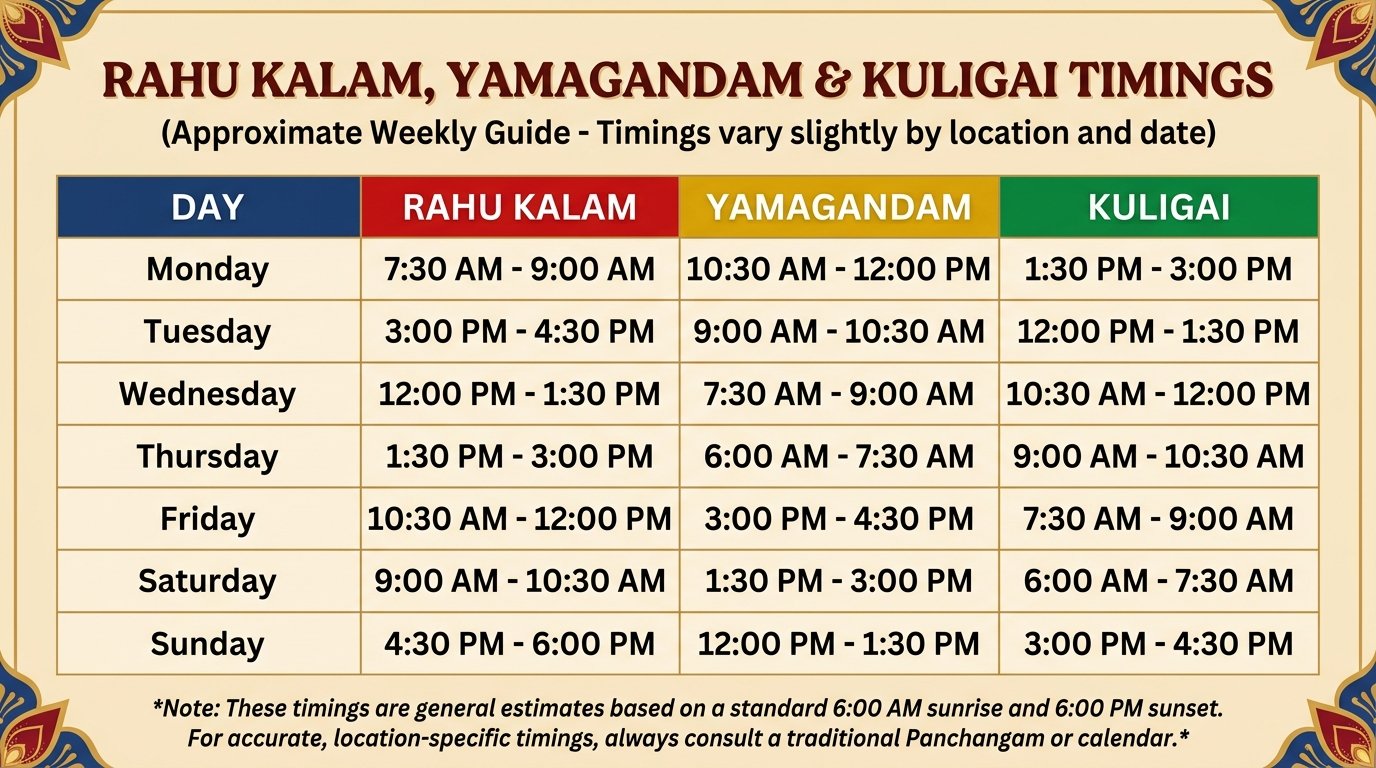
Below is the general Rahu Kalam Yamagandam timings chart followed across most parts of India. Note that these are calculated assuming a 6:00 AM sunrise your local timings might shift by 15-30 minutes depending on your city (more on that in the calculation section below).
| Day | Rahu Kalam | Yamagandam | Kuligai (Gulik Kalam) |
|---|---|---|---|
| Monday | 7:30 AM – 9:00 AM | 10:30 AM – 12:00 PM | 1:30 PM – 3:00 PM |
| Tuesday | 3:00 PM – 4:30 PM | 9:00 AM – 10:30 AM | 12:00 PM – 1:30 PM |
| Wednesday | 12:00 PM – 1:30 PM | 7:30 AM – 9:00 AM | 10:30 AM – 12:00 PM |
| Thursday | 1:30 PM – 3:00 PM | 6:00 AM – 7:30 AM | 9:00 AM – 10:30 AM |
| Friday | 10:30 AM – 12:00 PM | 3:00 PM – 4:30 PM | 7:30 AM – 9:00 AM |
| Saturday | 9:00 AM – 10:30 AM | 1:30 PM – 3:00 PM | 6:00 AM – 7:30 AM |
| Sunday | 4:30 PM – 6:00 PM | 12:00 PM – 1:30 PM | 10:30 AM – 12:00 PM |
(Timings are approximate, based on 6:00 AM sunrise. Always adjust a bit for your city’s actual sunrise time — we’ll show you how below.)
Let’s be honest, most people don’t memorize this whole table. They just want to know today Rahu Kalam Yamagandam Gulika timings or check tomorrow’s slot before stepping out. So let’s break it down day-wise too, since that’s usually how people actually search for this.
Monday’s Rahu Kalam falls between 7:30 AM and 9:00 AM, right when most people are getting ready for work — so many avoid making big decisions in that window. Yamagandam on Monday runs from 10:30 AM to 12:00 PM, and Kuligai closes the trio from 1:30 PM to 3:00 PM.
Sunday Yamagandam timings sit between 12:00 PM and 1:30 PM, right in the middle of the day. Sunday Rahu Kalam is a bit later than other days, running from 4:30 PM to 6:00 PM — which honestly catches a lot of people off guard since they assume it’s earlier like on weekdays. Kuligai on Sunday is from 10:30 AM to 12:00 PM.
On Saturday, Rahu Kalam falls between 9:00 AM and 10:30 AM. Yamagandam takes over from 1:30 PM to 3:00 PM, and Kuligai — fittingly, since Saturday belongs to Shani anyway — runs early morning from 6:00 AM to 7:30 AM.
Friday’s Rahu Kalam is between 10:30 AM and 12:00 PM. Friday Yamagandam timings run later in the afternoon, from 3:00 PM to 4:30 PM, while Kuligai happens early, between 7:30 AM and 9:00 AM.
Tuesday is one of the trickier days because Rahu Kalam shows up quite late — 3:00 PM to 4:30 PM. But Tuesday Yamagandam timings are earlier in the day, from 9:00 AM to 10:30 AM, and Kuligai follows right after from 12:00 PM to 1:30 PM.
Wednesday’s Rahu Kalam sits at midday, 12:00 PM to 1:30 PM, with Yamagandam earlier at 7:30 AM to 9:00 AM. Thursday flips things a bit — Yamagandam is the earliest of the week here, starting right at 6:00 AM and ending 7:30 AM, while Rahu Kalam comes later, 1:30 PM to 3:00 PM.
Rahu → is → a shadow planet associated with illusion, confusion, and sudden disruption. Because of this, Rahu Kalam is considered inauspicious for starting new ventures, signing contracts, or beginning journeys. Most people simply pause and wait it out rather than fight it kind of like how you wouldn’t launch a product on a day your gut just says “not today.”
Yamagandam → is ruled by → Yama, the god of death and transformation, and represents stagnant or negative energy during that window. It’s generally advised to avoid big financial decisions, travel bookings, or ceremonies in this slot. That said, it isn’t something to fear — it’s more of a “let’s not tempt fate today” kind of caution that’s been passed down for generations.
Here’s where it gets interesting. Kuligai → is ruled by → Shani (Saturn), and unlike the other two, it’s considered somewhat neutral, even mildly auspicious for spiritual activities. Meditation, temple visits, and quiet worship are actually encouraged during this window, even though new material ventures are still best avoided.
Most articles just hand you a table and move on — but here’s the part that actually matters if you want accurate timings for your city, not some generic 6 AM sunrise assumption.
Hindu Panchangam divides the daytime (from sunrise to sunset) into eight equal parts, each roughly 90 minutes long on a standard 12-hour day. Each of these eight segments is assigned to a specific planetary ruler, and the sequence rotates depending on the day of the week. Rahu Kalam, Yamagandam, and Kuligai each occupy one of these eight segments — never overlapping — which is why they always show up as distinct, non-overlapping blocks in the table above.
Here’s the simplified logic:
This is exactly why two websites can sometimes show slightly different timings for the same day — one might be using a fixed 6 AM sunrise, while another calculates it live based on your actual location.
A city like Chennai, closer to the equator, has a fairly consistent sunrise year-round. But somewhere like Delhi or Srinagar, sunrise can shift by almost an hour between summer and winter, which pushes every single one of these time blocks earlier or later.
If you’re in Mumbai, Bengaluru, Kolkata, or a smaller town, it’s worth checking a location-based Panchangam calculator rather than relying purely on a national average table — especially for something important like a wedding muhurat or a business launch date.
While Rahu Kalam is avoided for starting new tasks, many devotees actually use this window for prayer and remedial rituals instead — turning a “bad time” into a spiritually productive one.
Some simple, commonly followed rituals include:
Just like Rahu Kalam, Yamagandam doesn’t have to be purely a “wait it out” period. Many devotees use it for karmic cleansing and protective worship instead.
Here’s a fast side-by-side so you don’t have to scroll back and forth:
| Aspect | Rahu Kalam | Yamagandam | Kuligai |
|---|---|---|---|
| Ruling Entity | Rahu | Yama | Shani (Saturn) |
| Nature | Inauspicious | Inauspicious | Neutral to auspicious |
| Best Avoided For | New ventures, travel | Financial decisions, travel | Not strictly avoided |
| Recommended Activity | Prayer, reflection | Karmic remedies, fasting | Worship, meditation, temple visits |
Rahu Kalam is a daily time period ruled by Rahu, considered inauspicious for new work, travel, or ceremonies. It’s avoided because Rahu is associated with confusion, illusion, and sudden disruption in Hindu astrology.
Yamagandam today depends on the current weekday — for instance, it’s 6:00–7:30 AM on Thursday and 12:00–1:30 PM on Sunday. Check the day-wise table above for exact timings.
Kuligai is generally considered neutral to mildly auspicious, especially for spiritual practices like meditation and temple visits, unlike Rahu Kalam and Yamagandam which are avoided for new tasks.
It varies daily by weekday and your local sunrise time. Refer to the day-specific table above, or use a location-based Panchangam calculator for precise, real-time timings.
On Sunday, Yamagandam typically falls between 12:00 PM and 1:30 PM, based on standard sunrise assumptions. Local variations may shift this by a few minutes.
Saturday’s Rahu Kalam runs 9:00–10:30 AM, and Yamagandam runs 1:30–3:00 PM, with Kuligai occurring earliest at 6:00–7:30 AM.
Friday’s Yamagandam typically falls between 3:00 PM and 4:30 PM, while Rahu Kalam on the same day is earlier, from 10:30 AM to 12:00 PM.
It’s traditionally advised against, especially for important or long-distance trips. Many people delay departures until after Rahu Kalam ends to avoid perceived obstacles or delays.
Yes, timings shift based on your local sunrise and sunset, which vary by latitude and season. A generic table (like 6 AM sunrise) is only an approximation.
On Monday, Rahu Kalam falls 7:30–9:00 AM, and Yamagandam follows at 10:30 AM–12:00 PM, with Kuligai occurring later, 1:30–3:00 PM.
Yes, prayer and pooja are actually encouraged during this window. It’s new ventures and major decisions that are typically avoided, not spiritual practice itself.
Tuesday’s Yamagandam runs from 9:00 AM to 10:30 AM, notably earlier than Rahu Kalam, which falls later at 3:00–4:30 PM on the same day.
The daylight period is divided into eight equal segments, each ruled by a different planetary influence, with Rahu Kalam, Yamagandam, and Kuligai occupying three distinct segments.
Yamagandam represents stagnant or negative energy tied to Yama, so major financial commitments made during this window are traditionally believed to face obstacles or instability later.
Since Kuligai is ruled by Saturn and considered relatively favorable, it’s a good window for meditation, temple visits, or quiet worship rather than starting new material tasks.
https://templetimingsnow.com/thiruthani-murugan-temple-timings/
https://templetimingsnow.com/sri-kalahasti-temple-online-booking/
https://templetimingsnow.com/sri-kalahasti-temple-darshan-timings/
https://templetimingsnow.com/rahu-ketu-pooja-at-sri-kalahasti-temple/