Physical Address
304 North Cardinal St.
Dorchester Center, MA 02124
Physical Address
304 North Cardinal St.
Dorchester Center, MA 02124

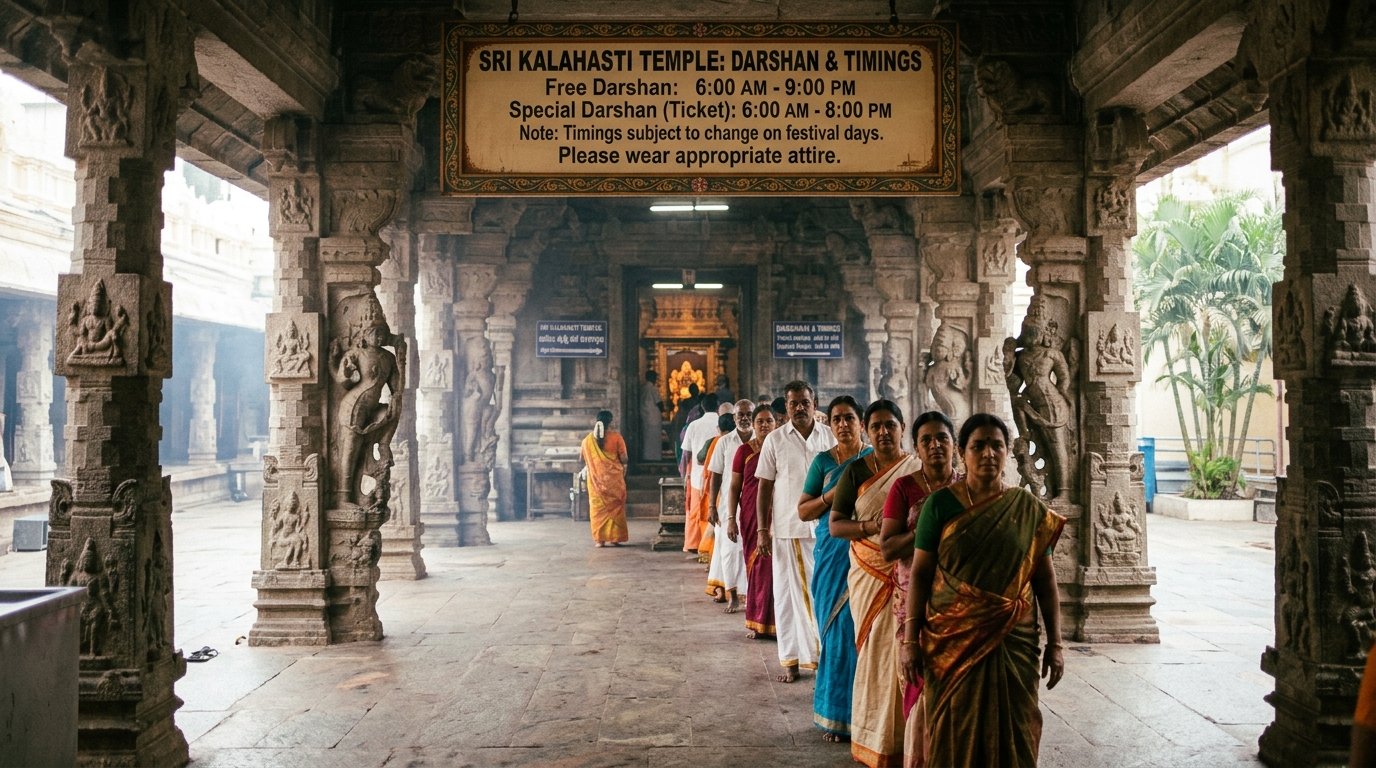
If you’re planning a trip and typing “srikalahasti temple timings today” into Google at midnight, trust me, you’re not alone. Thousands of devotees do this every week before heading to one of South India’s most powerful Shiva shrines.
This guide covers everything about Sri Kalahasti Temple Darshan & Timings general darshan hours, Rahu Ketu Pooja slots, ticket rates, and a few practical tips that most temple guides honestly skip over.
Whether you’re visiting for the first time or you’ve been a dozen times already, there’s usually something new to plan around, and that’s exactly what we’ll sort out here.
Srikalahasti temple isn’t just another Shiva shrine it’s one of the Pancha Bhoota Sthalams, representing the Vayu Lingam (the Air element), and it draws pilgrims specifically for Rahu-Ketu dosha relief.
So getting your timing right actually matters, not just for convenience but because certain days and hours are considered far more auspicious than others.
Sri Kalahasti Temple, officially known as Sri Kalahasteeswara Swamy Vari Devasthanam, sits on the banks of the Swarnamukhi River in Andhra Pradesh, roughly 36 km from Tirupati. Locals often call it the “Kailasam of the South” (Dakshina Kailasam) because of its spiritual stature, comparable in significance to Mount Kailash itself.
The presiding deity, Lord Kalahasteeswara, represents the Vayu Lingam one of the five Pancha Bhoota Sthalams dedicated to Lord Shiva, each symbolizing one of the five natural elements (earth, water, fire, air, and space).
Alongside him sits Goddess Gnana Prasunambika Devi, and darshan here is considered incomplete without paying respects to both deities.
What makes this temple genuinely unique and this is something a lot of guides gloss over is that it never closes, not even during solar or lunar eclipses.
Most Shiva temples in India shut their doors during eclipse periods for ritual reasons, but Sri Kalahasti stays open, which tells you something about the temple’s specific theological tradition around Rahu and Ketu worship.
So, what’s the actual answer to “kalahasti temple timings today“? The temple runs on a fairly consistent, year-round schedule, so unless there’s a special festival happening, these timings should hold steady.
The temple opens daily at 5:00 AM and closes at 9:00 PM. General darshan → runs → the entire 5:00 AM to 9:00 PM window, though the sanctum does pause briefly a few times through the day for abhishekam and naivedyam rituals. Here’s the fuller breakdown:
| Temple Session | Timings |
|---|---|
| Temple Opening Hours | 5:00 AM – 9:00 PM |
| Suprabhata Seva | 5:00 AM – 5:30 AM |
| Abhishekam & Morning Poojas | 6:00 AM – 9:00 AM |
| General Darshan Hours | 5:00 AM – 9:00 PM |
| Rahu–Ketu Pooja Timings | 6:00 AM – 5:00 PM |
| Afternoon Break | Short ritual pauses only, no fixed time |
| Evening Pooja & Harathi | 6:00 PM – 8:30 PM |
| Temple Closing | 9:00 PM |
A quick honest note here — the Devasthanam doesn’t publish an official fixed afternoon closing window. It’s not that they’re hiding it, it’s just that the pause depends on how long that day’s abhishekam and naivedyam take, which can shift by 15-20 minutes depending on crowd volume. If your visit timing is tight, it’s genuinely worth calling the temple office before you leave your hotel, rather than assuming the sanctum will be open the second you arrive at noon.
This is one of those small details competitors mention but never really explain, so let’s fix that. The afternoon pause exists because naivedyam (the offering of food to the deity) has to happen at a specific ritual pace it can’t be rushed just to meet a printed timetable.
Priests typically begin this process sometime between 12:00 PM and 1:00 PM, and depending on the day’s crowd and any ongoing sevas, it can wrap up anywhere from 20 minutes to a full hour later.
Practically speaking, if you’re planning your visit, treat 12:00 PM to 1:30 PM as a soft “avoid” window for arriving fresh at the sanctum door.
It doesn’t mean the temple is closed the outer areas, queue lines, and darshan corridors stay accessible but you might find yourself waiting near the front for the sanctum to reopen. Early morning (before 9 AM) or late afternoon (after 3 PM) tend to be the safest bets if you want to avoid this uncertainty altogether.
Is Kalahasti crowded today? On a typical weekday, crowd levels are moderate, with wait times usually falling somewhere between 1 to 2 hours depending on the season and whether any special pooja is happening. Weekends, Amavasya days, and festival dates push this up significantly, sometimes to 3-4 hours during peak season.
As of today, Monday, 14 September 2026, it’s worth noting that this date coincides with Vinayaka Chaturthi, which marks the beginning of Bhadrapada Masam (running 12 September to 10 October 2026).
Mondays are already considered auspicious for Shiva worship, so combine that with a major festival day, and you should genuinely expect heavier-than-usual footfall today. If you can shift your visit to a Tuesday or Wednesday later this week, the queues will likely be a lot friendlier.
Also worth flagging: Pitru Paksha runs from 26 September to 10 October 2026, closing on Mahalaya Amavasya (10 October).
This fortnight is the primary window for ancestral tharpanam rituals, and a lot of families combine that with a Rahu Ketu Pooja booking here, so expect that period to get busy too if you’re planning ahead.
Sri Kalahasti Temple offers several darshan categories, each suited to different needs and time constraints. Choosing the right one depends mostly on how much time you have and how much of a queue you’re willing to stand in.
| Darshan Type | Description | Best Suited For |
|---|---|---|
| Free Darshan | Standard queue, entry from East Gopuram | General pilgrims, no time pressure |
| ₹50 Special Entrance | Priority queue, moderately faster | Families, elderly visitors |
| ₹200 Seeghra Darsanam | Fastest ticketed line | Short trips, busy travel days |
| Seva Darshan | Includes pooja participation plus darshan | Devotees doing Abhishekam/Rahu-Ketu Pooja |
| NRI / VIP Darshan | Select days, subject to approval | NRIs, senior devotees, special guests |
All these queues eventually merge near the sanctum, where devotees receive blessings from both Lord Kalahasteeswara and Goddess Gnana Prasunambika Devi — so regardless of which ticket you pick, the final darshan experience itself is largely the same, just the wait differs.
The ₹200 Seeghra Darsanam ticket is by far the most popular pick among pilgrims who can’t afford to spend half a day in line. It’s purchased directly at the temple counter (near the East Gopuram entrance) and typically shaves your wait down to 20-30 minutes even on a moderately busy day.
The ₹50 special entrance ticket sits somewhere in between a bit slower than Seeghra Darsanam but noticeably quicker than the free line, and it’s a decent middle-ground option if you’re traveling with elderly family members but don’t want to pay the higher fee.
Now here’s where I want to be upfront with you, because srikalahasti temple timings online booking is one of the most searched phrases, but the reality is a bit less streamlined than people expect. Unlike Tirupati’s TTD system, Sri Kalahasti Temple does not currently run a fully centralized, always-available online booking portal for every darshan category.
Here’s how it actually breaks down in practice:
If online booking availability changes or expands (which does happen periodically), the temple’s official communication channels and notice boards at the entrance are usually the fastest way to find out — faster than most travel blogs, honestly, since these details get updated without much advance notice.
The Rahu-Ketu Pooja is arguably the single biggest reason people travel specifically to Sri Kalahasti rather than any other Shiva temple. It’s believed to relieve the negative effects of Rahu and Ketu placements in one’s horoscope issues affecting career growth, marriage delays, chronic health problems, or general mental unrest.
Rahu-Ketu Pooja → removes → the astrological ill-effects tied to career, marriage, and health troubles, according to long-standing temple tradition.
The pooja is conducted daily between 6:00 AM and 5:00 PM, with each session typically lasting 45 to 60 minutes depending on how many devotees are booked in that particular slot. Here’s the pricing structure as commonly listed:
Keep in mind these are approximate rates and do change periodically, so don’t treat this as gospel — confirm the exact figure at the counter or through the temple’s official contact number before budgeting your trip.
Beyond just cost, timing your pooja right matters a lot here. Sunday, Monday, and Tuesday are widely considered the best days for Rahu-Ketu Pooja, and Amavasya (new moon), Pournami (full moon), and specific Rahu Kalam windows (roughly 1.5-hour slots calculated per the lunar calendar) are treated as peak spiritually significant periods.
Naturally, these same days also bring the heaviest crowds, so there’s a genuine trade-off between spiritual timing and practical convenience something worth discussing with your family before locking in a date.
Beyond the main darshan and Rahu-Ketu Pooja, the temple conducts several other daily rituals that devotees often combine with their visit:
| Seva Name | Timings | Duration | Description |
|---|---|---|---|
| Rudrabhishekam | 6:30 AM – 8:00 AM | 1 hr | Sacred bathing ritual for the Shiva Lingam |
| Archana | 7:00 AM – 6:00 PM | 15 min | Name recitation before the deity |
| Naga Pratishta | 10:00 AM – 11:00 AM | 45 min | For devotees with Sarpa Dosha |
| Somavara Abhishekam | Mondays only | 1 hr | Special milk abhishekam, exclusive to Mondays |
| Rahu-Ketu Pooja | 6:00 AM – 5:00 PM | 45–60 min | Performed in the designated mandapam |
| Pradosha Pooja | As per lunar calendar | Varies | Evening ritual for prosperity and obstacle removal |
If your schedule allows, pairing a simple Archana or Rudrabhishekam with your main darshan adds barely 15-30 extra minutes but rounds out the whole spiritual experience nicely.
Like most traditional South Indian temples, Sri Kalahasti expects visitors to dress modestly and follow certain conduct norms inside the premises.
The main entry point for darshan is the East Gopuram, where separate queue lines are maintained for free darshan, ₹50 special entrance, and other ticketed categories. On weekdays, waiting time generally runs 30-60 minutes, while weekends, Amavasya days, and festival periods can stretch that to 2-4 hours.
The temple does provide basic facilities along the queue path drinking water stations, fans, and resting areas plus periodic announcements to keep things moving.
Special consideration (usually a slightly faster lane or priority handling) is extended to senior citizens, differently-abled devotees, and mothers carrying infants, so don’t hesitate to ask a temple volunteer if you fall into one of these categories.
Certain days at Sri Kalahasti are considered spiritually more potent, and devotees plan their visits around these deliberately:
| Day/Occasion | Significance |
|---|---|
| Monday | Sacred to Lord Shiva |
| Amavasya (New Moon) | Ideal for Rahu-Ketu Pooja |
| Maha Shivaratri | The grandest night of Shiva worship |
| Karthika Month (November) | Month dedicated to deepa (light) offerings |
| Pradosham (twice monthly) | Believed to remove sins and obstacles |
During Maha Shivaratri and Karthika Deepotsavam specifically, the temple often extends its regular timings and adds extra queues to manage the crowd, so if you’re visiting on one of these dates, budget extra time regardless of which darshan ticket you buy.
Since you’re already making the trip, it’s worth carving out a couple of extra hours for these spots nearby:
Yes, absolutely, and honestly it’s one of the most common combined pilgrimage routes in the region. Since Tirupati is only about 36 km away, roughly an hour’s drive, plenty of devotees complete their Kalahasti darshan in the morning and then head straight to Tirumala for Balaji darshan the same day or the next.
Just remember that Tirupati’s own darshan process (especially for the main Venkateswara temple) requires its own separate planning, tickets, and often a longer wait, so don’t try to squeeze both into a single rushed afternoon.
A few practical pointers that genuinely make a difference:
For any last-minute confirmation on timings, ticket availability, or seva bookings, reach out directly:
It’s genuinely worth a quick call before you set out, especially during festival season, since timings and fares can shift without much public notice.
On average, general darshan takes 1-2 hours on a normal day, including queue time. With a Seeghra Darsanam ticket, this drops to around 20-30 minutes, depending on the day’s crowd.
The ₹50 Special Entrance ticket offers a quicker queue, while the ₹200 Seeghra Darsanam is the fastest paid option. Prices can change, so confirm at the counter.
As of Monday, 14 September 2026, crowds are expected to be moderate to heavy due to Vinayaka Chaturthi falling on the same day, so plan for longer wait times than usual.
Rahu-Ketu Pooja runs 6:00 AM to 5:00 PM daily. Sunday, Monday, and Tuesday are considered the best days, especially during Amavasya or Pournami.
Monday is spiritually significant as it’s dedicated to Lord Shiva. For lighter crowds though, mid-week days like Tuesday or Wednesday tend to be calmer.
Yes, Tirupati is just 36 km away, roughly an hour’s drive. Many pilgrims combine both temples, doing Kalahasti darshan first and Tirumala darshan afterward.
Expect 1-2 hours for general darshan today given the Vinayaka Chaturthi festival, though ticketed queues like Seeghra Darsanam will be noticeably faster.
Devotees believe darshan here relieves Rahu-Ketu dosha, Naga dosha, and karmic troubles. It’s also one of the Pancha Bhoota Sthalams, representing the Vayu (Air) element.
Most pilgrims visit Kalahasti first, then proceed to Tirupati, since Kalahasti darshan is generally quicker and it fits naturally before a longer Tirumala visit.
No, overnight stay inside the temple premises isn’t permitted. However, plenty of lodges, guesthouses, and hotels are available nearby for overnight stays.
It’s known as the Vayu Sthalam among the Pancha Bhoota temples and is famous specifically for Rahu-Ketu Pooja, drawing devotees from across India for this particular ritual.
Including both Rahu-Ketu Pooja and main deity darshan, most devotees spend 2-3 hours total at the temple on an average day, longer during festivals.
Yes, free general darshan requires no advance booking at all — you can simply walk in and join the queue any day of the year.
No, the temple itself doesn’t offer overnight accommodation, but the town of Srikalahasti has several hotels and devotee guesthouses within a short distance of the temple.
https://templetimingsnow.com/mantralayam-raghavendra-swamy-mutt-timings/
https://templetimingsnow.com/kanipakam-vinayaka-temple-timings/
https://templetimingsnow.com/padmavathi-ammavari-temple-timings/
https://templetimingsnow.com/thiruthani-murugan-temple-timings/