Physical Address
304 North Cardinal St.
Dorchester Center, MA 02124
Physical Address
304 North Cardinal St.
Dorchester Center, MA 02124
Diwali season is right around the corner again, and honestly, the excitement always starts a few days early right when Dhanteras knocks on the calendar. If you’ve been typing “dhanteras 2026” into Google every few weeks just to double check, you’re definitely not alone.
This one day sets the tone for the entire five-day festival, and getting the date, muhurat, and rituals right actually matters to a lot of families across India.
In this guide we’ll break down the Dhanteras 2026 date, the exact puja muhurat timing (which, surprisingly, most sites forget to mention properly), the deep mythological significance, and every ritual you need to know without the fluff.
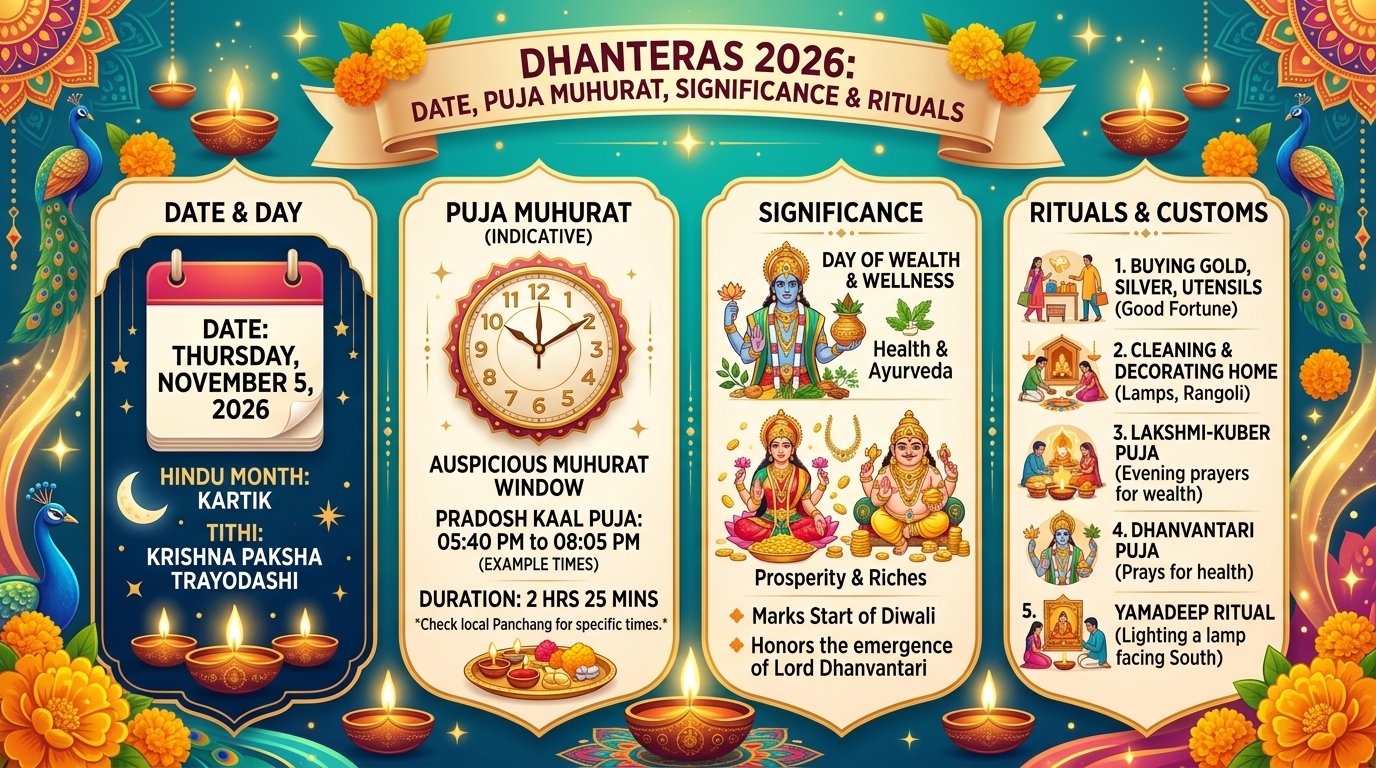
Dhanteras 2026 falls on Friday, November 6, 2026. It marks the Trayodashi tithi (13th day) of Krishna Paksha in the Hindu lunar month of Kartik, and it is the official first day of the Diwali festival cluster.
If someone in your family group chat is asking about the “2026 dhanteras date” or the “date of dhanteras” this is your answer, print it out if you have to. The Dhanteras date shifts every year because it’s calculated using the lunar calendar, not the Gregorian one, so it never lands on the same day twice.
| Detail | Information |
|---|---|
| Dhanteras 2026 Date | Friday, November 6, 2026 |
| Tithi | Trayodashi (13th day), Krishna Paksha |
| Lunar Month | Kartik |
| Nakshatra | Kritika |
| Duration | 1 day (evening puja primarily) |
| Deities Worshipped | Lord Dhanvantari, Goddess Lakshmi, Kubera |
| Celebrated In | Pan-India — especially Maharashtra, Gujarat, Rajasthan, UP, Haryana, Punjab, MP |
The Dhanteras meaning in English is fairly literal once you split it up. “Dhan” translates to wealth or prosperity, and “Teras” means the thirteenth (referring to the thirteenth lunar day). So put together, Dhanteras basically means “wealth on the thirteenth day” — and that’s exactly what the festival is built around, inviting prosperity into the home before Diwali fully begins.
It’s also known by a couple of other names you’ll see floating around:
Both refer to the same day, just with slightly more formal, Sanskrit-rooted phrasing.
For readers outside India who stumble on this word for the first time, the Dhanteras pronunciation is roughly “dhun-teh-ras” — with the emphasis sitting gently on the first syllable. It’s not a hard word once you say it out loud a couple times, and honestly a lot of non-Hindi speakers get it right on the second try.
Dhanteras is celebrated to honour Lord Dhanvantari’s emergence from the cosmic ocean, invite Goddess Lakshmi’s blessings of wealth into homes, and protect family members from untimely death through the Yama Deepam ritual. It’s really three big themes rolled into one single evening — health, wealth, and protection from death.
Let’s unpack why exactly this day carries so much cultural weight.
According to Hindu mythology, Lord Dhanvantari emerged from Samudra Manthan — the churning of the cosmic ocean by gods and demons carrying a golden pot of Amrit (the nectar of immortality) along with the sacred knowledge of Ayurveda.
He is considered an avatar of Lord Vishnu and is worshipped on Dhanteras specifically for good health, healing, and freedom from disease.
This is actually why the Government of India officially observes National Ayurveda Day on Dhanteras — it’s not a random coincidence, it’s a deliberate nod to Dhanvantari being the father of Ayurvedic medicine.
There’s a widespread belief that purchasing gold, silver, or metal utensils on Dhanteras multiplies household wealth thirteenfold (tying back to the “Teras” or thirteenth day symbolism). This is one of the biggest reasons markets stay open till late at night — jewellery shops, utensil stores, even appliance showrooms see a massive rush.
Here’s a ritual that often gets glossed over on other sites, but it deserves proper attention: Yama Deepam is the practice of lighting a single earthen lamp and placing it facing south — the direction associated with Yama, the god of death.
This single lamp is lit outside the main door (not inside, that’s an important detail people often mess up) as a prayer against akaal mrityu, meaning untimely or premature death.
So to sum it, Yama Deepam protects against untimely death, while the gold and silver purchases invite prosperity — two very different intentions, same evening.
Here’s something we noticed while researching this — a lot of competitor articles literally leave the muhurat section blank or unanswered. That’s a pretty big gap when people are specifically searching “dhanteras 2026 muhurat time” hoping for actual numbers.
While exact minute-by-minute Panchang timings can shift slightly depending on your city and should ideally be cross-checked with a regional Panchang closer to the date, here’s the general framework used every year to calculate the auspicious window:
Our honest suggestion — closer to November 2026, check a verified regional Panchang app or your local temple/priest for the exact minute-level muhurat for your city, since sunset times differ by location and that shifts the entire calculation.
A common question people ask is “dhanteras 2026 how many days” — meaning, how many days does Dhanteras itself last, and how does it fit into the broader Diwali celebration.
Dhanteras itself is a single-day observance, celebrated mainly through an evening puja. However, it kicks off the larger five-day Diwali festival cluster, which typically unfolds like this:
So Dhanteras → leads into → the entire Diwali celebration, functioning almost like the opening ceremony.
Since the date changes yearly based on lunar calculations, here’s a quick year-wise reference table:
| Year | Date | Day |
|---|---|---|
| 2025 | Monday, November 17, 2025 | Monday |
| 2026 | Friday, November 6, 2026 | Friday |
| Dhanteras 2027 | Tuesday, October 26, 2027 | Tuesday |
Notice how the gap between 2026 and 2027 is smaller (only around 11 days earlier) compared to the jump from 2025 to 2026. This happens because the Hindu lunar calendar runs roughly 10-11 days shorter than the solar Gregorian year, so festival dates keep drifting backward each year until a leap month resets things occasionally.
We noticed quite a few people search for terms like “dhanteras 2026 april” or “dhanteras 2026 may” — and to clear this up plainly: Dhanteras never falls in April or May. It’s tied to the Kartik lunar month, which always corresponds to late October or November in the Gregorian calendar.
If you’re seeing April or May dates anywhere claiming to be Dhanteras, that information is simply incorrect — possibly confused with an unrelated regional festival or a calendar error. Always cross-check against a verified Panchang.
In the Dhanteras Gujarati calendar, the day is referred to as “Dhanteras” too, but it holds extra financial significance for the Gujarati business community. Since Gujarat traditionally begins its new financial year around Diwali (with Chopda Puja, the ceremonial opening of new account books, happening on Diwali day itself), many merchants actually start the preparatory rituals cleaning ledgers, worshipping Lakshmi at their shops — right from Dhanteras itself.
So while Chopda Puja technically happens a day later, Dhanteras acts as the financial “warm-up” day in Gujarati business households.
Three deities take centre stage on this evening, and each one plays a distinct role.
Kubera worship alongside Lakshmi worship → stabilizes → long-term household prosperity. This pairing is actually one of the more overlooked details — most people know about Lakshmi puja, but fewer realise Kubera’s role is specifically about making that wealth permanent, not just attracting it once.
Here’s a practical, easy-to-follow rundown of the Dhanteras puja, exactly how it’s traditionally performed in most North and West Indian households:
Chanting the right Dhanteras mantra is believed to amplify the effect of the puja. Here are the three most commonly recited ones:
Dhanvantari Mantra: ॐ नमो भगवते वासुदेवाय धन्वन्तरये अमृत-कलश हस्ताय सर्व-भय-विनाशाय सर्व-रोग-निवारणाय…
This mantra essentially asks Lord Dhanvantari to remove fears and diseases, invoking his form as the holder of the Amrit pot.
Lakshmi Mantra: ॐ श्रीं ह्रीं श्रीं महालक्ष्म्यै नमः
A short seed-mantra (“beej mantra”) that’s simple enough to chant even for people unfamiliar with longer Sanskrit verses, invoking Lakshmi’s full grace.
Kubera Mantra: ॐ यक्षाय कुबेराय वैश्रवणाय धनधान्याधिपतये धनधान्यसमृद्धिं मे देहि दापय स्वाहा
This one specifically asks Kubera for abundance in wealth and grain.
A lot of buyers naturally search “dhanteras 2026 gold price” hoping for exact figures, but here’s the honest truth — gold prices fluctuate daily based on international markets, so no article can predict the exact rate months in advance with real accuracy. What we can offer instead is practical guidance:
Interestingly, some searches for “dhanteras restaurant” pop up online — this usually isn’t related to the festival’s rituals at all. It’s simply that some restaurants, sweet shops, or local businesses in India adopt festive names like “Dhanteras” or run “Dhanteras special” menus and offers during this period, since the name itself carries such a strong association with prosperity and good fortune.
If you’re searching for an actual eatery by that name, it’s most likely a local establishment capitalising on the festive branding rather than anything tied to the religious observance itself.
Dhanteras isn’t celebrated identically everywhere — regional flavour adds a lot of texture to the day:
People often ask what they actually “get” from observing all these rituals, so here’s a simple breakdown:
Dhanteras 2026 falls on Friday, November 6, 2026, observed on Trayodashi tithi of Krishna Paksha in the Kartik lunar month, marking the first day of Diwali.
The most auspicious window is generally during Pradosh Kaal, right after sunset, typically between 6:00–8:30 PM — but confirm exact local timing with a regional Panchang.
It honours Lord Dhanvantari’s emergence from Samudra Manthan, invites Lakshmi’s wealth blessings, and includes Yama Deepam to protect against untimely death.
“Dhan” means wealth and “Teras” means thirteenth — together signifying wealth arriving on the thirteenth lunar day.
It’s pronounced roughly as “dhun-teh-ras,” with a soft emphasis on the first syllable.
Gold purchases are believed to multiply household wealth thirteenfold and invite Goddess Lakshmi’s lasting blessings into the home.
He’s the divine physician and an avatar of Vishnu who emerged from the cosmic ocean bearing Amrit and Ayurvedic knowledge, worshipped for health.
A single lamp lit facing south, outside the home, as a prayer for protection against untimely death for family members.
Dhanteras is the first day of the five-day Diwali cluster, focused on wealth and health worship, while Diwali (main day) centres on Lakshmi Puja and lights.
Gold, silver coins, new utensils, appliances, or even a new broom — all considered auspicious purchases that invite prosperity.
Coriander seeds mixed with jaggery is the traditional prasad, especially popular in Maharashtra and Rajasthan households.
Dhanteras is a single-day observance, mainly an evening puja, but it opens the larger five-day Diwali festival.
Dhanteras 2027 falls on Tuesday, October 26, 2027, roughly 11 days earlier than 2026 due to lunar calendar shifts.
In Gujarat, Dhanteras marks the start of financial year preparations, with Chopda Puja (new account books) following on Diwali day itself.
No, Dhanteras always falls in late October or November since it’s tied to the Kartik lunar month — any April or May date is incorrect.
https://templetimingsnow.com/vijayawada-temple-timings/
https://templetimingsnow.com/palani-murugan-temple-timings/
https://templetimingsnow.com/durga-puja/
https://templetimingsnow.com/tiruchanoor-padmavathi-devi-temple-timings/
https://templetimingsnow.com/kateramma-temple-hoskote-kambalipura/