Physical Address
304 North Cardinal St.
Dorchester Center, MA 02124
Physical Address
304 North Cardinal St.
Dorchester Center, MA 02124

If you’ve ever seen photos of thousands of people walking barefoot around a hill, chanting “Radhe Radhe” like it’s the only word left in the world that’s Govardhan Parikrama, and honestly, no photo really does it justice.
This isn’t just some tourist walk near Mathura. It’s one of the most emotionally charged pilgrimages in the whole Braj region, and for lakhs of devotees, Govardhan Parvat isn’t a hill at all it’s Giriraj Maharaj, a living, breathing form of Lord Krishna himself.
This guide is meant to be the one-stop resource you actually need before you go the real Govardhan Parikrama distance, the exact route, timing tips, history, rituals, rules, and yes, the stuff most guides skip like how to actually get there and stay comfortably.
We’ll also clear up common confusions around the govardhan parikrama map, the starting and ending point, and whether doing it by car even counts (spoiler: sort of, but not really). Let’s get into it.
Devotees don’t treat this parikrama like a regular temple visit, and honestly once you’re there you understand why. In the Vaishnav tradition, circling Govardhan Hill is considered spiritually equal to circumambulating Krishna in person. That’s a big claim, but it comes from a very specific story.
According to scripture, when Lord Indra got arrogant about being worshipped, Krishna told the villagers of Braj to stop the ritual and instead worship Govardhan Hill, since it was the hill (not Indra) that actually gave them food, water, and shelter. Furious, Indra sent torrential rains to flood the region.
Lord Krishna → lifted → Govardhan Hill on his little finger and held it up for seven days and nights, sheltering every person and animal in Braj underneath it. That single act is why the hill is now worshipped as Giriraj Maharaj — the eternal protector.
People genuinely believe walking this parikrama with a sincere heart can:
The parikrama becomes extra powerful, so to speak, during Govardhan Puja, Kartik Purnima, Guru Purnima, Amavasya, and Ekadashi — though plenty of devotees do it on a normal Tuesday too, no festival needed.
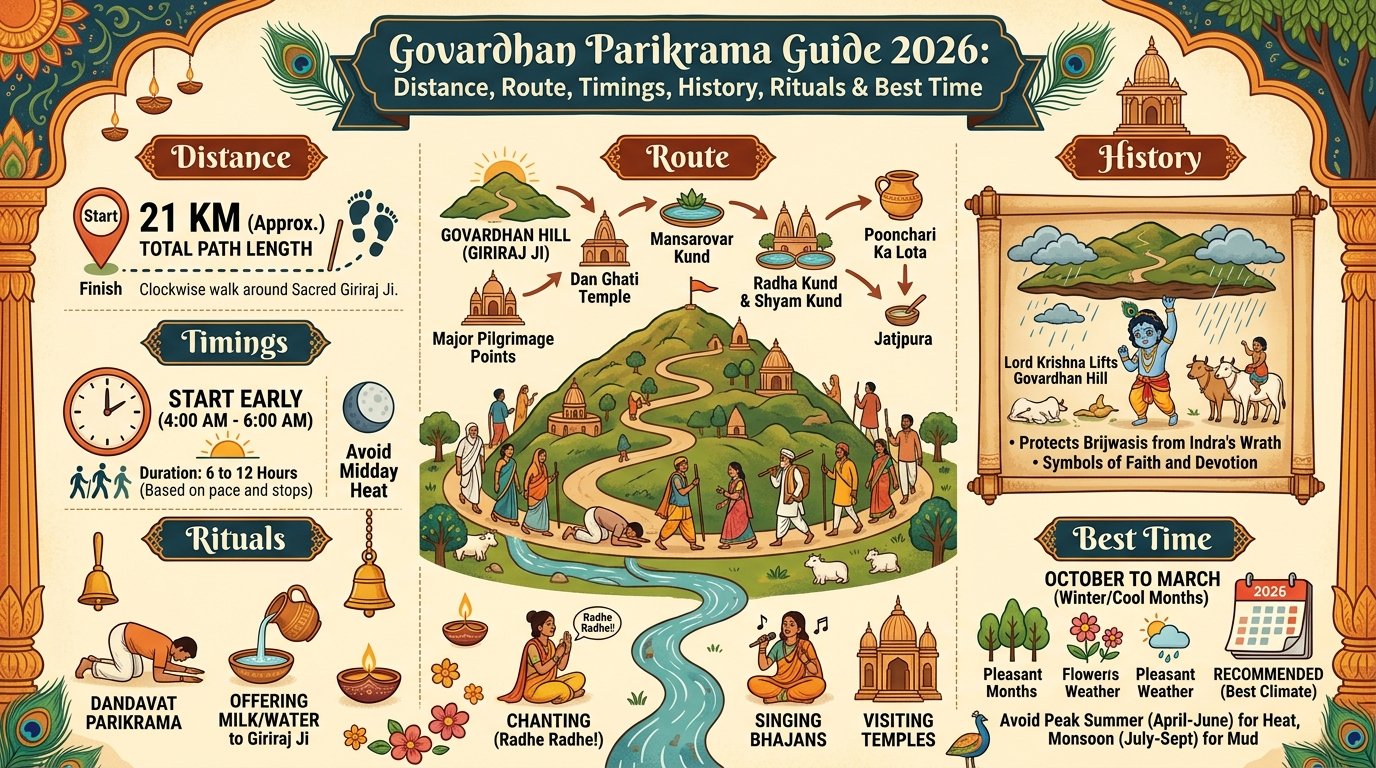
Right, let’s answer the number one question people search for. The full Govardhan Parikrama is 21 km, but it’s actually made of two separate parts that most people don’t realize are technically different circuits.
| Parikrama Type | Distance | Description |
|---|---|---|
| Badi Parikrama | 12 km | The outer, longer route covering major temples and kunds |
| Chhoti Parikrama | 9 km | The inner, shorter route focused on key sacred spots |
| Total Parikrama | 21 km | Both combined, done by most pilgrims in a day |
Badi Parikrama → covers → the major outer circuit with temples like Daan Ghati and Jatipura, while the Chhoti Parikrama → focuses on → inner kunds such as Radha Kund and Mansi Ganga.
Most devotees who are reasonably fit just do all 21 km in one go, but if you’ve got knee issues, health concerns, or you’re travelling with elderly family, the Chhoti route alone is a perfectly acceptable option and nobody will judge you for it (despite what some overly strict forums might say).
On foot, without long stops, most people finish in 5 to 6 hours. But realistically? Add another hour or two if you want proper darshan time at temples like Radha Kund, Shyam Kund, or Mansi Ganga.
A few things that change your timing:
And then there’s Dandavat Parikrama — a whole different level of devotion where pilgrims lie flat, mark the ground with their hands, stand up, walk to that mark, and repeat. This can take days or even weeks to complete the same 21 km. It’s not for everyone, but it’s considered one of the most meritorious acts of surrender in the entire tradition.
This is where most guides get a bit vague, so let’s be specific about the actual govardhan parikrama route.
Almost every devotee starts and ends at Daan Ghati Mandir, walking in a clockwise direction — this direction matters spiritually and isn’t just tradition for tradition’s sake. Govardhan village sits roughly in the center of the loop, with Radha Kund to the north and Jatipura/Puchhari to the south.
If you’re searching for a govardhan parikrama google map reference before you travel, search “Daan Ghati Mandir, Govardhan” — that pin is your true starting point, and the loop runs clockwise back to the same spot.
Mansi Ganga → is believed to be → the spiritual center of the parikrama circuit, and most devotees bathe here before starting their walk.
The absolute best window is early morning, 4 AM to 6 AM — cooler, quieter, and honestly a lot more peaceful before the crowds show up. Beyond that:
Here’s something competitor guides barely touch on properly — not everyone can walk 21 km, and that’s okay. So what are your actual options?
Technically, you can drive around the outer road that loosely follows the Badi Parikrama route, and many elderly pilgrims or families with small kids do exactly this. But it’s worth being upfront here: doing it by car → does not carry → the same spiritual merit as walking, according to most local priests and long-time devotees.
The physical humility of walking (or crawling, in Dandavat’s case) is kind of the whole point. That said, if health genuinely doesn’t allow walking, a slow drive with stops at each major temple is considered acceptable rather than skipping the pilgrimage altogether.
Locally, e-rickshaws are a common compromise — cheaper than a car, more flexible for narrow lanes, and drivers usually know exactly where each kund and temple is. Expect to negotiate the fare beforehand; there’s no fixed meter system here.
A lot of pilgrims ask about a govardhan parikrama map pdf they can save offline, since mobile network can get patchy in parts of the route. Honestly, your best bet is to screenshot the Google Maps view of the loop (search “Govardhan Parikrama route Mathura”) before you leave your hotel, or pick up a printed map from any of the small shops near Daan Ghati Mandir — several local vendors sell laminated route maps for a few rupees, and they’re often more accurate than what you’ll find online.
This is genuinely one of the biggest gaps in most Govardhan guides online, so let’s actually cover it properly.
Getting there:
Where to stay: Most pilgrims stay in dharamshalas (pilgrim guesthouses) clustered near Daan Ghati Mandir and Radha Kund — these are basic but clean and very affordable, often run by temple trusts. If you want more comfort, mid-range hotels are available in Mathura or Vrindavan, roughly a 30-45 minute drive away.
Booking ahead during Kartik month or Govardhan Puja is genuinely important, since rooms fill up fast and prices can spike without warning.
The full 21 km walk is packed with small rituals that, together, make it feel like a complete spiritual practice rather than just a walk:
This tradition traces back to Dwapar Yuga, the era of Krishna’s earthly life. Govardhan Hill → provided → food, water, and shelter to the people of Braj long before the Indra incident, which is exactly why Krishna redirected the village’s worship toward the hill in the first place.
After Krishna lifted the hill to protect everyone from Indra’s flood, the practice of walking around it began as a direct way of honoring that divine act — and it’s continued, more or less unbroken, for thousands of years since.
If you’re trying to visualize the whole loop before you go, think of it as one continuous clockwise circle starting and ending at Daan Ghati Mandir, passing through Govardhan village, curving past Jatipura and Poonchhri to the south, then swinging north through Radha Kund, Shyam Kund, Kusum Sarovar, and Mansi Ganga before returning to the start.
Searching “govardhan parikrama google map” on your phone right before you leave is honestly the easiest way to confirm the live route, since minor diversions do happen around festival dates.
It’s a sacred circumambulation around Govardhan Hill in Mathura, worshipped as Giriraj Maharaj, a living form of Lord Krishna. Millions walk it each year seeking spiritual blessings and inner peace.
The complete parikrama is 21 km, combining the Badi Parikrama (12 km) and Chhoti Parikrama (9 km) into one continuous clockwise circuit around the hill.
Most pilgrims start and end at Daan Ghati Mandir, walking clockwise. This is considered the traditional and most auspicious starting location.
Typically 5 to 6 hours on foot without long stops. Adding darshan time at temples and kunds can extend this to 7-8 hours comfortably.
Yes, technically, though it’s considered spiritually less meritorious than walking. It’s a reasonable option for elderly devotees or those with health limitations.
An advanced devotional practice involving full-body prostration at every step. It can take days or weeks to complete the same 21 km distance.
Early morning (4-6 AM) is ideal. Winter months suit daytime walks, while summer devotees often prefer nighttime parikrama to avoid extreme heat.
Key stops include Daan Ghati Mandir, Radha Kund, Shyam Kund, Mansi Ganga, Kusum Sarovar, Jatipura Temple, and Kaan Wale Baba, among several other sacred kunds.
No single official PDF exists online, but pilgrims can screenshot Google Maps beforehand or buy laminated printed maps from local vendors near Daan Ghati Mandir.
Start and end at the same point, bathe at Mansi Ganga first, avoid stepping on sacred stones, never leave the walk incomplete, and maintain cleanliness throughout.
Govardhan is approximately 22 km from Mathura city, easily reachable by shared jeep, bus, or private taxi in under 45 minutes.
It’s considered the spiritual heart of the parikrama, believed to have appeared here by Krishna’s will during Kartik Amavasya. Most devotees bathe here first.
Yes — drinking water points, dharamshalas, small food stalls, and basic medical aid are available, though facilities get busier and more limited during major festivals.
Water, basic medicines, comfortable footwear (or none, if walking barefoot), and secured valuables. Being cautious of monkeys near food items is also strongly advised.
Because devotees believe the hill itself is Giriraj Maharaj, a living divine form of Krishna, not merely a geographic landmark — making worship, not sightseeing, the primary purpose of the visit.
https://templetimingsnow.com/kashi-vishwanath-temple-vip-darshan/
https://templetimingsnow.com/ambalapuzha-palpayasam-online-booking/
https://templetimingsnow.com/ambalapuzha-temple-payasam-timings/
https://templetimingsnow.com/babulnath-temple-timings/