Physical Address
304 North Cardinal St.
Dorchester Center, MA 02124
Physical Address
304 North Cardinal St.
Dorchester Center, MA 02124

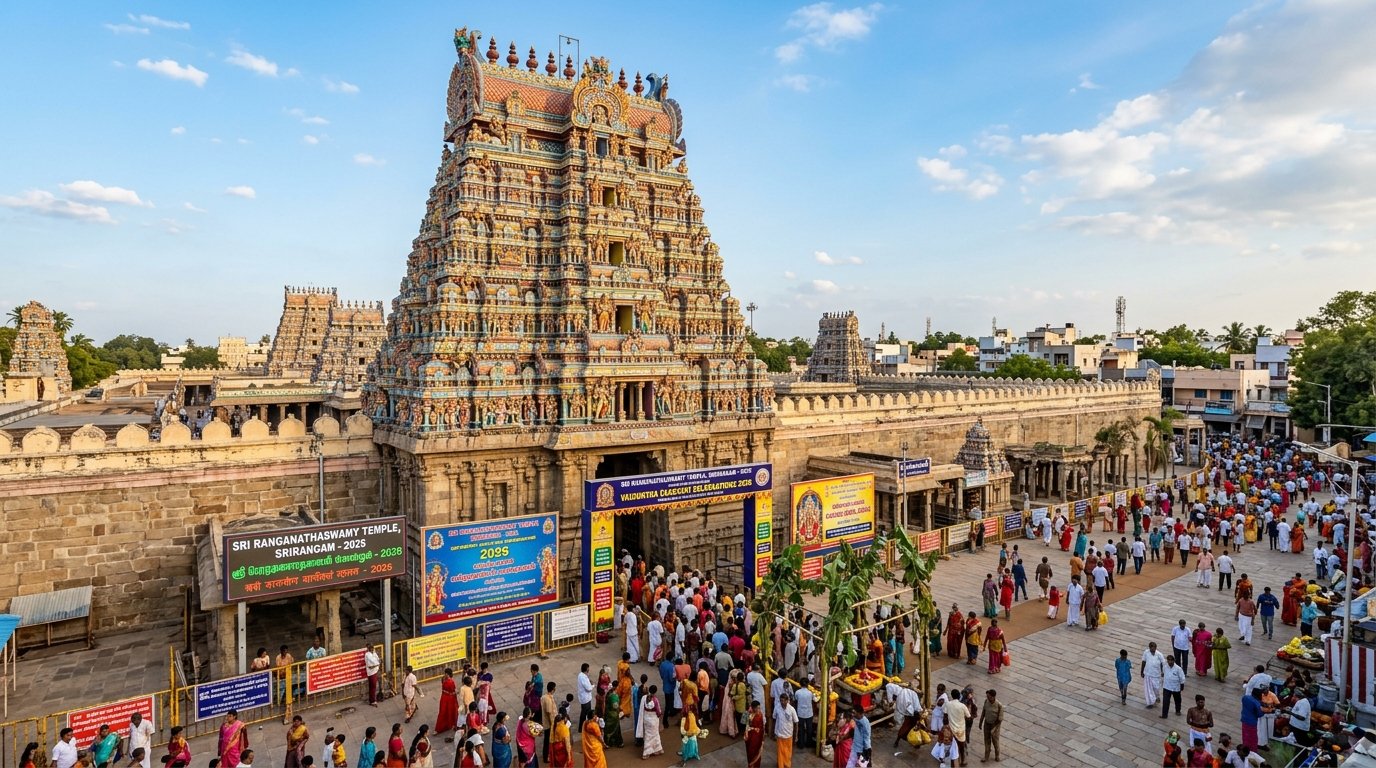
Planning a trip to Srirangam this year? Honestly, if there’s one temple in South India that deserves a spot on your 2026 bucket list, it’s the Sri Ranganathaswamy Temple. Known officially as the largest functioning Hindu temple complex in the world, this sprawling shrine dedicated to Lord Ranganatha (the reclining form of Lord Vishnu) pulls in millions of devotees every single year, and for good reason.
Between the towering gopurams, the endless stone corridors, and rituals that go back centuries, it’s not just a temple visit it’s an experience you carry with you.
This guide is going to walk you through everything darshan timings, ticket prices, sevas, how to reach the place, where to stay, dress code, and even some lesser-known facts competitor blogs tend to skip over. So grab a cup of chai and let’s get into it.
The Sri Ranganathaswamy Temple history stretches back well over a thousand years, with references to it appearing in ancient Tamil Sangam literature. The temple → is considered → one of the 108 Divya Desams, the most sacred Vishnu temples revered by Vaishnavite tradition. Over the centuries, dynasties like the Cholas, Pandyas, Hoysalas, and later the Vijayanagara rulers all contributed to expanding the temple, adding gopurams, mandapams, and inner prakarams.
What makes this place genuinely fascinating is its scale the complex spans roughly 156 acres and is enclosed by seven concentric prakarams (walls), with 21 gopurams in total. It’s practically a small town within a temple, honestly, with shops, homes, and even schools inside the outer walls.
This layered construction history is part of why the Sri Ranganatha Temple is often called a living monument rather than just a place of worship.
The Sri Ranganathaswamy Temple location is Srirangam, an island town formed between the Kaveri and Kollidam rivers in Tiruchirappalli (Trichy) district, Tamil Nadu. It sits just about 9 km from Tiruchirappalli Junction, making it one of the more accessible major pilgrimage sites in the south.
Because it’s surrounded by rivers on two sides, the town itself has a peaceful, almost island-like feel that adds to the spiritual atmosphere. If you’re mapping your trip, just search “Srirangam Temple, Tiruchirappalli” and most navigation apps will drop you right at the Southern Rajagopuram entrance.
The temple is generally open from 6:00 AM to 9:00 PM, though timings can shift a bit during major festivals like Vaikunta Ekadasi. If you want a peaceful darshan without the elbow-to-elbow crowd, early mornings on weekdays is your best bet, hands down.
| Darshan / Ritual | Timings | Details |
|---|---|---|
| Suprabhatam | 6:00 AM | Prayer chanted to wake the deity |
| Vishwaroopa Seva | 6:45 AM – 7:15 AM | Special early darshan of Lord Ranganatha |
| Thirumanjanam | 8:00 AM | Sacred bath (Abhishekam) for the deity |
| Morning General Darshan | 9:00 AM – 12:00 PM | Regular darshan window |
| Madhyanha Pooja | 12:00 PM | Midday worship rituals |
| Afternoon Darshan | 1:15 PM – 6:00 PM | Darshan resumes post noon-break |
| Sayaratchai | 6:00 PM | Evening pooja |
| Ardha Jama Pooja | 8:00 PM – 9:00 PM | Final ritual before closing |
A quick tip — pooja and naivedyam breaks do close the sanctum briefly, so don’t panic if you arrive and the doors seem shut for 20-30 mins. It happens, just wait it out.
The temple offers four darshan categories, letting devotees choose based on how much time (and money) they’re willing to spend in line.
| Darshan Type | Ticket Price | Details |
|---|---|---|
| Free Darshan | ₹0 | Standard queue; longest wait on weekends |
| Special Darshan | ₹100 | Moves noticeably faster |
| Quick Darshan | ₹200 | Best choice during rush hours |
| VIP Darshan | ₹500 | Priority access during festivals |
VIP Darshan ticket (₹500) → provides → priority access during peak festival days, which honestly is worth it if you’re visiting during Vaikunta Ekadasi or any weekend when the crowd swells into thousands. Tickets can be bought online through the official TN HR&CE portal or offline at the counters near the entrance — just don’t wait till the last minute during festival season, counters get chaotic.
Taking part in a seva is genuinely one of the more meaningful ways to connect with the temple beyond just a quick darshan. Most sevas happen early morning and slots fill fast.
Since these fill up quick, especially around Panguni Uthiram and Vaikunta Ekadasi, book at least a week ahead if you can — trust me, walk-in seva slots during festival week are basically nonexistent.
One of the biggest annual events at the temple is the Srirangam Brahmotsavam, a grand multi-day festival where the utsava idol of Lord Ranganatha is taken out in elaborate processions on different vahanams (vehicles) each day, including the Garuda Vahanam and the Simha Vahanam.
It typically falls in the Tamil month of Panguni (March–April), though exact Srirangam Brahmotsavam 2026 dates are announced by the temple’s HR&CE administration a few months in advance, so it’s worth checking the official website or local Tamil calendars closer to the date.
During Brahmotsavam, expect the town to be absolutely packed accommodation books out fast, roads get crowded, and darshan lines stretch for hours. If your goal is witnessing the processions rather than a quiet sanctum visit, this is actually the best time to come.
Getting here isn’t complicated at all — the temple → is well connected → by rail, road, and air from most major South Indian cities.
By Train: Tiruchirappalli Junction (TPJ) is 9 km away and handles frequent long-distance trains from Chennai, Bangalore, Hyderabad, and Vijayawada. There’s also a smaller Srirangam Railway Station just 1 km from the temple, though fewer trains stop there.
By Road: Regular buses run between Trichy and Srirangam for around ₹11, and autos/taxis are available round the clock if you’d rather skip the wait.
By Air: Tiruchirappalli International Airport (TRZ) → connects to → Srirangam, sitting roughly 15 km away, with direct flights from Chennai, Bangalore, Hyderabad, Kochi, and a handful of international routes too.
Accommodation ranges from budget lodges to mid-range hotels, most within a couple kilometers of the temple.
If you’re visiting during Brahmotsavam or Vaikunta Ekadasi, book at least 3-4 weeks in advance. Rooms genuinely vanish fast during these periods, and last-minute options tend to be overpriced.
The temple maintains a fairly strict dress code to preserve its sacred atmosphere.
For Men: Dhoti or pyjama paired with a shirt. For Women: Saree, half-saree, or salwar kameez. Not Permitted: Jeans, shorts, skirts, T-shirts, or other Western outfits.
A few extra entry rules worth knowing — footwear must be deposited outside (roughly ₹5), mobile phones are allowed but photography and videography inside the sanctum are strictly prohibited, and the Southern Rajagopuram is the main entrance devotees typically use. Also, maintain a bit of silence near the corridors and sanctum it’s a shared spiritual space after all.
Early weekday mornings offer the calmest darshan experience, hands down. Beyond that, the Tamil months of Margazhi (Dec–Jan) and Panguni (Mar–Apr) are considered spiritually vibrant, filled with special rituals and festive decorations throughout the complex.
January’s Vaikunta Ekadasi → increases → darshan crowd levels and wait times dramatically — expect lines stretching for hours. But if you don’t mind the crowd, witnessing this festival is genuinely a once-in-a-lifetime kind of experience, with the temple opening the symbolic “Paramapada Vasal” (Gate of Salvation) for devotees.
For photography, late afternoons work best — the light hits the Rajagopuram beautifully and the outer prakarams are less crowded for capturing the mandapams and sculptures.
The temple isn’t just a single shrine — it’s practically a museum of history and architecture layered across seven prakarams.
| Feature | Highlights |
|---|---|
| Rajagopuram | Tallest temple tower in South India at 239.5 feet |
| Ramanujacharya Sannidhi | Preserves the body of saint Sri Ramanuja |
| Ranga Vilas Mandapam | Sculptures depicting Vishnu’s avatars |
| Garuda Mandapam | Massive Garuda idol facing the sanctum |
| Golden Vimanam | Golden tower above the sanctum |
Sri Ramanuja → is enshrined in → the Ramanujacharya Sannidhi, a detail many first-time visitors don’t even realize until they’re standing right in front of it.
Here’s something most competitor blogs mention briefly but never really explain — there’s a local belief that spotting four specific carvings hidden in the sixth prakaram brings spiritual liberation, or moksha. The four are: a lame horse, a blind fish, Lord Krishna, and Hanuman.
They’re tucked into pillar carvings along the corridor walls, and locals will often point you in the right direction if you ask a temple guide near the sixth enclosure. It’s become a bit of a tradition for repeat visitors to hunt these down each trip — kind of like a spiritual scavenger hunt, honestly, and it makes the visit feel a lot more personal than just walking through and leaving.
If you’re searching for Sri Ranganatha Temple photos before your trip, most of what you’ll find online covers the Rajagopuram entrance, the golden vimanam, and the elephant that blesses devotees near the outer mandapam.
For your own photos, the best spots are the outer prakaram walkway (great wide shots of the gopuram towers) and the area just outside the Vellayi Gopuram in late afternoon light. Remember though photography is not allowed inside the sanctum sanctorum itself, so keep your camera for the outer courtyards and corridors only.
Browsing through Sri Ranganatha Temple reviews online, a pattern shows up pretty consistently — visitors praise the sheer scale and architectural grandeur of the complex, but many also mention long queues during weekends and festival days as their biggest frustration.
Reviewers frequently recommend the Quick or VIP darshan lines if you’re short on time, and several point out that hiring a local guide near the entrance genuinely enhances the visit since so much of the temple’s history isn’t posted anywhere visible. If crowd management matters to you, weekday morning visits consistently earn the highest praise in reviews.
A lot of people searching for this temple online accidentally stumble onto results for a completely different shrine — the Nellore Ranganathaswamy Temple, located in Andhra Pradesh, which also holds its own annual Brahmotsavam celebrations (Nellore Ranganathaswamy Temple Brahmotsavam 2026 dates are announced separately by that temple’s local trust, unrelated to Srirangam’s schedule).
These are two distinct temples honoring different forms and traditions, so double-check your search results before booking travel.
Similarly, if you’ve come across mentions of a Pomona temple calendar 2026 while researching Hindu temple calendars in general, that refers to an entirely different regional temple listing service and has no connection to the Srirangam temple’s official calendar. Always cross-check with the official Sri Ranganathaswamy Temple / HR&CE Tamil Nadu website for accurate Srirangam-specific dates.
Planning a trip to the Sri Ranganathaswamy Temple in 2026 doesn’t have to be overwhelming once you know the darshan timings, ticket options, and travel logistics. Whether you’re going for a quiet weekday darshan or timing your visit around Brahmotsavam and Vaikunta Ekadasi, a little advance planning goes a long way toward making the trip smooth and genuinely peaceful.
Srirangam has a way of staying with you long after you leave the towering gopurams, the quiet corridors, that golden vimanam catching the evening light. It’s worth the trip, plain and simple.
The temple is generally open from 6:00 AM to 9:00 PM daily, though it closes briefly during pooja and naivedyam breaks throughout the day.
Tickets can be booked online through the official HR&CE Tamil Nadu portal or purchased directly at the temple ticket counters near the entrance.
Free Darshan costs ₹0, Special Darshan ₹100, Quick Darshan ₹200, and VIP Darshan ₹500, with faster lines at higher price points.
Vishwaroopa Seva takes place between 6:45 AM and 7:15 AM daily, with pricing typically ranging between ₹100 and ₹250 depending on the package.
The temple dates back over a thousand years, expanded by Chola, Pandya, and Vijayanagara dynasties, and is recognized as one of the 108 sacred Divya Desams.
It’s located in Srirangam, an island town between the Kaveri and Kollidam rivers, about 9 km from Tiruchirappalli Junction in Tamil Nadu.
It usually falls during the Tamil month of Panguni (March–April), though exact 2026 dates are confirmed closer to the event by temple authorities.
Popular sevas include Thirumanjanam, Kalyanotsavam, Sahasranama Archana, Dolotsavam, Thulabharam, and Vastra Samarpanam, each offering a unique ritual experience.
Early weekday mornings offer the most peaceful darshan experience, while weekends and festival days bring significantly longer queues.
Men should wear a dhoti or pyjama with a shirt, while women should wear a saree, half-saree, or salwar kameez; Western clothing isn’t permitted.
From Trichy, take a taxi or auto (₹200–₹250 approx.) or a public bus for around ₹11 to reach Srirangam directly.
Yes, options like Yatri Nivas, Arya Vaishya Satram, and several local hotels are available within 1–2 km of the temple complex.
It’s the world’s largest functioning Hindu temple, a revered Divya Desam, and an architectural marvel featuring 21 gopurams across seven prakarams.
No, the Nellore Ranganathaswamy Temple in Andhra Pradesh is a separate shrine with its own Brahmotsavam schedule, distinct from the Srirangam temple.
Located in the sixth prakaram, they include a lame horse, a blind fish, Lord Krishna, and Hanuman, believed to bring spiritual liberation when found.