Physical Address
304 North Cardinal St.
Dorchester Center, MA 02124
Physical Address
304 North Cardinal St.
Dorchester Center, MA 02124

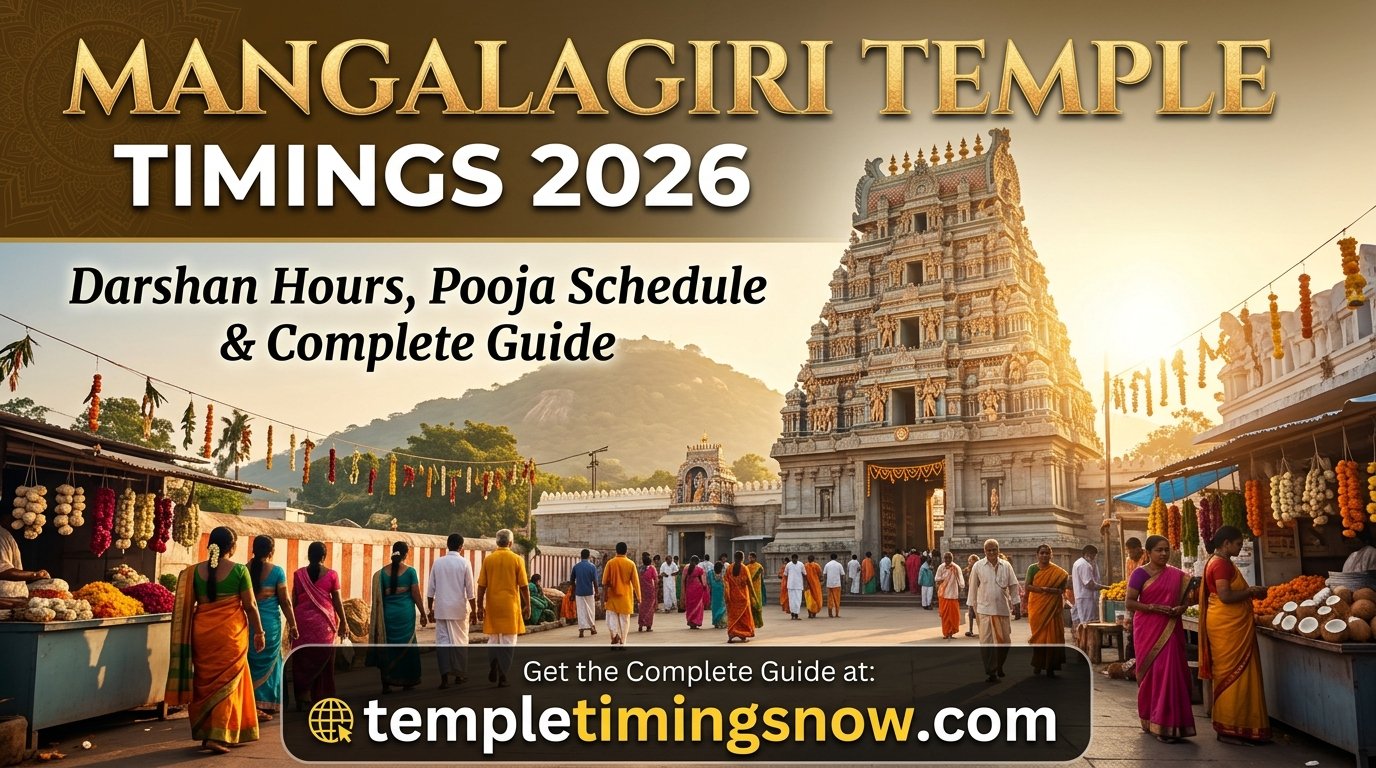
Planning a trip to Andhra Pradesh’s famous Narasimha shrine and wondering when to actually show up? Getting the Mangalagiri temple timings right is the single biggest thing that decides whether your visit is smooth or a wasted trip.
The hill temple closes by 4:00 pm, while the foothill temple stays open till 8:30 pm, and plenty of first-timers mix the two up.
This guide covers darshan hours, pooja schedule, special rituals, travel distance, tickets, and the little practical stuff nobody tells you until you’re standing at the bottom of the steps.
Quick answer: The hilltop Panakala Narasimha Swamy temple opens at 7:00 am and closes at 4:00 pm, with Sarva Darshan from 7:00 am to 3:30 pm. The foothill Lakshmi Narasimha Swamy temple opens at 5:00 am and closes at 8:30 pm, with a break from 12:30 pm to 4:00 pm.
There are really two temples here, and that’s where the confusion starts. Mangalagiri sits in Andhra Pradesh, near Vijayawada, and the main darshan happens at two separate shrines. One is on the hill (the Panakala one), the other is at the base. Each has its own temple opening hours and temple closing hours, so check which one you’re heading to before you plan your day.
Quick answer: The Mangalagiri Panakala Swamy temple timings run from 7:00 am to 4:00 pm daily. Sarva Darshan, panakam offering, pooja and archana all happen between 7:00 am and 3:30 pm.
The Mangalagiri Panakala Swamy Temple is the big draw, a hill shrine where Lord Narasimha Swamy is worshipped in a unique form. You’ll also see it written as the Panakala Narasimha Swamy temple timings or just the Mangalagiri Narasimha Swamy temple timings in different searches, but they all point to the same hilltop schedule.
| Time | Pooja / Darshan |
|---|---|
| 7:00 am | Temple opening |
| 7:00 am – 3:30 pm | Sarva Darshan, Panakam offering, Pooja and Archana |
| 12:00 pm | Avasara Nivedana |
| 3:30 pm | Maha Nivedana |
| 4:00 pm | Temple closing |
A couple of things to notice. The Avasara Nivedana at noon is a short midday food offering to the deity, and Maha Nivedana at 3:30 pm is the main one. Darshan gets interrupted for a little while around these rituals, so don’t panic if the queue pauses. Also, since the temple closing hours are early, I’d say aim to reach the hill before 2:00 pm at the latest, especially on weekends.
Quick answer: Nijaroopa Darshan is a special viewing of the Lord’s original form, held at 6:00 am on every Ekadasi.
Ekadasi falls twice every lunar month, on the eleventh day of each fortnight. On these days the temple does something different from the normal schedule, and devotees who want this rare darshan show up very early, sometimes before dawn. If your trip can be adjusted, lining it up with an Ekadasi is honestly one of the best ways to experience the place. Check a Panchangam or a Telugu calendar for the exact date, because it shifts every year.
Quick answer: The Mangalagiri Lakshmi Narasimha Swamy temple timings are 5:00 am to 12:30 pm and 4:00 pm to 8:30 pm, with the temple closed between 12:30 pm and 4:00 pm.
This is the foothill temple, the Sri Lakshmi Narasimha Swamy Temple at the foot of the hills. It has a much longer schedule than the hilltop shrine, which makes it handy for early risers and for people who arrive late in the day.
| Time | Ritual / Darshan |
|---|---|
| 5:00 am | Temple opening |
| 5:30 am | Theertha Snanam |
| 5:30 am – 11:30 am | Sarva Darshan |
| 6:00 am | Archana |
| 7:30 am | Ghoshti (Theertham offering) |
| 7:30 am – 11:00 am | Special Archana |
| 11:30 am | Maha Nivedana |
| 11:45 am – 12:30 pm | Sarva Darshan |
| 12:30 pm – 4:00 pm | Temple closed |
| 4:00 pm | Temple reopens |
| 4:00 pm – 7:30 pm | Sarva Darshan |
| 4:00 pm – 7:00 pm | Special Archana |
| 7:30 pm | Harathi, Archana and Ghoshti |
| 7:30 pm – 8:30 pm | Sarva Darshan |
| 8:30 pm | Temple closes |
The Theertha Snanam at 5:30 am is the ritual holy-water bath of the deity, while Ghoshti is when theertham (sacred water) is offered to devotees. The evening Harathi at 7:30 pm is lovely, lamps lit, bells going, and a very peaceful feel compared with the daytime rush.
One important note: these timings might change on festival days. During big events the schedule can extend, or darshan can get paused for special rituals.
Quick answer: The Mangalagiri temple timings Sunday are the same as any regular day, but crowds are much heavier, so expect longer queues.
There’s no separate Sunday schedule published for either shrine. What does change is the footfall. Sunday and public holidays bring families from Vijayawada, Guntur and nearby towns, and the hill queue can stretch well beyond the usual 15 to 30 minutes darshan duration. If you can, go on a weekday morning. If Sunday is your only option, get there right when the doors open at 7:00 am.
Quick answer: The Mangalagiri temple timings tomorrow will follow the regular daily schedule unless tomorrow is a festival day, Ekadasi, or a special occasion.
People search “tomorrow” because they want certainty, which makes sense. Since the daily pattern doesn’t really change, you can use the tables above for any normal day.
The things that can alter it are Ekadasi (for the 6:00 am Nijaroopa Darshan), annual festivals, eclipse days and special pooja arrangements. For a last-minute confirmation, calling the temple office is your safest option, since printed timings online sometimes lag behind.
Quick answer: Panakam is a jaggery-water drink offered to Lord Narasimha at the hill temple, and it’s the signature ritual that gives the deity his name, Panakala Swamy.
Here’s the part the competitor pages barely touch. The hill shrine is famous because of a tradition that the deity accepts only half of the panakam poured into his mouth, and the other half is returned to the devotee as prasadam. Locals will tell you that despite all that sweet jaggery water, you won’t find ants around the shrine. Whether you take it as faith or a curiosity, it’s a big part of why people visit.
Panakam Nivedana is the ritual of making this offering, and it takes place during the day alongside darshan, so you don’t need a separate slot. A few quick pointers:
The story goes that Lord Narasimha Swamy here is worshipped in a form with an open mouth, and tradition ties this to the divine’s presence in the hill itself. Different priests tell slightly different versions, so I’d encourage you to ask the temple archakas while you’re there.
Quick answer: The Vijayawada to Mangalagiri temple distance is roughly 13 km from the Vijayawada bus station, and about 35 km from Vijayawada airport.
Because the two cities are so close, most pilgrims base themselves in Vijayawada and make a half-day trip. Autos, cabs and local buses run regularly along the route, and the journey usually takes around 30 to 45 minutes depending on traffic. Mangalagiri is also practically a satellite of the Amaravati region now, so road connectivity is pretty good.
Quick answer: The Mangalagiri Panakala Swamy temple distance is about 13 km from Vijayawada bus station, 21 km from Guntur railway station, and 35 km from Vijayawada airport.
Here’s how to reach Mangalagiri Temple by each mode of transport:
Once you reach the base, you can either climb the steps or drive up the ghat road to the hill shrine. The foothill temple is easy to reach on foot from the main road, so if you’re short on time, you can do that one first.
Quick answer: There’s no strict dress code at Mangalagiri, so any decent outfit is fine. A typical darshan lasts 15 to 30 minutes.
Still, traditional attire is always appreciated. Many men wear dhoti or kurta, women often wear sarees or salwar suits, and shorts or sleeveless tops are best avoided. Comfortable footwear matters more than you’d think, because you’ll be taking them off and handling hot stone surfaces in summer. Mid-afternoon in May can be brutal underfoot, no kidding.
Quick answer: Sarva Darshan is free. Special darshan and certain sevas usually require paid Mangalagiri temple darshan tickets, and online booking availability depends on the temple’s current system.
This is where most visitors have questions, and I’ll be upfront: ticket prices change from time to time, and I don’t want to quote a number that’s outdated by the time you read this. What you can expect is a tiered setup. General darshan costs nothing, while special entry and archana tickets are bought at the counter.
For Mangalagiri temple online booking, check the Andhra Pradesh Endowments Department’s temple services portal, which is generally where sevas and darshan slots get listed for temples in the state. If online options aren’t available for a particular seva, you can buy at the counter on the day.
Quick answer: For the Mangalagiri temple official website, use the Andhra Pradesh Endowments Department portal (aptemples.ap.gov.in). For the Mangalagiri temple phone number, check the contact page there.
I’m deliberately not pasting a phone number here, since numbers get changed and a wrong one will frustrate you. Look it up on the official portal or the board outside the temple. Beware of random websites and agents who claim to book darshan for a fee. Stick to official channels and you’ll avoid the usual scams.
Quick answer: Go early on a weekday, wear comfortable footwear, carry minimal belongings, and check for festival-day changes before you leave.
Most pages list the timings and stop there. But actual visitors want to know how the day plays out. Here’s what I’ve gathered about making the most of your visit:
Quick answer: Visit the foothill Lakshmi Narasimha Swamy temple early or late, and the hill Panakala temple during the main daytime window before 4:00 pm.
Since the hill temple shuts at 4:00 pm and the foothill one reopens at 4:00 pm, the two actually complement each other. A smart plan is hill darshan in the morning, lunch, and then foothill darshan and evening Harathi. That way you cover both in one day without rushing.
Here’s a simple way to organize your day:
The Mangalagiri temple timings are simple once you know there are two schedules, hill and foothill. Remember the 4:00 pm closing at the top, the 8:30 pm closing at the bottom, and the festival-day exceptions.
Go early, dress comfortably, try the panakam, and give yourself enough time. It’s a lovely, spiritually rich stop that’s well worth the short drive from Vijayawada.
The hilltop Panakala temple opens 7:00 am to 4:00 pm. The foothill Lakshmi Narasimha temple runs 5:00 am to 12:30 pm and 4:00 pm to 8:30 pm daily.
The Panakala Narasimha Swamy temple opens at 7:00 am and closes at 4:00 pm. Sarva Darshan, panakam offering, pooja and archana take place between 7:00 am and 3:30 pm.
Mangalagiri Panakala Swamy temple timings are 7:00 am to 4:00 pm. Avasara Nivedana is at 12:00 pm and Maha Nivedana at 3:30 pm, before the temple closes.
Narasimha Swamy darshan is available at two shrines. The hill temple operates 7:00 am to 4:00 pm, while the foothill temple stays open until 8:30 pm with a afternoon break.
The foothill temple opens at 5:00 am, closes 12:30 pm to 4:00 pm for a break, reopens at 4:00 pm, and finally closes at 8:30 pm every day.
Tomorrow’s timings follow the regular schedule unless it’s an Ekadasi, festival or special occasion. Confirm with the temple office or official portal if you’re planning a last-minute visit.
The temple is roughly 13 km from Vijayawada bus station and about 35 km from the airport. The drive usually takes 30 to 45 minutes depending on traffic.
Sunday timings are the same as regular days for both temples. However, crowds are much larger, so reach early, ideally at 7:00 am, to avoid long queues at the hill shrine.
Yes, the Andhra Pradesh Endowments Department temple portal (aptemples.ap.gov.in) lists information and services. Always use official channels rather than third-party sites that charge extra booking fees.
The temple is about 21 km from Guntur railway station and around 13 km from Vijayawada bus station. Regular buses and taxis connect both cities to Mangalagiri.
Check the contact details on the official Endowments Department portal or the notice board at the temple. Avoid numbers from unverified websites, since they may be outdated or wrong.
Sarva Darshan is free and needs no ticket. Special darshan, archana and some sevas require paid tickets, which are usually bought at the temple counters or through official channels.
Online booking depends on the services currently listed by the Endowments Department portal. Some sevas and darshan slots may be bookable online, while others are available only at the temple counter.
Nijaroopa Darshan is a special darshan of Lord Narasimha Swamy’s original form, held every Ekadasi at 6:00 am. It draws large crowds, so arriving early is strongly advised.
There’s no strict dress code, and any decent outfit works. Traditional clothing is preferred, and sleeveless tops or short shorts are best avoided. Wear comfortable footwear for the climb.