Physical Address
304 North Cardinal St.
Dorchester Center, MA 02124
Physical Address
304 North Cardinal St.
Dorchester Center, MA 02124
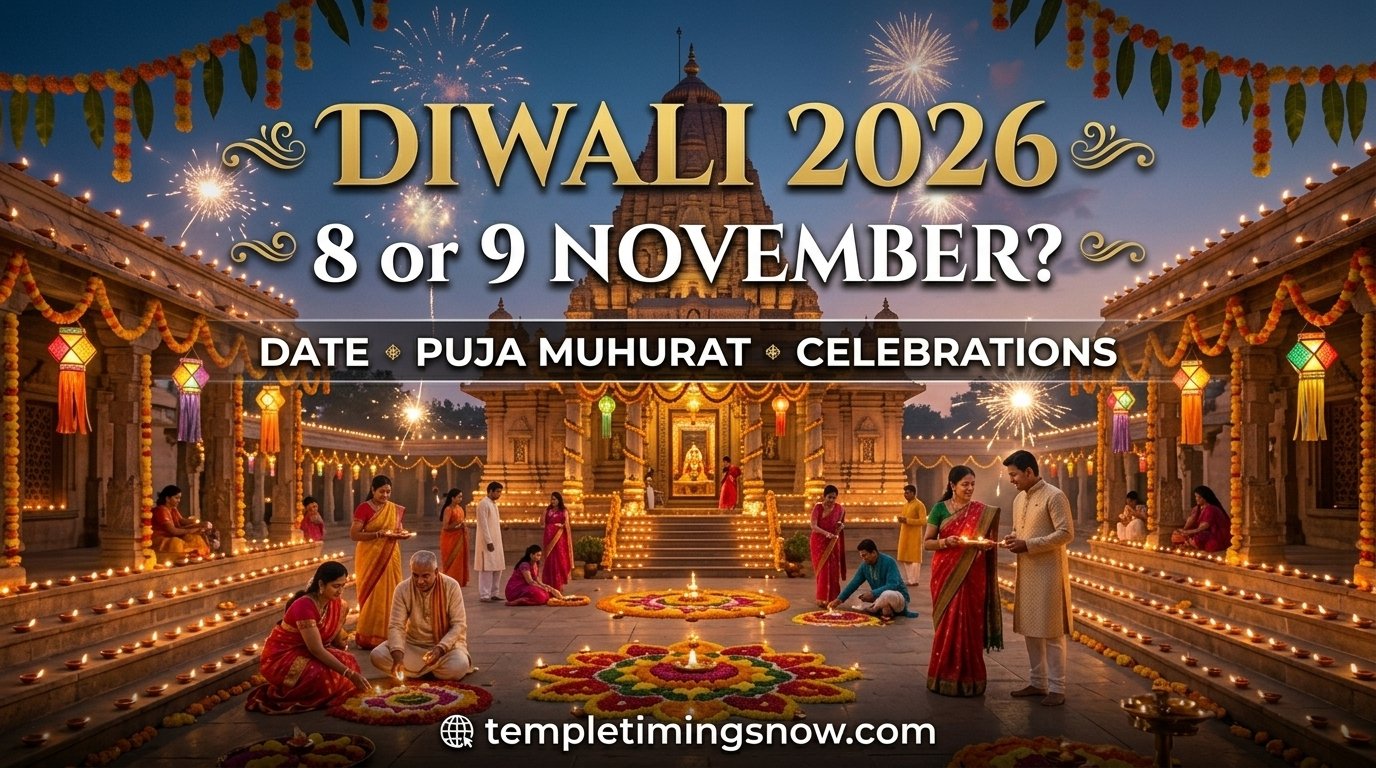
Every year the same confusion pops up, and this time it’s worse because Amavasya stretches across two calendar dates. So, Diwali 2026 8 or 9 November? The short answer is Sunday, 8 November 2026.
The Lakshmi Puja muhurat in New Delhi is 5:54 PM to 7:50 PM, and the full festive stretch runs from Dhanteras to Bhai Dooj.
Below you’ll get the date, timings, puja steps, the five-day calendar, regional views (Marathi, Sikh, Pakistan) and the panchang logic nobody really explains properly.
Diwali 2026 will be celebrated on Sunday, 8 November 2026 in India. This is the day of Lakshmi-Ganesha Puja on Kartik Amavasya. Diwali, also called Deepavali or the Festival of Lights, doesn’t have a fixed Gregorian date because it follows the lunar calendar, so it moves around between mid-October and mid-November each year.
If you’re typing “Diwali kab hai 2026” or “2026 mein Diwali kab hai” into Google, the answer is the same: 8 November, रविवार. Since today is 4 November, you’ve got just four days left to get your diyas, sweets and rangoli colours sorted!
The confusion starts because Amavasya Tithi doesn’t line up neatly with one date. Here are the timings for New Delhi, as per Drik Panchang:
Lakshmi Puja is an evening ritual, so what matters is whether Amavasya is there during the evening Pradosh Kaal. On 8 November it is. On 9 November it isn’t, since the tithi has already finished by lunchtime. That’s the whole story in two lines, and we’ll go deeper in a bit.
A lot of people search “diwali 2026 9 november” because Amavasya technically continues into that date. But the tithi ends at 12:31 PM, well before sunset. Nobody does Lakshmi Puja at noon on that day,
so 9 November isn’t the main Diwali. Some families do observe snan-daan or Pitru-related rituals on the Amavasya morning, but that’s a different thing from Diwali puja.
This is the part most competing pages just skip. They state the rule and move on. Lets actually unpack it, because once you get it, you’ll never be confused about Diwali dates again.
A Hindu tithi is not a 24-hour day. It’s the time the moon takes to gain 12 degrees on the sun, so it can start at 11:27 AM and end at 12:31 PM next day, lasting anywhere between roughly 19 and 26 hours. A calendar day, however, runs sunrise to sunrise in the panchang system.
Lakshmi Puja → is performed → during Pradosh Kaal on Amavasya. Pradosh is the period right after sunset (around 2 hours 24 minutes in most calculations). So the question astrologers ask isn’t “which date has Amavasya?” but “on which evening is Amavasya present at Pradosh?” In 2026, only 8 November passes that test.
Sometimes, in other years, Amavasya covers Pradosh on both days. In that case, the general principle is:
Different panchang traditions can interpret edge cases a bit differently, so if your family follows a particular sampradaya, ask your priest. For 2026 though, there’s no edge case. The evening of 8 November is clean.
The 5:54 PM to 7:50 PM window is for New Delhi only. Pradosh Kaal is tied to sunset, and sunset happens at different clock times across India, so the Lakshmi Puja Muhurat changes with your city. Eastern cities see sunset earlier, western ones later. The table below shows approximate sunset differences from Delhi, just to give you a feel. These are estimates, not official muhurats, so check your local panchang for exact numbers.
| City | Approx. sunset vs Delhi | What it means for puja |
|---|---|---|
| Kolkata | About 35-40 minutes earlier | Evening puja starts earlier |
| Delhi (reference) | Pradosh begins 5:31 PM | Muhurat 5:54-7:50 PM |
| Chennai / Hyderabad | A few minutes later to similar | Close to Delhi timing, slightly later |
| Bengaluru | Around 15-20 minutes later | Muhurat shifts slightly later |
| Mumbai / Pune | Around 30 minutes later | Muhurat begins closer to 6:20 PM |
| Ahmedabad | Around 30 minutes later | Similar to Mumbai |
Diaspora families in the USA, UK or UAE should look up local panchang for their city, because the tithi timing converts to local time and sometimes Amavasya even falls on a different local date. Tip: Drik Panchang lets you set your own location.
Diwali puja 2026 should ideally be started within your local Pradosh Kaal muhurat. Practices vary from family to family, but this is a simple version most households follow:
Many traditional families also do Chopda Pujan (worship of account books), especially in business communities in Gujarat and Rajasthan. That’s usually done at the same muhurat or a specially marked one.
Diwali is typically described as a five-day festival, but in 2026 the observances spread across six calendar dates because of how the tithis fall. So when people search “5 days of Diwali 2026”, the honest answer is five main festivals, six dates. Here’s the layout:
| Observance | Date in 2026 | Notes |
|---|---|---|
| Dhanteras | Friday, 6 November | Gold, silver and utensil buying; some calendars show 7 Nov |
| Kali Chaudas | Saturday, 7 November | Often called Choti Diwali in Gujarat and parts of the west |
| Narak Chaturdashi (Abhyang Snan) | Sunday, 8 November (morning) | Oil bath before sunrise in the Delhi calendar |
| Diwali / Lakshmi Puja (Badi Diwali) | Sunday, 8 November (evening) | Main day |
| Govardhan Puja / Annakut | Tuesday, 10 November | Also Balipratipada in some regions |
| Bhai Dooj | Wednesday, 11 November | Brothers and sisters |
Notice that 9 November has no major observance. That’s another clue that the main Diwali isn’t on that date. Dates like Dhanteras can differ by a day across panchangs, so confirm with your local one before you go shopping.
Dhanteras marks the traditional start of Diwali and is dedicated to Goddess Lakshmi, Lord Kubera and Lord Dhanvantari, the god of Ayurveda. People buy gold, silver, brass utensils or even a new broom, and light a diya at the doorstep in the evening. If you are planning a big purchase, check the shubh muhurat for your city, because the Trayodashi tithi timing decides the best buying window.
Choti Diwali usually means the day of Narak Chaturdashi / Kali Chaudas, while Badi Diwali is the main Lakshmi Puja on Amavasya. In 2026 it gets slightly tricky: Kali Chaudas falls on 7 November, the morning Abhyang Snan of Narak Chaturdashi is on 8 November, and Badi Diwali is on 8 November too.
That’s why some websites say Choti Diwali is 7th and others say 8th. Both can be right, depending on whether they mean the evening Kali Chaudas observance or the morning oil bath.
Diwali 2026 starts on 6 November with Dhanteras and ends on 11 November with Bhai Dooj. If your family celebrates Dhanteras on the 7th as per a local calendar, the start shifts by a day. The core celebration, of course, stays at 8 November.
People often type “when was Diwali in 2026” even though it hasn’t happened yet. No worries, it’s a common phrasing. Diwali 2026 hasn’t passed; it’s on Sunday, 8 November, just a few days from now. If you’re actually looking for the past one, Diwali 2025 was observed in October 2025.
Dussehra (Vijayadashami) in 2026 falls around 20 October, and Diwali is on 8 November, so the gap is roughly 19 days. Traditionally, Diwali comes about 20 days after Dussehra, which is when Lord Rama defeated Ravana, and Ayodhya’s celebration happened after Rama’s return from exile.
The two festivals are connected in the Ramayana story, and that’s the reason many communities treat the days in between as one long festive season, starting with Navratri.
Diwali has many reasons depending on region and community, and that’s what makes it so rich.
Lord Rama’s return to Ayodhya. In the Ramayana tradition, the people of Ayodhya lit lamps to welcome Rama, Sita and Lakshmana after 14 years of exile and the defeat of Ravana. Lighting diyas symbolises the victory of light over darkness.
Worship of Goddess Lakshmi. Many Hindu families see Diwali as the night when Lakshmi, the goddess of wealth and prosperity, visits clean, well-lit homes. She is worshipped along with Ganesha, the remover of obstacles.
Krishna and Narakasura. In several traditions, Narak Chaturdashi celebrates Lord Krishna’s defeat of the demon Narakasura, which is why early morning oil baths and lamps are common that day.
Other traditions. Jains remember the nirvana of Lord Mahavira on Diwali, and Sikhs mark Bandi Chhor Divas, which we’ll cover next.
For Sikhs, the festival is known as Bandi Chhor Divas, the “Day of Liberation,” commemorating the release of Guru Hargobind Ji from Gwalior Fort along with 52 kings. Gurdwaras, especially the Golden Temple in Amritsar, are lit up with thousands of lamps.
In 2026, Bandi Chhor Divas is generally observed on the same day as Diwali, 8 November, though the exact date depends on whether an institution follows the Bikrami or Nanakshahi calendar, so check with your local gurdwara or SGPC notices.
In Maharashtra, people search the Marathi calendar (Marathi panchang) for the Diwali 2026 date, and the main Lakshmi Pujan is also on 8 November. The Marathi festive sequence has its own flavour, with Vasu Baras, Dhanatrayodashi, Narak Chaturdashi with the pre-dawn abhyang snan and a fragrant uptan, Lakshmi Pujan, Diwali Padwa (Balipratipada) on about 10 November, and Bhau Beej on 11 November.
The faral (snacks like karanji, chakli, laddu) is a huge part of the celebration. If you follow a printed Marathi calendar, the dates will match the above, but small differences in the tithi’s start and end times can happen.
Diwali is celebrated by Pakistan’s Hindu community, mostly in Sindh (Karachi, Hyderabad, Umerkot and Tharparkar). The date is the same, 8 November 2026, since the lunar tithi doesn’t change with borders, but the puja timing will differ from Delhi because of local sunset.
Diwali is an official holiday for Hindu citizens in Pakistan, and temples such as Shri Swaminarayan Mandir and Shri Laxmi Narayan Mandir in Karachi hold big gatherings. Local panchangs published by community groups will give the right muhurat.
Deepavali 2026 in Tamil Nadu and parts of the south is often celebrated on Narak Chaturdashi, with the oil bath at dawn (called Ganga Snanam). That’s why states like Tamil Nadu and Puducherry sometimes declare the holiday on a different day. In Bengal and Odisha, Amavasya night is dedicated to Kali Puja instead of Lakshmi Puja, usually done at Nishita Kaal around midnight.
Yes, Diwali 2026 is a gazetted holiday in India, and since it falls on Sunday, many schools, banks and offices are shut anyway. The catch is that you probably won’t get a bonus weekday off for the festival itself, which disappoints people every time. Some states, however, announce holidays on Narak Chaturdashi, Govardhan Puja (10 November) or Bhai Dooj (11 November), so Diwali 2026 school holidays can vary a lot by state, board and school.
A few practical tips:
Diwali brings families, neighbours and friends together. Popular customs include:
For a green Diwali, choose clay diyas over plastic lights, make paper lanterns, use natural colours for rangoli and skip loud crackers. Pets, older adults and kids with breathing issues really struggle with smoke and noise, and honestly a quieter Diwali with games, music and good food is just as memorable. If you do want fireworks, go for approved green crackers where local rules allow them.
Dev Diwali (Dev Deepawali) is observed on Kartik Purnima, and in 2026 that’s Tuesday, 24 November. It’s celebrated mainly in Varanasi, where the ghats along the Ganga glow with lakhs of diyas, and devotees perform Deep Daan. It isn’t the same festival as main Diwali, so don’t mix the two up when you’re planning leave or travel.
People often search “when was Diwali in 2027” when they actually want to plan ahead. Diwali 2027 is expected on Friday, 29 October 2027, according to current panchang calculations. It’s about 10 days earlier than this year, because the lunar year is shorter than the solar year. Final muhurat timings are usually published closer to the date.
Diwali 2026 is on Sunday, 8 November. Amavasya is present during the evening Pradosh Kaal on that day, while on 9 November the tithi ends at 12:31 PM, before sunset.
The Lakshmi Puja muhurat in New Delhi is 5:54 PM to 7:50 PM on 8 November 2026, within Pradosh Kaal from 5:31 PM to 8:09 PM. Other cities have different timings.
According to Drik Panchang, Amavasya Tithi begins at 11:27 AM on 8 November 2026 and ends at 12:31 PM on 9 November 2026. These timings are given for New Delhi.
Dhanteras 2026 falls on Friday, 6 November in most calendars, marking the start of the five-day festival. A few local panchangs list 7 November, so verify the Trayodashi timing for your city.
Diwali is a five-day festival, but in 2026 the five main observances stretch over six calendar dates, from Dhanteras on 6 November to Bhai Dooj on 11 November.
Kali Chaudas falls on 7 November, and the morning Abhyang Snan of Narak Chaturdashi is on 8 November. So Choti Diwali may be listed on either date, depending on the regional calendar.
Govardhan Puja, also known as Annakut or Balipratipada in some regions, is on Tuesday, 10 November 2026. It follows the main Diwali Lakshmi Puja by two days this year.
Bhai Dooj 2026 is on Wednesday, 11 November, which marks the end of the festival. Brothers and sisters celebrate their bond with tilak, gifts and a family meal.
Yes, Diwali is a gazetted holiday in the Central Government calendar. Because 8 November is a Sunday, many offices and schools are closed anyway, though state-level holidays on adjoining days may differ.
Most schools will be closed on Sunday, 8 November, and many give extra Diwali break days. Holiday lists differ by state and board, so always check your school’s official circular.
Dussehra 2026 is around 20 October, roughly 19 days before Diwali on 8 November. Traditionally Diwali arrives about 20 days after Vijayadashami, linked to Lord Rama’s victory and return.
Sikhs generally observe Bandi Chhor Divas on the Diwali day, 8 November 2026. The exact date may differ depending on the Bikrami or Nanakshahi calendar followed, so confirm with your gurdwara.
Hindu communities in Pakistan celebrate Diwali on 8 November 2026 too. Puja timing varies by city, such as Karachi, due to sunset differences, so refer to local community panchangs.
Dev Diwali is on Tuesday, 24 November 2026, on Kartik Purnima. It’s celebrated mostly in Varanasi, with lit ghats and Deep Daan, and is separate from the main Diwali.
Diwali 2027 is expected on Friday, 29 October 2027, as per current panchang calculations. The date moves yearly because it follows the lunar calendar, and exact muhurats are announced closer to the festival.