Physical Address
304 North Cardinal St.
Dorchester Center, MA 02124
Physical Address
304 North Cardinal St.
Dorchester Center, MA 02124

Planning a trip to Ratnagiri Hill and not sure when to reach? You’re not alone, plenty of devotees land at the foot of the hill only to find a queue snaking around the corner.
This guide covers Annavaram Temple timings 2026, from the first Suprabhatha Seva at 4:00 am to the 9:15 pm closing, plus ticket rates, vratham booking, rooms, distances and crowd tips. Read it once before you travel and you’ll save yourself alot of confusion.
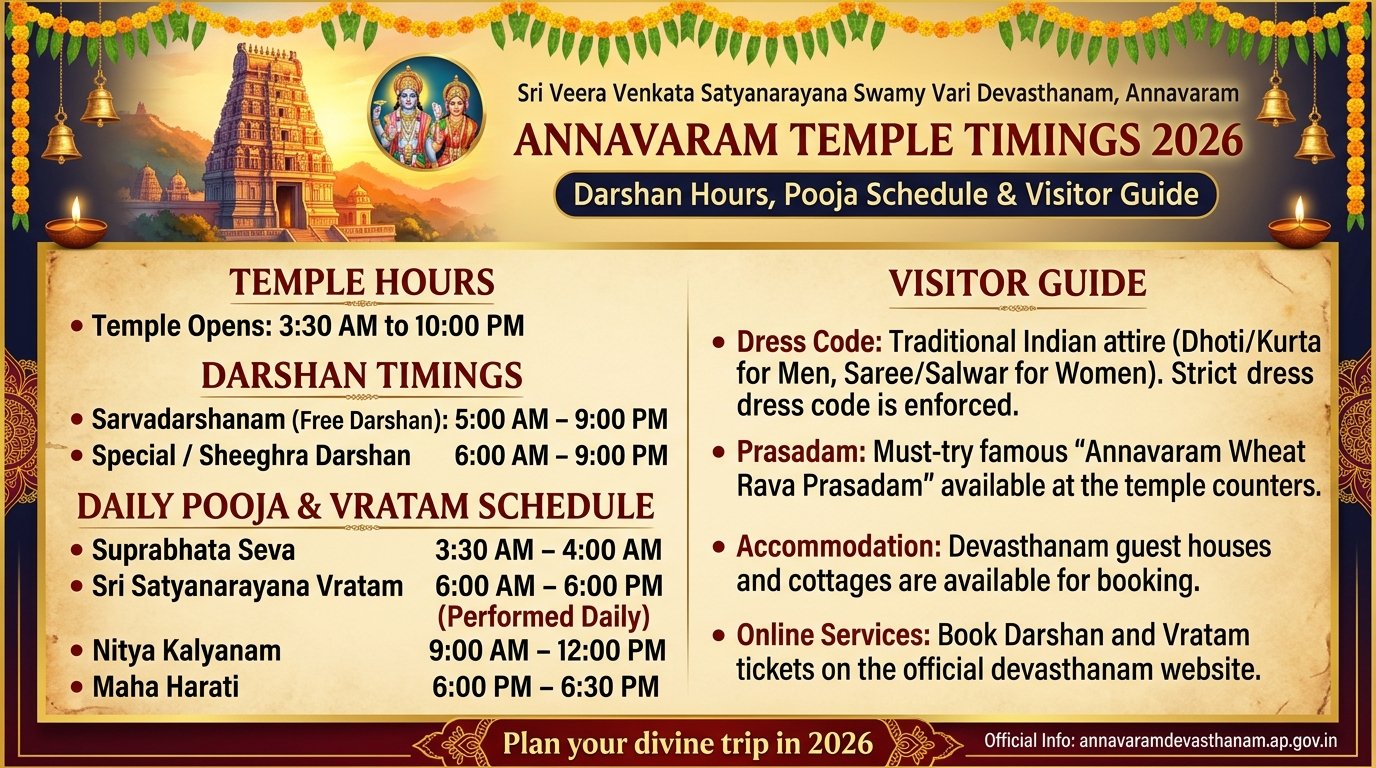
The Annavaram temple opens for general darshan at 6:00 am and closes at 9:15 pm on regular days. The day begins earlier with Suprabhatha Seva at 4:00 am, and Sarva Darshan starts at 6:00 am.
Morning darshan runs roughly 6:00 am to 12:30 pm, afternoon darshan 1:00 pm to 5:00 pm, and evening darshan 5:00 pm to 9:00 pm. These Annavaram timings apply every day except festivals and peak days, when the schedule changes.
The Sri Veera Venkata Satyanarayana Swamy Temple, as the shrine is formally called, follows one fixed routine through the week. So whether you’re searching for Annavaram temple timings today, Annavaram temple timings tomorrow or Annavaram temple timings Sunday, the base schedule doesn’t change. What changes is the crowd, and on special days the opening time itself.
The temple opens at 6:00 am for devotees, with priests starting rituals two hours earlier. The 4:00 am Suprabhatha Seva wakes the deity, followed by Dhoopa Seva at 5:00 am. Ordinary visitors are usually not allowed in during these early rituals, so dont show up at 4 am expecting darshan.
The Annavaram temple closing time is 9:15 pm on a normal day. Ekantha Seva, the last ritual, wraps up between 8:30 and 9:00 pm, then the doors are shut. My advice is reach the queue by 8:00 pm at the latest, because the line is usually cut off a bit before closing and late arrivals get disappointed.
During festivals the Annavaram temple closing time stretches later to let more devotees in. That’s why checking the Devasthanam’s notice board or website a day before is a smart move.
Annavaram darshanam timings are split into three windows: 6:00 am to 12:30 pm, 1:00 pm to 5:00 pm, and 5:00 pm to 9:00 pm. The short break around 12:30 to 1:00 pm is when the Maha Nivedana (main food offering) takes place at noon, so the sanctum is closed briefly.
Which slot is best? Morning is the most rewarding if you can manage it, since the Nitya Kalyanam and Vedic chanting happen then and the air on the hill is cooler. Afternoon is quieter, kinda the sweet spot for families with elders. Evening is lovely for the Darbaru Seva atmosphere but gets busy after office hours, especially on weekends.
The daily pooja schedule starts at 4:00 am and ends with the Ekantha Seva around 9:00 pm. Here is the full Annavaram temple seva list with timings, as published for regular days.
| Time | Seva / Event |
|---|---|
| 4:00 am | Suprabhatha Seva |
| 5:00 am | Dhoopa Seva |
| 6:00 am | Sarva Darshan begins |
| 7:00 am | Bala Bhogam |
| 7:30 am | Bali Harana |
| 8:00 am – 11:00 am | Chaturveda Parayanam |
| 8:00 am – 11:00 am | Sahasranama Pooja |
| 9:30 am – 11:30 am | Swamy Nitya Kalyanam |
| 12:00 pm | Maha Nivedana |
| 6:00 pm | Dhoopa Seva |
| 6:30 pm – 7:30 pm | Abhishekam to Lord Siva at Yantralayam |
| 7:30 pm – 8:30 pm | Darbaru Seva |
| 8:30 pm – 9:00 pm | Ekantha Seva |
| 9:15 pm | Temple closes |
Nitya Kalyanam is the daily celestial wedding ritual of the Lord, performed between 9:30 and 11:30 am. Chaturveda Parayanam is the recitation of the four Vedas, while Sahasranama Pooja involves chanting the thousand names of the deity.
Evening brings the Darbaru Seva, a court-style ceremony, and the Ekantha Seva closes the day by putting the Lord to rest. Interesting bit: the temple also has a small Yantralayam where Lord Siva is worshipped, which is why you see an abhishekam listed in the evening.
Annavaram temple special darshan tickets come in two paid categories, Seegra Darshan at Rs.50 and Antaralayam Darshan at Rs.100, while Sarva Darshan remains free. The table below breaks it down.
| Darshan Type | Ticket Price | What You Get |
|---|---|---|
| Sarva Darshan | Free | General queue, open to all devotees |
| Seegra Darshan | Rs.50 per person | Faster queue plus 100 gm Bhoga Prasadam |
| Antaralayam Darshan | Rs.100 per person | Closer inner-sanctum darshan, less waiting time |
Seegra Darshan includes 100 gm of Bhoga Prasadam, so you get a faster line and a keepsake in one go. Antaralayam Darshan offers reduced waiting time and a nearer view of the deity. On a Sunday those extra rupees are honestly worth it. Prices get revised now and then, so confirm at the counter or on the official Devasthanam site before you go.
Satyanarayana Vratham is the signature ritual of Annavaram, and tickets are priced per couple, historically around Rs.800 (verify the latest rate). Devotees from across Andhra Pradesh and Telangana travel specifically for this vratham, which is performed in groups in the vratham mandapam, with several batches running through the day starting early morning.
If you’re hunting for Annavaram vratham tickets price 2026, here’s the honest situation: the Devasthanam revises rates occasionally and I cant promise a 2026 figure without a fresh notice.
Treat the number above as a ballpark and double check on the official portal or at the ticket counter near the hill base. Batch timings also shift on crowded days, so ask about the next available slot when you buy.
A few practical things about the vratham:
You can book Annavaram vratham tickets online through the Devasthanam’s official website or the AP government’s temple services portal. The steps are simple:
Book a couple of days ahead for weekends, since slots do fill up. And always take your original ID, they check it sometimes.
On Sundays and weekends, the temple follows the same timings but darshan takes 45 to 90 minutes, versus 20 to 30 minutes on weekdays. That’s a big difference, so plan accordingly. Sundays also see many families coming for vratham, which pushes the queues even longer.
If your schedule allows, aim for a Tuesday or Wednesday. Weekend visitors should reach by 6:00 am sharp, or choose Antaralayam Darshan to skip a chunk of the wait. Midday is somewhat lighter even on Sundays, though the heat on the hill climb can be harsh in summer, so carry water.
During festivals and peak seasons, the temple opens as early as 2:30 am and Nitya Kalyanam also begins at 2:30 am. Closing hours get pushed too, so every devotee gets a chance. This is the main exception to the regular Annavaram temple timings.
Here’s where most competitor pages fall short, they say “timings change” and stop there. In practice, the busiest periods generally include:
Exact 2026 dates depend on the Telugu panchangam, and I haven’t got a confirmed festival calendar, so check the Devasthanam announcements about two weeks before your trip. On Kalyanotsavam day expect lakhs of pilgrims and very long waits, honestly not great for small kids or elderly relatives.
The dress code is simple: any decent outfit. Men usually wear dhoti, kurta or neat shirt-trousers, and women wear sarees, salwar kameez or similar modest clothing. Avoid shorts, sleeveless tops and very tight clothes, just to be safe. For vratham, traditional dress is the norm and some couples buy new clothes for it.
Other etiquette points worth remembering: footwear stays outside at the stands, mobile phones and cameras may be restricted near the sanctum (rules change, so look for signboards), and queue discipline matters since the hill temple can get packed. Keep your valuables light, and carry small cash for counters.
The Annavaram temple sits on Ratnagiri Hill beside the Pampa River in Kakinada district, about 50 km from Kakinada, roughly 70–75 km from Rajahmundry and around 120 km from Visakhapatnam. Distances are approximate and depend on the route you take.
By train, Annavaram railway station is close to the hill base and several express trains stop there. Buses from Kakinada, Rajahmundry, Tuni and Visakhapatnam run all day. If you drive, NH-16 is the easiest way, and then you take the road up Ratnagiri or use the steps. Hill-top parking fills quickly on weekends, so go early.
You can book Annavaram temple rooms through the Devasthanam’s cottages and guest houses, either online or at the accommodation office near the hill base. Options range from basic non-AC rooms to AC cottages and larger family suites. Rates are modest compared to private hotels, though availability is tight during Kartika Masam and festival weeks.
For a smooth stay, reserve rooms at least a week early, bring your ID, and check-in/check-out rules before you arrive. If the Devasthanam rooms are full, private lodges are available in Annavaram town and nicer hotels in Kakinada and Rajahmundry. Many pilgrims plan a night stay so they can catch the early morning darshan without rushing.
Most Annavaram temple timings pages stop at a table, but real visitors need more. Three things stand out.
First, the festival calendar: peak days change the schedule, so don’t assume 6:00 am opening during Kartika or Kalyanotsavam. Second, seva booking: vratham and other sevas can be reserved online, while darshan tickets are typically bought at counters on the day. Third, practical rules like dress, footwear and phone policy affect your whole visit, and they’re easy to overlook.
My simple rule is this: confirm timings on the official site the day before, arrive 30 minutes early, and keep a Plan B for rooms.
The best time to visit Annavaram is on a weekday morning between October and February. The weather is pleasant, crowds are manageable, and the hill climb isn’t exhausting. Avoid peak summer afternoons if you can and skip weekends during Kartika Masam unless you’re prepared for a long day.
If you want the festive vibe and don’t mind queues, Kalyanotsavam in Vaisakha is spectacular. Otherwise, a quiet weekday gives you a calmer darshan and time to sit and soak things in.
The temple opens for Sarva Darshan at 6:00 am and closes at 9:15 pm on regular days. Rituals begin earlier at 4:00 am, and festival days may have extended or changed hours.
The regular Annavaram temple closing time is 9:15 pm, after Ekantha Seva ends. On festival and peak days the closing hour may be extended so more devotees can have darshan.
Today’s timings follow the usual 6:00 am to 9:15 pm schedule unless it’s a festival or special day. Check the Devasthanam website or notice board for same-day changes.
Tomorrow’s timings will be the standard 6:00 am to 9:15 pm schedule unless tomorrow is a festival. Verify the official announcements the evening before, since peak-day hours can open as early as 2:30 am.
Sunday timings are the same as other days, 6:00 am to 9:15 pm. However, crowds are heavier, and darshan can take 45 to 90 minutes instead of 20 to 30.
Annavaram darshanam timings are 6:00 am to 12:30 pm in the morning, 1:00 pm to 5:00 pm in the afternoon, and 5:00 pm to 9:00 pm in the evening.
Seegra Darshan costs Rs.50 per person and includes 100 gm Bhoga Prasadam. Antaralayam Darshan costs Rs.100 per person with less waiting. Sarva Darshan is free. Rates can be revised.
Vratham tickets have historically been around Rs.800 per couple, with multiple batches from early morning through the day. Confirm current prices and slots at the counter or official portal.
The 2026 price depends on the latest Devasthanam notification. It has recently been near Rs.800 per couple, but please verify on the official website before booking, as revisions do happen.
Visit the official Devasthanam or AP temples portal, choose Vratham under Arjitha Sevas, pick a date and batch, enter couple details, pay online, and download your e-ticket.
Rooms can be booked through the Devasthanam’s online accommodation service or the accommodation office near the hill base. Book early during festivals and Kartika Masam since availability gets limited.
Annavaram is about 50 km from Kakinada and roughly 70–75 km from Rajahmundry. Visakhapatnam is around 120 km away. Distances are approximate and vary by route.
Darshan takes about 20 to 30 minutes on weekdays and 45 to 90 minutes on weekends. Seegra or Antaralayam tickets can cut your waiting time noticeably.
Yes, but a flexible one. Any decent outfit works, with traditional wear like sarees, dhotis and salwar suits preferred. Avoid shorts and sleeveless clothing. Vratham participants usually dress traditionally.
Weekday mornings from October to February are ideal, with pleasant weather and smaller crowds. Avoid weekends and festival days like Kalyanotsavam unless you’re ready for long queues.