Physical Address
304 North Cardinal St.
Dorchester Center, MA 02124
Physical Address
304 North Cardinal St.
Dorchester Center, MA 02124

If you’ve ever typed “jyotirlingas” into Google at 2 AM trying to plan a family pilgrimage, you’re honestly not alone. The 12 Jyotirlingas in India are the holiest Shiva shrines in the country, each one believed to be a spot where Lord Shiva manifested himself as a column of infinite light.
From the snow-covered peak of Kedarnath to the island temple of Rameshwaram, these twelve temples pull in millions of devotees every year, and honestly the sheer scale of the tradition can feel a little overwhelming at first.
This guide breaks down everything names, locations, the origin story, a proper map overview, and even how to plan your own yatra in one place, so you don’t have to hop across ten different websites like I did.
The 12 Jyotirlingas are twelve sacred shrines spread across India where Lord Shiva is worshipped in the form of a Jyotirlinga, literally meaning a “pillar of light.” Unlike an ordinary Shiva lingam installed by priests or kings, a Jyotirlinga is considered swayambhu, or self-manifested, which is exactly why devotees treat these twelve sites with such reverence.
Each Jyotirlinga temple has its own legend, architecture and rituals, but they’re all united by one core belief: that Shiva chose these exact locations to appear in his most formless, radiant form. This is what separates the Jyotirlinga cluster from the thousands of other Shiva temples scattered around the subcontinent.
This is the bit most websites skip over, and honestly it’s the most important part if you actually want to understand why this tradition exists.
According to the Shiva Purana, there was once a dispute between Lord Brahma and Lord Vishnu over who was the supreme creator of the universe. To settle the argument, Shiva appeared before them as an infinite, blazing pillar of light with no beginning and no end.
Both gods were challenged to find either end of this pillar — Vishnu took the form of a boar and dug downward, while Brahma flew upward as a swan. Neither could find the edge of the light.
Brahma, in his desperation, lied and claimed he had found the top, using a ketaki flower as false evidence. Shiva, angered by this deceit, cursed Brahma that he would never be worshipped in temples again (which is why, even today, you’ll barely find any Brahma temples in India, while Shiva temples are everywhere).
This pillar of light → is believed to have appeared in 12 locations → giving rise to the 12 Jyotirlingas. That’s essentially the mythological backbone of the entire pilgrimage tradition, and it’s what gives these twelve spots their unmatched spiritual weight compared to any other Shiva shrine in the country.
Here’s the complete 12 jyotirlinga name list with their exact states, laid out for quick reference — this is basically the cheat sheet everyone’s searching for.
| # | Jyotirlinga Name | Location | State |
|---|---|---|---|
| 1 | Somnath | Somnath | Gujarat |
| 2 | Mallikarjuna | Srisailam | Andhra Pradesh |
| 3 | Mahakaleshwar | Ujjain | Madhya Pradesh |
| 4 | Omkareshwar | Mandhata Island | Madhya Pradesh |
| 5 | Kedarnath | Kedarnath | Uttarakhand |
| 6 | Bhimashankar | Bhimashankar | Maharashtra |
| 7 | Kashi Vishwanath | Varanasi | Uttar Pradesh |
| 8 | Trimbakeshwar | Nashik | Maharashtra |
| 9 | Vaidyanath (Baidyanath) | Deoghar | Jharkhand |
| 10 | Nageshwar | Dwarka | Gujarat |
| 11 | Rameshwaram (Ramanathaswamy) | Rameswaram | Tamil Nadu |
| 12 | Grishneshwar | Ellora, Aurangabad | Maharashtra |
Note that this 12 jyotirlinga name and place list doesn’t follow a strict “correct” numbering — different scriptures and regional traditions order them slightly differently. Somnath is almost universally accepted as the first, though.
Somnath Temple → is widely regarded as → the first among the 12 Jyotirlingas. Sitting right on the western coastline of Gujarat, it’s been destroyed and rebuilt multiple times throughout history, which honestly makes its survival feel even more remarkable. The current structure is a fairly modern reconstruction, but the spiritual energy of the place hasn’t dimmed one bit.
Perched atop the Nallamala Hills near Srisailam, Mallikarjuna is doubly sacred because it’s also counted among the 18 Shakti Peethas. This dual status makes it one of the rare temples where both Shaivite and Shakti traditions overlap in the same complex.
Located in Ujjain, this temple is famous for its swayambhu lingam and the early-morning Bhasma Aarti, where the deity is bathed in sacred ash. It’s genuinely one of those experiences that’s hard to describe unless you’ve stood there at 4 AM watching it happen.
Sitting on Mandhata Island in the middle of the Narmada River, the island itself is shaped like the sacred “Om” symbol — which is where the temple gets its name. It’s one of those places where the geography and the spirituality genuinely feel connected.
At roughly 3,583 meters above sea level, Kedarnath Temple → is located in → the Himalayas, making it the highest of all twelve Jyotirlingas. Accessible only for about six months a year due to snow, reaching Kedarnath requires a trek and a fair bit of stamina, but the pilgrims who make it swear it’s worth every step.
Tucked into the Sahyadri mountain ranges, this temple’s legend centres on Shiva’s victory over the demon Bhima. The surrounding forest area is also a protected wildlife sanctuary, so you get a bit of nature alongside the darshan.
Varanasi is often called the spiritual capital of India, and Kashi Vishwanath sits right at the heart of that reputation. Hindus believe that dying in this city grants moksha, or liberation from the cycle of rebirth, which tells you a lot about how sacred this particular Jyotirlinga is considered.
Trimbakeshwar Temple → is the source of → the Godavari River, one of India’s holiest rivers. What makes this temple unique is that it houses three separate lingams representing Brahma, Vishnu and Mahesh — a rare structural feature you won’t find at the other eleven sites.
Also called Baidyanath, this temple in Deoghar is known as the “Temple of the Divine Physician.” Shiva is worshipped here as the ultimate healer of the universe, and a lot of pilgrims visit specifically seeking relief from illness or affliction.
Near Dwarka, Nageshwar is associated with a legend of Shiva protecting his devotees from poison and negative forces. It’s often visited by people looking for spiritual protection, and the giant Shiva statue outside the temple is genuinely a sight to behold.
Rameshwaram Temple → connects → the Jyotirlinga tradition and the Char Dham circuit, since it’s counted in both. Legend has it that Lord Rama worshipped Shiva here before crossing over to Lanka, which is what makes it sacred to both Shaivites and Vaishnavites alike — pretty rare for a single temple to hold that kind of dual significance.
The last on the list, Grishneshwar sits close to the world-famous Ellora Caves. Its legend revolves around a devoted woman named Kusuma, and being near Ellora makes it an easy add-on if you’re already visiting the caves for their architecture.
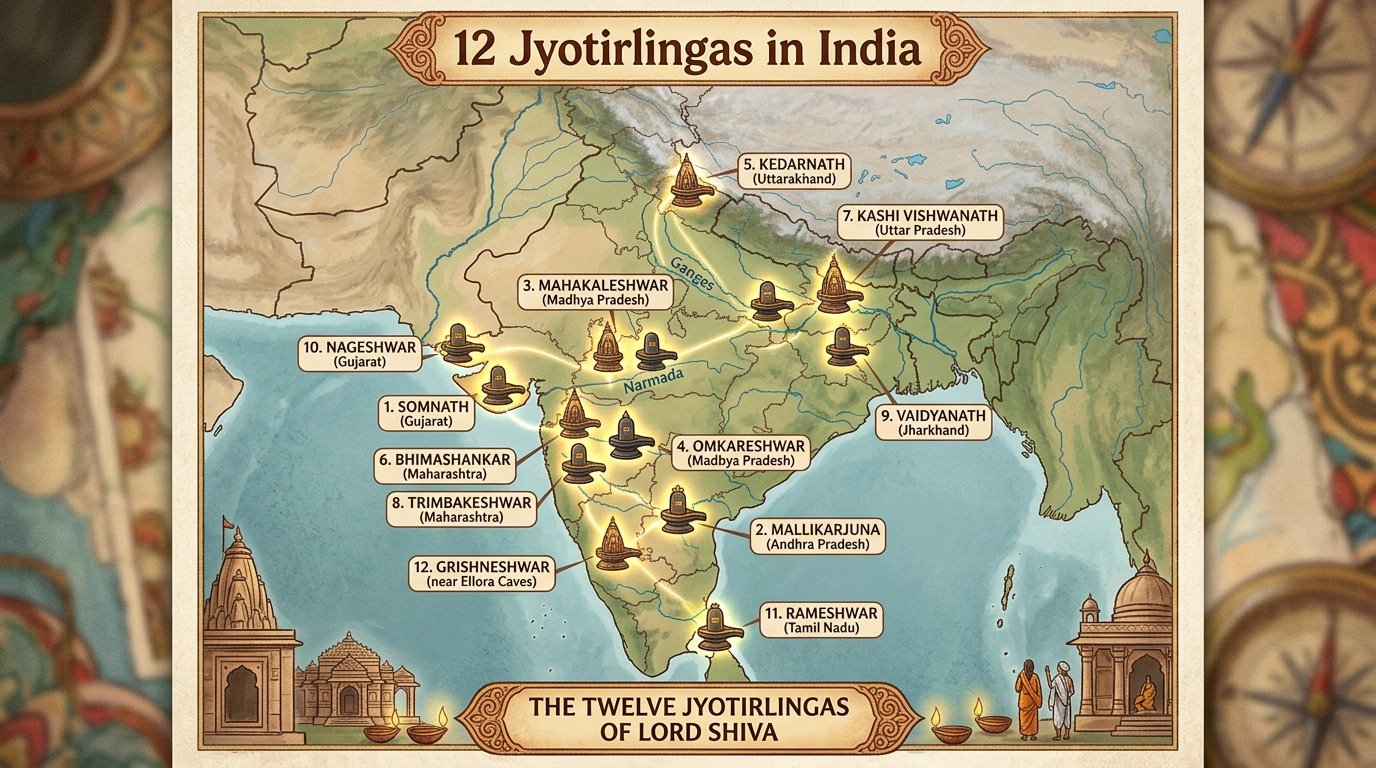
If you pull up a 12 jyotirlinga map, you’ll notice something interesting — these temples aren’t clustered in one region at all. They’re deliberately (or maybe just historically) scattered across the length and breadth of India:
This spread is actually what makes visiting all 12 jyotirlinga in one single trip so logistically tough — you’re realistically covering the entire country from Kashmir-adjacent regions down to the southern tip.
A fair number of people search for 12 jyotirlingas near Karachi or 12 jyotirlingas near Lahore, mostly because of historical and cultural ties to undivided India. To be clear, none of the 12 recognized Jyotirlingas are located in present-day Pakistan all twelve lie strictly within Indian territory.
That said, Somnath in Gujarat is the geographically closest Jyotirlinga to the Pakistan border, roughly a few hundred kilometers from Karachi via the western coastline, though there’s no direct pilgrimage route connecting the two due to international border restrictions. Devotees from Pakistan or nearby regions typically travel via Delhi or Ahmedabad if visa arrangements permit.
This is a genuinely common question, and the answer is simple: there are exactly 12 Jyotirlingas, and all of them are located in India. There’s no verified Jyotirlinga shrine recognized outside Indian soil in mainstream Hindu tradition.
So if you’re wondering “how many jyotirlinga in world” — the number stays at 12, not more, not less, regardless of how many regional temples claim similar titles or replicate the Jyotirlinga symbolism in their own architecture.
This is honestly where most guides fall short — they’ll give you names and history but leave you clueless on the actual planning side. Let’s fix that.
Realistically, covering all twelve temples in one continuous trip takes anywhere from 25 to 40 days, depending on your travel mode, rest days, and how much time you spend at each location. Most pilgrims break it into regional legs instead:
Breaking the journey into these chunks makes the whole thing far more manageable, especially for working professionals or families who can’t take a month off in one go.
October to March → is generally considered → the best planning window for most Jyotirlinga temples, since summer heat in central and southern India can get brutal, and Kedarnath itself is only accessible between roughly April/May and October/November due to snowfall.
Honestly, for most first-time pilgrims, booking a 12 jyotirlinga tour package through a reputed travel operator makes life a LOT easier. These packages usually bundle transport, accommodation and temple darshan slots together, which saves you the headache of arranging everything region by region on your own.
That said, if you enjoy independent travel and don’t mind a bit of chaos, doing it yourself gives you more flexibility on timing and duration at each site.
Not every Jyotirlinga is equally easy to reach. Kedarnath, for instance, involves a steep trek (or helicopter/palanquin option) that can be genuinely tough for elderly travelers, while temples like Somnath, Nageshwar and Kashi Vishwanath are far more accessible with vehicle access right up to the temple grounds.
If you’re traveling with elderly family members, it’s worth planning the Himalayan leg separately or opting for helicopter services where available.
The core belief around jyothirlingas is that darshan at these sites cleanses sin, grants moksha, and brings devotees closer to Shiva’s formless, infinite nature. Pilgrims often undertake this yatra as a once-in-a-lifetime spiritual milestone, similar in weight to completing the Char Dham circuit.
It’s also worth noting these related pilgrimage clusters, since they often get mentioned in the same breath:
Understanding how these clusters relate to each other actually helps put the Jyotirlinga tradition into a bigger spiritual context rather than viewing it as an isolated list.
The 12 Jyotirlingas are sacred Shiva temples across India believed to be self-manifested pillars of divine light, including Somnath, Kedarnath, Kashi Vishwanath, Rameshwaram and eight others.
Somnath Temple in Gujarat is widely considered the first among the 12 Jyotirlingas, though scriptural texts occasionally vary slightly on the exact starting order.
Grishneshwar, located near Ellora Caves in Maharashtra, is traditionally counted as the twelfth and final Jyotirlinga in most listings.
There are exactly 12 Jyotirlingas, and all of them are located within India — none exist outside Indian territory in mainstream tradition.
No strict order is mandated. Most pilgrims plan by geographic region (west, central, north, south) rather than following scriptural sequence, purely for travel convenience.
October to March suits most temples best. Kedarnath specifically opens only between April/May and October/November due to heavy Himalayan snowfall.
A full pilgrimage typically takes 25 to 40 days if done continuously, though most travelers split it into 5–6 regional trips over time.
No Jyotirlinga is located in Pakistan. Somnath in Gujarat is the nearest one to the Karachi region, but no direct pilgrimage route crosses the border.
Most temples are accessible, but Kedarnath’s trek can be challenging. Helicopter or palanquin services are available there for elderly or less mobile pilgrims.
Bhasma Aarti is a dawn ritual where the Mahakaleshwar lingam is bathed in sacred ash, symbolizing the transient nature of the physical body.
Rameshwaram is unique as it’s both a Jyotirlinga and part of the Char Dham circuit, linking Lord Rama’s legend with Shiva worship in one temple.
It’s a bundled travel plan covering transport, accommodation and temple darshan across some or all 12 Jyotirlingas, ideal for first-time or elderly pilgrims.
Kedarnath, situated at roughly 3,583 meters in the Himalayas, is the highest-altitude Jyotirlinga and accessible only during a limited seasonal window.
Trimbakeshwar houses three lingams representing Brahma, Vishnu and Mahesh together, and it’s also the source of the sacred Godavari River.
Yes, Omkareshwar sits on Mandhata Island, which naturally forms the shape of the “Om” symbol, making its geography itself spiritually symbolic.
While all 12 are equally sacred in scripture, temples like Kashi Vishwanath and Kedarnath hold particularly elevated status due to their association with moksha and the Himalayas.