Physical Address
304 North Cardinal St.
Dorchester Center, MA 02124
Physical Address
304 North Cardinal St.
Dorchester Center, MA 02124

If you’re trying to figure out the Shrinathji Temple Nathdwara timings today, you’ve landed in the right place. Honestly, planning a visit to this temple can get a little confusing because the darshan windows are short and the temple shuts its doors between each one miss it by ten minutes and you’re waiting hours for the next slot.
This guide breaks down everything, from nathdwara darshan time today to festival-specific schedules, so you don’t end up standing outside a closed gate wondering what went wrong.
Whether you’re heading there this weekend or just checking the shrinathji darshan time today before booking your tickets, this article covers the full Ashtayama system (all eight daily darshans), aarti timings, seva pricing, dress code, parking, accessibility, and much more that most other guides skip over.
Shrinathji Temple sits in the town of Nathdwara, in Rajsamand district, Rajasthan — roughly 48 km north of Udaipur. It’s one of the most revered Krishna temples in India, and honestly the whole town kind of revolves around it. Shops, dharamshalas, and even the local economy are built around pilgrim footfall.
If you’re wondering about the nathdwara to shrinathji temple distance from nearby cities, here’s a rough idea:
Most pilgrims combine a Udaipur trip with a day visit to Nathdwara since the road connectivity is decent and buses run frequently between the two.
Lord Shrinathji is worshipped as a form of Krishna at the age of seven, specifically depicted lifting the Govardhan Hill with his left hand. This isn’t just any Krishna idol — it’s considered a swaroop, a living manifestation, and devotees treat the deity almost like royalty, with a full daily routine of waking, bathing, dressing, feeding, and resting.
The temple is the principal seat of Pushtimarg Vaishnavism, a devotional tradition founded by Vallabhacharya in the 16th century. In simple terms: Vallabhacharya → founded → Pushtimarg Vaishnavism, and this sect’s entire philosophy of seva (service to the deity as a beloved child) is on full display here.
The temple is also famous worldwide for its intricate Pichwai paintings — hand-painted cloth backdrops depicting Krishna’s life, which are hung behind the deity and changed according to season and festival.
So, what time does the temple actually open? Here’s the direct answer for anyone in a hurry.
The temple opens at 5:30 AM for the first darshan and functions in short bursts throughout the day, closing completely between sessions. It finally shuts for the night around 10:00 PM after the last ritual, called Shayan.
| Session | Timing | Status |
|---|---|---|
| Temple Opening | 5:30 AM | Open |
| Morning Darshan | 5:30 AM – 12:00 PM (4 darshans) | Open |
| Midday Break | 12:00 PM – 4:00 PM | Closed |
| Evening Darshan | 4:00 PM – 10:00 PM (4 darshans) | Open |
| Temple Closing | 10:00 PM | Closed |
Keep in mind — this schedule can shift slightly depending on the season and, of course, festivals. It’s always smart to check the nathdwara live darshan today updates on official temple channels or ask a local before you plan your trip, especially if you’re travelling from far.
A question we get a lot: are nathdwara darshan timings on Sunday any different from weekdays? Generally, no the temple follows the same eight-darshan structure seven days a week. However, Sundays tend to draw significantly larger crowds since it’s a weekly holiday for most visitors, so expect longer queues and possibly extended wait times even though the actual timing slots remain unchanged.
If you’re checking tomorrow nathdwara darshan timing, the good news is the schedule is fairly consistent day-to-day unless there’s a festival on the calendar. The eight darshans repeat daily at roughly the same clock times.
That said, temple authorities do occasionally revise timings by 15–30 minutes based on the season (summer vs winter darshan hours can differ slightly), so it’s worth a quick call to the temple office the evening before if you’re travelling a long distance.
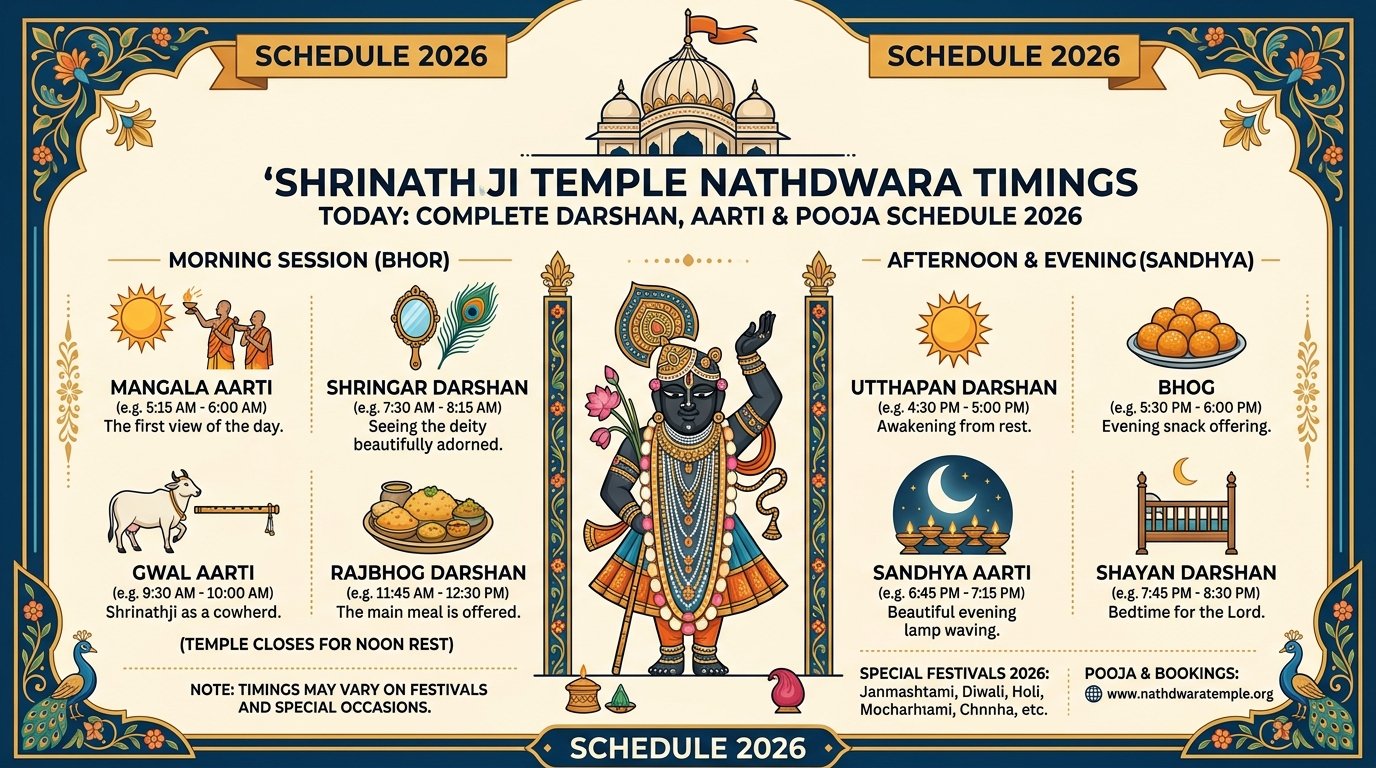
This is where most visitors get confused, so let’s slow down here. The temple → follows → an eight-darshan system known as Ashtayama, meaning the deity is shown to devotees at eight distinct moments representing different parts of his daily life — like a child waking up, playing, eating, and sleeping.
Between each of these eight windows, the temple closes completely for cleaning, ritual preparation, and change of Pichwai backdrop — so temple closure → occurs between → morning and evening darshan sessions, and also briefly between each individual darshan slot. This is honestly the single most important thing to understand before you go, because arriving even 15 minutes late can mean waiting over an hour for the gates to reopen.
Now let’s talk specifically about the aarti and pooja timings, since these are technically distinct rituals within each darshan window, even though they overlap with the schedule above.
| Ritual | Time | Fee | What Happens |
|---|---|---|---|
| Mangala Aarti | 5:30 AM | Free | Morning prayers to awaken the deity |
| Shringar | 7:15 AM | Free | Deity dressed & decorated |
| Gwaal | 10:30 AM | Free | Symbolic return from grazing |
| Rajbhog | 11:30 AM | Free | Elaborate food offering |
| Utthapan | 4:00 PM | Free | Deity wakes from rest |
| Bhog | 5:45 PM | Free | Evening food offering |
| Sandhya Aarti | 6:30 PM | Free | Evening lamp worship |
| Shayan | 8:45 PM | Free | Final night ritual |
All eight of these are technically free of charge for general devotees, which is worth pointing out because a lot of pilgrims assume there’s an entry fee — there isn’t, unless you’re opting for a specific paid seva (more on that below).
This is probably the most commonly searched question, so let’s answer it directly: general darshan at Shrinathji Temple is completely free, and it operates on a walk-in basis. There’s no online booking portal for standard darshan like you’d find at some other major temples.
However, nathdwara darshan booking charges do apply if you want to participate in special sevas:
So while regular darshan won’t cost you a rupee, the paid sevas can add up quite a bit if you’re looking for a more personalized ritual experience.
This is honestly where a lot of temple guides fall short — they’ll tell you the darshan timings but leave you guessing on the practical stuff. Let’s fix that.
There is a dress code, and temple staff do enforce it, especially during Rajbhog and Sandhya Aarti. Visitors are expected to wear modest, traditional clothing think sarees, salwar kameez, kurta-pyjama, or dhoti for men. Shorts, sleeveless tops, and generally “western casual” wear like ripped jeans are discouraged and can get you turned away at busier darshans.
Men are often asked to remove shirts (bare-chested is traditional for certain darshans, though this isn’t always strictly enforced for tourists). It’s honestly safer to just carry a simple cotton dupatta or shawl if you’re unsure — you can drape it if a volunteer asks you to cover up.
Parking is available but it fills up fast, particularly on weekends and festival days. There are a few designated parking zones a short walking distance from the main temple gate, and most charge a nominal fee (usually ₹20–₹50 depending on vehicle type).
During major festivals like Annakut or Janmashtami, traffic police often redirect vehicles to parking areas much further out, so budget an extra 20–30 minutes of walking time if you’re visiting during peak season.
Accessibility is, admittedly, one of the weaker points of this temple. The complex includes narrow lanes, stone steps, and crowded corridors, which can be genuinely tough for wheelchair users or elderly pilgrims.
That said, temple volunteers are usually willing to help guide elderly visitors through a slightly less crowded route if you ask at the entrance. There isn’t a dedicated ramp system throughout, so if mobility is a real concern, it’s worth arriving well before the darshan opens to avoid the worst of the crowd pushing.
For real-time updates, seva bookings, or to confirm the nathdwara darshan today schedule before you travel, it’s best to contact the temple office directly rather than relying solely on third-party websites, since timings can shift without much notice. Local tourism offices in Nathdwara and Udaipur can also usually provide the current temple helpline number if you’re unable to find it online.
No visit is complete without prasad, and this temple offers a few specialties:
Chhappan Bhog Prasad → is distributed especially → during the Annakut festival, so if you’re visiting around that time, expect a much wider variety than a regular weekday visit.
Festivals completely change the crowd dynamics here, so it helps to know what’s coming up.
Since festival → dates shift → yearly according to the Hindu lunar calendar, always double-check the exact date closer to your travel time rather than relying on last year’s calendar.
A few things we’d genuinely recommend before you go:
Visiting Shrinathji Temple Nathdwara is genuinely one of those experiences that’s hard to explain until you’ve stood in that crowd waiting for the doors to open.
The short darshan windows and the strict opening-closing rhythm can feel a bit overwhelming at first, but once you understand the eight-darshan Ashtayama structure, it actually becomes pretty easy to plan around. Just remember check the shrinathji darshan timing before you leave, dress modestly, and try to time your visit around Sandhya Aarti or Rajbhog for the best experience.
The temple opens at 5:30 AM for Mangala darshan and closes for the night around 10:00 PM after Shayan, the final ritual. It shuts briefly between each of the eight darshans.
Morning darshans run from 5:30 AM to 12:00 PM (four sessions), and evening darshans run from 4:00 PM to 10:00 PM (four sessions), with a midday closure in between.
The first darshan, called Mangala, starts at 5:30 AM sharp. It’s considered the most auspicious of the eight daily darshans since it “awakens” the deity for the day.
The temple is closed between roughly 12:00 PM and 4:00 PM daily, including Sundays. Evening darshan resumes at 4:00 PM, though Sunday crowds tend to be heavier than weekdays.
Yes, modest traditional clothing is expected — sarees, kurta-pyjama, or dhoti. Sleeveless tops, shorts, and western casual wear are generally discouraged, especially during major darshans.
Yes, prasad options include Panchamrit (₹50–₹150), Chhappan Bhog Prasad (₹50–₹500), and Panjiri (₹30–₹100), available at counters near the temple complex.
Yes, paid parking zones exist a short walk from the main gate, usually ₹20–₹50. Expect longer walks and traffic diversions during major festivals like Annakut or Janmashtami.
Accessibility is limited due to narrow lanes and stone steps. There’s no dedicated ramp system, though volunteers often assist elderly or disabled visitors on request.
Eight daily darshans, collectively called Ashtayama, are performed: Mangala, Shringar, Gwaal, Rajbhog, Utthapan, Bhog, Sandhya Aarti, and Shayan.
Evening darshan today typically runs from 4:00 PM to 10:00 PM, covering Utthapan, Bhog, Sandhya Aarti, and Shayan, though exact minute-level timing can shift slightly by season.
No, Sunday follows the same eight-darshan schedule as other days. The main difference is significantly heavier crowd volume, not the actual timing slots.
Contact the temple office directly or check official temple communication channels, since minor timing shifts happen occasionally and aren’t always reflected on third-party sites.
Shrinathji Temple is located approximately 48 km from Udaipur, roughly a 1 to 1.5 hour drive depending on traffic and road conditions.
No, general darshan is completely free and operates on a walk-in basis. Charges only apply to specific paid sevas like Abhishek or Annakut Seva.
It’s best to obtain the current helpline number through the local Nathdwara or Udaipur tourism office, as temple contact details can occasionally change.