Physical Address
304 North Cardinal St.
Dorchester Center, MA 02124
Physical Address
304 North Cardinal St.
Dorchester Center, MA 02124

Kerala’s biggest festival is almost here again, and honestly, if you’ve never experienced Onam, you’re missing out on one of the most colourful, food-heavy, and heartwarming celebrations in the whole of India.
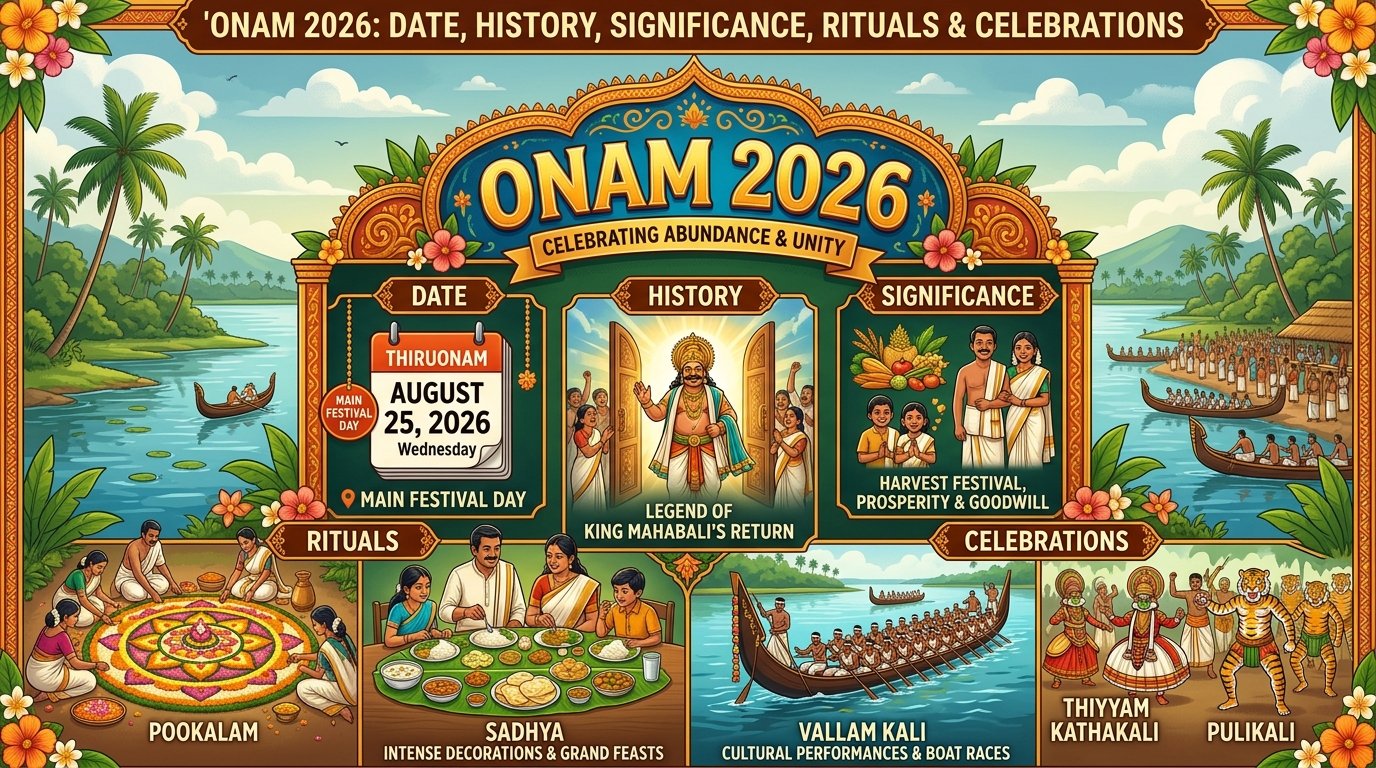
Onam 2026 falls on Wednesday, August 26, 2026, marking the return of the legendary King Mahabali to his beloved land. This isn’t just a “festival” in the calendar-holiday sense its a full ten-day extravaganza involving flower carpets, snake boat races, and a feast so big it barely fits on a banana leaf.
In this guide we’ll walk through everything dates, history, rituals, the Sadhya, and even a few things most articles skip over.
Onam 2026 (Thiruvonam) falls on Wednesday, August 26, 2026. The festival actually begins nine days earlier, on Atham, which lands on August 17, 2026, and builds up day by day until the grand finale on Thiruvonam.
Here’s a quick year-wise reference so you don’t have to go hunting elsewhere:
| Year | Date | Day |
|---|---|---|
| 2025 | September 6, 2025 | Saturday |
| 2026 | August 26, 2026 | Wednesday |
| 2027 | August 15, 2027 | Sunday |
You’ll notice the date shifts every year — that’s because Onam is calculated based on the Malayalam calendar, not the Gregorian one. Specifically, it falls in the lunar month of Chingam, during Shukla Paksha, on the day the moon aligns with the Thiruvonam nakshatra (star). So while the Gregorian date moves around, the astrological timing stays fixed to tradition.
Onam is Kerala’s official state festival, celebrated across all religions and communities as a shared cultural identity rather than a strictly religious event. At its core, though, it does have a mythological root: it celebrates the annual return of King Mahabali, a mythical asura (demon) king who once ruled Kerala with such fairness and prosperity that his reign is still remembered as a golden age.
So, why is Onam celebrated? According to legend, Lord Vishnu, in his Vamana avatar (his fifth incarnation among the Dashavatara), disguised himself as a dwarf Brahmin and asked Mahabali for three paces of land.
Mahabali agreed without hesitation a decision that, in classic mythological fashion, turned out to be his undoing. Vishnu grew to a cosmic size and covered the earth and sky in two steps, then placed his third step on Mahabali’s head, pushing him down to Patala (the netherworld).
But because Mahabali was such a humble and righteous king, Vishnu granted him one wish: to visit his people once every year. That yearly homecoming is what Malayalis celebrate as Onam.
In semantic terms, the relationship is simple: Lord Vishnu → subdued → King Mahabali, and in turn, King Mahabali → was granted the boon → to annually visit his kingdom. This single mythological exchange is the emotional backbone of the entire festival.
The Onam story is essentially a tale about humility triumphing over pride, and generosity being rewarded even in defeat. Mahabali wasn’t punished for being evil — he was actually a good ruler — he was subdued because his growing power was starting to threaten cosmic balance (the gods felt threatened, if we’re being real).
Yet Vishnu, moved by his devotion and honesty, made sure Mahabali’s legacy wasn’t erased. Every year, Keralites decorate their homes and prepare feasts not out of fear, but out of love — to welcome back a king who they genuinely believe still cares about them. It’s a rare mythological narrative where the “loser” is the one everyone roots for.
Onam is primarily celebrated in Kerala, though it’s not confined there. The festival is also observed in Tulunadu (parts of coastal Karnataka) with local Tulu cultural elements, and by the massive Kerala diaspora worldwide — from the Gulf countries to the US, UK, Canada, and Australia.
So when people ask “onam country” or which nation celebrates it, the honest answer is: it’s an Indian festival, rooted specifically in the state of Kerala, but its reach has genuinely gone global thanks to migration.
| Attribute | Detail |
|---|---|
| Deity | Lord Vishnu (Vamana Avatar) |
| Lunar Month | Chingam |
| Duration | 10 days |
| Regions | Kerala, Tulunadu, Kerala diaspora globally |
| 2026 Date | Wednesday, August 26, 2026 |
This is a question a lot of people genuinely get confused about — why not just one day like most festivals? The answer lies partly in tradition and partly in symbolism. The 10-day duration mirrors the idea of completeness in Hindu numerology, and each day is meant to represent a step closer to Mahabali’s arrival, building anticipation the way a good story should.
Each day of the festival has its own name and its own small set of rituals:
Honestly, most families today don’t observe all ten days with equal intensity — modern work schedules don’t really allow it — but the last three or four days (Moolam, Uthradom, and Thiruvonam) are almost universally observed.
Kerala schools and most government offices typically declare holidays around Onam, usually spanning the days closest to Thiruvonam — often a stretch covering Uthradom and Thiruvonam, sometimes extended to a week depending on the state government’s official calendar for that year.
Since exact school holiday lists are notified by the Kerala state education department closer to the date, its worth checking your specific school or district’s official holiday calendar nearer August 2026, as these can vary slightly year to year.
You might come across the term “first Onam” (Puthiya Onam) this refers to the first Onam celebrated after a wedding in a Malayali family. Traditionally, it’s a big deal: the bride’s family sends gifts, new clothes, and sometimes even a full Sadhya spread to the groom’s house (or vice versa depending on regional custom).
It’s less about the mythology and more about strengthening family bonds, and honestly it’s one of those sweet cultural add-ons that outsiders rarely hear about.
Clothing plays a genuinely important role in the celebrations. Onakkodi, meaning “new clothes for Onam,” is a tradition where families buy fresh outfits specifically for Thiruvonam.
The idea behind Onakkodi isn’t really about fashion — it’s about renewal, presenting your best self when welcoming Mahabali home.
Onam isn’t just a mythological story wrapped in flowers — it carries layered significance across multiple dimensions.
At its heart, Onam reaffirms the Hindu belief in the cyclical return of goodness. Mahabali’s yearly visit is treated almost like a metaphor: no matter how much time passes, righteousness finds its way back. The festival also honours Lord Vishnu’s Vamana avatar, the fifth of his ten incarnations, portraying him as the enforcer of cosmic balance and dharma.
Onam → marks → the end of the monsoon sowing season and the beginning of the kharif harvest in Kerala. Farmers use this period to express gratitude toward nature and toward Vishnu (in his role as sustainer) for a good crop. The Pookalam, made entirely from fresh flowers, is really a symbolic gesture of nature’s abundance — flowers that would otherwise wilt are instead turned into art, celebrated, and let go.
Because Onam is celebrated by people of all religions in Kerala, it functions less like a religious observance and more like a shared cultural heritage event — similar to how a national day might work elsewhere.
It’s also responsible for keeping classical Kerala art forms alive: Kathakali, Mohiniattam, Thiruvathirakali, and Panchavadyam all see a surge of performances during this period. The Sadhya feast, where everyone — rich or poor, high caste or low — sits on the same mat and eats identical food, embodies egalitarianism in a very literal, physical way.
Thiruvonam is the tenth and final day of Onam, and it’s the day most people actually mean when they casually say “Onam.” It falls on the day the moon aligns with the Thiruvonam star in the Chingam month.
This is when the Sadhya is served, new clothes are worn, homes are fully decorated with the largest Pookalam of the season, and families gather for what is genuinely one of the biggest home celebrations in Indian festival culture.
On this day, people wake before sunrise, take a traditional oil bath called Enna Thalimpu, wear their Onakkodi, and place a small clay idol of Thrikkakara Appan (representing Vamana) at the center of the Pookalam. A lamp, called nilavilakku, is lit, and prayers — sometimes the Vishnu Sahasranama — are recited to formally welcome Mahabali home.
The Onam Sadhya is, without question, the culinary highlight of the entire festival. It’s a vegetarian feast comprising 26 or more dishes, traditionally served on a fresh banana leaf, and eaten sitting on the floor as a mark of humility and equality.
A typical Sadhya includes:
The order of eating actually matters too — traditionally, the meal begins with a banana, pappadam, and pickle before moving onto the main courses, and it closes with payasam. A portion of the food is also offered to the Thrikkakara Appan idol before anyone eats — a small ritual gesture that ties the meal back to the festival’s spiritual roots.
Most articles list the dishes but never really explain how families pull off cooking 26+ items in a single morning — and honestly, that’s the part people actually want to know if they’re trying to recreate it at home. Preparation usually starts a day or two before Thiruvonam: pickles and payasam bases are often made in advance since they store well.
On the day itself, families divide labour someone handles the curries, someone else the thoran and stir-fries, while the rice and papadam are done last so everything is served fresh and hot. Coconut, in grated, milk, and oil form, is the connecting thread across almost every dish, which is part of why the Sadhya has such a distinctly Kerala flavour profile compared to other regional Indian feasts.
If you’re attempting a mini version at home, start with just five or six dishes — avial, thoran, pachadi, rice, pickle, and payasam — and you’ll already capture most of the authentic experience without burning yourself out in the kitchen.
Here’s something a lot of first-timers don’t expect: Onam is also tied to one of India’s most anticipated lottery draws, the Kerala Onam Bumper lottery, run by the Kerala State Lotteries department. It’s released ahead of the festival every year and carries one of the largest prize pools among Indian state lotteries, often running into crores of rupees.
While it has nothing to do with the mythology of Mahabali, its become such a cultural fixture around this time of year in Kerala that it genuinely deserves a mention — many households treat buying a ticket as a small, hopeful part of their festive season.
No discussion of Onam feels complete without Vallam Kali, the iconic snake boat races held on Kerala’s backwaters. The most famous of these is the Nehru Trophy Vallam Kali, held on Punnamada Lake near Alappuzha, where boats with over 100 oarsmen race in perfect synchronised rhythm while thousands cheer from the banks.
Other notable races include the Payippad Boat Race and the Champakulam Moolam Boat Race. These aren’t just sporting events they represent Kerala’s deep-rooted maritime heritage and the spirit of teamwork that the backwater communities have relied on for centuries.
Onam doesn’t look identical everywhere — different regions add their own flavour to it.
During Onam season, its common to see Onam-themed posters across schools, offices, and public spaces — usually featuring a Pookalam, a Sadhya spread, King Mahabali’s illustration, and sometimes a boat race scene. These posters are often part of school competitions or community event promotions, and they’ve become a fun creative outlet, especially for children, to express what the festival means to them visually.
For those observing the spiritual side of the festival, a few traditional chants are recited on Thiruvonam:
Vamana Gayatri Mantra: Om Dashabhahave Vidmahe Kara Akramanaya Dhimahi. Tanno Vamana Prachodayat. — A meditation on Vamana, the ten-armed one who measured the worlds with his steps.
Vishnu Mangalashtakam: Mangalam Bhagavan Vishnuh Mangalam Madhusudanah… — invoking auspiciousness through Lord Vishnu’s grace.
Onam Welcome Folk Verse: Maveli Nadu Vaneedum Kalam Manushyarellorum Onnupole — “When Maveli ruled the land, all people were equal,” a folk hymn still sung across Kerala households today.
Observing Onam with sincerity is believed to bring several benefits, both spiritual and social:
Onam 2026’s main day, Thiruvonam, falls on Wednesday, August 26, 2026. The 10-day festival begins on Atham (August 17, 2026) and concludes on Thiruvonam.
Lord Vishnu, in his Vamana avatar, is the primary deity worshipped, alongside reverence for King Mahabali as a devotee-king figure in some traditions.
Onam celebrates the mythological annual return of King Mahabali, who was granted a boon by Lord Vishnu to visit his kingdom once every year despite being sent to the netherworld.
The Onam Sadhya is a vegetarian feast of 26+ dishes served on a banana leaf, including avial, olan, thoran, and payasam, symbolising abundance and equality.
The 10-day span mirrors completeness in Hindu numerology, with each day building anticipation toward Mahabali’s arrival on the final day, Thiruvonam.
Kerala is the primary state celebrating Onam, though it’s also observed in Tulunadu (Karnataka) and among the global Kerala diaspora.
Pookalam is an intricate floral carpet created fresh each morning during Onam, growing larger daily and reaching its most elaborate form on Thiruvonam.
No, Onam isn’t traditionally a fasting festival — it’s centred around feasting, particularly the elaborate Sadhya meal shared with family and community.
Vallam Kali is the famous snake boat race held on Kerala’s backwaters, with the Nehru Trophy race at Punnamada Lake being the most renowned event.
Onakkodi refers to new clothes bought and worn specifically for Thiruvonam, symbolising renewal and presenting one’s best self for the celebrations.
Onam 2025 falls on Saturday, September 6, 2025, while Onam 2027 falls on Sunday, August 15, 2027, based on the Malayalam lunar calendar.
First Onam (Puthiya Onam) refers to the first Onam celebrated after a wedding, marked by gift exchanges and Sadhya between the bride’s and groom’s families.
The Onam Bumper is a large-prize lottery released by the Kerala State Lotteries department ahead of the festival, popular as a festive-season tradition.
Thrikkakara Appan is a clay idol representing Vamana, placed at the centre of the Pookalam as the divine witness to Onam celebrations.
Kerala schools typically declare holidays around Uthradom and Thiruvonam; exact 2026 dates depend on the state education department’s official calendar.